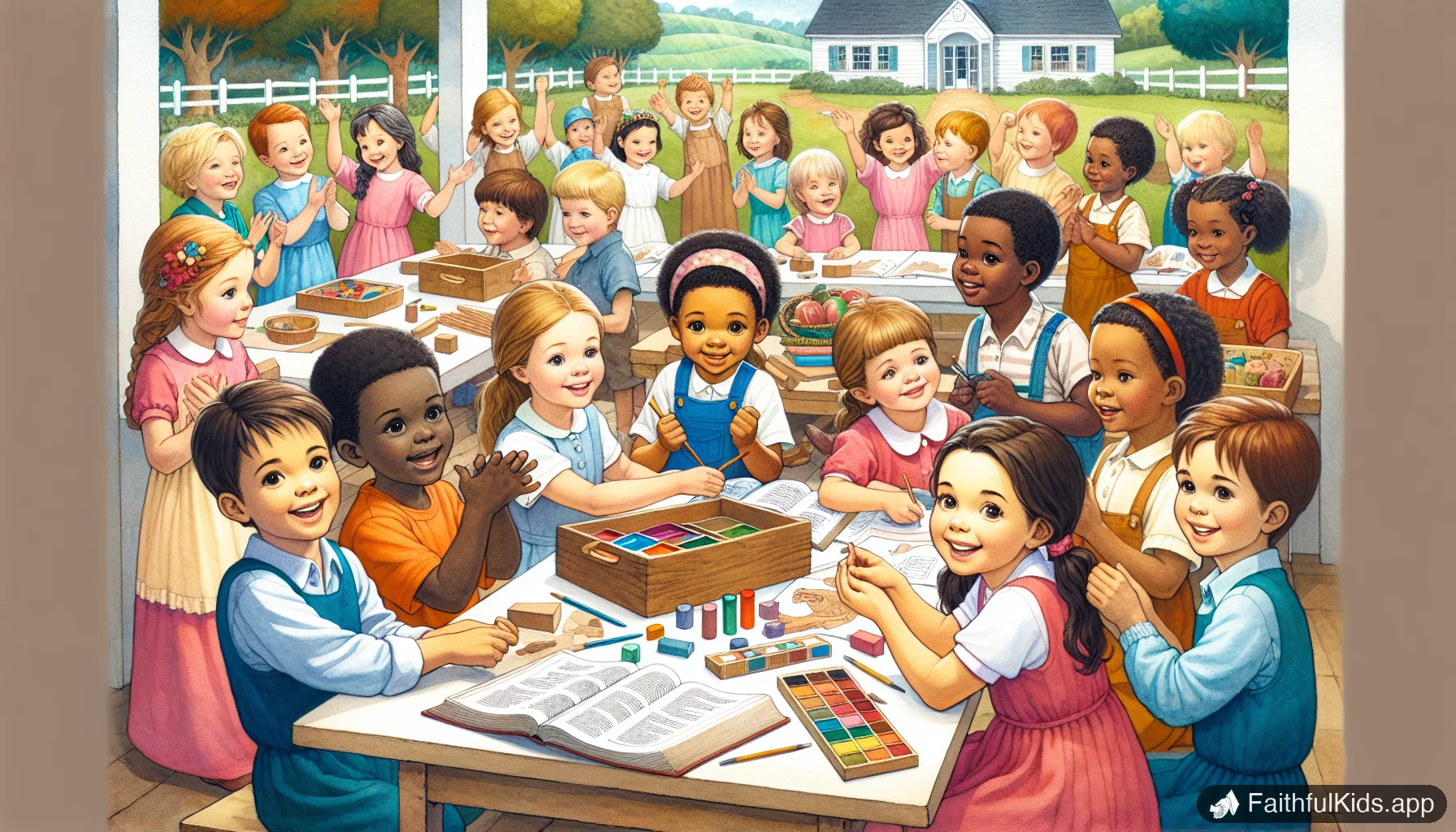
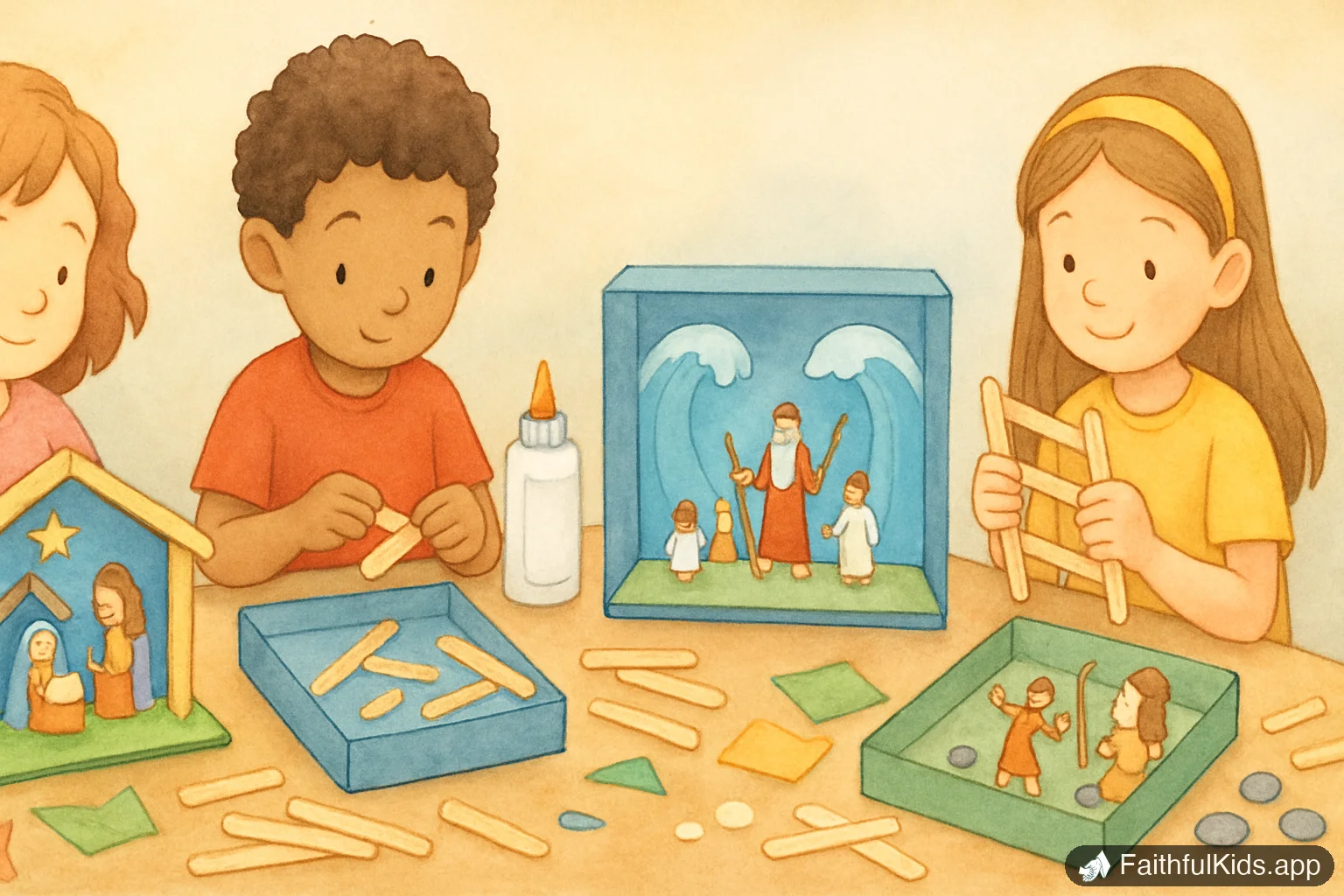
A Bible craft without a lesson is just arts and crafts. But when a child builds a paper plate lion and connects it to Daniel's courage in the lion's den, that craft becomes a memory anchor -- a physical reminder of a spiritual truth they'll carry long after the glue dries.
These 10 crafts are designed for kids ages 4-12, use supplies you probably already have at home, and each one ties directly to a Bible story and a life lesson. They work beautifully for Sunday school (see our dedicated Bible crafts for Sunday school list), homeschool Bible time, VBS, or a rainy afternoon at home.
1. Rainbow Promise Painting — Noah's Ark
Bible Story: Genesis 9:12-17
Lesson: God keeps His promises.
After the flood, God set a rainbow in the sky and promised Noah He would never destroy the earth with water again. Every rainbow is a reminder that God's promises are real and lasting.
Materials:
- White paper or cardstock
- Washable paints (red, orange, yellow, green, blue, purple) or markers
- Cotton balls
- Glue
Instructions:
- Paint a large rainbow arc across the paper using all six colors. For younger kids, draw the arcs in pencil first and let them paint over the lines.
- Glue cotton balls at each end of the rainbow for clouds.
- At the top of the paper, write Genesis 9:13: "I have set my rainbow in the clouds, and it will be the sign of the covenant between me and the earth."
Discussion while crafting: "God made this promise thousands of years ago and He's still keeping it today. Every time you see a rainbow, what should you remember? What's a promise God has made to you that you're waiting for?"
2. Paper Plate Lion — Daniel and the Lion's Den
Bible Story: Daniel 6:1-28
Lesson: God protects those who are faithful to Him.
Daniel prayed three times a day even when it was against the law. He was thrown into a den of hungry lions, but God sent an angel to shut their mouths. Daniel walked out without a scratch. (Read the whole story in Daniel in the lion's den for kids.)
Materials:
- 1 paper plate
- Yellow and orange construction paper or tissue paper
- Googly eyes (or draw them)
- Black marker
- Glue
- Scissors
Instructions:
- Cut strips of yellow and orange paper (about 1 inch wide, 4-5 inches long) for the mane.
- Glue the strips around the rim of the paper plate, overlapping and alternating colors.
- Glue googly eyes in the center of the plate. Draw a nose (upside-down triangle) and a mouth.
- On the back of the plate, write: "My God sent his angel, and he shut the mouths of the lions" (Daniel 6:22).
Discussion while crafting: "Daniel could have stopped praying for 30 days and avoided the lions. Why didn't he? What's something you would keep doing even if you got in trouble for it?"
3. Bethlehem Star — The Birth of Jesus
Bible Story: Matthew 2:1-12
Lesson: Jesus is worth seeking.
The wise men followed a star across hundreds of miles to find Jesus. They brought their best gifts: gold, frankincense, and myrrh. They didn't know exactly what they'd find -- they just followed the light. If your kids want to keep going with the Christmas story, printable pages for the manger scene are collected in our nativity scene printables guide.
Materials:
- Yellow or gold cardstock
- Glitter or gold glitter glue
- Hole punch
- String or yarn
- Scissors
- Pencil
Instructions:
- Draw a large star on the cardstock (trace a template if needed) and cut it out.
- Decorate with glitter or glitter glue. Let it dry completely.
- Punch a hole at the top and thread string through for hanging.
- On the back, write: "Where is the one who has been born king of the Jews? We saw his star when it rose and have come to worship him" (Matthew 2:2).
Discussion while crafting: "The wise men traveled a very long way just to see Jesus. What would you travel far for? What does it mean to 'seek' Jesus in your daily life?"
For quiet time afterwards, print the free Good Samaritan coloring page and let them color while you talk it through.
4. Easter Cross — The Crucifixion and Resurrection
Bible Story: Matthew 27:32-28:10
Lesson: Jesus' death brought life.
The cross was a place of suffering, but because of the resurrection, it became a symbol of hope. What looked like the end was actually the beginning. Build a whole Easter morning around this one with our things to do with kids on Resurrection Sunday.
Materials:
- 2 sticks or craft sticks (popsicle sticks work)
- Twine or string
- Small flowers (real, fake, or paper)
- Small pieces of paper
- Tape or glue
Instructions:
- Lay one stick vertically and one horizontally to form a cross shape. Wrap twine around the center where they meet to hold them together. Tie tightly.
- On small pieces of paper, write sins, fears, or worries (one per paper). Tape these to the cross.
- Pray together, thanking Jesus for carrying these things.
- After praying, remove the papers and replace them with small flowers. The cross of death becomes a cross of life.
- Keep the flower cross displayed through Easter.
Discussion while crafting: "Why do Christians call the day Jesus died 'Good Friday'? How did Jesus turn something terrible into something beautiful? What burden do you want to give to Jesus today?"
5. Coat of Many Colors — Joseph's Story
Bible Story: Genesis 37:1-4
Lesson: God uses every chapter of our story -- even the painful ones.
Jacob gave Joseph a special coat, and Joseph's brothers burned with jealousy. That jealousy led to betrayal, slavery, and prison -- but eventually to Joseph saving an entire nation. The coat that started the trouble was a symbol of a father's love.
Materials:
- White paper or a paper grocery bag (cut to lay flat)
- Markers, crayons, or paint in many colors
- Scissors
- Optional: fabric scraps, ribbon, or tissue paper
Instructions:
- Draw a simple coat/robe shape on the paper and cut it out.
- Divide the coat into sections (stripes, patches, or freeform shapes).
- Color each section a different bright color. For extra texture, glue fabric scraps or tissue paper onto some sections.
- On the back, write Genesis 50:20: "You meant evil against me, but God meant it for good."
Discussion while crafting: "Joseph's brothers were jealous of his coat and what it represented. Have you ever been jealous of something someone else had? What does Joseph's story teach us about trusting God with unfair situations?"
6. Cardboard Ark — Noah's Obedience
Bible Story: Genesis 6:9-22
Lesson: Obedience to God sometimes looks foolish to the world.
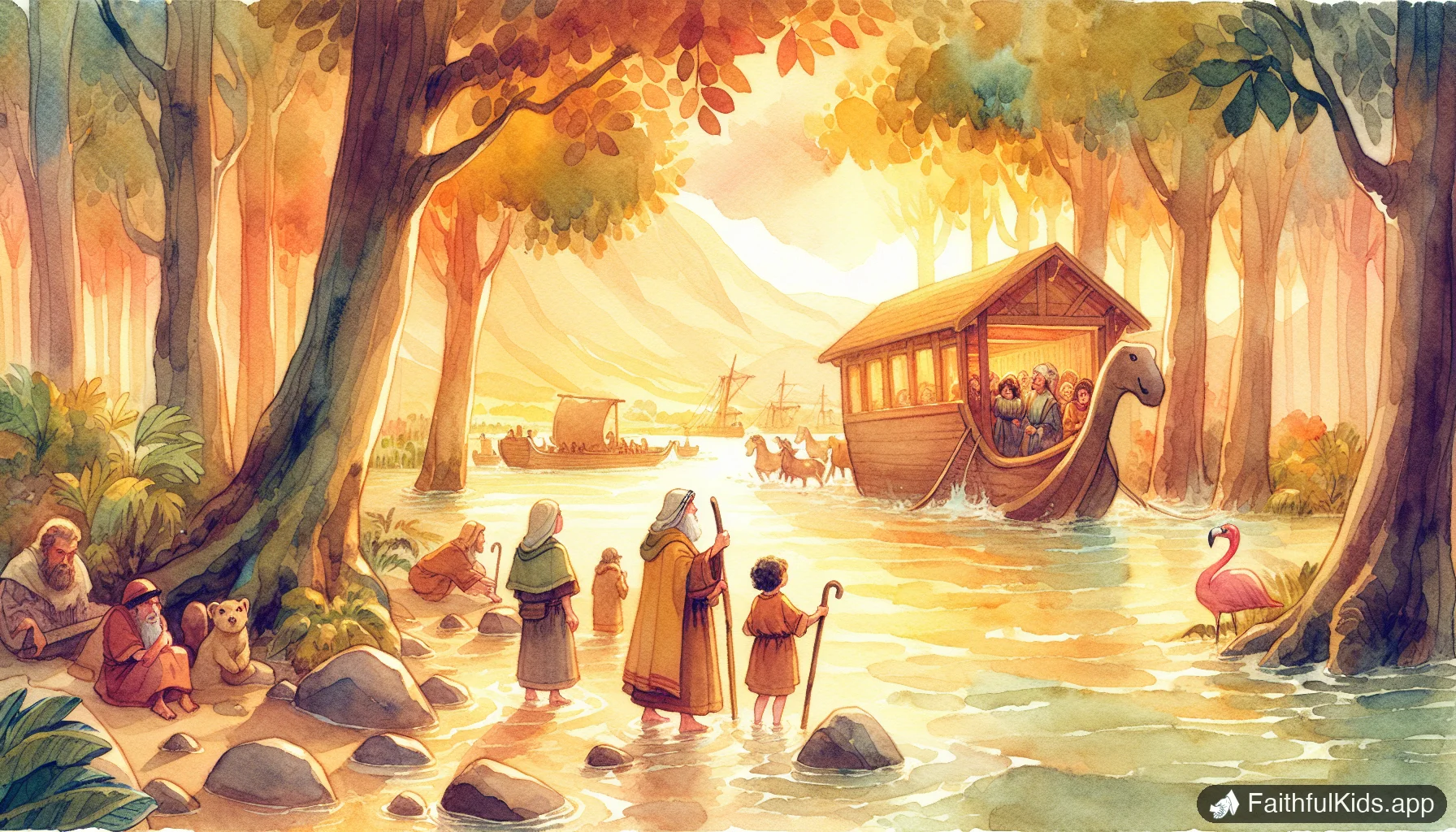
God asked Noah to build a massive boat in a place where it probably hadn't rained significantly. His neighbors likely thought he was crazy. Noah built it anyway.
Materials:
- Shoe box or small cardboard box
- Brown paint or brown paper
- Animal stickers or small toy animals
- Construction paper (for a sail or ramp)
- Glue
- Markers
Instructions:
- Paint the box brown (or cover it with brown paper) to look like wood.
- Cut a door flap in one side of the box.
- Make a ramp from folded cardboard leading up to the door.
- Add animal stickers or small toy animals walking up the ramp and into the ark.
- On one side of the ark, write: "Noah did everything just as God commanded him" (Genesis 6:22).
Discussion while crafting: "Building a boat when there's no water takes serious trust. What's the hardest thing God has ever asked you to trust Him with? Noah obeyed 'everything just as God commanded.' What does full obedience look like in your life?"
7. Mustard Seed Faith Jar — Jesus' Parable
Bible Story: Matthew 17:20
Lesson: Even tiny faith can do extraordinary things.
Jesus said, "If you have faith as small as a mustard seed, you can say to this mountain, 'Move from here to there,' and it will move. Nothing will be impossible for you."
Materials:
- Small glass jar or clear plastic container with lid
- Mustard seeds (available in the spice aisle of any grocery store)
- Label or sticker
- Marker
- Optional: small pebbles or decorative stones
Instructions:
- Place a few mustard seeds in the jar. (Mustard seeds are tiny -- about 1-2mm. Show kids how small they are.)
- Add small pebbles or stones to represent the "mountains" faith can move.
- Create a label for the jar that reads: "Faith as small as a mustard seed" -- Matthew 17:20.
- Attach the label to the jar.
- Keep it somewhere visible -- a nightstand, a desk, or a windowsill.
Discussion while crafting: "Look at how tiny this seed is. Jesus said that's all the faith you need. Why do you think He used something so small as an example? What 'mountain' in your life do you need faith to move?"
8. Good Samaritan Bandage Card — Love Your Neighbor
Bible Story: Luke 10:25-37
Lesson: Real love requires action, not just feelings.
A man was beaten and left on the road. A priest and a Levite walked past. A Samaritan -- a despised outsider -- stopped, bandaged the man's wounds, took him to an inn, and paid for his care.
Materials:
- Cardstock or thick paper (folded in half like a card)
- Band-aids (real ones)
- Markers or crayons
- Stickers (hearts, optional)
Instructions:
- On the front of the card, draw a simple outline of a person.
- Stick real band-aids on the person, as if bandaging their wounds.
- Write at the top: "Go and do likewise" -- Luke 10:37.
- Inside the card, write a kind message for someone who's having a hard time -- a sick friend, a lonely classmate, or a family member going through something difficult.
- Deliver the card to that person.
Discussion while crafting: "The Good Samaritan didn't just feel sorry for the hurt man -- he stopped, knelt down, and helped. Who in your life might need 'bandaging' right now? What does it cost you to help someone -- your time, your comfort, your plans?"
9. Prayer Hands — Teaching Kids to Pray
Bible Story: Matthew 6:9-13 (The Lord's Prayer)
Lesson: Prayer is talking to God -- and He always listens.
Jesus taught His disciples to pray with a simple model: praise God, ask for daily needs, seek forgiveness, and ask for protection. Prayer doesn't have to be fancy. (For more ideas, see our guide on how to pray with kids.)
Materials:
- Construction paper (any color)
- Pencil
- Scissors
- Markers
- Brass fastener (paper brad) or stapler
Instructions:
- Have each family member trace their hand on construction paper and cut it out.
- On each finger of the hand, write one type of prayer:
- Thumb (closest to your heart): Pray for family
- Pointer finger: Pray for teachers and leaders
- Middle finger (tallest): Pray for those in charge (government, pastors)
- Ring finger (weakest): Pray for the sick and hurting
- Pinky (smallest): Pray for yourself
- On the palm, write Matthew 6:9: "This, then, is how you should pray."
- Attach all family members' hands together at the wrist with a brad or staple to make a "family prayer bouquet."
Discussion while crafting: "Jesus taught us to pray in a specific order: praise, provision, forgiveness, protection. Why do you think praise comes first? Which finger prayer feels most important to you right now?"
10. Fruit of the Spirit Tree — Growing in Character
Bible Story: Galatians 5:22-23
Lesson: God grows good things in us when we stay connected to Him.
"But the fruit of the Spirit is love, joy, peace, patience, kindness, goodness, faithfulness, gentleness and self-control." These nine qualities aren't things we produce on our own -- they grow in us as we walk with God. Our lesson on the fruit of the Spirit for kids unpacks each one.
Materials:
- Large piece of brown paper or cardstock (for the trunk)
- Green construction paper
- Colored paper or sticky notes (9 different colors if possible)
- Markers
- Glue
- Scissors
Instructions:
- Cut a tree trunk and branches from brown paper and glue to a large piece of white paper or poster board.
- Cut leaf shapes from green paper and glue them to the branches to make a full canopy.
- Cut 9 fruit shapes (circles, apples, or ovals) from colored paper.
- Write one fruit of the Spirit on each: Love, Joy, Peace, Patience, Kindness, Goodness, Faithfulness, Gentleness, Self-Control.
- Glue the fruits onto the tree among the leaves.
- At the base of the tree, write Galatians 5:22-23.
Discussion while crafting: "A fruit tree doesn't strain to produce fruit -- it just stays connected to its roots and the fruit grows. What 'root' helps you grow these fruits? Which fruit of the Spirit is the hardest for you right now? Which one comes most naturally?"
Tips for Craft-Based Bible Lessons
Before you start: Read the Bible story together first. The craft should reinforce the lesson, not replace it.
During the craft: Talk. The best conversations happen when hands are busy. Ask questions while kids are coloring, gluing, and cutting. They'll share things during a craft that they'd never say in a formal discussion.
After the craft: Display it. A craft on the fridge or the bedroom wall becomes a daily visual reminder of the lesson. When your child sees the paper plate lion every morning, they think of Daniel's courage.
If your kids love the verse step: Several of these crafts finish with a Scripture written on the back, and children who linger over that part usually take to verse lettering sheets, where the words themselves become the artwork.
For mixed ages: Let older kids do more detailed versions while younger kids do simplified ones. A 5-year-old's rainbow painting and a 12-year-old's rainbow painting both teach the same lesson about God's promises. If your youngest is still in the tearing-and-gluing stage, a set built for little hands beats trying to scale these down.
For large groups: Pre-cut as much as possible. Have supplies organized in stations. Assign each table a volunteer who can help younger kids while leading discussion.
If you run out of supplies, these no-supplies Bible activities for kids at home keep the learning going.
Watch on Faithful Kids
Love hands-on Bible learning? Faithful Kids pairs animated video Bible lessons with interactive quizzes and reflections -- the perfect companion to your craft time. Watch the story, do the craft, and watch your kids' faith grow.
Start your free trial at faithfulkids.app/quiz
You can print any of our free Bible coloring pages without giving an email address.
If your kids like puzzles, the Bible crossword puzzles ask what happened in the story, not just how the names are spelled -- free, with answer keys.
Frequently Asked Questions
What age are these Bible crafts designed for?
These crafts work for kids ages 4-12. Younger children (4-6) may need help with cutting and writing, while older kids (7-12) can add more detail and complexity. Every craft can be simplified or elevated based on the child's ability.
Can I use these crafts for Sunday school or VBS?
Absolutely. Each craft includes a Bible story, a lesson connection, and discussion questions -- everything you need for a complete Sunday school activity. For larger groups, pre-cut materials and have volunteers at each table to help with assembly and discussion. Around Holy Week, swap in the classroom-tested projects from our Holy Week craft lineup.
How long does each craft take?
Most crafts take 15-25 minutes including discussion. Simpler ones (like the star or the bandage card) take 10-15 minutes. More involved ones (like the ark or the Fruit of the Spirit tree) can take 20-30 minutes. Add 5-10 minutes if you read the full Bible passage first.
What if I don't have all the supplies listed?
Improvise. Most of these crafts can be done with just paper, markers, glue, and scissors. Don't have googly eyes? Draw them. Don't have mustard seeds? Use rice grains and explain that mustard seeds are even smaller. The craft is a vehicle for the lesson -- the exact materials matter less than the conversation.