What Are the Best Bible Games for Young Kids (Ages 4-7)?
Young kids need games with movement, pictures, and zero reading. These six deliver. And if you searched for Jesus games for kids specifically, start with Disciples Tag and Lost Sheep Hide-and-Seek -- both come straight from Jesus's own words.
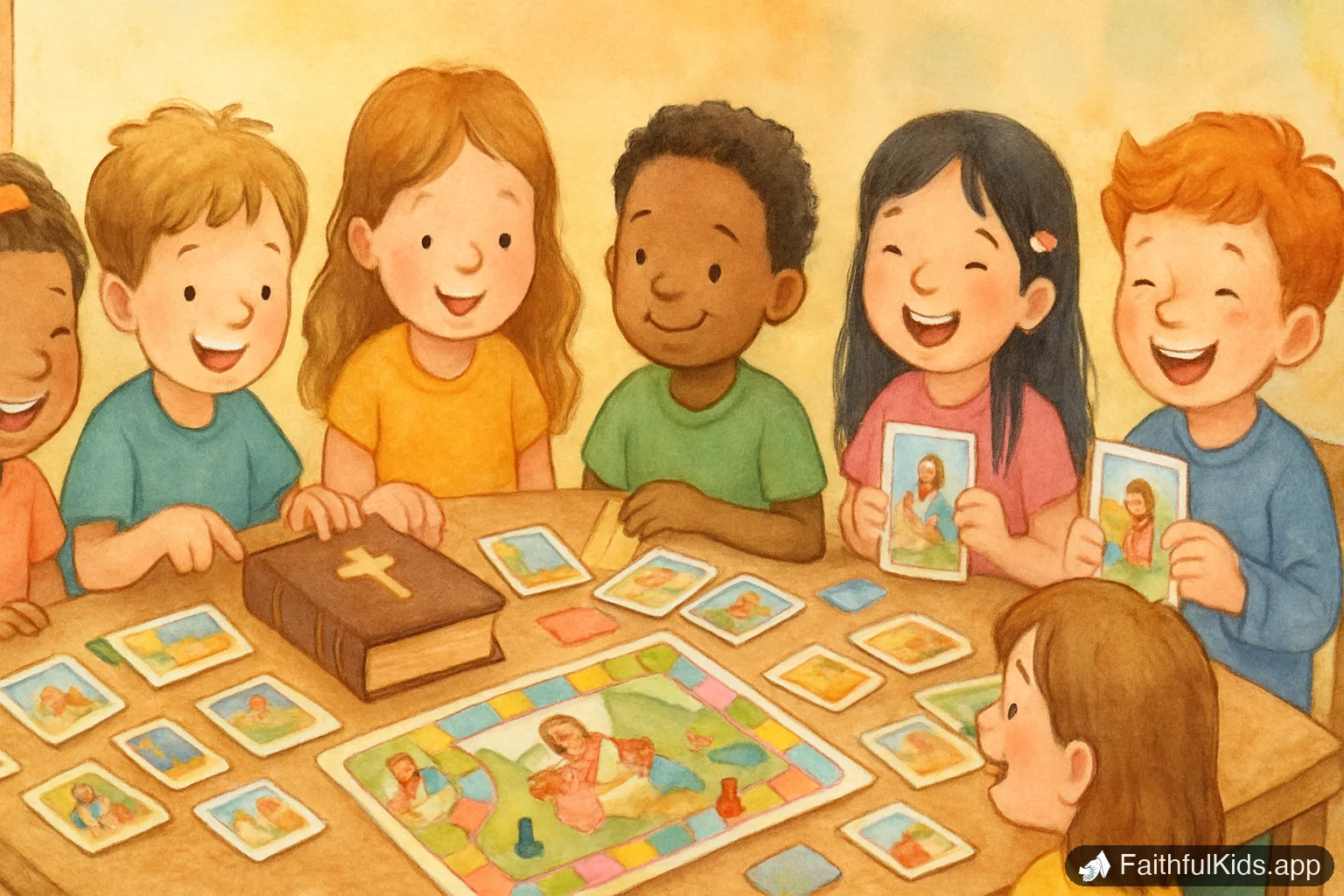
1. Bible Memory Match
Make pairs of index cards: two matching pictures (two arks, two crowns) or a character plus their story (David + Goliath, Jonah + big fish). Lay all cards face down in a grid. Players take turns flipping two cards; a match means you keep the pair and go again, a miss means both flip back. Most pairs wins.
Repetition is the engine of early memory, and this game is repetition disguised as suspense -- a four-year-old who plays a few rounds can name Noah, David, Daniel, and Jonah on sight. Prep is ten minutes of drawing or printing cards, and the same deck lasts for years.
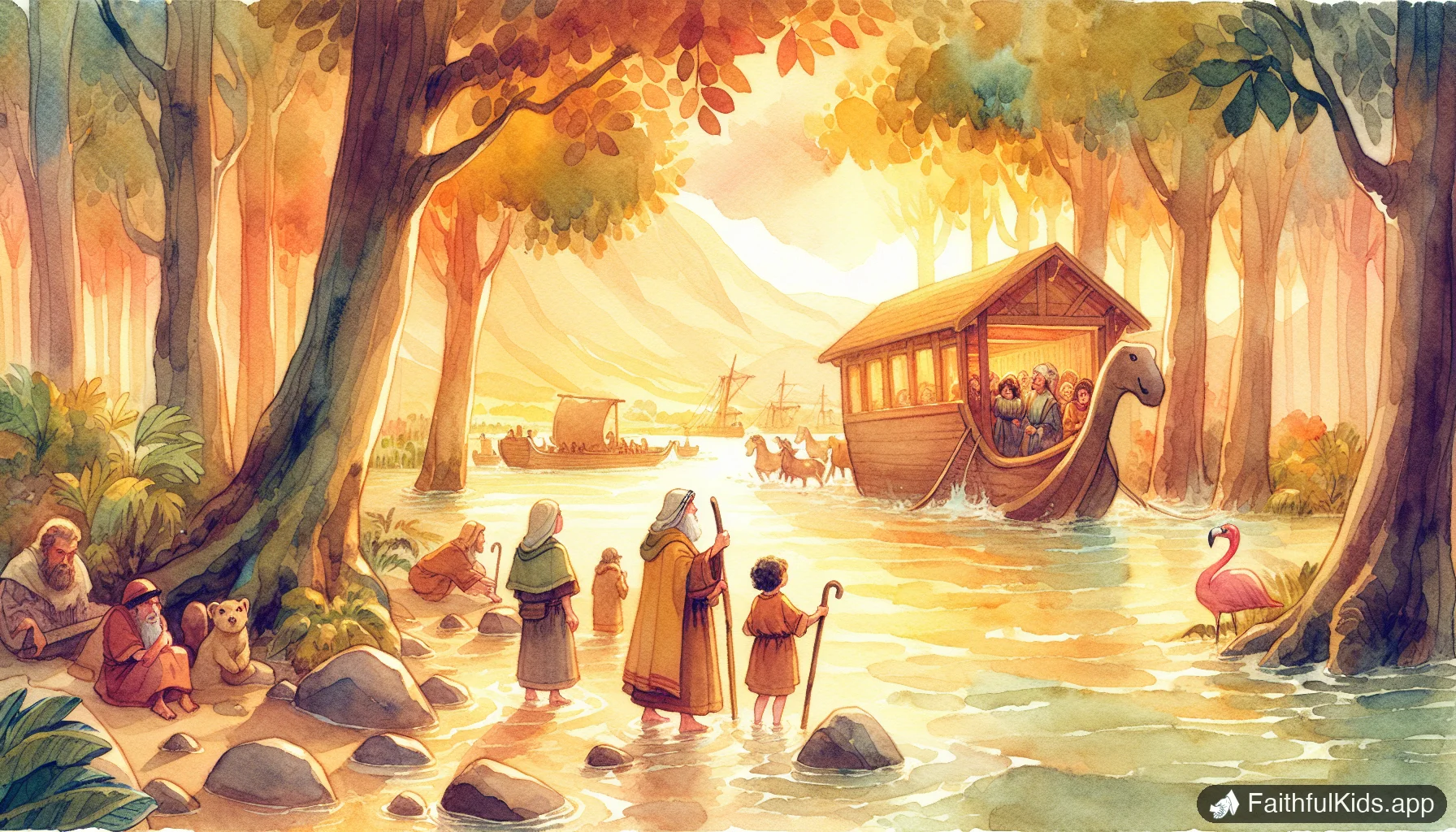
2. Noah's Ark Animal Charades
Whisper an animal to one child -- elephant, lion, snake, monkey -- and have them act it out while everyone else guesses. The guesser becomes the next actor. Frame the game with the story: "God told Noah to bring the animals into the ark two by two (Genesis 7:8-9), and today we get to be those animals."
It is the gentlest possible entry into Bible drama, because every preschooler already knows how to be an elephant. Ages 3+, and it needs nothing but floor space.
3. Disciples Tag
One player starts as the "fisher." Anyone tagged is not out -- they join the fisher's team and start tagging too. The team grows until the last free player is caught, and that player starts the next round.
The lesson writes itself: Jesus said, "Follow me, and I will make you fishers of men" (Matthew 4:19), and the people He called went out and brought others -- kids feel that multiplication happen in their own game. Ages 4+, six or more players, zero supplies.
4. Bible Story Freeze Dance
Play music and let kids dance. When the music stops, call out a freeze pose from a Bible story: "Freeze like David facing Goliath!" "Freeze like Jonah inside the fish!" Anyone who wobbles sits out one round, then rejoins.
Adding Bible poses turns a game this age already loves into story review without a single question asked. Rotate three or four stories per session; all you need is a phone with music.
5. Walls of Jericho Stack-and-Shout
Let kids build a tall wall out of plastic cups, cardboard boxes, or blocks -- the walls of Jericho. Then everyone marches around it in a circle while you count laps aloud, staying silent for six laps just like Joshua's army (Joshua 6:3-5). On the seventh lap, shout "The Lord has given us the city!" and let the kids yell and knock the wall flat. Rebuild and repeat; preschoolers will happily play five rounds in a row.
The silent marching is the secret ingredient -- holding in a shout for six laps makes the seventh-lap explosion unforgettable, which is exactly how the story is supposed to feel. All you need is a stack of cups or empty boxes.
6. Lost Sheep Hide-and-Seek
One player (or the adult) hides a stuffed sheep -- any stuffed animal works -- somewhere in the room while the "shepherds" cover their eyes. Kids search until someone finds it, and the finder gets to hide it next round. Give warmer/colder hints so no round drags, and when the sheep is found, everyone cheers together.
The cheer is the point: Jesus said the shepherd who finds his one lost sheep "rejoices over it more than the ninety-nine" (Luke 15:4-7), so the celebration is not a bolt-on -- it IS the lesson. Ages 4-7, two or more players, and the only supply is one stuffed animal.
Which Bible Games Work for Ages 8-12?
Kids who can read and handle real competition are ready for these seven. That competitive streak is also what makes the goofiest youth group games land once these kids hit middle school, so the transition is easier than it looks.
7. Sword Drill
Everyone holds a closed Bible at chest height -- the "sword" of Ephesians 6:17, which calls the word of God "the sword of the Spirit." The leader calls a reference like "John 3:16," then says "Charge!" First player to find the verse and read it aloud wins the round. Play 10-15 rounds.
No game makes kids more fluent at navigating the Bible: speed forces them to internalize the order of the books. Start with easy books (Psalms, John) and graduate to Obadiah, Philemon, and Habakkuk. Ages 7+; the only supply is one Bible per player, with matching translations to keep it fair.
8. Who Am I? Bible Edition
Write a Bible character on a sticky note and press it onto each player's forehead so everyone can see it except the wearer. Players take turns asking yes-or-no questions -- "Am I in the Old Testament?" "Did I perform miracles?" -- with one guess allowed per turn. First to name their own character wins.
The genius here is that kids review for each other: to answer "Did I build something?" about Noah, the answerer has to know the story too. Good characters: Moses, Ruth, Esther, Daniel, Mary, Peter, Paul. Ages 7+; the only prep is a pad of sticky notes.
9. Verse Scramble Relay
Print a verse in large type, cut it into individual words, and seal each scrambled set in an envelope -- one per team. On "Go!" teams race to arrange the words in the correct order; first correct verse wins. Then read the verse together and ask what it means.
Physically ordering the words plants a verse far deeper than reciting it once would. Great verses: John 3:16, Psalm 23:1, Philippians 4:13, Proverbs 3:5-6. Ten minutes of prep with a printer and scissors. If memorization is the actual goal rather than a side effect, our roundup of Bible memory verse games has a dozen more built around the same idea.
10. Bible Pictionary
Write Bible scenes and objects on slips of paper: burning bush, empty tomb, five loaves and two fish, Noah's ark. Split into two teams. One player draws the prompt on a whiteboard without letters or numbers while their team guesses within 60 seconds. Alternate teams and keep score.
Drawing forces kids to ask what makes each story recognizable -- exactly the thinking that makes stories stick. It shines with 8-12s, who will attempt "the transfiguration" and laugh at the results. Prep: slips of paper and something to draw on.
11. Bible Emoji Pictionary
Instead of drawing scenes, players write a string of three to five simple symbols -- emoji-style -- and their team guesses the story: boat + rain + rainbow is Noah's ark, crown + baby + star is the wise men, bread + fish + crowd is the feeding of the five thousand. One player per team "encodes" a story slip into symbols on a whiteboard or paper while teammates guess within 60 seconds; then teams swap.
Encoding is even harder thinking than drawing, because kids must boil a whole story down to its three most essential images -- summary skills in disguise. It works on paper in a restaurant just as well as on a whiteboard in class. Ages 8+, and prep is a handful of story slips.
12. Giant Goliath Knockdown
Stack empty cans or bottles into a tower and draw a face on the top one -- that is Goliath. Players stand behind a line 10-15 feet back and get exactly five throws with a soft ball, echoing the five smooth stones David chose (1 Samuel 17:40). Score a point per can, with a bonus for toppling Goliath's head.
Retell 1 Samuel 17 first and the game becomes a lesson on courage: David won not because he was stronger but because he trusted God. Ages 5+, indoors or out, and the "prep" is raiding the recycling bin.
13. Books-of-the-Bible Sorting Race
Write each book of the Bible on its own index card, shuffle the deck, and race the clock (or another team) to lay all the cards out in the correct order on the floor. Beginners can start with just the Old Testament, the New Testament, or one section like the Gospels, then work up to all 66. Keep a Bible's table of contents nearby as the answer key, and record the best time so kids have a score to beat next week.
Where Sword Drill tests book order under pressure, this game teaches it hands-on -- kids physically hold Habakkuk and decide where it goes, which is how the order finally sticks. Prep is 15 minutes of card-writing once, and the deck lasts forever. Ages 8+, solo or in teams.
In spring, add a quiet station with our free Easter coloring pages — five printable scenes walking Holy Week.
What Bible Games Work in Sunday School or Groups?
Group settings need games that scale to a dozen kids and survive a wide age spread. (For a classroom-specific list, see our Sunday school games for kids.)
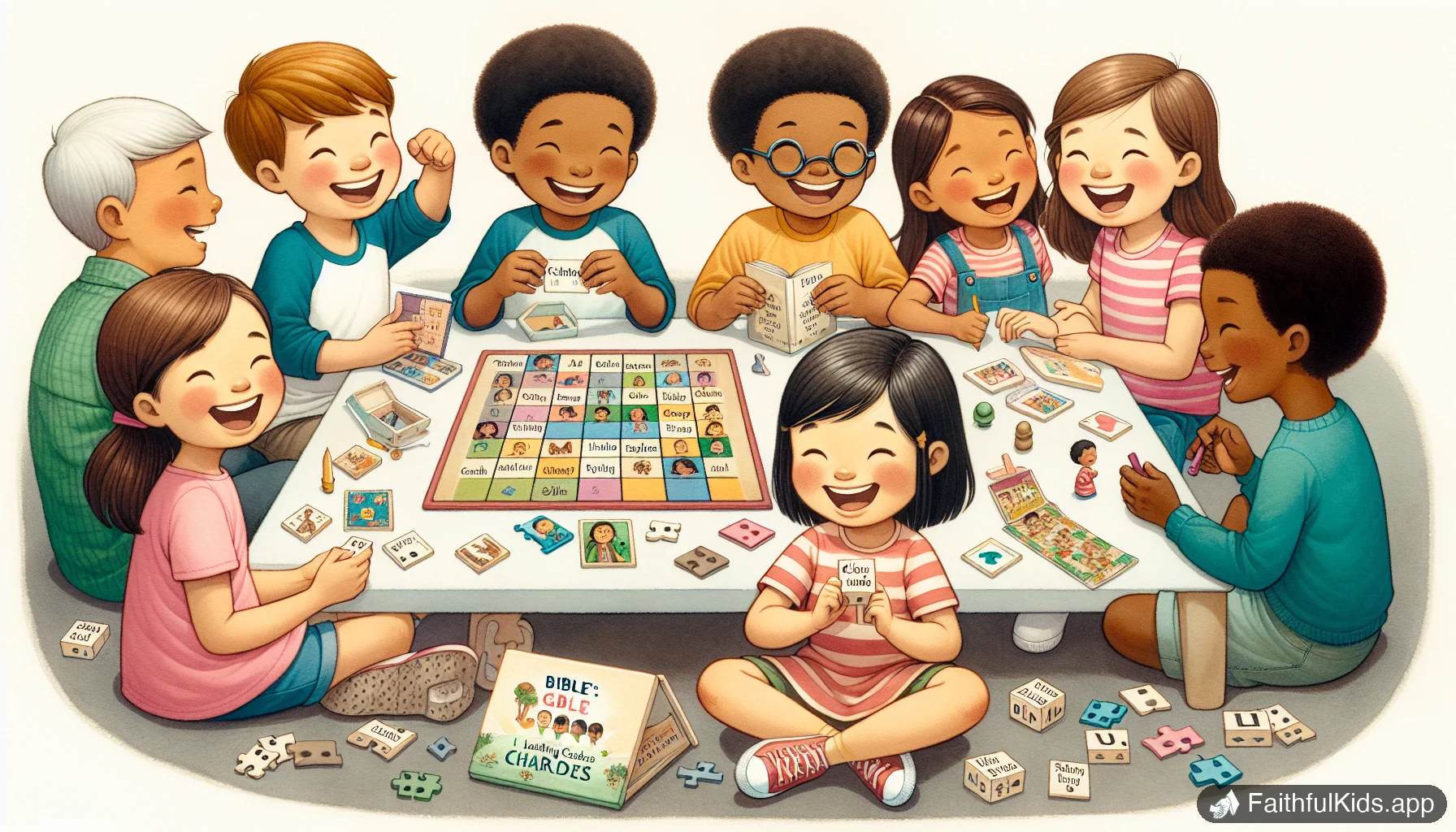
14. Bible Charades
Write Bible stories on slips of paper -- David and Goliath, Jonah and the great fish, Moses parting the Red Sea, Daniel in the lions' den, Jesus walking on water. Split into two teams. An actor draws a slip and performs it silently while their team guesses within 60 seconds; a miss lets the other team steal.
Charades is the workhorse of Sunday school games: it scales from 4 players to 40, works across every age, and acting a story out forces kids to recall its key beats -- retelling in disguise. For ready-made prompts sorted by difficulty, use this list of Bible charades ideas for kids.
15. Bible Bingo
Make 5x5 bingo cards filled with Bible names, objects, and words -- Moses, manger, cross, faith, ark -- each card arranged differently. The caller draws a matching calling card and reads it with a one-line clue: "Noah -- the man who built the ark." Players cover matches; five in a row shouts "Bingo!"
Bingo reviews dozens of Bible terms per game while feeling like pure luck -- perfect for mixed groups where quiz-style games would embarrass slower readers. Use candy as markers and let winners eat their row. (Our Bible bingo for kids guide has card ideas and variations.) The clue lines can come straight from a bank of Bible trivia questions for kids.
16. Bible Scavenger Hunt
Write clues where a Bible verse points to the next location: "Jesus said, 'I am the light of the world' (John 8:12) -- go find something that gives LIGHT," and the lamp holds the next clue. Chain five to eight clues to a final treasure of snacks or prizes.
Kids look up real verses, extract the key word, and hunt -- Scripture reading with a prize at the end. Verses that map to findable objects: Genesis 1:11 (trees), John 2:9 (water), 1 Samuel 17:49 (stone), Genesis 6:14 (wood). Setup takes 20-30 minutes; this guide to Bible scavenger hunt ideas has ready-made clue chains.
17. Armor of God Dress-Up Relay
Set up two piles of "armor," one per team: a belt (any strip of fabric), a breastplate (a vest or cardboard sheet with string), shoes (oversized slippers), a shield (a trash-can lid or cardboard circle), a helmet (any hat), and a sword (a pool noodle or cardboard tube). On "Go!" the first runner races down, puts on all six pieces while naming each one aloud -- "belt of truth! breastplate of righteousness!" -- strikes a warrior pose, takes it all off, and runs back to tag the next teammate. First team to armor up every player wins.
By round three, kids have shouted Ephesians 6:13-17 from memory a dozen times without ever being asked to memorize it. Gathering the costume pieces takes 20 minutes of closet-raiding, and the same bin works every year. Ages 5+, six or more players.
18. Promised Land Obstacle Course
Build stations from the Exodus journey with whatever you have: run between two blue tarps (the Red Sea, Exodus 14), zigzag through cones (the wilderness), climb over a bench to grab a paper commandment (Mount Sinai), jump a chalk line (the Jordan), and knock down a box tower with a ball (Jericho, Joshua 6). Time each runner.
Kids physically travel the story arc from Egypt to Jericho, and the sequence itself is the lesson -- ask "What happened at each station?" and watch them narrate the whole journey. Ages 5+, any group size.
19. Fruit of the Spirit Fruit Basket
Arrange chairs in a circle, one fewer than the number of players, and assign every child one of the nine fruits of the Spirit from Galatians 5:22-23 -- love, joy, peace, patience, kindness, and so on, repeating as needed. The player in the middle calls a fruit, and everyone with that fruit must dash to a new chair while the caller tries to grab one; whoever is left standing calls next. Shout "Fruit of the Spirit!" and every player must move at once.
It is classic Fruit Basket Upset with Scripture wired straight into the mechanics: after ten rounds, every kid in the room can rattle off the nine fruits because they have been listening for their own. Zero supplies beyond chairs, ages 5+, best with eight or more players.
20. Bible Story Theater
Assign each small group a story -- the Good Samaritan, Daniel in the lions' den, Zacchaeus in the tree -- with 10-15 minutes to plan and rehearse using simple props like bathrobes and cardboard swords. Each group performs; afterward, ask the audience what the story's main lesson was.
Performing demands deeper processing than listening ever will: kids must decide what matters, who felt what, and how it ends. Older kids can direct younger ones, which solves the mixed-age problem beautifully. Ages 6+, and props are optional.
Which Bible Games Need Zero Prep?
No printer, no supplies, no notice. These five run anywhere -- car, waiting room, dinner table. (If you do have a printer, Bible word searches and Bible mazes and puzzles make great quiet-time companions.) Leaders covering an older class on short notice can raid this list of games with nothing to buy and nothing to print for the same effect.
21. 20 Questions: Bible Edition
One player thinks of a Bible person, place, or thing. Everyone else asks yes-or-no questions -- 20 total -- to identify it. Guess right within 20 and the guessers win; run out and the thinker wins and goes again.
Easy subjects for younger kids: Noah's ark, a shepherd, baby Jesus -- our easy Bible trivia questions list doubles as a subject bank when nobody can think of one. Devious subjects for older ones: Balaam's donkey, Gideon's fleece, the burning bush. The question-asking itself is the review -- a child asking "Is it a miracle?" is building a mental map of the Bible out loud. Ages 6+.
22. Bible Story Telephone
Sit in a line. The first player whispers a one-sentence Bible story summary -- "God told Noah to build a big boat because a flood was coming" -- and each player whispers what they heard onward. The last player says the final version aloud, and everyone compares it to the original.
The payoff is the built-in lesson: the story always mutates, which is why we go back to the Bible itself instead of relying on secondhand versions. Six or more players, ages 5+, and it is one of the easiest wins on any list of Bible activities to do at home.
23. Bible Riddle Race
Fire off first-person riddles and let kids race to shout the answer: "I built a boat before it ever rained -- who am I?" (Noah). "I knocked down a giant with one stone -- who am I?" (David). Score a point per correct answer; first to ten wins.
You can improvise riddles from any story your kids know, and stumped kids get hints rather than shame. Keep a stash of ready-made Bible riddles for kids and a few funny Bible jokes on your phone and you will never face a boring car ride again.
24. Bible Sound Effects Story
Tell or read a Bible story aloud and assign each kid a sound cue they must perform every time their word comes up: rain sounds whenever you say "flood," a lion roar for "lion" in Daniel 6, marching feet for "Jericho," wind whooshes for the storm Jesus calmed in Mark 4. Pause dramatically before each cue word so kids hang on every sentence waiting to pounce. For extra chaos, speed up the story on the second telling.
Kids cannot supply the sound without tracking the story, so this turns passive listening into full-body attention -- and it works read-aloud at bedtime just as well as in a classroom of twenty. Ages 4+, any group size, truly zero supplies.
25. Books of the Bible Beat
Set a lap-slap-clap rhythm and go around the circle naming the books of the Bible in order, one book per beat: Genesis... Exodus... Leviticus. Miss the beat or the book and you are out (or, gentler, the group just starts over and tries to beat its record).
Rhythm is a memory superpower -- it is why kids can recite song lyrics they have heard twice. A group that plays weekly will have all 66 books memorized without ever sitting down to "memorize" anything. Ages 7+, nothing needed but hands.
What Bible Games Work Outdoors?
When you have a backyard, a park, or a church lawn, these four outdoor Bible games give youth groups and big family gatherings room to actually run. All of them handle mixed ages, and none needs more prep than a bag of balloons or a couple of ropes. When the older siblings tag along and burn through all four in half an hour, these field-sized games for teens will keep them busy for the rest of the afternoon.
26. Red Sea Crossing Relay
Lay two ropes (or chalk lines) about eight feet apart across the yard -- that is the Red Sea, parted. Split into teams and pile "Israelite belongings" (balls, stuffed animals, shoes) at one end. On "Go!" runners race one at a time between the walls of water carrying one item per trip; step outside the lines and you restart that trip. First team to move every item across the sea wins.
Kids run the escape from Egypt (Exodus 14:21-22) with their own legs, and the one-item-per-trip rule means everyone makes multiple crossings instead of one fast kid doing it all. Ages 5+, six or more players, and prep is two ropes.
27. Bible Verse Water Balloon Toss
Pair kids up facing each other, hand each pair a water balloon, and pick a short memory verse like Psalm 56:3. After each successful catch, the catcher says the next word of the verse; each time the verse is completed, both partners take a big step back and start it again. Splash and you refill and rejoin at the shortest distance. Last dry pair wins.
The stakes make the words stick -- nobody forgets the verse they recited while a water balloon hung in the air. Ages 6+, best on hot days, and prep is one bag of balloons.
28. Good Samaritan Rescue Relay
Mark a "roadside" at one end of the field and an "inn" (a blanket or bench) at the other. Teams of three run out together: one plays the hurt traveler, and the other two help them back to the inn -- supporting under the arms, a two-person seat carry, or a piggyback for little ones. Rotate roles each round so every player gets rescued once. Fastest total team time wins.
The race flips Luke 10:25-37 into muscle memory: you cannot win this game by leaving anyone behind. Ages 6+, six or more players, and the only supply is a blanket.
29. Manna Hunt
Before the kids come outside, scatter a few hundred cotton balls -- the "manna" -- across the lawn. Give each child a cup and exactly two minutes to gather, with the twist from Exodus 16:16-18: announce a "one omer" limit, say 20 pieces, and anything a player holds over the limit is removed from their score. Play several "mornings" worth of rounds.
The limit rule sneaks the real lesson of the manna story -- God provides enough for everyone, and hoarding gains nothing -- into a game kids treat like an egg hunt. Ages 4+, any group size, and cleanup is the final round.
How Do You Keep Bible Games Fun (Not a Pop Quiz)?
The one mistake that kills Bible games is making the game a thin wrapper around interrogation. The fix: play first, connect after. Let the game be genuinely fun on its own terms, then spend 60 seconds afterward on the story or verse behind it -- the game opens the door, and the one-minute connection walks through it. Never withhold the fun until the "learning part" is done.
A few more rules keep the energy up. Keep games short -- three quick games beat one long one that loses the room. Mix ages by pairing older kids with younger ones, so the big kids reinforce what they know by teaching it. Celebrate effort, not just winning, so the slowest reader still wants to come back next week -- and for any quiz-style game, switching to multiple choice Bible trivia gives shy kids a way to play without risking a blank stare. Screens can pull in the same direction too: Faithful Kids pairs short animated Bible story videos with game-style quizzes -- points, streaks, celebrations -- so the "game first, lesson inside" principle keeps working on days you cannot run charades in the living room. Finally, make it a rhythm, not a one-off: a monthly family Bible trivia night gives the games a reason to matter. And when these kids graduate into the teen room, none of it gets thrown out -- our master list of youth group games picks up right where this one stops.
There are eleven printable Bible word searches on our site, each with its answer key on the page.
If the adults keep stealing the kids' questions, point them at Bible trivia for adults instead -- the expert round settles who actually knows their Bible.
We also keep a set of 80 Christmas trivia questions sorted into rounds, so the six-year-old and the Sunday-school veteran both get a fair turn.
There is a screen version: the Bible quiz online keeps score so you can just read and referee.
For the puzzle-lover at the table, there's a whole set of Bible crossword puzzles -- free to print, answer keys included.
And when the kids start repeating the same three jokes, restock from our clean Christian jokes for the whole family.
For a game that gets everyone moving, our Bible scavenger hunt has three ready-to-play hunts -- verse hunt, object hunt, and a church photo hunt -- with a free printable.
Planning an October event? Our church fall festival games list has 25 booth, trunk-or-treat, and big-group games with supply notes.
Frequently Asked Questions
What are good Bible games for 4 and 5 year olds?
Bible Memory Match, Noah's Ark Animal Charades, Walls of Jericho Stack-and-Shout, and Lost Sheep Hide-and-Seek are the best fits because none require reading. Preschoolers learn through pictures, movement, and repetition, and all four deliver Bible content through exactly those channels. Keep rounds under five minutes and expect to repeat favorites -- at this age repetition is a feature, not a bug.
What Bible games can I play indoors with no supplies?
20 Questions: Bible Edition, Bible Story Telephone, Bible Riddle Race, Bible Sound Effects Story, and Books of the Bible Beat all work indoors with zero supplies, and Who Am I? needs only a scrap of paper. Between those six, you can fill an hour with nothing but the people in the room. For a bigger crowd stuck in a fellowship hall on a rainy night, these indoor games built for larger groups scale further than a circle of six will.
Which Bible games work best for Sunday school?
Team games scale best: Bible Charades, Bible Bingo, Verse Scramble Relay, Armor of God Dress-Up Relay, and Bible Story Theater all handle 10-30 kids and a wide age range. Split the class into teams of four to six and rotate through two or three games per session. Save individual competitions like Sword Drill for smaller classes of similar-age readers. For end-of-lesson review, these Bible review games for Sunday school are built to reinforce the day's story.
How do I make Bible games educational without ruining the fun?
Play the game at full fun, then spend 60 seconds afterward connecting it to the story or verse -- never gate the fun behind the lesson. Choose games where the Bible content lives inside the mechanics (acting the story, finding the verse) rather than bolted on as quiz questions between turns. Kids who associate the Bible with laughter come back; kids who associate it with being tested do not.
What age should kids start playing Sword Drill?
Around age 7, once a child reads well enough to recognize book names and flip to them. Before that, let younger kids team up with an older partner who does the page-turning. Identical Bibles keep the race fair, and starting with easy-to-find books like Psalms and John builds confidence fast.
How long should a Bible game session last?
For ages 4-7, plan 5-10 minutes per game and switch the moment energy dips; for ages 8-12, competitive games can run 15-20 minutes. A good session is two or three short games plus a one-minute connection after each -- roughly 30-45 minutes total. Always end while kids still want more; that is what brings them back.