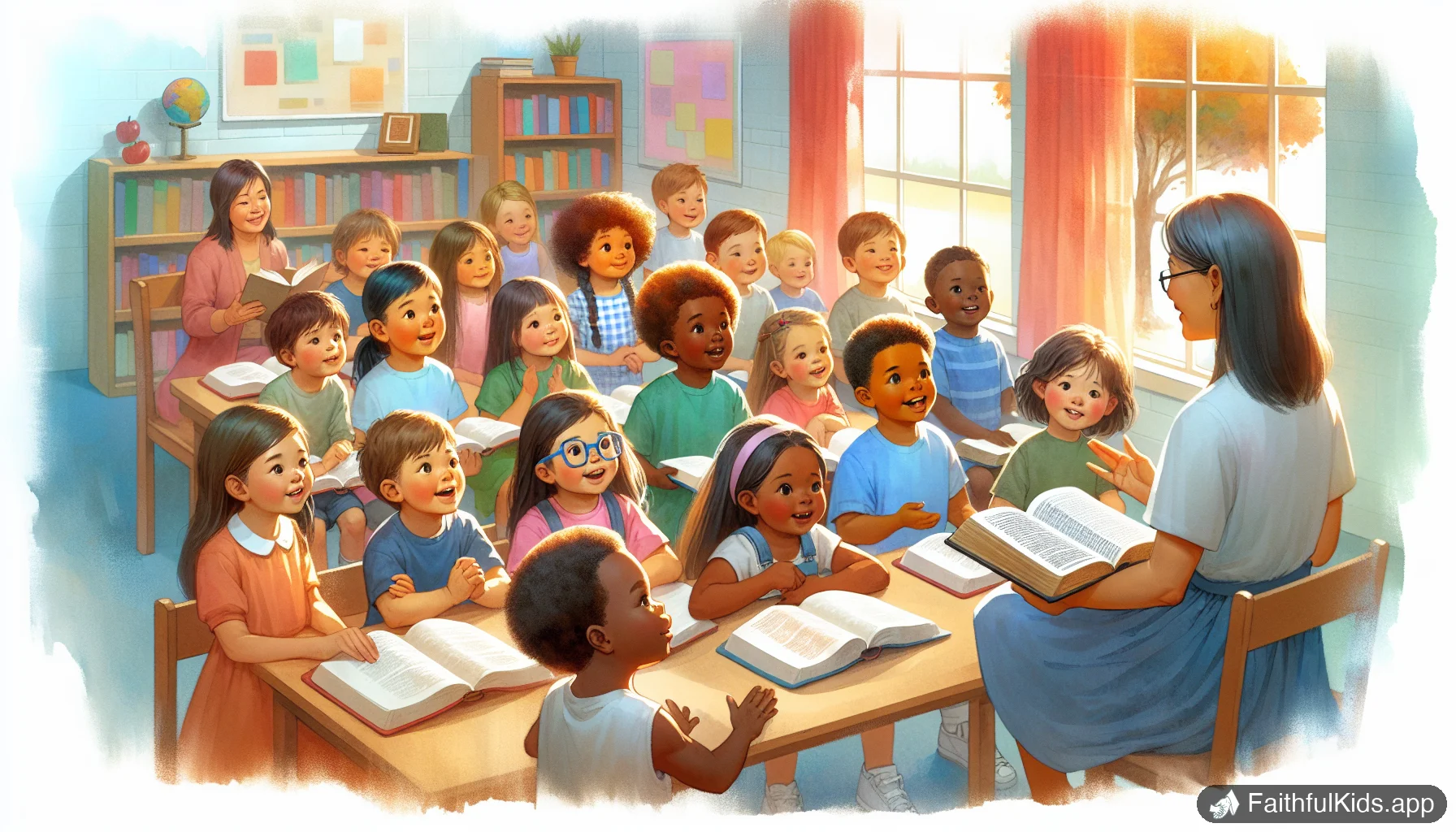
If you teach Sunday School, you know the feeling. It is Saturday night, you have 25 minutes to prepare tomorrow's lesson, and you are staring at a blank page. Or maybe you are a brand-new teacher who volunteered last week and now you are wondering what you got yourself into.
Either way, you need lesson plans that are simple enough to prepare quickly, structured enough to actually teach something, and engaging enough to hold the attention of children who would rather be on their tablets.
This guide gives you a proven 30-minute lesson structure that works every single week, plus 10 complete lesson outlines you can use immediately. Print them out. Adapt them. Make them your own. They are free. If you need still more material once you have worked through these ten, we maintain a growing archive of free Sunday school lessons organized by book and theme.
The 30-Minute Lesson Structure
This structure works for ages 5-12 with minor adjustments. It has been used by thousands of Sunday School teachers and children's ministry leaders because it hits every learning style: auditory, visual, and kinesthetic. It is the same skeleton behind our full library of Sunday school lessons for kids, and if you teach the middle and high school hour instead, the pacing changes enough that we broke it out separately in Sunday school lessons for teens.
Minutes 1-5: Welcome and Review (5 minutes)
Start with a simple question that connects to last week's lesson or introduces today's theme. "Who remembers what we talked about last week?" or "Has anyone ever felt really scared about something?" This warms up the group, gets kids talking, and creates a bridge to the new material.
Tip: Have a simple activity at each seat (a coloring page, a word search, a question card) for kids who arrive early. Idle time is chaos time. These Sunday school opening activities give you a month of ready-made warm-ups.
Minutes 6-15: The Story (10 minutes)
Tell the Bible story. Do not read it word-for-word from the Bible unless your students are older. Instead, retell it in your own words with enthusiasm, voices, and dramatic pauses. Use visual aids: flannel boards, props, pictures, or a short video.
Tip: Ask questions during the story, not just after. "What do you think David was feeling right now?" "What would you have done?" This keeps kids engaged and prevents the glaze-over that comes from a 10-minute monologue.
Minutes 16-20: Discussion (5 minutes)
Ask 3-4 questions that move from factual ("What happened?") to interpretive ("Why do you think God chose David?") to personal ("When have you needed to be brave?"). Let kids answer. Affirm every response. Do not rush this section. If you need prompts, we keep a bank of 200+ Bible discussion questions for kids organized by story.
Minutes 21-27: Activity (7 minutes)
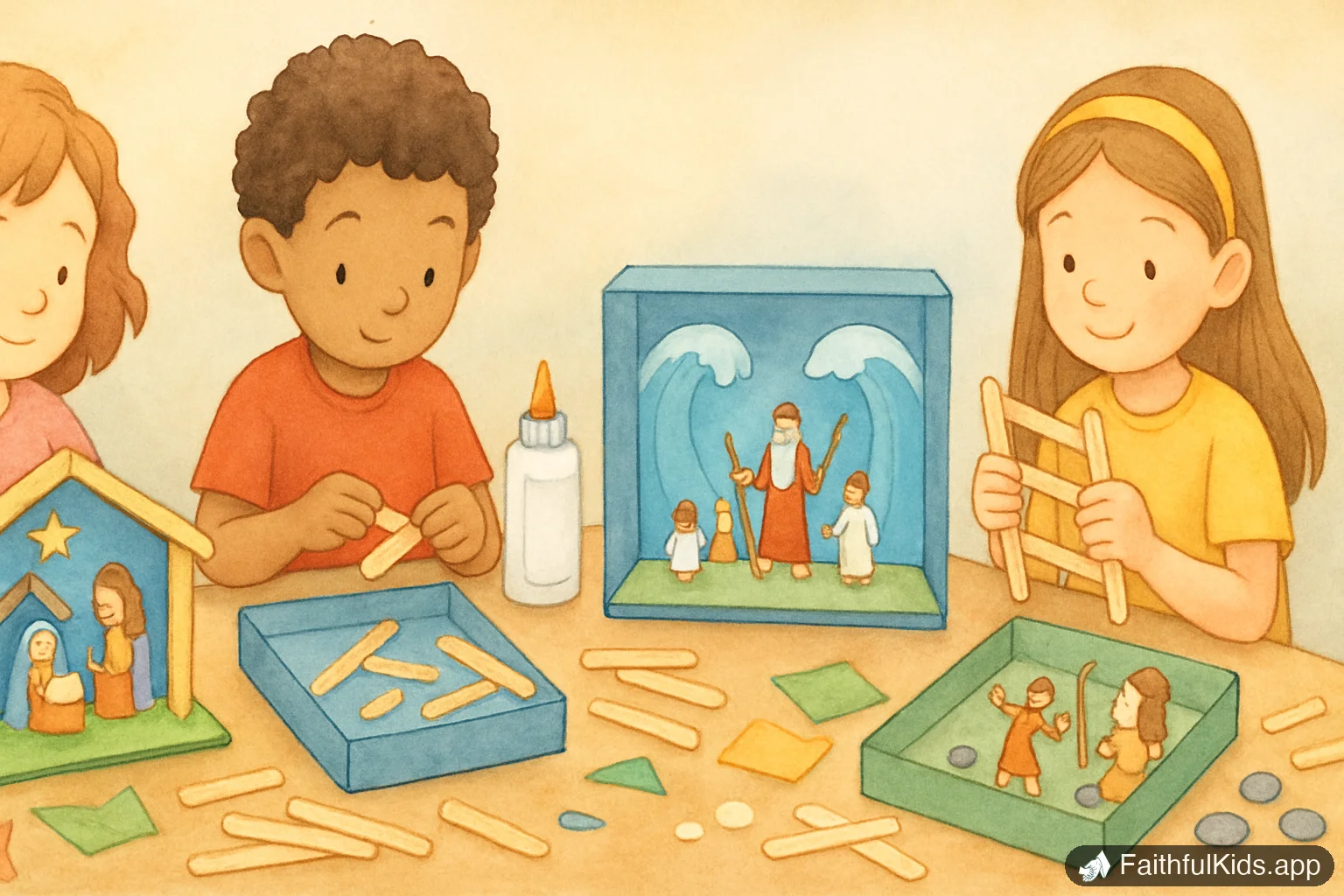
Give kids something to do with their hands that reinforces the lesson. This could be a craft, a game, a role-play, a drawing activity, or a written response. The activity should connect directly to the Bible story, not just be "something fun to do."
Minutes 28-30: Closing and Prayer (3 minutes)
Summarize the one big idea from today's lesson in a single sentence. Have kids repeat it back to you. Then pray together. For younger kids, let them repeat a prayer after you line by line.
10 Complete Lesson Outlines
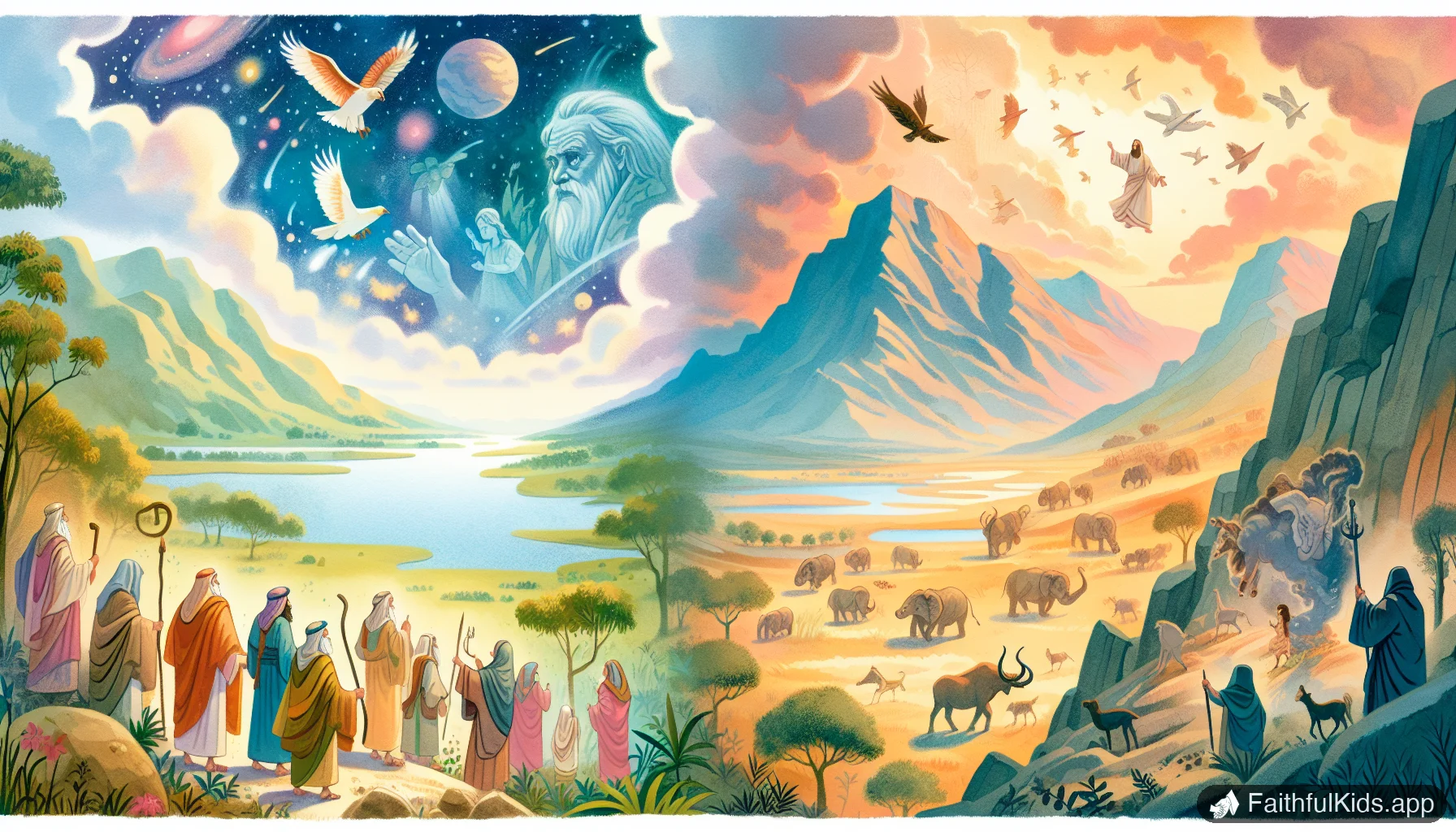
Lesson 1: Creation (Genesis 1-2)
Big idea: God made everything, and He made you on purpose.
Welcome question: "What is the most amazing thing you have ever seen in nature?"
Story summary: Tell the seven days of creation with wonder. Day 1: light. Day 2: sky. Day 3: land and plants. Day 4: sun, moon, stars. Day 5: fish and birds. Day 6: animals and people. Day 7: rest. Emphasize that God looked at everything He made and said it was "very good" (Genesis 1:31), and that includes every child in the room.
Discussion questions:
- What is your favorite thing God created? Why?
- God said everything He made was "very good." What does it mean that God made you and called you very good?
- Why do you think God rested on the seventh day?
Activity: Give each child a paper plate divided into 7 sections. They draw or write one creation in each section (light, sky, land, sun/moon, fish/birds, animals/people, rest).
Memory verse: "God saw all that he had made, and it was very good" (Genesis 1:31).
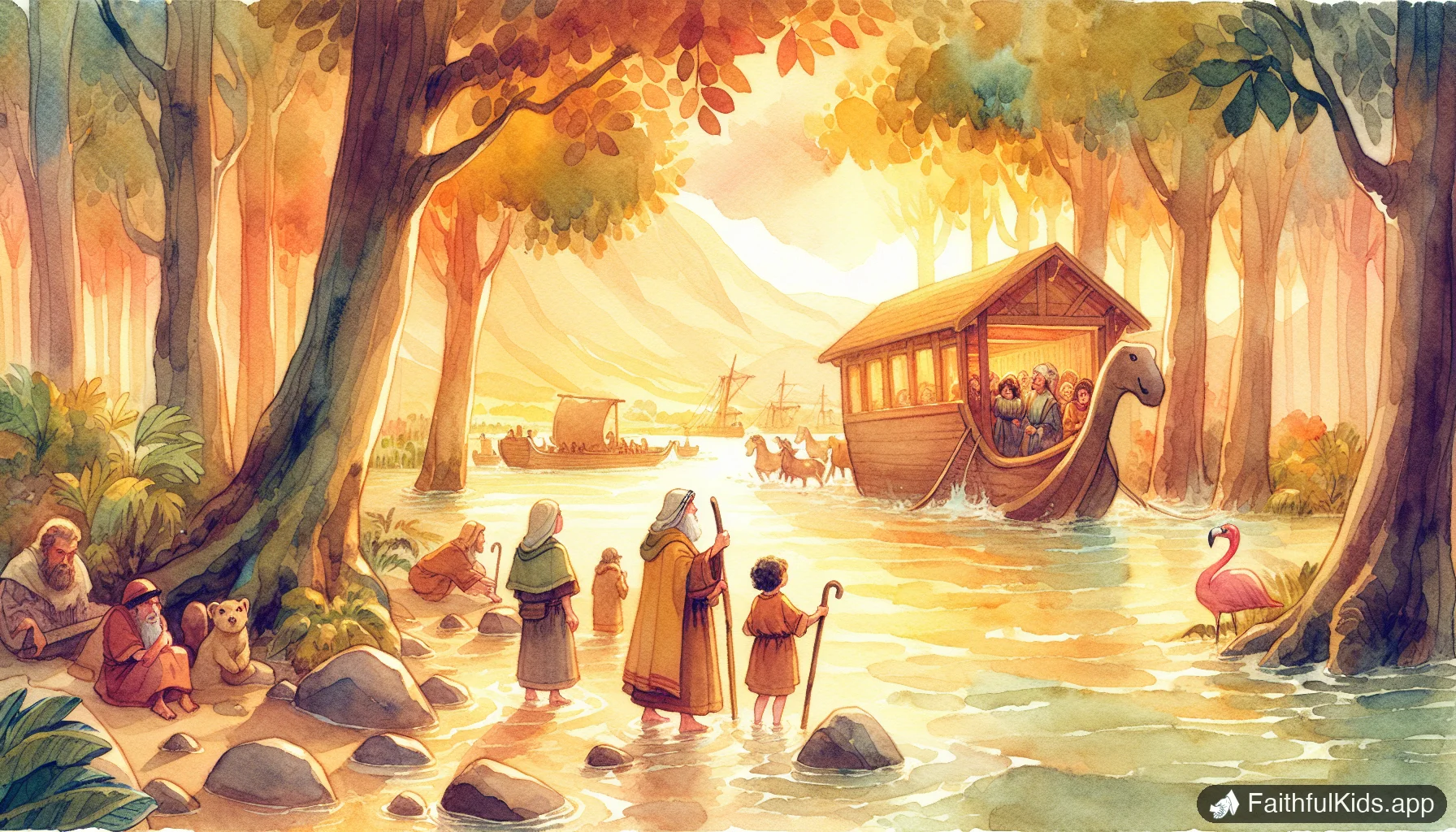
Lesson 2: Noah's Ark (Genesis 6-9)
Big idea: God keeps His promises, even when things look impossible.
Welcome question: "What is the longest you have ever waited for something?"
Story summary: The world had become very wicked. God was grieved, but He found one faithful man: Noah. God told Noah to build an enormous boat, an ark, and to bring two of every animal on board. It had never rained before, so people thought Noah was crazy. But Noah obeyed. The flood came. Everything God said would happen, happened. After the waters receded, God put a rainbow in the sky as a promise: "Never again" (Genesis 9:11).
Discussion questions:
- How do you think Noah felt building a giant boat when it had never rained?
- What does it mean that Noah "walked faithfully with God" (Genesis 6:9)?
- What does the rainbow remind us about God?
Activity: Rainbow promise craft. Give kids a paper with an arch outline. They fill each stripe with a different promise from God (I will be with you, I love you, I will never leave you, etc.).
Memory verse: "I have set my rainbow in the clouds, and it will be the sign of the covenant between me and the earth" (Genesis 9:13).
Lesson 3: Abraham and Isaac (Genesis 22:1-18)
Big idea: God tests our trust, and He always provides.
Welcome question: "Have you ever had to do something really hard that someone you trusted asked you to do?"
Story summary: God told Abraham to take his only son Isaac to a mountain and offer him as a sacrifice. Abraham obeyed, trusting that God had a plan. As he raised the knife, an angel stopped him: "Now I know that you fear God, because you have not withheld from me your son, your only son" (Genesis 22:12). Abraham looked up and saw a ram caught in the bushes. God provided the sacrifice.
Discussion questions:
- How do you think Abraham felt on the walk up the mountain?
- Why do you think God tested Abraham this way?
- Abraham named the place "The Lord Will Provide." When has God provided something you needed?
Activity: Trust walk. Pair kids up. One is blindfolded, the other guides them around the room using only words. Debrief: "How did it feel to trust someone you could not see? That is what Abraham did with God."
Memory verse: "Abraham called that place The Lord Will Provide" (Genesis 22:14).
Lesson 4: David and Goliath (1 Samuel 17)
Big idea: With God on your side, no problem is too big.
Welcome question: "What is the biggest thing you have ever faced that scared you?"
Story summary: Tell the story with drama. Describe Goliath's size (over nine feet tall). Describe the fear of the Israelite army. Then introduce David: a young shepherd boy with no armor, no sword, just a sling and five stones, and total trust in God. "The Lord who rescued me from the paw of the lion and the paw of the bear will rescue me from the hand of this Philistine" (1 Samuel 17:37). One stone. One giant. Down.
Discussion questions:
- Why do you think David was brave when all the soldiers were afraid?
- David remembered how God helped him with the lion and the bear. Can you remember a time God helped you?
- What is your "Goliath" right now, something that feels too big to handle?
Activity: "My Goliath" stones. Give each child a smooth stone and a marker. They write their biggest fear or challenge on the stone. Then they write "God is bigger" on the other side.
Memory verse: "The battle is the Lord's" (1 Samuel 17:47).
Going further: David's life stretches far past the giant, and a class that loves this week usually wants more of him. Our Sunday school lessons on David carry the story through Saul's jealousy, the friendship with Jonathan, the crown, and the psalms he wrote along the way.
Lesson 5: Daniel in the Lions' Den (Daniel 6)
Big idea: Doing the right thing is always worth it, even when it is scary.
Welcome question: "Have you ever gotten in trouble for doing something good?"
Story summary: Daniel was faithful to God. He prayed three times a day, every day. Jealous officials convinced the king to pass a law: anyone who prays to anyone other than the king will be thrown to the lions. Daniel heard about the law and went home and prayed anyway, with his windows open. He was arrested and thrown into the lions' den. The king was devastated. But in the morning, Daniel was alive. "My God sent his angel, and he shut the mouths of the lions" (Daniel 6:22).
Discussion questions:
- Why did Daniel keep praying even though it was against the law?
- Would you have prayed with the windows open or closed? Why?
- What is something right that is hard to do because of what others might think?
Activity: "I will stand for God" pledge cards. Kids write or draw one way they will stand up for their faith this week, even if it is hard.
Memory verse: "My God sent his angel, and he shut the mouths of the lions" (Daniel 6:22).
Lesson 6: Jonah and the Big Fish (Jonah 1-3)
Big idea: You cannot run from God, and His mercy is for everyone.
Welcome question: "Have you ever tried to avoid doing something you were supposed to do?"
Story summary: God told Jonah to go to Nineveh and tell the people to repent. Jonah did not want to because Nineveh was Israel's enemy. So he ran the opposite direction, boarded a ship, and sailed away. God sent a storm. The sailors threw Jonah overboard. A huge fish swallowed Jonah, and he spent three days inside it praying. The fish spit Jonah out, and this time he went to Nineveh. The entire city repented.
Discussion questions:
- Why did Jonah run away from God?
- Can you actually hide from God? Why or why not?
- God showed mercy to Nineveh even though they were enemies. Who is hard for you to be kind to?
Activity: Sequence cards. Give kids 6-8 cards with scenes from Jonah's story. They put them in order and retell the story to a partner.
Memory verse: "From inside the fish Jonah prayed to the Lord his God" (Jonah 2:1).
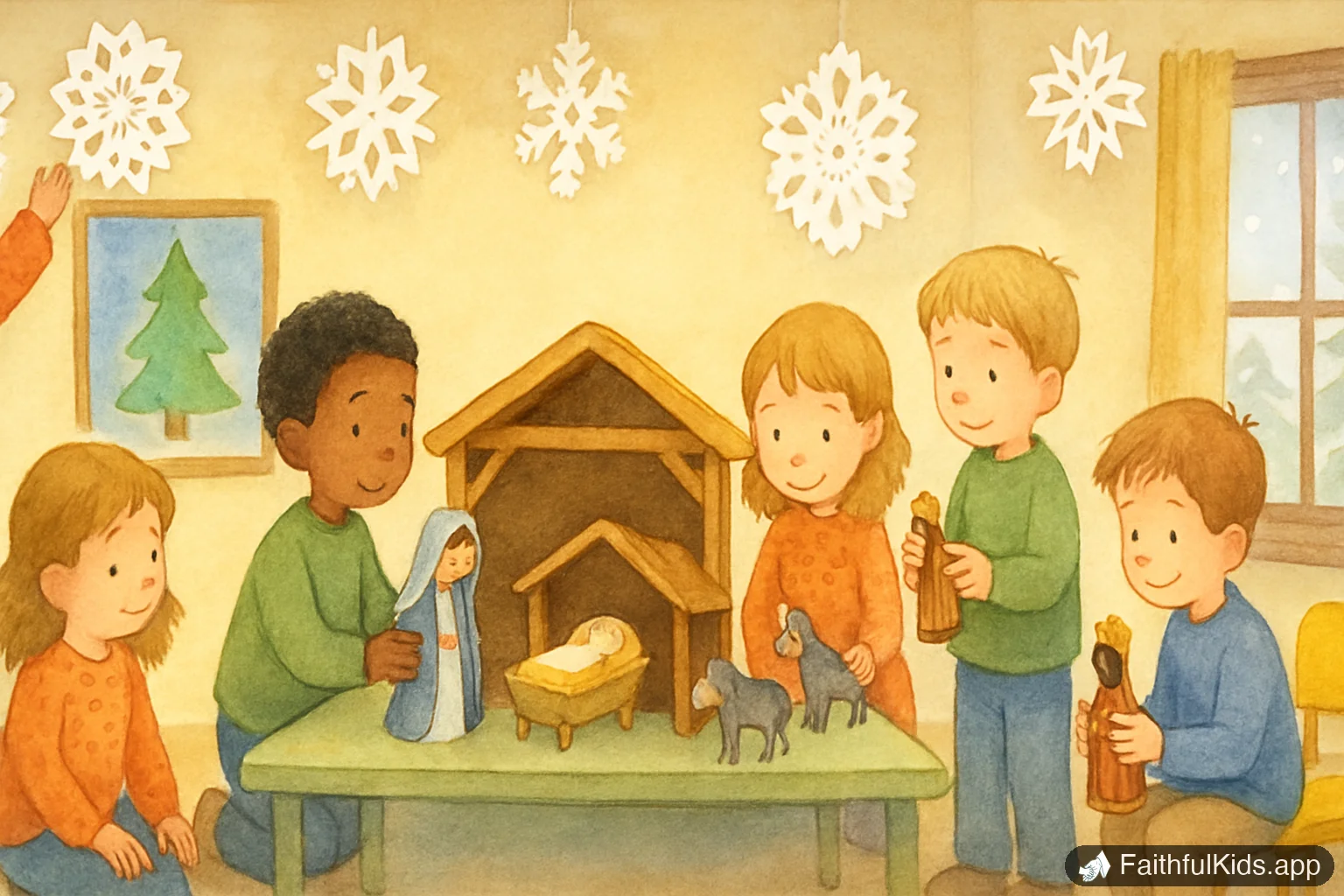
Lesson 7: The Birth of Jesus (Luke 2:1-20)
Big idea: God's biggest gift came in the smallest, most unexpected package.
Welcome question: "What is the best gift you have ever received?"
Story summary: Tell the Christmas story with fresh eyes. A teenage girl and a carpenter traveling to Bethlehem. No room at the inn. A baby born in a place where animals eat. Angels appearing to shepherds in a field at night. The shepherds running to find the baby. The King of Kings, wrapped in cloth strips, lying in a feeding trough.
Discussion questions:
- Why do you think God chose for Jesus to be born in a manger instead of a palace?
- The angels told the shepherds first, not the kings or the priests. Why do you think God chose shepherds?
- What does the birth of Jesus tell us about what God thinks is important?
Activity: "Unexpected gifts" writing prompt. Kids write about a time something good came from an unexpected place or in an unexpected way.
Memory verse: "For unto you is born this day in the city of David a Savior, who is Christ the Lord" (Luke 2:11, ESV).
Lesson 8: Jesus Feeds 5,000 (John 6:1-14)
Big idea: God can do incredible things with whatever you are willing to give.
Welcome question: "What is something small you have that you think is not very important?"
Story summary: A crowd of 5,000 men (plus women and children) had followed Jesus, and there was no food. The disciples wanted to send them away. But a boy had five small loaves of bread and two fish. Andrew brought the boy to Jesus and said, almost apologetically, "But how far will they go among so many?" (John 6:9). Jesus took the lunch, gave thanks, and fed the entire crowd. There were twelve baskets of leftovers.
Discussion questions:
- Why do you think the boy offered his lunch when it seemed so small?
- What did Jesus do before He broke the bread? (He gave thanks.) Why is that important?
- What do you have, even if it seems small, that you could offer to God?
Activity: "Small things, big God" offering bags. Give each child a small paper bag. They write or draw something they can offer God this week: their time, a kind word, sharing something they have. They take the bag home as a reminder.
Memory verse: "Here is a boy with five small barley loaves and two small fish, but how far will they go among so many?" (John 6:9).
Lesson 9: The Good Samaritan (Luke 10:25-37)
Big idea: Your neighbor is anyone who needs your help, even if they are different from you.
Welcome question: "Has a stranger ever helped you? What did they do?"
Story summary: A man was robbed, beaten, and left on the side of the road. A priest saw him and walked by on the other side. A Levite saw him and walked by. But a Samaritan, someone from a group the injured man's people despised, stopped. He bandaged the man's wounds, put him on his donkey, took him to an inn, and paid for his care. Jesus asked, "Which of these three do you think was a neighbor to the man?" The answer was obvious: "The one who had mercy on him." Jesus said, "Go and do likewise" (Luke 10:37).
Discussion questions:
- Why do you think the priest and the Levite walked past?
- What made the Samaritan different from the others?
- Who is someone in your life who might need a "Good Samaritan" right now?
Activity: Role-play scenarios. Give small groups cards with situations: "A new kid is eating lunch alone." "Someone dropped their books." "A kid is being picked on." Groups act out what the priest, the Levite, and the Samaritan would do in each situation.
Memory verse: "Go and do likewise" (Luke 10:37).
Lesson 10: The Prodigal Son (Luke 15:11-32)
Big idea: No matter how far you wander, God is always waiting to welcome you home.
Welcome question: "Have you ever made a really big mistake and been afraid to tell your parents?"
Story summary: A son asked his father for his inheritance early (essentially saying "I wish you were dead"). He left home and spent everything on wild living. When a famine came, he had nothing. He ended up feeding pigs and was so hungry he wanted to eat their food. He decided to go home and beg his father to let him work as a servant. But while he was still far away, his father saw him, ran to him, embraced him, and threw a party. "This son of mine was dead and is alive again; he was lost and is found" (Luke 15:24).
Discussion questions:
- How do you think the son felt when he was feeding the pigs?
- The father ran to meet the son. He did not wait at home or make the son come crawling. What does that tell us about how God feels when we come back to Him?
- Have you ever felt far from God? What brought you back?
Activity: "Welcome home" cards. Kids make a card from God to themselves with the message: "I see you coming. I am running to meet you. Welcome home." They can decorate it and take it home as a reminder of God's unconditional love.
Memory verse: "While he was still a long way off, his father saw him and was filled with compassion for him" (Luke 15:20).
Watch on Faithful Kids
Every one of these 10 stories is available as a short video lesson on Faithful Kids, complete with a comprehension quiz and a guided reflection. If your Sunday School class has screen time, you can use Faithful Kids lessons as your "story" segment and then lead the discussion and activity yourself.
Start Your Free Trial
Want it to run itself? Our interactive Bible quiz handles the questions, the scoring, and the verses.
We have eleven Bible word search puzzles for kids, playable online and free to print.
Before the meeting, skim our youth group games — every entry says what it needs and how long it takes to set up.
If the budget is zero, start with our verified list of free Bible curriculum for kids ministry.
Frequently Asked Questions
How do I handle a wide age range in my Sunday School class?
Use the same story for everyone but adjust the discussion questions. Ask younger kids factual questions ("What happened?") and older kids interpretive questions ("Why did that happen?"). For activities, give younger kids coloring or drawing and older kids writing or discussion prompts. If your youngest table is three and four year olds, swap their portion for one of these Bible object lessons for preschoolers, which teach the same big idea through a single object you can hold up.
What if a child asks a question I cannot answer?
Say, "That is a really thoughtful question. I want to give you a good answer, so let me look into it and I will tell you next week." Then follow through. Kids respect honesty more than bluffing.
How do I keep kids focused during the lesson?
Movement helps. Change activities every 5-7 minutes. Ask questions frequently (not just at the end). Use props and visual aids. And remember: if the entire class is distracted, the problem is probably the lesson, not the kids.
Can I use videos instead of telling the story myself?
Yes, and Faithful Kids' short lessons are ideal for this because they are short enough to maintain attention and focused enough to set up your discussion. Show the video, then lead your own discussion and activity around it.