Ages 5+·10 min read··By Faithful Kids Team·Updated August 16, 2026
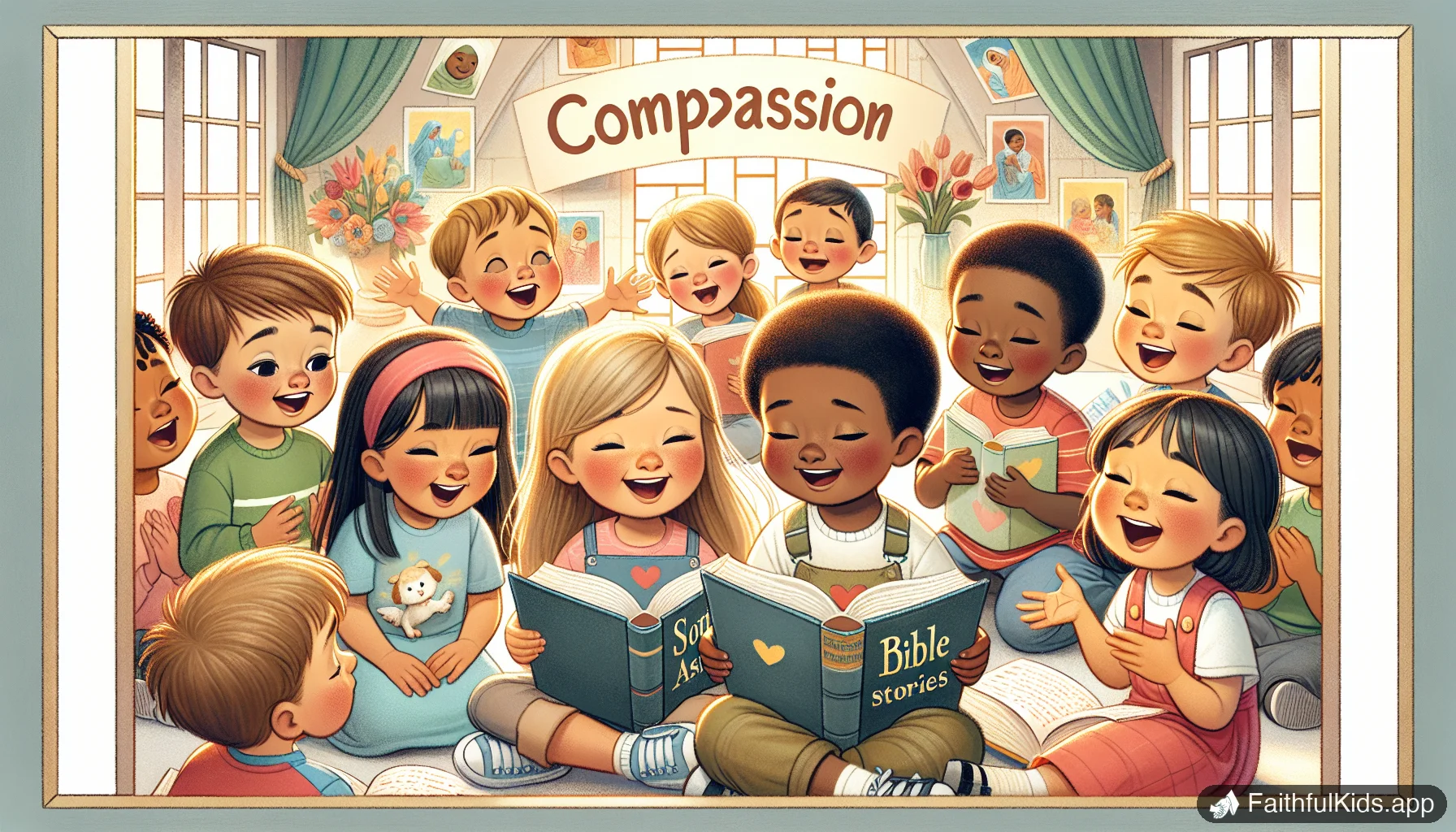
Compassion is one of the most important qualities we can nurture in our children. In a world that often rewards self-focus and competition, the Bible offers a radically different vision — one where we notice people who are hurting, feel something in our hearts, and then do something about it.
The Greek word for compassion used most often in the New Testament is splanchnizomai, which literally means to be "moved in one's gut." It is not a polite nod of sympathy. It is a deep ache that leads to action. And that is exactly the kind of compassion Jesus modeled throughout His ministry.
These eight Bible stories are perfect for teaching kids what compassion looks like in real life. Each one shows a different dimension of caring for others — from strangers to friends, from physical needs to emotional pain. Read them together, talk about them, and watch your kids begin to see the world through more compassionate eyes.
1. The Good Samaritan (Luke 10:25-37)
A man is beaten and left on the road. A priest walks by. A Levite walks by. But a Samaritan — someone from a group that was despised by the Jewish community — stops, bandages the man's wounds, carries him to an inn, and pays for his care.
Jesus told this story to answer one simple question: "Who is my neighbor?" The answer shook everyone listening. Your neighbor is not just the person who looks like you or lives next to you. Your neighbor is anyone who needs help.
Talk about it: Ask your child, "Have you ever seen someone who needed help but nobody was helping? What did you do? What could you do next time?"
2. Jesus Weeps for His Friend (John 11:1-44)
When Jesus arrived in Bethany and learned that His friend Lazarus had died, He did something that surprises many kids when they hear it for the first time: He cried. John 11:35 is the shortest verse in the Bible — "Jesus wept" — but it carries enormous weight.
Jesus knew He was about to raise Lazarus from the dead. He had the power to fix the situation. And yet He still wept. Why? Because He saw Mary and Martha grieving, and their pain moved Him. Compassion does not skip over grief just because a solution is coming. Sometimes the most compassionate thing we can do is simply cry with someone.
Talk about it: "When your friend is sad, do you have to fix the problem? Or is it okay to just be sad with them?" Help your child understand that presence is a powerful form of compassion.
3. Ruth and Naomi (Ruth 1:1-18)
Naomi lost her husband and both of her sons. She was heartbroken and told her daughters-in-law to go back to their own families. Orpah left. But Ruth refused. Her words are among the most beautiful in all of Scripture: "Where you go I will go, and where you stay I will stay. Your people will be my people and your God my God" (Ruth 1:16).
Ruth gave up her homeland, her comfort, and her future plans to stay with a grieving mother-in-law. Her story of loyalty is compassion that costs something. And God honored it beyond anything Ruth could have imagined — she became the great-grandmother of King David and an ancestor of Jesus Himself.
Talk about it: "Ruth could have gone home where life was easier. Why do you think she stayed?" This is a wonderful opportunity to talk about loyalty and sacrificial love.
A related freebie: our lost sheep coloring page, drawn as clean line art for crayons and markers.
4. David and Mephibosheth (2 Samuel 9:1-13)
After King Saul died, David could have ignored or even harmed Saul's remaining family. Instead, he asked, "Is there anyone still left of the house of Saul to whom I can show kindness for Jonathan's sake?" (2 Samuel 9:1).
He found Mephibosheth, Jonathan's son, who was disabled and living in hiding. David invited him to eat at the king's table for the rest of his life and restored all of Saul's land to him. Mephibosheth expected to be rejected or punished. Instead, he received dignity and belonging.
Talk about it: "David showed kindness to someone who expected nothing. Is there someone at school or in your neighborhood who might feel left out? How could you include them?"
5. Feeding the 5,000 (Matthew 14:13-21)
Jesus had just learned that John the Baptist had been killed. He tried to withdraw to a quiet place, but a huge crowd followed Him. Matthew 14:14 says, "When Jesus landed and saw a large crowd, he had compassion on them and healed their sick."
Even in His own grief, Jesus saw the needs of others. And when the disciples wanted to send the hungry crowd away, Jesus said, "They do not need to go away. You give them something to eat" (Matthew 14:16). With five loaves of bread and two fish from a boy's lunch, Jesus fed over 5,000 people.
Talk about it: "The boy gave his small lunch to Jesus, and Jesus turned it into something huge. What small thing could you share that might help someone a lot?"
6. Boaz Shows Kindness to Ruth (Ruth 2:1-16)
When Ruth went to gather leftover grain in the fields — backbreaking work reserved for the poorest people — she happened to end up in the field of Boaz. Boaz noticed her, learned her story, and went far beyond what the law required. He told his workers to leave extra grain for her on purpose (Ruth 2:15-16), invited her to eat with his workers, and made sure no one bothered her.
Boaz did not just follow the minimum requirement of the law. He was generous and protective. His compassion was practical, quiet, and deeply respectful.
Talk about it: "Boaz did not make a big announcement about helping Ruth. He just quietly made sure she was taken care of. Can you think of a way to help someone without making a big deal about it?"
See what they get
Watch The Good Samaritan Come Alive
The Good Samaritan is one of 300+ short narrated video lessons your child will love. Watch the whole episode right here — in the app, every lesson ends with a fun quiz to check what they learned.
A real lesson from the app — watch the whole thing free.
7. The Woman Anoints Jesus (Luke 7:36-50)
A woman known in the town as "a sinner" entered the home of a Pharisee where Jesus was eating. She knelt at His feet, weeping, and poured expensive perfume on them. She wiped His feet with her hair. The Pharisee was disgusted.
But Jesus saw what the Pharisee missed. He saw a woman pouring out gratitude and love because she had been forgiven. Jesus said, "Her many sins have been forgiven — as her great love has shown" (Luke 7:47). While others judged her, Jesus received her compassion with grace.
This story teaches kids that compassion can flow in unexpected directions. The woman showed compassion to Jesus. And Jesus showed compassion to the woman by defending her when everyone else wanted to push her away.
Talk about it: "Have you ever seen someone being judged or talked about unfairly? What would Jesus want you to do in that moment?"
8. Peter Heals the Lame Man (Acts 3:1-10)
Peter and John were walking into the temple when a man who had been unable to walk since birth asked them for money. Peter said something remarkable: "Silver or gold I do not have, but what I do have I give you. In the name of Jesus Christ of Nazareth, walk" (Acts 3:6).
The man jumped up, walked, and leaped with joy. Peter did not give what was expected. He gave something far greater. And he stopped. That is the first step of compassion — noticing someone and stopping instead of walking past.
Talk about it: "Peter stopped when he could have kept walking. Who do you walk past every day that you could stop and talk to?" This is a great conversation about seeing the people around us.
Why Compassion Matters for Kids
Research from developmental psychology confirms what Scripture has taught for thousands of years: children who learn compassion early develop stronger relationships, better emotional regulation, and greater resilience. A 2019 study published in Developmental Psychology found that children who regularly practiced perspective-taking — imagining what another person feels — showed measurably higher empathy and prosocial behavior.
Bible stories are uniquely powerful tools for building compassion because they do not just tell kids to "be nice." They show real people in real situations making real choices. Kids see the cost of compassion (Ruth leaving her homeland), the surprise of compassion (David inviting Mephibosheth to his table), and the joy of compassion (the lame man leaping in the temple).
Practical Ways to Reinforce Compassion at Home
Name it when you see it. When your child shares, helps, or comforts someone, say, "That was compassion. You noticed someone needed help, and you did something."
Read these stories regularly. Repetition matters. Kids internalize values through stories they hear again and again. Rotate in these Bible stories about kindness for variety on the same theme.
Practice perspective-taking. At dinner, ask, "What do you think that person was feeling?" Help your child build the mental muscle of imagining others' experiences.
Serve together. Compassion grows through action. Volunteer as a family, write cards for people who are sick, or bake cookies for a neighbor.
Watch these stories come alive. Short, engaging video retellings help kids absorb these lessons in a format they love.
Watch on Faithful Kids
Want your kids to experience these compassion stories through beautifully animated, age-appropriate videos? Start your free trial on Faithful Kids and watch stories like the Good Samaritan, Ruth and Naomi, and the feeding of the 5,000 come alive in short episodes your kids will want to watch again and again.
Browse the full shelf at 200 Bible stories for kids -- every retelling is free and runs from Genesis to Revelation in order.
Frequently Asked Questions
At what age can kids understand compassion?
Children begin to show early signs of empathy as toddlers — offering a toy to a crying friend, for example. By ages 4-5, they can start to understand that other people have different feelings than their own. Bible stories about compassion are effective for kids as young as 3 when told simply, and they deepen in meaning as kids grow through elementary and middle school years.
How is compassion different from empathy?
Empathy is feeling what another person feels — sensing their sadness or joy. Compassion takes it a step further: it is empathy plus action. When we teach kids compassion through Bible stories, we are teaching them not just to feel for others but to do something about it. The Good Samaritan did not just feel sorry for the beaten man. He bandaged his wounds and paid for his care.
How do I teach compassion to a child who seems uninterested in others' feelings?
Some children are naturally more inwardly focused, and that is okay. Start with stories rather than lectures. Stories create emotional engagement without pressure. Ask open-ended questions like "How do you think that person felt?" rather than "You should be nicer." Compassion is a skill that develops over time with practice and modeling. When your child sees you showing compassion, they absorb more than any lesson could teach.
Can watching Bible story videos really help build compassion in kids?
Yes. Research on narrative transportation — the experience of being "absorbed" in a story — shows that both reading and watching stories can increase empathy and prosocial behavior in children. Video is especially effective for kids who are visual learners or who struggle with reading. The key is pairing the story with conversation: watch together, then talk about what happened and why it matters.
🌙 Free: The Bedtime Bible Kit
Seven nights of five-minute stories — a story, a prayer, and one question to whisper about.
Free printable + a few helpful emails. Unsubscribe anytime.