Ages 5+·11 min read··By Faithful Kids Team·Updated August 16, 2026
Kids face moments that require real courage: the first day at a new school, standing up to a bully, performing on stage, dealing with a parent's illness, or simply getting through a hard day. They need to know that strength doesn't mean never being afraid — it means trusting God even when you are.
The Bible is full of stories of ordinary people who did extraordinary things because God was their strength. David faced a giant. Esther spoke to a king. Daniel survived a lions' den. None of them were strong on their own — they were strong because God was with them.
Here are 12 Bible verses about strength that your child can hold onto when life gets tough. They pair naturally with these Bible verses about courage for kids.
1. Philippians 4:13
"I can do all this through him who gives me strength."
What it means for kids: This is one of the most popular verses in the Bible, and kids love it because it's short, powerful, and personal. It doesn't say "I can do all this by myself." It says through HIM — through God. When you feel like you can't do something, remember that God is adding His strength to yours. You're not alone in your struggle.
When to remember it: Before a big test, a sports tryout, a recital, or any moment when your child thinks "I can't do this."
2. Isaiah 40:31
"But those who hope in the Lord will renew their strength. They will soar on wings like eagles; they will run and not grow weary, they will walk and not be faint."
What it means for kids: Eagles are some of the strongest birds in the sky. They can fly for hours without getting tired because they ride on the wind currents instead of flapping constantly. This verse says that when you put your hope in God, He becomes your wind. He lifts you up when you're exhausted and carries you forward when you feel like giving up.
When to remember it: When your child is tired, discouraged, or feels like quitting something hard.
3. Joshua 1:9
"Have I not commanded you? Be strong and courageous. Do not be afraid; do not be discouraged, for the Lord your God will be with you wherever you go."
What it means for kids: God said this to Joshua right after Moses died. Joshua had to lead the entire nation of Israel into a new land full of enemies — and he was scared. God didn't say "Don't worry, nothing bad will happen." He said "Be strong and courageous BECAUSE I will be with you." The courage doesn't come from the situation being easy. It comes from God being present.
When to remember it: When your child faces something new or scary — a move, a new school, meeting new people, or any situation where they feel alone. For school nerves specifically, try these Bible verses for the first day of school.
There is a free the cross coloring page on our site too, printable on one sheet with no sign-up.
4. Psalm 46:1
"God is our refuge and strength, an ever-present help in trouble."
What it means for kids: A refuge is a safe place — like a shelter in a storm. This verse says God is that shelter. And He's not just there sometimes — He's "ever-present," which means always there. When trouble comes (and it will), God is already right there, ready to help. You don't have to go find Him. He's never left.
When to remember it: When your child is going through a difficult time — family problems, friendship conflicts, illness, or grief.
5. 2 Timothy 1:7
"For the Spirit God gave us does not make us timid, but gives us power, love and self-discipline."
What it means for kids: "Timid" means fearful and shy. God doesn't give His children a spirit of fear — He gives them power, love, and self-discipline. Power to face hard things. Love to care about others even when it's risky. Self-discipline to make good choices even when it's hard. Fear is real, but it doesn't come from God. What comes from God is strength.
When to remember it: When fear is holding your child back from doing something they know is right.
6. Ephesians 6:10
"Finally, be strong in the Lord and in his mighty power."
What it means for kids: Paul wrote this at the beginning of his famous passage about the "armor of God." He's saying: before you put on any armor, before you prepare for any battle, remember where your strength comes from. Not from muscles, not from being the biggest or toughest — from the Lord and His power. His power is mighty, and He shares it with you.
When to remember it: When your child feels small, weak, or outmatched by a challenge.
7. Psalm 18:32
"It is God who arms me with strength and keeps my way secure."
What it means for kids: David wrote this psalm after God rescued him from King Saul, who had been trying to kill him for years. David had been on the run, hiding in caves, and sleeping in the wilderness. But through all of it, God gave him strength and kept him safe. "Arms me with strength" is like God strapping armor on you — He's the one who makes you strong for the battle.
When to remember it: When your child is going through a long, drawn-out difficulty (not just a bad day, but a hard season).
See what they get
Watch The Walls of Jericho Come Alive
The Walls of Jericho is one of 300+ short narrated video lessons your child will love. Watch the whole episode right here — in the app, every lesson ends with a fun quiz to check what they learned.
A real lesson from the app — watch the whole thing free.
8. Deuteronomy 31:6
"Be strong and courageous. Do not be afraid or terrified because of them, for the Lord your God goes with you; he will never leave you nor forsake you."
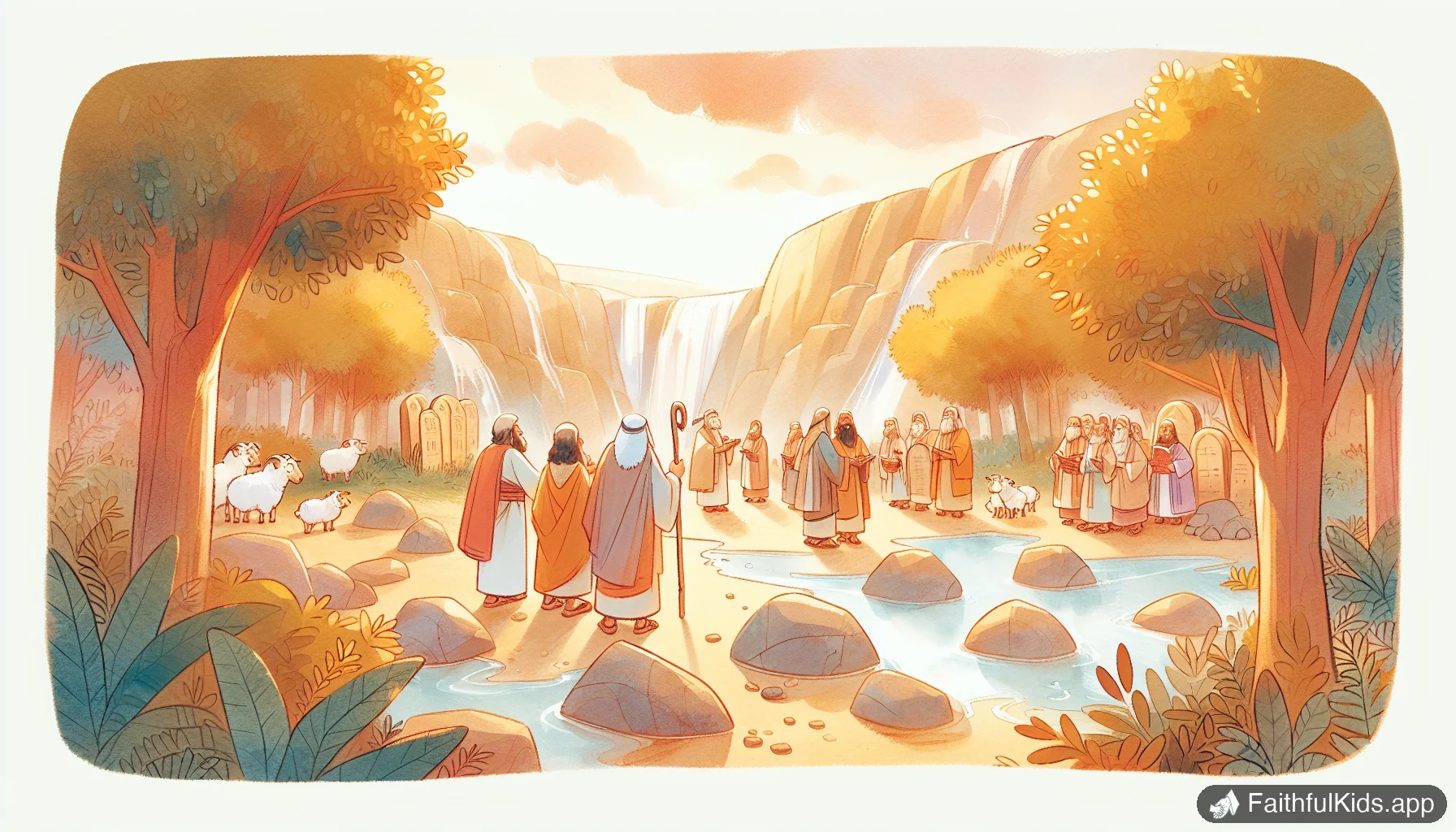
What it means for kids: Moses said this to all of Israel right before he died. They were about to enter a land full of powerful nations, and they were terrified. Moses' message was simple: God goes WITH you. He doesn't send you ahead and catch up later. He doesn't stay behind while you go alone. He walks beside you into every scary situation. And He will never — ever — leave.
When to remember it: When your child feels abandoned or alone, or when they're facing a group of people who intimidate them.
9. Psalm 28:7
"The Lord is my strength and my shield; my heart trusts in him, and he helps me. My heart leaps for joy, and with my song I praise him."
What it means for kids: Notice the progression: God is my strength (He makes me strong), God is my shield (He protects me), my heart trusts Him (I believe He'll come through), He helps me (and He does!), and then my heart leaps for joy (I'm so happy I want to sing!). Trust leads to help, and help leads to joy. When you trust God with your struggles, you end up celebrating.
When to remember it: When your child needs a reminder that trusting God leads to real, tangible joy.
10. Nehemiah 8:10
"Do not grieve, for the joy of the Lord is your strength."
What it means for kids: This might sound backwards — joy is strength? But think about it: when you're joyful, you have energy. When you're joyful, problems seem smaller. When you're joyful, you can keep going. The joy that comes from knowing God loves you and is in control — that joy gives you real strength that sadness and worry can't take away.
When to remember it: When your child is sad or discouraged and needs a reason to hope.
11. Isaiah 41:10
"So do not fear, for I am with you; do not be dismayed, for I am your God. I will strengthen you and help you; I will uphold you with my righteous right hand."
What it means for kids: God makes four promises in this verse: I am with you, I am your God, I will strengthen you, I will uphold you. "Uphold" means to hold you up — like when you're learning to ride a bike and someone holds the back of the seat so you don't fall. God's hand is always on the back of your seat, keeping you steady.
When to remember it: When your child is afraid and needs concrete reassurance that God is actively involved in their life. We cover this theme in depth in our list of Bible verses about fear for kids.
12. Psalm 73:26
"My flesh and my heart may fail, but God is the strength of my heart and my portion forever."
What it means for kids: This verse is honest about something important: our bodies get tired, our hearts get discouraged, and sometimes we fail. That's real. But even when everything in us is running on empty, God is still full of strength — and He shares that strength with us. "My portion" means "what I receive" — God is what you receive, forever. He is the gift that never runs out.
When to remember it: When your child has genuinely failed at something and needs to know that failure isn't the end of the story.
Teaching Strength Through Scripture
Connect verses to Bible heroes. When you read Philippians 4:13, tell the story of Paul writing it from prison — he was literally in chains, yet he felt strong. When you read Joshua 1:9, tell the story of Joshua leading Israel across the Jordan. Verses stick better when they come with stories.
Practice before the moment arrives. Don't wait until your child is in crisis to introduce these verses. Memorize them during calm times so they're ready when hard times come. These memory verse strategies for kids make that practice easier. As Psalm 119:11 says, "I have hidden your word in my heart that I might not sin against you."
Model it yourself. When you face something hard, tell your child: "I'm nervous about this, but I'm remembering Philippians 4:13 — I can do this through God's strength." Seeing you lean on Scripture normalizes it for them.
Acknowledge that fear is real. These verses don't say "never be afraid." Joshua 1:9 literally says "do not be afraid" — which implies that fear is the natural response. God isn't telling us fear is bad. He's telling us what to do with it: give it to Him.
Watch on Faithful Kids
Faithful Kids brings the stories of David, Joshua, Daniel, Esther, and Paul to life through interactive video lessons. Your child won't just hear about courage — they'll see it in action and reflect on how to live it. Start your free trial today.
What is the most popular Bible verse about strength for kids?
Philippians 4:13 ("I can do all this through him who gives me strength") is by far the most quoted and memorized verse about strength among children. Its simplicity and personal nature make it easy for kids of all ages to understand and apply. Joshua 1:9 ("Be strong and courageous") is a close second.
How can I help my child feel strong when they're being bullied?
Start with 2 Timothy 1:7 — God gives power, not fear. Help your child understand that true strength isn't about fighting back but about knowing their worth comes from God. Psalm 46:1 reminds them that God is their refuge. Pair Scripture with practical action: talk to teachers, practice responses, and reassure your child that seeking help is a sign of strength, not weakness.
Are there Bible stories that teach kids about strength?
Many. David and Goliath (1 Samuel 17) shows courage against impossible odds. Daniel in the lions' den (Daniel 6) shows faith under threat. Esther approaching the king (Esther 4-5) shows bravery in the face of death. Shadrach, Meshach, and Abednego in the fiery furnace (Daniel 3) shows standing firm when everyone else bows down. Each story puts a face and a narrative to the verses in this article.
How young can kids start memorizing Bible verses about strength?
Children as young as 4-5 can memorize short verses like Philippians 4:13 or Psalm 46:1 with repetition and visual aids. By age 7-8, most children can memorize longer passages like Joshua 1:9 or Isaiah 40:31. The key is making it fun — use songs, hand motions, or a verse-of-the-week challenge with a small reward for memorization.
🌙 Free: The Bedtime Bible Kit
Seven nights of five-minute stories — a story, a prayer, and one question to whisper about.
Free printable + a few helpful emails. Unsubscribe anytime.