The Fruit of the Spirit for Kids: Bible Stories for Each One
Ages 5+·13 min read··By Faithful Kids Team·Updated August 16, 2026
"But the fruit of the Spirit is love, joy, peace, patience, kindness, goodness, faithfulness, gentleness and self-control. Against such things there is no law." — Galatians 5:22-23
This is one of the most important passages in the entire New Testament for practical, daily Christian living. And it is perfect for kids because it gives them a concrete checklist: nine character qualities that the Holy Spirit grows in us when we follow Jesus.
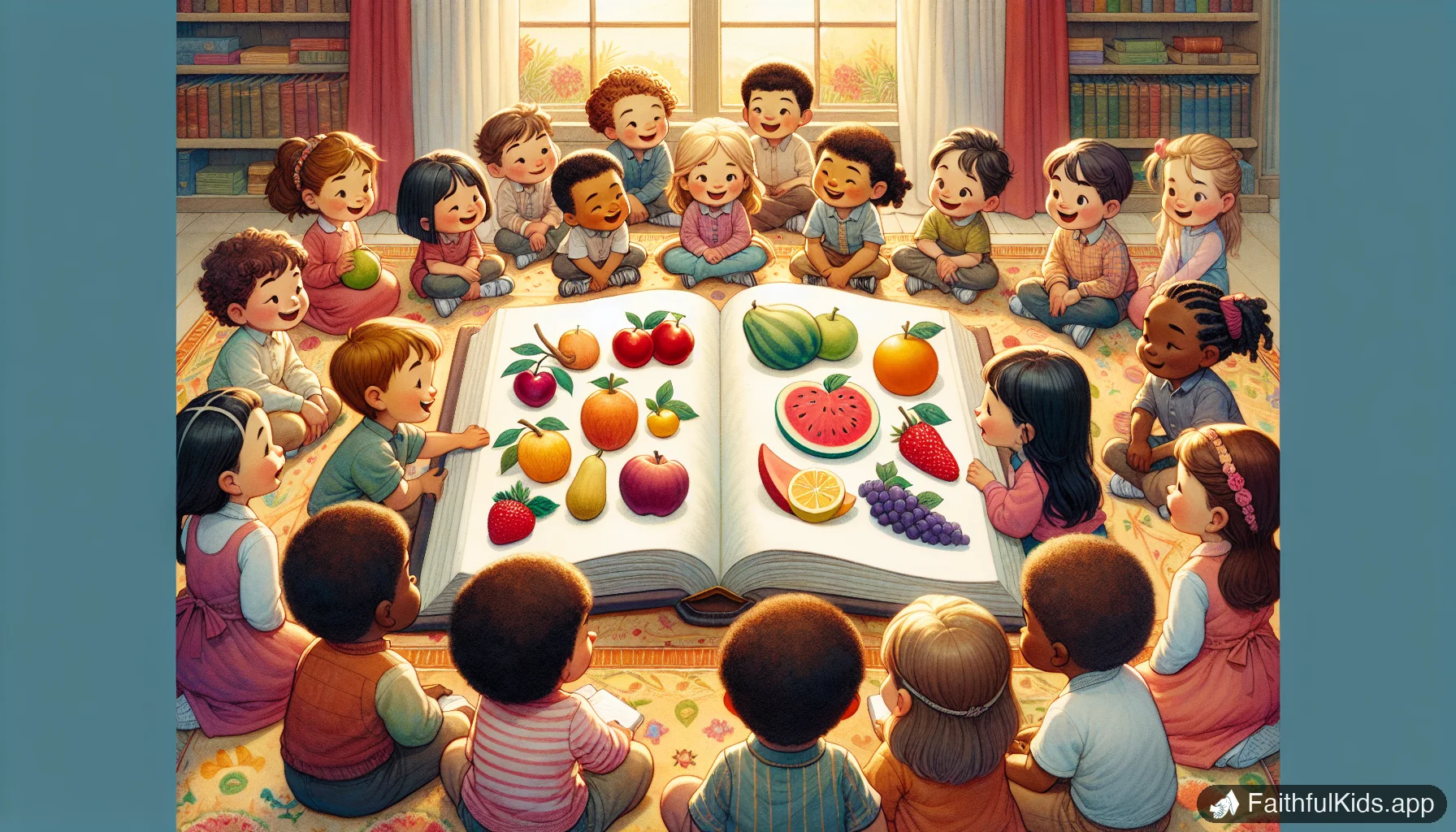
But here is the thing about fruit. You do not produce it by trying harder. You produce it by staying connected to the vine (John 15:5). The fruit of the Spirit is not a to-do list. It is the natural result of walking with God.
The best way to teach these qualities to children is not through definitions. It is through stories. Each of the nine fruits has at least one Bible story that brings it to life. Here they are.
1. Love — The Good Samaritan (Luke 10:25-37)
Kid-friendly definition: Love means caring about someone and showing it through what you do, even when it is hard or when they are different from you.
The story: A man was robbed, beaten, and left on the side of the road. A priest walked by and did nothing. A Levite walked by and did nothing. But a Samaritan, a person from a group that the injured man's people hated, stopped. He bandaged the man's wounds, put him on his own donkey, took him to an inn, and paid for his care.
Why this shows love: The Samaritan had every reason to keep walking. The injured man's people despised Samaritans. But love does not ask "Does this person deserve my help?" Love asks "Does this person need my help?" Jesus said the greatest commandment is to "love your neighbor as yourself" (Mark 12:31), and then told this story to answer the question "Who is my neighbor?" Everyone is.
Application for kids: "Is there someone at school or in your neighborhood who is different from you, maybe someone other kids ignore? What would it look like to be a Good Samaritan to them this week?" (Read the full retelling in the Good Samaritan for kids.)
2. Joy — Paul and Silas Singing in Prison (Acts 16:22-34)
Kid-friendly definition: Joy is a deep happiness that comes from knowing God is with you, even when things are not going well. Joy is different from regular happiness because it does not depend on your circumstances.
The story: Paul and Silas were arrested for preaching about Jesus. They were beaten and thrown into the innermost cell of the prison with their feet locked in stocks. At midnight, instead of complaining or crying, they started praying and singing hymns to God. The other prisoners were listening. Suddenly, an earthquake shook the prison, the doors flew open, and the chains fell off every prisoner.
Why this shows joy: Paul and Silas had every reason to despair. They were innocent, beaten, and locked in a dungeon. But their joy was not based on their circumstances. It was based on their relationship with God. They could sing because they knew God was with them regardless of where they were.
Application for kids: "Paul and Silas sang even in a really bad situation. When you are having a terrible day, what could you do to remember that God is still with you? Could you sing, pray, or think about something good God has done?" (There is a kid-friendly version of this story in Paul and Silas in prison.)
3. Peace — Jesus Calms the Storm (Mark 4:35-41)
Kid-friendly definition: Peace is feeling calm and safe because you know God is in control, even when scary things are happening around you.
The story: Jesus and His disciples were on a boat when a violent storm hit. Waves were crashing over the sides. The boat was filling with water. The disciples panicked. Meanwhile, Jesus was asleep on a cushion. They woke Him up: "Do you not care if we drown?" Jesus stood up, said "Quiet! Be still!" to the storm, and everything went calm.
Why this shows peace: Jesus was at peace in the middle of a storm because He knew who was in charge: His Father. The disciples had the same Jesus in their boat, but they forgot to trust Him. Peace comes not from the absence of storms, but from the presence of God in the storm.
Application for kids: "When things feel stormy in your life, scary or chaotic or out of control, Jesus is in the boat with you. What would it look like to trust Him instead of panicking? What helps you feel God's peace?" (See calming the storm for kids for the full story.)
We drew a printable nativity coloring page to go with this story — free, and the printed sheet includes the answer to where it came from.
4. Patience — Abraham Waits for Isaac (Genesis 15-21)
Kid-friendly definition: Patience is waiting without complaining, trusting that God's timing is better than yours even when the wait feels really long.
The story: God promised Abraham that he would have a son and that his descendants would be as numerous as the stars. Abraham was 75 years old when God made the promise. He waited. And waited. And waited. Twenty-five years later, when Abraham was 100 years old and his wife Sarah was 90, Isaac was born. God kept His promise, but it took a quarter of a century.
Why this shows patience: Twenty-five years is a long time to wait for a promise. Abraham was not perfectly patient, he made mistakes along the way, but he kept trusting God through decades of waiting. The Bible calls Abraham a man of faith specifically because he trusted God's timing even when it seemed impossible.
Application for kids: "Abraham waited 25 years for God's promise. What are you waiting for right now? A prayer to be answered? Something to get better? What does Abraham's story tell you about waiting?"
5. Kindness — Ruth and Naomi (Ruth 1-4)
Kid-friendly definition: Kindness means treating people with warmth and generosity, especially when they are hurting or when you do not have to.
The story: Naomi lost her husband and both of her sons. She was heartbroken and decided to return to her homeland. She told her daughters-in-law to go back to their own families. One did. But Ruth refused to leave. "Where you go I will go, and where you stay I will stay. Your people will be my people and your God my God" (Ruth 1:16). Ruth left everything familiar to take care of her grieving mother-in-law.
Why this shows kindness: Ruth had no obligation to stay with Naomi. She could have gone home to her own family and started over. But she chose kindness over convenience. She worked in the fields to provide food. She stayed loyal through hardship. And God honored her kindness: Ruth became the great-grandmother of King David and an ancestor of Jesus Himself.
Application for kids: "Ruth gave up what was easy to do what was kind. Is there someone in your life who is sad or lonely right now? What is one kind thing you could do for them this week, even if it is not easy?"
6. Goodness — The Boy Who Shared His Lunch (John 6:1-14)
Kid-friendly definition: Goodness is doing the right thing and being generous with what you have, even when no one is watching or asking you to.
The story: A crowd of 5,000 people had followed Jesus, and there was no food. The disciples were ready to send everyone away hungry. But a young boy offered his lunch: five small loaves of bread and two fish. It was barely enough for one person. Jesus took the boy's lunch, blessed it, and fed the entire crowd with leftovers to spare.
Why this shows goodness: The boy did not have much. He could have kept his lunch to himself, and no one would have blamed him. But goodness prompted him to offer what he had, however small, and God multiplied it beyond anything the boy could have imagined. Goodness is not about having a lot. It is about giving what you have.
Application for kids: "The boy's lunch was tiny, but he offered it anyway. What do you have that you could share? Your time? A kind word? A toy? God can take small acts of goodness and make them bigger than you expect." (The whole miracle is retold in feeding the five thousand for kids.)
See what they get
Watch The Fruit of the Spirit Come Alive
The Fruit of the Spirit is one of 300+ short narrated video lessons your child will love. Watch the whole episode right here — in the app, every lesson ends with a fun quiz to check what they learned.
Kid-friendly definition: Faithfulness means keeping your promises and staying loyal to God and to the people you love, day after day, even when it is hard.
The story: Daniel prayed to God three times every day. When a law was passed making prayer to anyone other than the king illegal, Daniel did not stop. He went to his room, opened his window toward Jerusalem, and prayed just as he had always done. He was faithful to God even when faithfulness meant being thrown to the lions.
Why this shows faithfulness: Faithfulness is not dramatic. It is daily. Daniel did not start praying because of the crisis. He had been praying three times a day for years, probably decades. When the test came, faithfulness was already his habit. That is what made him strong enough to face the lions' den.
Application for kids: "Daniel prayed every single day, not just when he needed something. What is one thing you could do every day to be faithful to God? Reading the Bible? Praying before bed? Being kind at school?"
8. Gentleness — Jesus and the Children (Mark 10:13-16)
Kid-friendly definition: Gentleness means being soft and careful with people, especially people who are smaller, younger, or weaker than you.
The story: People were bringing their children to Jesus so He could bless them. The disciples told them to go away, probably thinking Jesus was too busy and too important for kids. Jesus was angry at the disciples. "Let the little children come to me, and do not hinder them, for the kingdom of God belongs to such as these" (Mark 10:14). He took the children in His arms, placed His hands on them, and blessed them.
Why this shows gentleness: Jesus was the most powerful person who ever lived. He could calm storms and raise the dead. But with children, He was gentle. He held them. He blessed them. He defended them against adults who thought they were not important enough. True strength shows itself through gentleness, not force.
Application for kids: "Jesus was the strongest person ever, but He was so gentle with kids. How can you be gentle with someone smaller or younger than you? With a sibling? A pet? A new kid at school who is nervous?"
9. Self-Control — Jesus Tempted in the Desert (Matthew 4:1-11)
Kid-friendly definition: Self-control means choosing to do what is right even when you really want to do something wrong. It is being the boss of your own actions.
The story: After fasting for 40 days in the desert, Jesus was hungry and weak. The devil came and tempted Him three times: turn stones to bread (satisfy hunger), jump from the temple (test God), worship the devil (gain power). Each time, Jesus responded with Scripture. "It is written: 'Man shall not live on bread alone'" (Matthew 4:4). "It is also written: 'Do not put the Lord your God to the test'" (Matthew 4:7). "Away from me, Satan! For it is written: 'Worship the Lord your God, and serve him only'" (Matthew 4:10).
Why this shows self-control: Jesus was at His weakest physical point, 40 days without food, and faced the strongest possible temptation. But He did not give in. He used Scripture as His weapon and chose obedience over comfort, trust over testing, and worship over power. Self-control is not about being strong. It is about knowing what is right and choosing it.
Application for kids: "Jesus was tempted when He was really hungry and tired. When are you most tempted to make bad choices? When you are tired? Hungry? Bored? What could help you choose the right thing in those moments?"
Growing the Fruit Together
The fruit of the Spirit is not about perfection. It is about growth. If one fruit needs extra attention in your home, we have story collections like Bible stories about patience and Bible stories about self-control to go deeper. Here is a simple family activity: pick one fruit per week. Read the Bible story together. Talk about what it means. Look for opportunities to practice it during the week. By the end of nine weeks, your family will have explored every fruit, and you will have a shared vocabulary for talking about character that is rooted in Scripture.
Watch on Faithful Kids
Every one of these Bible stories is available as a short video lesson on Faithful Kids, complete with a comprehension quiz and a guided reflection. Your child can work through the entire Fruit of the Spirit one story at a time.
What age should I start teaching the Fruit of the Spirit?
Children as young as 4-5 can understand the basic concepts (love means being kind, patience means waiting nicely). By ages 7-8, they can engage with the full list and the Bible stories. The Galatians passage itself is appropriate for any age when explained with kid-friendly definitions.
How is the Fruit of the Spirit different from just being a good person?
The fruit of the Spirit is produced by the Holy Spirit in someone who follows Jesus. It is not self-improvement through willpower. It is transformation through relationship with God. A non-believer can be kind, but the kindness described in Galatians 5 flows from a life connected to Christ (John 15:5).
My child struggles with one specific fruit (like patience or self-control). What should I do?
Focus on that fruit for an extended period. Read the Bible story multiple times. Pray about it together specifically. Create practical exercises: for patience, practice waiting for something without complaining. For self-control, role-play tempting situations and practice saying no. Growth takes time, and struggling with a fruit does not mean your child is failing.
Are there other Bible stories for each fruit beyond the ones listed here?
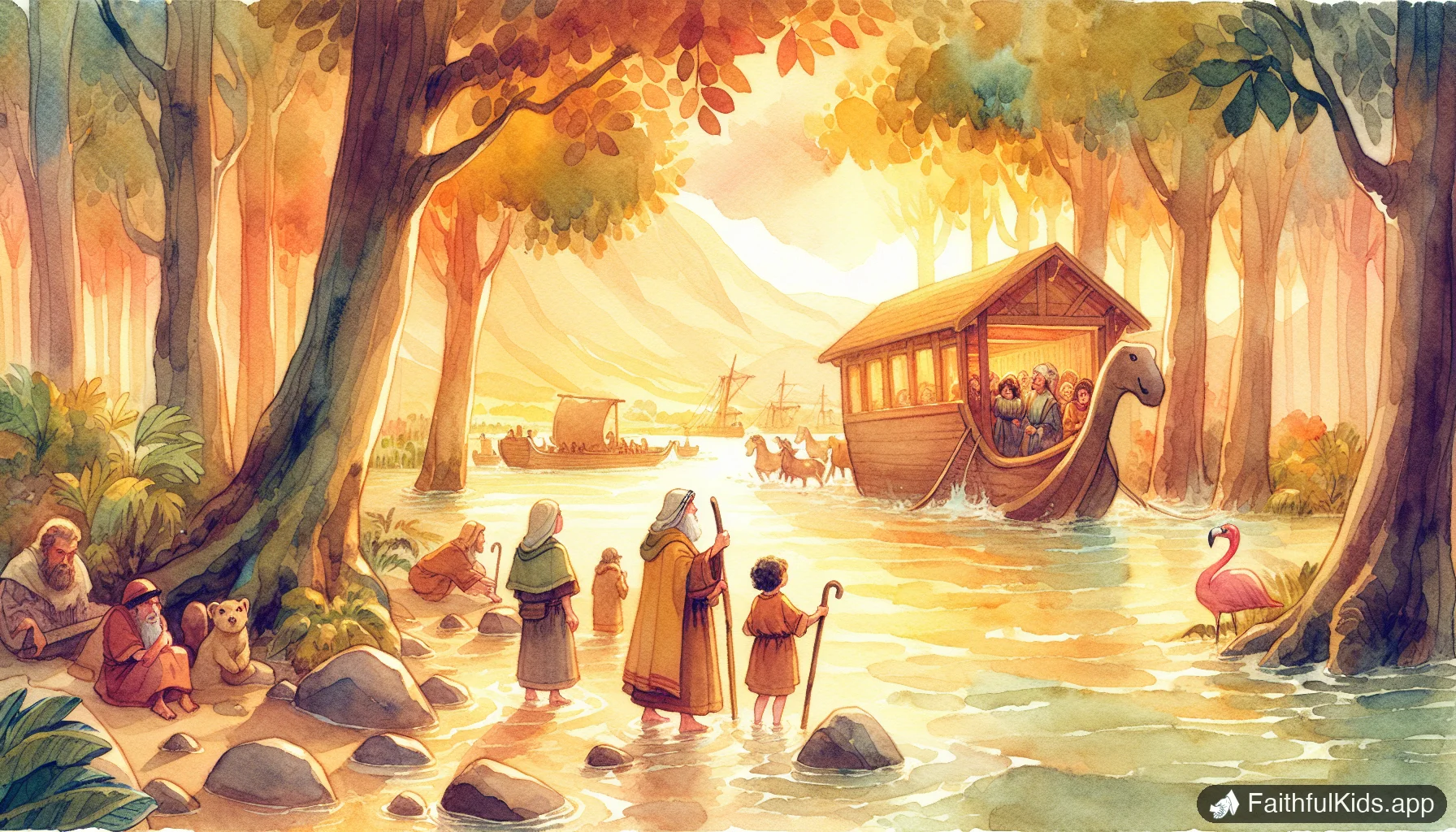
Absolutely. Love: Jesus washing the disciples' feet (John 13). Joy: Hannah's prayer of praise (1 Samuel 2). Peace: Elijah's still small voice (1 Kings 19). Patience: Joseph in prison (Genesis 39-41). Kindness: Boaz and Ruth (Ruth 2). Goodness: Dorcas helping the poor (Acts 9:36). Faithfulness: Noah building the ark (Genesis 6-9). Gentleness: David spares Saul (1 Samuel 24). Self-control: Daniel refuses the king's food (Daniel 1).
🌙 Free: The Bedtime Bible Kit
Seven nights of five-minute stories — a story, a prayer, and one question to whisper about.
Free printable + a few helpful emails. Unsubscribe anytime.