Blog/How to Explain Easter to a Child (Beyond the Bunny)
Guide
How to Explain Easter to a Child (Beyond the Bunny)
Ages 5+·11 min read··By Faithful Kids Team·Updated August 20, 2026
Chocolate eggs, bunny ears, and Easter baskets — your child probably knows that part of Easter already. But at some point, they look at you and ask, "What is Easter really about?"
And that is the moment you have been waiting for.
Easter is the most important day on the Christian calendar. It is the day we celebrate the most incredible event in all of history: Jesus rose from the dead. Here is how to tell that story to your child in a way that captures their heart without overwhelming their mind.
The Easter Story in Kid-Friendly Language
Before diving into explanations and applications, just tell the story. Kids learn through stories, and this one is the greatest story ever told. If you want the chapter and verse behind each scene, our walkthrough of where the Easter account sits in Scripture lays them out in order.
The Triumphal Entry (Palm Sunday)
"A few days before Easter, Jesus rode into the big city of Jerusalem on a donkey. People were so excited to see Him that they waved palm branches and laid them on the road, shouting, 'Hosanna! Blessed is He who comes in the name of the Lord!' It was like a parade for a king. But this king was different — He did not come riding a war horse. He came on a humble donkey." (Read the longer version in the triumphal entry for kids.)
The Last Supper (Thursday)
"On Thursday night, Jesus had a special dinner with His twelve closest friends. He washed their feet, which was a job usually done by servants. He told them He loved them and that something very hard was about to happen. He shared bread and wine with them and said, 'Remember me when you do this.'"
The Arrest and Trial (Thursday Night / Friday Morning)
"After dinner, Jesus went to a garden to pray -- the story we tell in the Garden of Gethsemane for kids. He was very sad because He knew what was coming. While He was praying, soldiers came and arrested Him. His friend Judas had told the soldiers where to find Him. They took Jesus to the leaders of the city, and even though Jesus had never done anything wrong, they said He had to die."
The Cross (Good Friday)
"On Friday, the soldiers nailed Jesus to a wooden cross. This is the hardest part of the story. Jesus suffered a lot, but He chose to go through it because He loved us. While He was on the cross, He said, 'Father, forgive them.' Even while people were hurting Him, Jesus was asking God to forgive them. Then Jesus died."
For younger children, you can soften this: "Jesus was hurt very badly by people who did not understand who He was. He died on a cross, which was very sad. But He did it because He loves us and wanted to take the punishment for all the wrong things people have ever done."
The Burial (Friday Evening)
"After Jesus died, His friends took His body down from the cross and put it in a tomb — a cave carved out of rock. They rolled a huge stone in front of the opening. A group of soldiers guarded it. Everyone was so sad. They thought it was over."
The Resurrection (Easter Sunday!)
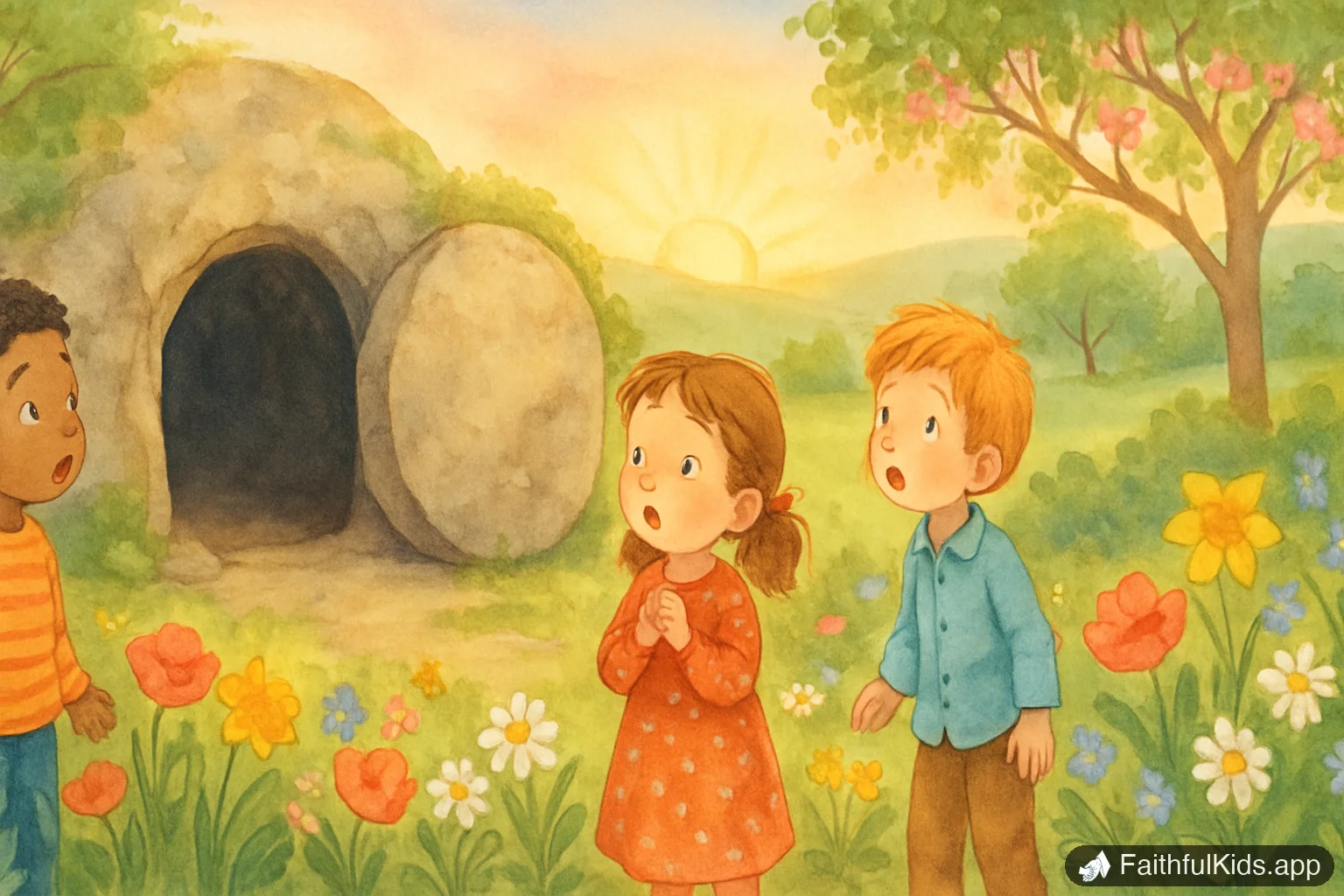
"But on Sunday morning — three days later — some women who loved Jesus went to the tomb to visit. When they got there, the huge stone had been rolled away. The tomb was empty. An angel was sitting there, and he said the most amazing words in all of history..."
Matthew 28:5-6: "The angel said to the women, 'Do not be afraid, for I know that you are looking for Jesus, who was crucified. He is not here; he has risen, just as he said.'"
"Jesus was alive! He had beaten death! Over the next forty days, He appeared to His friends — He ate with them, talked with them, and showed them He was really, truly alive. More than 500 people saw Him." Kids who want to relive that morning can explore the empty tomb for kids.
Why Easter Matters (Explained for Kids)
After telling the story, your child might ask, "But why? Why did Jesus have to die?" Here are ways to explain the significance:
"Jesus Took Our Punishment"
"Remember how we talked about sin — how everyone does things that are wrong? Those wrong things separate us from God. The punishment for sin is death. But Jesus, who never did anything wrong, took that punishment for us. It is like if you broke a window and your big brother said, 'I will pay for it.' Jesus paid for all of our mistakes."
"Jesus Beat Death"
"The most amazing part is not that Jesus died — it is that He came back to life. Death could not hold Him. And because Jesus beat death, everyone who believes in Him gets to live forever with God. Death is not the end of the story."
"It Proves Jesus Is Who He Said He Was"
"Lots of people throughout history have said they were special or important. But only Jesus predicted He would die and come back to life — and then actually did it. The resurrection proves that everything Jesus said is true."
How to Keep Christ in Easter (Practical Ideas)
1. Read the Easter Story Together
Get a good children's Bible or storybook Bible and read the Easter story during the week leading up to Easter. You could read one part each day — Palm Sunday on Monday, the Last Supper on Tuesday, and so on — building toward the resurrection on Easter morning. Our day-by-day Holy Week guide for kids maps out exactly what to read and do each day.
2. Do a Resurrection Egg Hunt
Instead of (or alongside) a regular egg hunt, use special eggs that tell the Easter story. Put small symbols inside numbered eggs: a palm leaf, a piece of bread, a nail, a small rock, and leave the last egg empty — representing the empty tomb. Open them in order and tell the story together. If you need more make-it-yourself ideas, our roundup of Easter crafts for Sunday school works just as well at the kitchen table.
3. Start an Easter Tradition
Some families light a candle on Easter morning to represent Jesus as the light of the world. Others make empty-tomb rolls (crescent rolls with a marshmallow inside — the marshmallow melts away during baking, leaving the roll hollow like the empty tomb). Find a tradition that works for your family.
4. Talk About New Life
Easter is all about new life. Take a nature walk and point out the signs of spring — flowers blooming, birds singing, trees budding. "Just like God brings new life to the world in spring, Jesus brings new life to our hearts."
5. Watch the Story Come to Life
Animated video lessons can help kids visualize the Easter story in a way that sticks. Watching Jesus enter Jerusalem, share the Last Supper, and emerge from the empty tomb brings the narrative to life. Our roundup of Easter Bible stories for kids collects the key scenes in one place.
6. Serve Others
"Because Jesus gave everything for us, we can give to others." Volunteer as a family, deliver meals, or make Easter cards for people who are alone. Show your child that the love of Easter is meant to overflow into action.
There is also a free set of Easter coloring pages on our site, drawn for crayons and ready to print.
See what they get
Watch The Empty Tomb Come Alive
The Empty Tomb is one of 300+ short narrated video lessons your child will love. Watch the whole episode right here — in the app, every lesson ends with a fun quiz to check what they learned.
A real lesson from the app — watch the whole thing free.
Common Kid Questions About Easter
"Did it hurt when Jesus died on the cross?"
Be honest but gentle: "Yes, it hurt a lot. The cross was a very painful way to die. But Jesus chose to go through it because He loves us that much. He could have stopped it at any time — He is God — but He chose to stay so that we could be forgiven."
"Why do we call it Good Friday if something bad happened?"
"Great question! We call it 'good' because even though what happened was terrible, what it accomplished was the best thing ever. Jesus's death opened the way for everyone to be forgiven and to know God. The worst day became the best day because of what God was doing through it."
"Did Jesus really come back to life? Like, for real?"
"Yes, for real. The Bible says that over 500 people saw Jesus alive after He rose from the dead. His friends ate with Him, talked with Him, and even touched His hands. This was not a ghost or a dream. Jesus really, truly came back to life, and that is what makes Easter the most amazing day in all of history."
"Is the Easter Bunny real?"
This one is up to you as a parent. Some families enjoy the Easter Bunny as a fun tradition while keeping the focus on Jesus. Others skip it entirely. Whatever you choose, make sure your child knows that the real story of Easter is so much bigger and more exciting than any bunny could ever be.
"Will I come back to life too?"
"The Bible says that everyone who believes in Jesus will live forever with God. Our bodies will die someday, but that is not the end. Because Jesus beat death, we do not have to be afraid of it. He made a way for us to be with Him forever."
Age-by-Age Guide
Ages 3-5: Focus on the happy ending. "Jesus loves you so much. Some people were mean to Him, and He died. But guess what? God brought Him back to life! Jesus is alive, and that is why we celebrate Easter."
Ages 6-8: Tell the full story simply. Explain that Jesus died to take the punishment for our sins and rose again to give us new life. Use the Resurrection Egg activity to make it hands-on.
Ages 9-12: Go deeper into the why. Discuss substitutionary atonement in kid terms (Jesus taking our place). Talk about the evidence for the resurrection (500+ witnesses, the empty tomb, the disciples' transformed lives). Let them ask hard questions.
Ages 13+: Engage with historical evidence and apologetics. Discuss why the resurrection matters theologically and historically. Read 1 Corinthians 15 together, where Paul makes the case that everything depends on the resurrection being real.
If you are teaching a class rather than one child, our Easter Sunday school lessons are grouped by age the same way.
Watch on Faithful Kids
Bring the Easter story to life for your kids with animated video lessons, quizzes, and reflections. Faithful Kids covers the death, burial, and resurrection of Jesus in a way that is engaging, accurate, and age-appropriate for kids 7-15. Start your free trial today and give your child the real Easter story.
For a quieter follow-up, try the Easter word search — twelve words hidden in the grid, answer key included.
Frequently Asked Questions
How do I talk about the crucifixion without scaring my child?
For very young children (under 5), you can focus more on the resurrection and less on the details of the cross. As children get older, they can handle more of the story. Always pair the hard parts with the beautiful truth: Jesus chose this because He loves us, and the story does not end on Friday — Sunday is coming. Anchoring the week in a few verses short enough to memorize by Sunday gives kids something hopeful to hold on to.
At what age should I tell my child the Easter Bunny is not real?
There is no perfect age, but many parents transition the conversation around ages 6-8 when children naturally start questioning. Frame it positively: "The Easter Bunny is a fun pretend tradition, but the real Easter story is even more amazing because it actually happened."
How do I balance Easter fun (egg hunts, candy) with the real meaning?
You do not have to choose one or the other. Many families enjoy the fun traditions while making the real story the centerpiece. You might do your egg hunt on Saturday and focus Sunday on the resurrection story, church, and family time. The key is making sure your child knows what Easter is really about.
Why is Easter on a different date every year?
Easter falls on the first Sunday after the first full moon following the spring equinox. This tradition dates back to the early church, which connected Easter to the Jewish Passover (since Jesus was crucified during Passover). You can tell your child, "Easter moves around on the calendar, but the story it celebrates never changes."
🌙 Free: The Bedtime Bible Kit
Seven nights of five-minute stories — a story, a prayer, and one question to whisper about.
Free printable + a few helpful emails. Unsubscribe anytime.