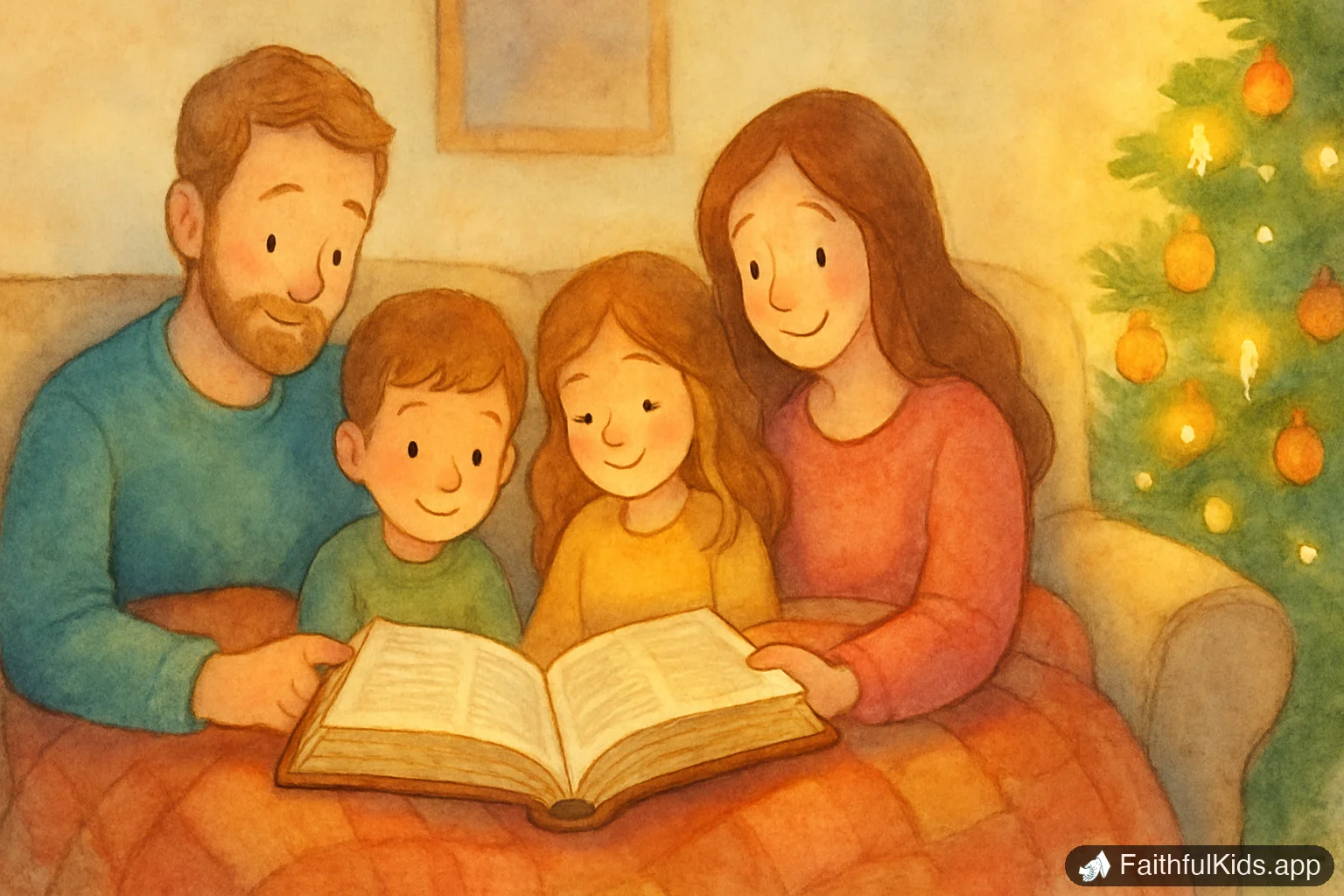
You know you should be reading the Bible with your kids. Every Christian parenting book says so. Your pastor mentions it. You see other families posting about their devotionals on social media. And yet, in your house, it has not happened. Or it happened twice and then fell apart.
You are not failing. You are normal. Starting family Bible time is one of those things that sounds simple but feels overwhelming in practice. When do you do it? What do you read? How do you keep a six-year-old and a twelve-year-old engaged at the same time? What if you do not know the Bible well enough yourself?
This guide answers all of those questions. And at the end, you will find a complete 7-day starter plan with specific stories, discussion questions, and activities so you can begin tonight.
Why Family Bible Time Matters
Before the "how," let us settle the "why," because on the nights when you are exhausted and Netflix is calling, you need to remember why this matters.
It is commanded. Deuteronomy 6:6-7 says, "These commandments that I give you today are to be on your hearts. Impress them on your children. Talk about them when you sit at home and when you walk along the road, when you lie down and when you get up." God did not delegate your child's spiritual education to the church. He gave it to you.
It builds identity. Children who regularly engage with Scripture develop a biblical worldview that shapes how they see themselves, others, and the world. They learn that they are created on purpose, loved unconditionally, and called to live differently.
It creates connection. Family Bible time is not just about information transfer. It is a shared experience that creates memories, rituals, and a common language. Years from now, your children will remember sitting together and talking about David's courage or Ruth's loyalty.
It compounds. Fifteen minutes a day, five days a week, for a year is over 60 hours of Bible teaching. That is more than most adults get in a decade of Sunday sermons. Consistency beats intensity, which is exactly why a set of devotions you can finish in a quarter hour outperforms the ambitious hour you never actually schedule.
Step-by-Step: How to Start
Step 1: Pick a Time (and Protect It)
The best time for family Bible time is the time that actually happens. For most families, that is one of three windows:
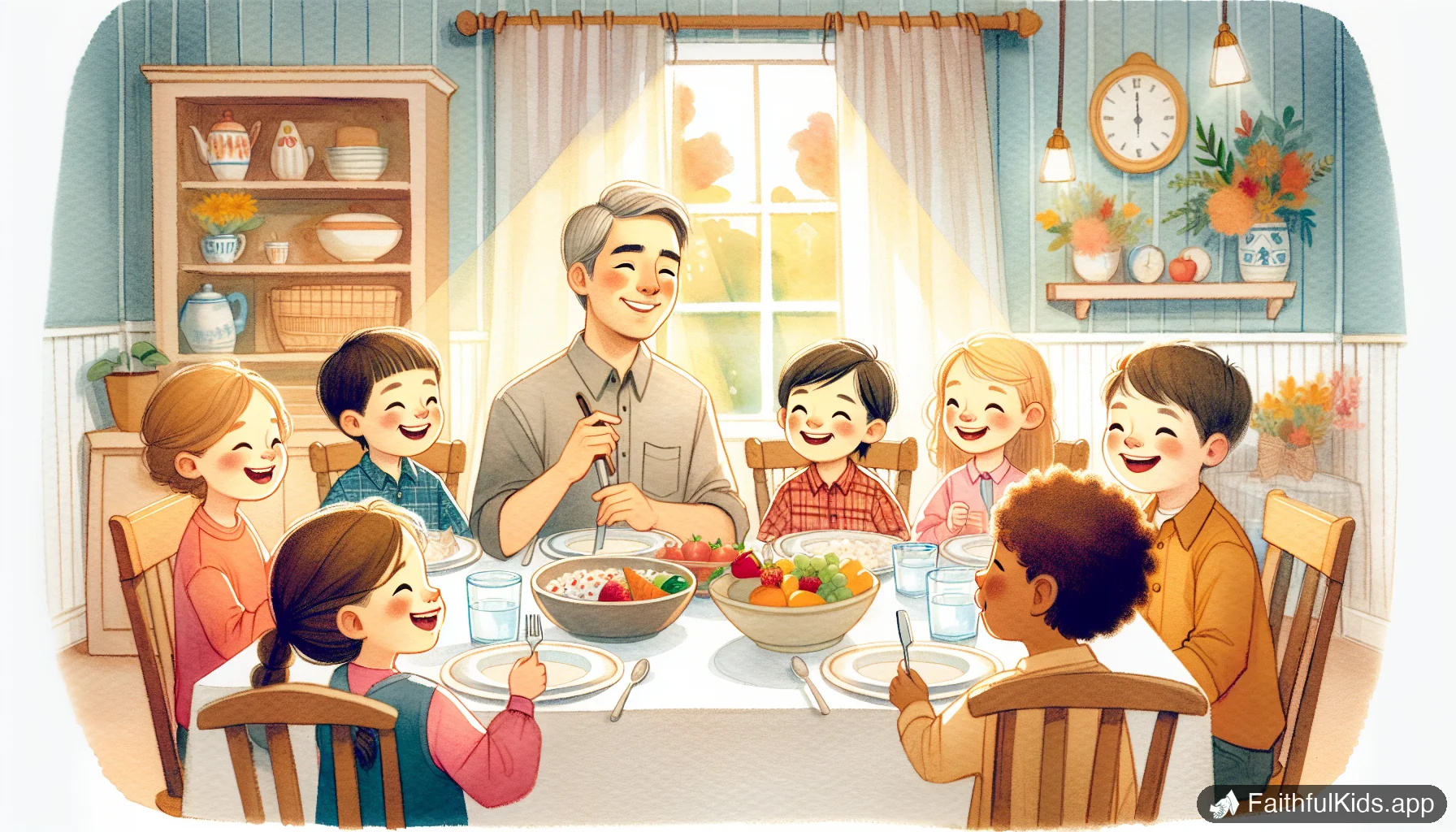
- After dinner, before screen time. The table is already cleared, everyone is together, and you can use Bible time as the gateway to evening activities.
- Bedtime. Replace one bedtime story with a Bible story. This is especially effective for families with younger children -- these Bible stories for bedtime are made for winding down.
- Morning before school. Harder to pull off, but powerful for families with early risers. Even five minutes over breakfast works.
Pick one. Put it on the calendar. Treat it like a non-negotiable appointment. The biggest enemy of family Bible time is not opposition. It is distraction.
Step 2: Start Short (Really Short)
Your first family Bible time should be 10-15 minutes, not an hour. Here is why: if you go long, kids will associate Bible time with boredom and parents will associate it with stress. Neither is sustainable.
A good session looks like this:
- Read or watch a Bible story (3-5 minutes)
- Discuss 2-3 questions (3-5 minutes)
- Pray together (2-3 minutes)
That is it. Ten minutes. You can always add time later as the habit solidifies. But you cannot recover from kids who dread it because the first session was 45 minutes of awkward silence.
Step 3: Use a Story-Based Approach
Do not start in Romans. Do not start with theology. Start with stories. Children are wired for narrative. They learn through characters, conflict, and resolution. The Bible is the greatest story ever told, and your job is to let them experience it as a story first. The theology will follow naturally. Our roundup of best-loved Bible stories for kids gives you a ready-made menu.
Good starting points:
- Creation (Genesis 1-2) — God made everything, including them
- Noah (Genesis 6-9) — God keeps His promises
- David and Goliath (1 Samuel 17) — God gives courage
- Jonah (Jonah 1-3) — You cannot hide from God
- The birth of Jesus (Luke 2) — God's biggest gift
- Jesus feeds 5,000 (John 6:1-14) — God does big things with small offerings
- The Good Samaritan (Luke 10:25-37) — Love your neighbor
Step 4: Ask Questions, Do Not Lecture
The fastest way to kill family Bible time is to turn it into a one-way monologue. Instead, after the story, ask questions that invite participation:
- What happened? (factual, easy, gets everyone talking)
- How did [character] feel? (empathy, emotional engagement)
- Why did [character] do that? (interpretive, critical thinking)
- When have you felt like that? (personal connection)
- What does this story teach us about God? (theological reflection)
Let your kids answer. Do not correct unless they are factually wrong about the story. Affirm their thinking. Say "That is a great observation" often. The goal is not to quiz them. The goal is to help them think about Scripture. If you ever run dry, these Bible discussion questions for kids will keep the conversation moving.
Step 5: Pray Together (Keep It Simple)
Close with a short prayer. For younger children, use the "repeat after me" method: you say a line, they repeat it. For older children, ask if anyone wants to pray about something specific from the story or from their own life.
Prayer does not need to be eloquent. "God, thank you for this story. Help us be brave like David. Amen." Done.
Step 6: Be Consistent, Not Perfect
You will miss days. You will have nights where everyone is cranky and it lasts three minutes. You will have weeks where it does not happen at all. That is fine. The goal is not perfection. The goal is pattern. If you do family Bible time three or four nights a week, you are doing better than most Christian families in America.
When you miss a day, do not apologize or make it a big deal. Just pick it back up the next day. Guilt is the enemy of habit.
The 7-Day Starter Plan
Use this plan to begin tonight. Each day includes a story, a key verse, three discussion questions, and a simple activity. Total time: 10-15 minutes per day. If your kids would rather draw than talk, keep a stack of Bible journaling sheets on the table and let those stand in for the activity.
Day 1: Creation (Genesis 1:1-2:3)
Read or summarize: God created everything in six days and rested on the seventh. Light, sky, land, sun and moon, sea creatures and birds, animals and people. He looked at everything and said it was "very good."
Key verse: "God saw all that he had made, and it was very good" (Genesis 1:31).
Discussion:
- What is your favorite thing God created?
- God called everything "very good," and that includes you. How does that make you feel?
- Why do you think God rested on the seventh day?
Activity: Go outside (or look out the window) and find three things God made. Thank Him for each one.
Day 2: Noah and the Ark (Genesis 6:9-9:17)
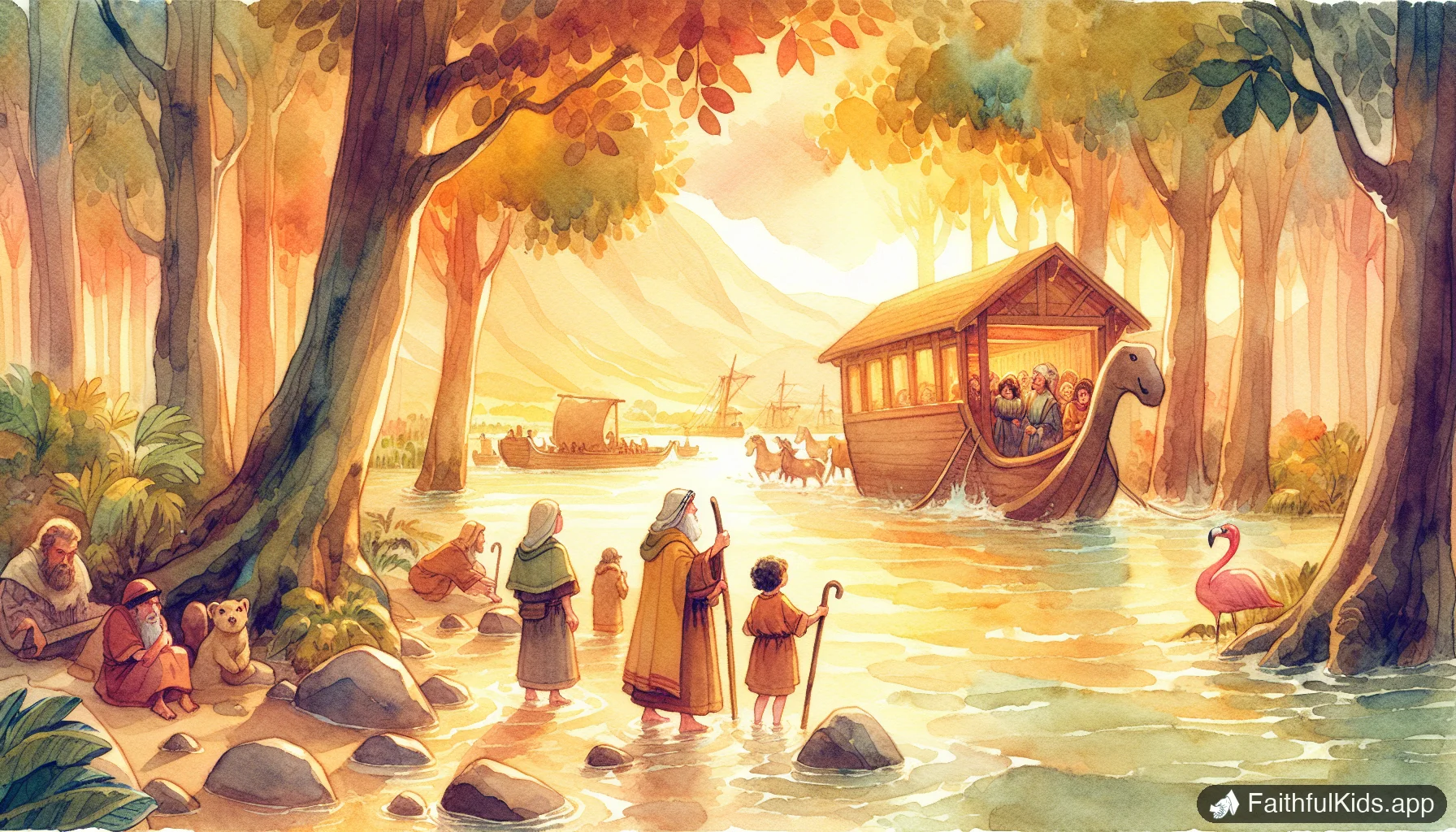
Read or summarize: God told Noah to build a huge boat because a flood was coming. Noah obeyed even though people thought he was crazy. The flood came, but Noah's family and the animals were safe. After the flood, God put a rainbow in the sky as a promise to never flood the whole earth again.
Key verse: "I have set my rainbow in the clouds, and it will be the sign of the covenant between me and the earth" (Genesis 9:13).
Discussion:
- How do you think Noah felt building a boat when it had never rained?
- What does it mean to obey God even when it does not make sense?
- What does the rainbow remind us about God?
Activity: Draw a rainbow together. On each color stripe, write something God has promised (I love you, I am with you, I will help you, etc.).
Day 3: David and Goliath (1 Samuel 17)
Read or summarize: A giant warrior named Goliath challenged the Israelite army. Everyone was too scared to fight him. But a young shepherd boy named David volunteered. He did not wear armor or carry a sword. He picked up five smooth stones and a sling. He told Goliath, "You come against me with sword and spear, but I come against you in the name of the Lord." One stone. The giant fell.
Key verse: "The Lord who rescued me from the paw of the lion and the paw of the bear will rescue me from the hand of this Philistine" (1 Samuel 17:37).
Discussion:
- Why was David brave when everyone else was scared?
- David remembered how God helped him before (with the lion and the bear). Can you think of a time God helped you?
- What "giant" are you facing right now?
Activity: Each family member writes one fear or challenge on a piece of paper, crumples it up, and throws it in a bowl. Pray over each one together.
Day 4: Jonah and the Big Fish (Jonah 1-3)
Read or summarize: God told Jonah to go to Nineveh and tell the people to stop doing wrong. Jonah did not want to, so he ran the opposite direction and got on a boat. God sent a storm. Jonah was thrown overboard and swallowed by a huge fish. Inside the fish for three days, Jonah prayed. The fish spit him out, and Jonah finally went to Nineveh. The people listened and turned back to God.
Key verse: "From inside the fish Jonah prayed to the Lord his God" (Jonah 2:1).
Discussion:
- Why did Jonah run from God?
- Can you actually hide from God?
- Has there ever been something you knew you should do but tried to avoid?
Activity: Play a quick game of hide and seek. After the game, talk about how even when we try to hide, God always knows where we are and always loves us.
Day 5: Jesus Feeds 5,000 (John 6:1-14)
Read or summarize: A huge crowd followed Jesus, and they were hungry. There was no food except for a boy's small lunch: five loaves of bread and two fish. The disciples said it was not enough. But Jesus took the food, thanked God, and started passing it out. Everyone ate until they were full, and there were twelve baskets of leftovers.
Key verse: "Here is a boy with five small barley loaves and two small fish, but how far will they go among so many?" (John 6:9).
Discussion:
- Why do you think the boy offered his lunch?
- Have you ever thought you did not have enough to share? What happened?
- What small thing could you offer to God or to someone else this week?
Activity: Each family member identifies one small thing they can give or share this week: time, a kind word, a possession, a talent. Write it down and put it on the fridge.
Day 6: The Good Samaritan (Luke 10:25-37)
Read or summarize: A man was robbed and left hurt on the road. A priest saw him and walked past. Another religious leader saw him and walked past. But a Samaritan, someone from a group that the hurt man's people did not like, stopped. He bandaged the man's wounds, took him to an inn, and paid for his care. Jesus said, "Go and do likewise."
Key verse: "Go and do likewise" (Luke 10:37).
Discussion:
- Why do you think the priest and the other leader walked past?
- What made the Samaritan's choice surprising?
- Who is someone you could help this week, even if it is not easy or convenient?
Activity: Plan one "Good Samaritan" act for the week as a family. Bake cookies for a neighbor. Write a card for someone who is lonely. Help someone at school who is struggling.
Day 7: The Lost Sheep (Luke 15:1-7)
Read or summarize: Jesus told a story about a shepherd who had 100 sheep. One wandered off and got lost. The shepherd left the 99 safe sheep and went searching for the one lost sheep. When he found it, he carried it home on his shoulders and threw a party. Jesus said, "There will be more rejoicing in heaven over one sinner who repents than over ninety-nine righteous persons who do not need to repent" (Luke 15:7).
Key verse: "Rejoice with me; I have found my lost sheep" (Luke 15:6).
Discussion:
- Why did the shepherd leave 99 sheep to find just one?
- What does this story tell us about how much God loves each person?
- Have you ever felt lost or alone? How does it feel to know God is looking for you?
Activity: Celebrate the end of your first week of family Bible time. Have a treat, high-fives, or a special dessert. Make the end of the week feel like an accomplishment worth repeating.
Homeschooling? Our free homeschool Bible curriculum page shows how families use the video lessons as an open-and-go Bible block.
Watch on Faithful Kids
If you want to take family Bible time to the next level without adding preparation time, Faithful Kids does the work for you. Each lesson is a short video followed by a quiz and reflection, all designed for kids ages 7-15. Use it as your story segment and then discuss as a family.
Start Your Free Trial
When the kids' round ends, hand the grown-ups our Bible trivia for adults -- the warm-up round catches almost everyone on the stories they think they know.
Every story mentioned here is retold in full in our 200 Bible stories for kids -- simple retellings of the whole Bible, free, Genesis to Revelation.
Frequently Asked Questions
What if my spouse is not interested in participating?
Start without them. You can do family Bible time with just you and your kids. Many parents find that when their spouse sees the kids engaged and excited, they naturally want to join. Do not pressure them. Model it.
How do I keep a wide age range engaged (say, 5 and 12)?
Use the same story but differentiate the discussion. Ask your five-year-old "What happened?" and your twelve-year-old "Why did that happen?" Let older kids help explain things to younger siblings. This actually deepens the older child's understanding.
What if I do not know the Bible very well myself?
You do not need to be a Bible scholar. You are learning alongside your children, and that is a beautiful thing. Use a children's Bible, a study guide, or video lessons (like Faithful Kids) that explain the stories simply. Your kids will not judge your knowledge. They will remember that you made time. Growing your own understanding on the commute helps as well, and a few podcasts made for Christian parents will teach you more than you expect in a month of drives.
We tried before and it fell apart after two weeks. How do we make it stick this time?
Lower the bar. If 15 minutes feels like too much, do 5. If every night feels overwhelming, commit to three nights per week. Attach it to an existing habit (right after dinner, right before bedtime). And give yourself grace. Missing days is not failure. Quitting is. Just start again.