Ages 5+·12 min read··By Faithful Kids Team·Updated August 16, 2026
Summer break is a gift: long days, slow mornings, and time together as a family. It's also the season when routines disappear, screen time skyrockets, and the spiritual habits built during the school year can quietly fade away.
This 10-week family reading plan keeps Bible learning alive all summer -- without feeling like homework. One story per week. A short reading, three discussion questions, and a hands-on activity you can do together. The whole thing takes about 20-30 minutes per week, and the memories last much longer.
How to Use This Plan
Pick one day a week as your family Bible day. Saturday mornings, Sunday evenings, or a weeknight -- whatever works.
Read the passage together. Take turns reading aloud, or have a parent read while younger kids listen.
Discuss. Use the three questions provided. Let everyone talk. There are no wrong answers.
Do the activity. These are designed to be fun, not educational-feeling. Most use things you already have at home.
No guilt if you miss a week. Just pick up where you left off. Progress matters more than perfection.
Week 1: Creation — God Made Everything Good
Read: Genesis 1:1-2:3
The Story: In six days, God created light, sky, land, sea, plants, animals, and people. On the seventh day, He rested. After each day of creation, God looked at what He'd made and said it was good. After creating people, He said it was very good.
Discussion Questions:
What is your favorite thing God created? Why do you think He made it?
God rested on the seventh day. Why do you think rest is important -- even for God?
If you could spend a whole day with any animal God created, which would you pick?
Summer Activity: Go on a creation scavenger hunt. Make a list of 10 things God created and find them outside: a flower, a bird, a cloud, a rock, a bug, a tree, water, grass, the sun, and a person. Check them off as you find them. Take photos or draw pictures of your favorites.
Week 2: Noah's Ark — Trusting God When Things Get Scary
Read: Genesis 6:9-22, 8:1-12, 9:12-17
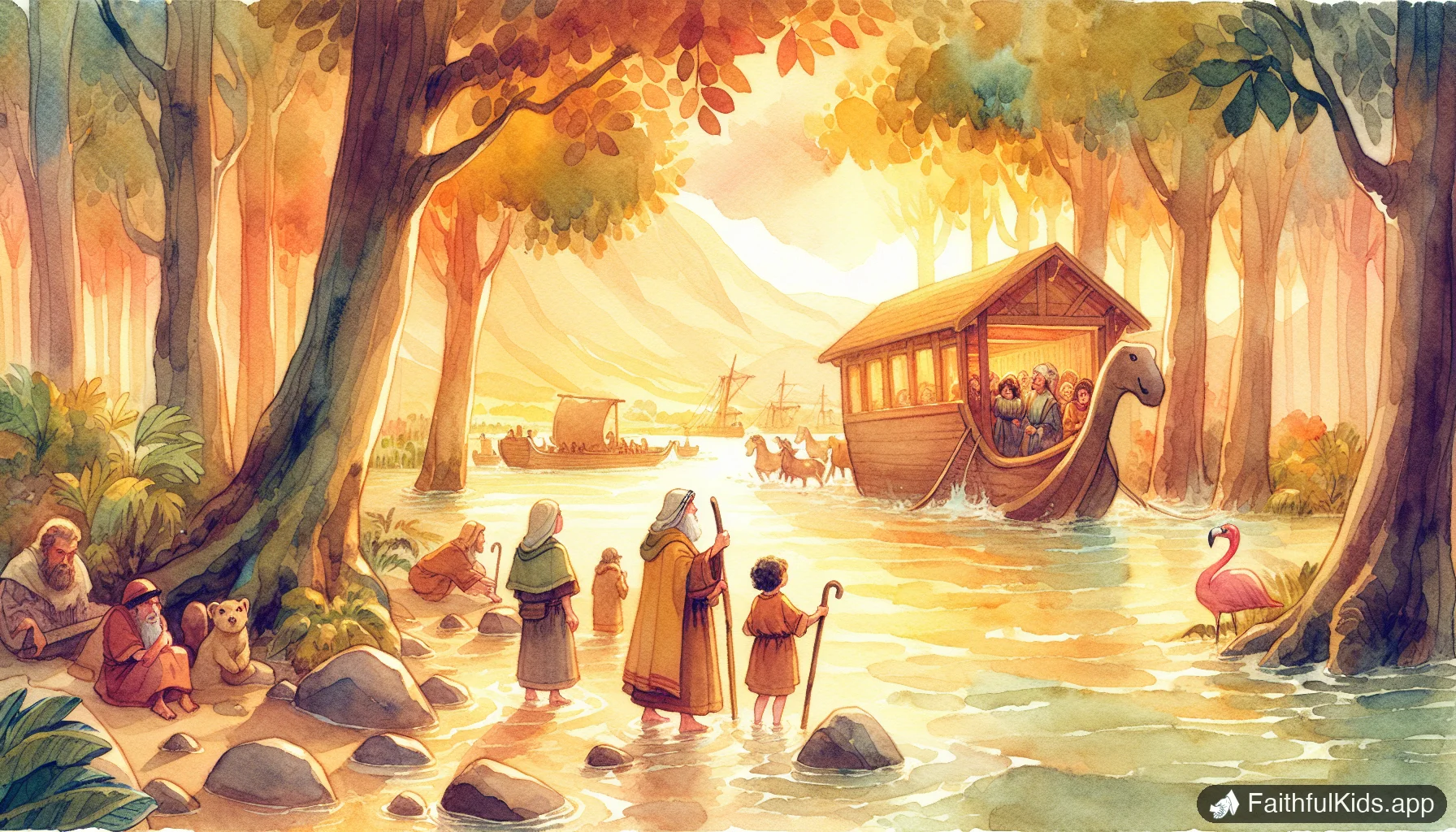
The Story: God saw that people had become wicked, but Noah was faithful. God told Noah to build an enormous boat and fill it with animals -- two of every kind. The rain came for 40 days and nights. When the flood receded, God set a rainbow in the sky as a promise that He would never flood the earth again. (Our retelling of Noah and the great flood for kids goes deeper into this story.)
Discussion Questions:
Noah obeyed God even though building a boat in the desert made no sense. When has someone asked you to do something that seemed weird but turned out to be right?
It rained for 40 days. What do you think it was like on the ark?
What does the rainbow remind you of when you see one?
Summer Activity: Build a backyard boat. Use cardboard boxes, couch cushions, or blankets to build an "ark" in your yard or living room. Gather stuffed animals as your passengers. While you're inside the ark, read the story one more time and imagine what it was like.
Week 3: Joseph — God Can Use Hard Times for Good
Read: Genesis 37:3-28, 39:1-6, 41:37-43, 50:15-21
The Story: Joseph's brothers sold him into slavery because they were jealous of him. Joseph ended up in Egypt, was falsely accused, and thrown in prison. But God gave him the ability to interpret dreams, which eventually brought him before Pharaoh. Joseph became the second most powerful man in Egypt and saved his entire family from famine. When he finally faced his brothers, he said, "You meant evil against me, but God meant it for good" (Genesis 50:20).
Discussion Questions:
Joseph went through years of hard things before God's plan became clear. Is it hard to trust God when you can't see the reason?
Joseph forgave his brothers even though they did terrible things to him. How hard would that be for you?
Have you ever had something bad happen that turned into something good?
Summer Activity: Make a paper chain of hope. Cut strips of colored paper. On each strip, write one hard thing that happened to Joseph (sold by brothers, prison, etc.) and one good thing that came from it. Link them into a chain. Hang it up as a reminder that God connects our hard moments to good purposes.
Week 4: Moses and the Red Sea — God Makes a Way
Read: Exodus 14:5-31
The Story: The Israelites had just escaped from Egypt when they hit a dead end -- the Red Sea in front, Pharaoh's army behind. There was no escape. Moses told the people, "Do not be afraid. Stand firm and you will see the deliverance the Lord will bring" (Exodus 14:13). God parted the sea, and the people walked through on dry ground.
Discussion Questions:
The Israelites were trapped between the sea and the army. Have you ever felt stuck with no way out?
Moses said "Stand firm." What does it look like to stand firm when you're scared?
God made a way that nobody expected. How does that change the way you pray about impossible situations?
Summer Activity: Water day. Head to a pool, lake, or set up the sprinkler and water balloons in the backyard. Before playing, stand at the edge of the water together. Read Exodus 14:13 out loud. Then jump in. Sometimes you just have to take the step.
Week 5: David and Goliath — Small but Mighty
Read: 1 Samuel 17:32-50
The Story: The Philistine giant Goliath challenged Israel's army, and nobody would fight him. David, a young shepherd boy, volunteered. He refused the king's armor and went with a sling and five smooth stones. "You come against me with sword and spear," David said, "but I come against you in the name of the Lord Almighty" (1 Samuel 17:45). One stone. One giant. Done. (Read the full David and Goliath story for kids.)
Discussion Questions:
What made David brave -- was it confidence in himself or confidence in God?
David's brothers told him to go home. Have you ever been told you're too young or too small for something?
What is your "Goliath" this summer -- something that feels bigger than you?
Summer Activity: Target practice. Set up empty cans or plastic bottles on a fence or table. Use a ball (or a sock filled with rice) to try to knock them down. After each round, name a "Goliath" -- a fear or challenge -- and imagine knocking it down with God's help.
Week 6: Jonah — Running From God Never Works
Read: Jonah 1:1-3:10
The Story: God told Jonah to go to Nineveh and preach. Jonah ran the opposite direction, boarded a ship, and ended up in the belly of a great fish for three days. Inside the fish, Jonah prayed. God had the fish spit him out, and Jonah went to Nineveh. The entire city repented.
Discussion Questions:
Why did Jonah run from God? Have you ever tried to avoid something God (or your parents) asked you to do?
What do you think Jonah was thinking inside the fish?
When Jonah finally obeyed, the whole city changed. What might happen if you obey God even when it's hard?
Summer Activity: Fish craft. Draw and cut out a large fish from poster board. Inside the fish, have each family member write or draw something they've been avoiding that God might be asking them to do. Tape the fish to the fridge as a reminder: running from God's plan doesn't work, but obeying it leads to amazing things.
See what they get
Watch a Real Lesson From the App
Press play on David and Goliath — a complete lesson exactly as your child sees it. 300+ episodes cover the whole Bible in order, each ending in a fun quiz to check what they learned.
A real lesson from the app — watch the whole thing free.
Week 7: Daniel in the Lion's Den — Standing Up for What's Right
Read: Daniel 6:1-28
The Story: Daniel was the best administrator in the kingdom, and the other officials were jealous. They tricked the king into signing a law that made praying to anyone except the king punishable by death. Daniel kept praying to God three times a day. He was thrown into a den of lions. God shut the lions' mouths, and Daniel came out without a scratch. (There's more in our guide to Daniel in the lion's den for kids.)
Discussion Questions:
Daniel could have stopped praying for 30 days and avoided trouble. Why didn't he?
Is there anything you would keep doing even if you got in trouble for it?
The king was so impressed by Daniel's faith that he honored God publicly. How does your faithfulness affect the people around you?
Summer Activity: Bravery badges. Cut circles from cardboard or thick paper. Each family member decorates a badge and writes one thing they want to stand up for this summer -- kindness, honesty, faith, including others, etc. Wear them for the rest of the day as a reminder.
Week 8: The Good Samaritan — Who Is My Neighbor?
Read: Luke 10:25-37
The Story: A man was beaten and left on the road. A priest walked by and didn't help. A Levite walked by and didn't help. Then a Samaritan -- someone from a group despised by the Jewish people -- stopped, bandaged the man's wounds, took him to an inn, and paid for his care. Jesus said, "Go and do likewise" (Luke 10:37).
Discussion Questions:
Why do you think the priest and the Levite didn't stop?
The Samaritan helped someone who probably wouldn't have helped him. Why is it important to be kind to everyone, not just people like you?
Who is your "neighbor" -- someone you can help this summer?
Summer Activity: Kindness week challenge. Each day for the next seven days, do one act of kindness for someone outside your family: bring cookies to a neighbor, write a thank-you card for the mail carrier, pick up litter at the park, compliment a stranger, help with yard work, donate toys to a shelter, or make a card for someone who's sick.
Week 9: Jesus Feeds 5,000 — Small Offerings, Big God
Read: John 6:1-14
The Story: Five thousand people were hungry and far from any town. A boy offered his lunch -- five small barley loaves and two fish. The disciples said it was useless. Jesus gave thanks, broke the bread, and fed the entire crowd with twelve baskets left over.
Discussion Questions:
The boy could have kept his lunch for himself. Why do you think he offered it?
Have you ever given something away and it made a bigger difference than you expected?
What's something small you have that God might want to use for something big?
Summer Activity: Lemonade stand for good. Set up a lemonade stand and donate the money to a cause your family cares about -- a local food bank, a missions organization, or a family in need. Before you start, read John 6:9-11 together: small offerings, multiplied by God.
Week 10: The Resurrection — The Greatest Story Ever Told
Read: Matthew 28:1-10, John 20:11-18
The Story: On the third day after the crucifixion, women went to Jesus' tomb and found it empty. An angel said, "He is not here; he has risen, just as he said" (Matthew 28:6). Jesus appeared first to Mary Magdalene, then to the disciples, and over the next 40 days, to hundreds of people. Death did not win.
Discussion Questions:
How do you think Mary felt when she heard "He has risen"?
Why is the resurrection the most important event in all of history?
What does it mean for your life that Jesus is alive today?
Summer Activity: Celebration picnic. Pack a special meal and go to your favorite outdoor spot -- a park, a beach, the backyard. Spread a blanket. Before eating, read Matthew 28:5-6 together. Celebrate the fact that Jesus is alive with your favorite food, games, and time together. End the summer the way it started: with God's goodness.
Keeping the Momentum Going
After ten weeks of family Bible time, you've built something valuable: a habit. Here's how to carry it into fall:
Continue weekly. Keep your family Bible day going year-round with a new passage each week. When school starts, transition with these back-to-school Bible stories for kids.
Add daily devotions. Apps and platforms like Faithful Kids give kids a 15-minute daily Bible habit with video stories, quizzes, and reflections.
Let kids choose. Ask your kids which story was their favorite this summer, and let them pick what you read next. Ownership increases engagement.
Celebrate. At the end of the ten weeks, celebrate what you've done. Make a poster listing all ten stories. Talk about your favorite moments. Thank God for the summer together.
Watch on Faithful Kids
Want to keep Bible learning going all summer? Faithful Kids offers animated Bible video lessons with interactive quizzes and reflections -- all in 15 minutes a day. It's like Duolingo for the Bible.
About 20-30 minutes total: 5-10 minutes to read the passage, 5-10 minutes of discussion, and 10-15 minutes for the activity. You can shorten it by picking just one discussion question or simplifying the activity.
What ages is this reading plan designed for?
This plan works for families with children ages 5-13. Younger kids (5-7) will engage most with the activities and simple story questions. Older kids (8-13) can read the passages themselves and handle the deeper discussion questions.
Can I use this plan for VBS or summer Sunday school?
Yes. Each week's content translates easily into a group lesson format. Read the passage together, split into small groups for discussion, then do the activity as a whole group. Many of the activities work well for larger groups with minimal adaptation. For more group-ready ideas, see our list of Bible stories for VBS.
What if my kids already know these Bible stories?
Familiarity is an advantage, not a problem. The discussion questions are designed to push beyond "what happened" into "why it matters" and "how it connects to my life." Even adults discover new depths in stories they've heard a hundred times. The activities also give kids a fresh, experiential way to engage with familiar narratives.
🌙 Free: The Bedtime Bible Kit
Seven nights of five-minute stories — a story, a prayer, and one question to whisper about.
Free printable + a few helpful emails. Unsubscribe anytime.