Blog/The 10 Commandments for Kids Explained Simply
Guide
The 10 Commandments for Kids Explained Simply
Ages 5+·10 min read··By Faithful Kids Team·Updated August 16, 2026
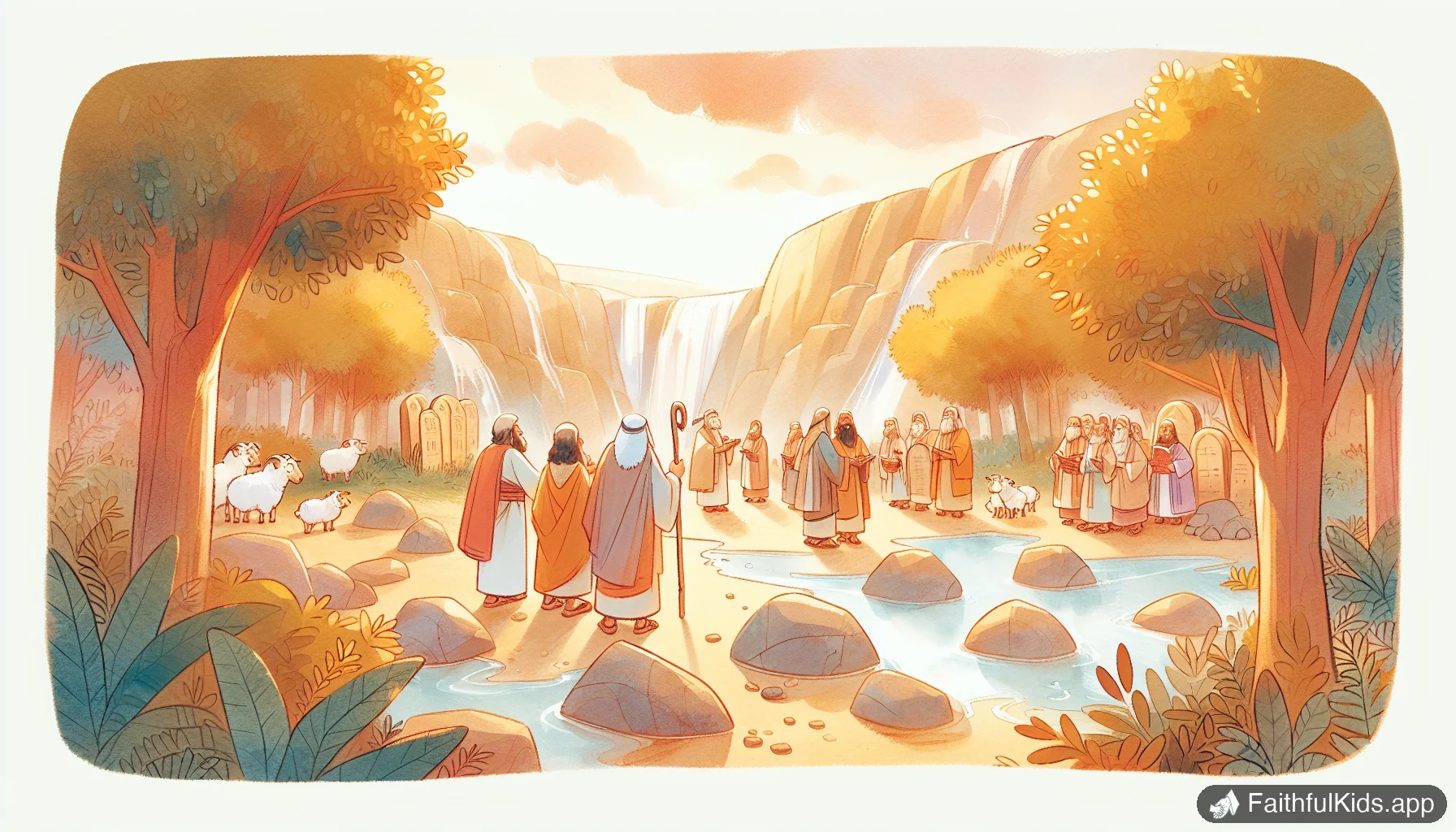
The Ten Commandments are the most famous rules in history. God gave them to Moses on Mount Sinai after rescuing the Israelites from slavery in Egypt. They are found in Exodus 20:1-17 (see our overview of the Book of Exodus for kids) and repeated in Deuteronomy 5:6-21.
But here is something important to understand: these commandments are not a list of rules designed to ruin your fun. They are more like instructions from a loving parent who knows what is best. God had just set His people free, and now He was teaching them how to live as free people. The commandments are a gift, not a burden.
Think of it this way. If you got a brand-new puppy, you would put up a fence in the yard, not to be mean to the puppy, but to keep it safe. The Ten Commandments are God's fence. They protect us from hurting ourselves and each other.
Here is each commandment explained in kid-friendly language, with a modern example your family can talk about.
Commandment #1: Put God First
"You shall have no other gods before me." (Exodus 20:3)
In kid language: Nothing should be more important to you than God. Not video games, not sports, not popularity, not even your phone. God is the one who made you, loves you, and takes care of you. He deserves the number one spot in your heart.
Modern example: Imagine it is Sunday morning and you have a choice: go to church with your family or stay home to play a new video game. Putting God first means choosing what feeds your soul, not just what feels fun in the moment. That does not mean video games are bad. It means God comes before everything else.
Commandment #2: Do Not Make Idols
"You shall not make for yourself an image in the form of anything in heaven above or on the earth beneath or in the waters below." (Exodus 20:4)
In kid language: An idol is anything you treat like a god. In ancient times, people made statues out of gold and wood and prayed to them -- like the Israelites did in the golden calf story. Today, idols look different. They might be money, fame, a celebrity, a sport, or even your own appearance. Anything that takes God's place in your heart is an idol.
Modern example: If you spend hours every day scrolling through social media and zero minutes talking to God, your phone might have become an idol. It does not mean you cannot use it. It means it should not replace God.
Commandment #3: Respect God's Name
"You shall not misuse the name of the Lord your God." (Exodus 20:7)
In kid language: God's name is holy, which means it is special and set apart. Using God's name as a swear word, a joke, or a casual exclamation treats something sacred like it is worthless. When you say God's name, mean it.
Modern example: When something surprises you and you blurt out "Oh my God" without thinking, that is using His name carelessly. Try replacing it with "Oh my goodness" or "Wow." It is a small change that shows big respect.
Add five quiet minutes with the free Moses word search; it prints one to a sheet with the key on the page.
Commandment #4: Keep the Sabbath
"Remember the Sabbath day by keeping it holy. Six days you shall labor and do all your work, but the seventh day is a sabbath to the Lord your God." (Exodus 20:8-10)
In kid language: God worked for six days creating the world and rested on the seventh. He wants us to do the same. One day a week should be different from the others. It is a day to rest, spend time with family, worship God, and recharge. You were not designed to go full speed every single day.
Modern example: Your family picks one day a week (maybe Sunday) where screens are off, homework is done ahead of time, and you do things together: go to church, take a walk, play board games, have a special meal. It is not a punishment; it is the best day of the week.
Commandment #5: Honor Your Parents
"Honor your father and your mother, so that you may live long in the land the Lord your God is giving you." (Exodus 20:12)
In kid language: Your parents are not perfect, but God placed them in your life to protect you, teach you, and love you. Honoring them means listening when they talk, obeying even when you do not want to, speaking to them respectfully, and being grateful for what they do. This is the first commandment that comes with a promise: things will go well for you.
Modern example: Your mom asks you to take out the trash. You do not want to. Honoring your parent means doing it without complaining, eye-rolling, or slamming doors. It is not about being a robot; it is about showing respect to the people who sacrifice for you every day.
Commandment #6: Do Not Murder
"You shall not murder." (Exodus 20:13)
In kid language: Every human life is precious because every person is made in God's image. Taking a life is the most serious wrong a person can commit. But Jesus later expanded this commandment to include hatred and anger in our hearts (Matthew 5:21-22). Being furious at someone and wishing them harm is like a seed that, if left unchecked, grows into something terrible.
Modern example: You probably will never face the literal command not to murder. But this commandment also means: do not bully. Do not tear people down with your words. Do not harbor hatred. Do not wish harm on others. Protect life, whether it is standing up for the kid being picked on or being kind to someone nobody else likes.
Commandment #7: Be Faithful
"You shall not commit adultery." (Exodus 20:14)
In kid language: When two people get married, they make a promise to be loyal to each other. This commandment protects that promise. For kids, the bigger lesson is about faithfulness and keeping your word. When you make a commitment, whether to a friend, a team, or a family member, follow through.
Modern example: If you promise your friend you will keep a secret, keep it. If you join a team, show up to practice. Faithfulness starts with small commitments and grows into the kind of loyalty that holds marriages and families together.
See what they get
Watch The Ten Commandments Come Alive
The Ten Commandments is one of 300+ short narrated video lessons your child will love. Watch the whole episode right here — in the app, every lesson ends with a fun quiz to check what they learned.
A real lesson from the app — watch the whole thing free.
Commandment #8: Do Not Steal
"You shall not steal." (Exodus 20:15)
In kid language: Taking something that does not belong to you is wrong. It does not matter if it is big or small, a toy from a store, a pencil from a classmate, or answers from someone's test. Stealing breaks trust, and trust is one of the hardest things to rebuild.
Modern example: Your friend leaves their cool new pen on their desk and you really want one. Slipping it into your backpack is stealing, even if "they have two" or "they will not notice." Respecting other people's things is one of the foundations of being a trustworthy person.
Commandment #9: Do Not Lie About Others
"You shall not give false testimony against your neighbor." (Exodus 20:16)
In kid language: Do not lie, especially about other people. Spreading rumors, making up stories, or blaming someone for something they did not do causes real harm. Your words should be honest, and when you talk about others, you should tell the truth.
Modern example: Your teacher asks who threw the paper airplane and you point at the kid next to you even though you did it. Or you tell your friends that a classmate said something mean when they actually did not. False testimony ruins reputations and hurts innocent people.
Commandment #10: Do Not Be Jealous
"You shall not covet your neighbor's house... or anything that belongs to your neighbor." (Exodus 20:17)
In kid language: Coveting means wanting what someone else has so badly that it makes you unhappy with what you have. It is okay to notice nice things, but it is not okay to let jealousy take over your heart. God wants you to be grateful for your own blessings instead of wishing you had someone else's.
Modern example: Your friend gets a brand-new bike and you still have your old one. Instead of being happy for them and thankful for what you have, you sulk and think it is unfair. Coveting steals your joy. Gratitude gives it back.
Why the 10 Commandments Still Matter Today
These commandments are thousands of years old, but they are not outdated. Every single one applies to life today. In fact, Jesus summarized all ten commandments in just two sentences: "Love the Lord your God with all your heart, soul, and mind" (covers Commandments 1-4) and "Love your neighbor as yourself" (covers Commandments 5-10). See Matthew 22:37-40.
When your kids understand the Ten Commandments, they have a moral foundation that will guide them through every stage of life. These are not arbitrary rules. They are the blueprint for a life of love, respect, and peace.
Tips for Teaching the 10 Commandments to Kids
Use fingers. Ten commandments, ten fingers. Assign one commandment to each finger and practice until your child can name all ten by counting on their hands.
Make it a conversation, not a lecture. Ask your child: "Why do you think God said we should not steal?" Let them think it through. Kids who discover the reasoning remember it longer than kids who are just told.
One per week. Spend one week on each commandment. Talk about it at dinner, share examples from your day, and look for it in the shows or books your family enjoys. In ten weeks, you will have covered them all.
Pair with stories. Each commandment connects to a Bible story. Honor your parents? Think of Jesus as a boy in the temple (Luke 2:51). Do not steal? Think of Zacchaeus returning what he took (Luke 19:8). Stories make the commandments come alive. Start with the story of how God gave the Ten Commandments at Mount Sinai.
Watch on Faithful Kids
Bring the Ten Commandments to life for your children with Faithful Kids. Our animated video series teaches each commandment through engaging stories, quizzes, and reflections designed for ages 7-15.
At what age should kids learn the 10 Commandments?
Most children can begin learning the commandments in simple language around age 5-6. By age 8-10, they can understand the deeper meaning and modern applications. Start with the ones most relevant to their daily life, like honoring parents, not lying, and not stealing.
Are the 10 Commandments the same in all Christian denominations?
The content is the same (Exodus 20:1-17), but different traditions number them slightly differently. Catholic and Lutheran traditions combine the first two commandments and split the last one into two. Protestant traditions follow the numbering used in this article. The teachings are identical.
How do the 10 Commandments relate to the teachings of Jesus?
Jesus did not abolish the commandments. He deepened them. He taught that anger is connected to murder, that lust is connected to adultery, and that all ten commandments flow from two great commands: love God and love people (Matthew 22:37-40). Understanding the Ten Commandments helps kids understand what Jesus taught.
What if my child breaks one of the commandments?
That is actually the whole point of the Bible's story. Everyone breaks the commandments, which is why we need grace. Use it as a teaching moment about repentance, forgiveness, and God's unfailing love (our guide on how to explain sin to a child can help). The commandments show us the standard; Jesus shows us the Savior who meets us when we fall short.
🌙 Free: The Bedtime Bible Kit
Seven nights of five-minute stories — a story, a prayer, and one question to whisper about.
Free printable + a few helpful emails. Unsubscribe anytime.