Blog/When Should Kids Start Reading the Bible on Their Own?
Guide
When Should Kids Start Reading the Bible on Their Own?
Ages 5+·11 min read··By Faithful Kids Team·Updated August 16, 2026
It's one of the most common questions Christian parents ask: When is my child ready to read the Bible?
The short answer: it depends on what you mean by "read." A 3-year-old can "read" the Bible with a parent through picture Bibles. A 7-year-old can read simplified Bible storybooks. A 10-year-old can read an age-appropriate translation. And a 14-year-old can engage with standard translations like the NIV or ESV independently.
The longer answer is that Bible reading isn't a single milestone — it's a progression. And getting the progression right makes the difference between a child who loves Scripture and one who finds it intimidating.
Here's a stage-by-stage guide based on child development research and decades of Christian education wisdom.
Ages 3-4: Picture Bibles With a Parent
What to use: The Beginner's Bible, Bible App for Kids, or any illustrated children's Bible
How it works: At this age, your child isn't reading — you are. Sit together, look at the pictures, and tell the stories in simple language. Let them point to characters and ask questions. Keep sessions to 5-10 minutes.
What they'll learn: God made the world. God loves us. Jesus loves children. Basic character recognition (Noah, Moses, David, Jesus).
Key tips:
Read the same stories repeatedly. Toddlers learn through repetition, and they'll start narrating the stories back to you
Let them hold the book and turn pages — tactile involvement builds connection
Don't worry about theological precision. "God made the animals and said they were good!" is perfect for a 3-year-old
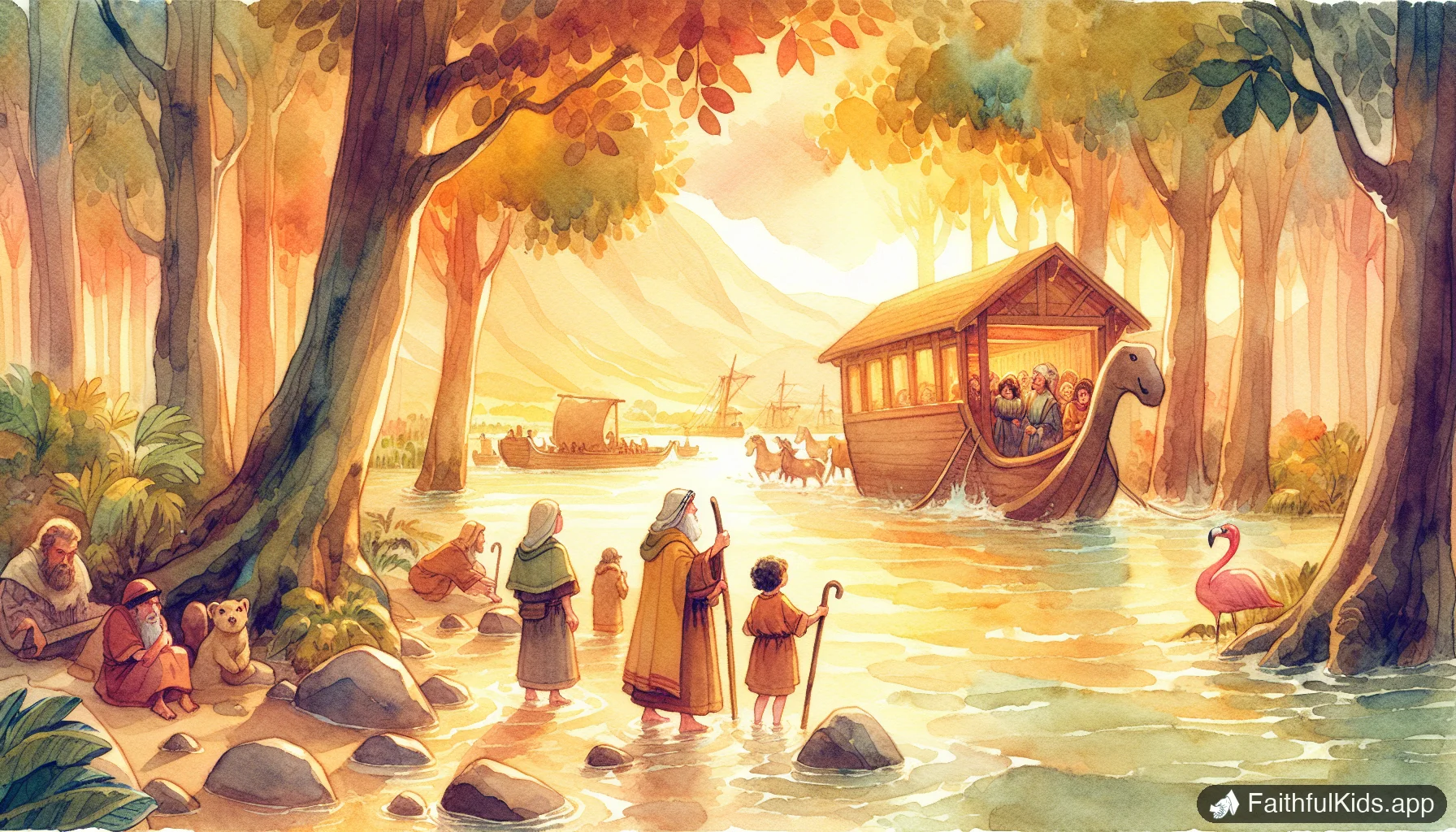
Ask simple questions: "What animal do you see on the ark?" or "Who is this?" (pointing to Jesus)
This stage is about building familiarity and positive associations with the Bible. (For story picks that work at this age, see our Bible stories for preschoolers.) As Moses told the Israelites in Deuteronomy 6:6-7, "These commandments that I give you today are to be on your hearts. Impress them on your children. Talk about them when you sit at home and when you walk along the road."
At age 3-4, you're walking alongside the road together.
Ages 5-7: Bible Storybooks and First Readers
What to use: The Jesus Storybook Bible (Sally Lloyd-Jones), The Action Bible (Sergio Cariello), early reader Bible story collections
How it works: Children in this range are learning to read. Many 5-year-olds can follow along while you read aloud, and by 7, many can read simplified Bible stories on their own. This is also the age when Bible story apps with audio narration become powerful — kids can "read along" with the narrator.
What they'll learn: Major Bible storylines (Creation, the Flood, Exodus, David and Goliath, Jesus's birth, miracles, resurrection). Cause and effect in stories. Basic moral lessons. The idea that the Bible is one big connected story, not just random tales.
Key tips:
The Jesus Storybook Bible is a masterpiece for this age. Every story points to Jesus, building the meta-narrative naturally
The Action Bible (graphic novel format) is incredible for reluctant readers, especially boys. The comic-book style keeps them engaged
Start asking "why" questions: "Why do you think David was brave enough to fight Goliath?" This builds comprehension
If your child wants to read the same story every night for a week, let them. Mastery before moving on is how children learn
Begin simple memorization: Genesis 1:1, John 3:16, Psalm 23:1. Keep it to one verse at a time
Proverbs 22:6 says, "Start children off on the way they should go, and even when they are old they will not turn from it." Ages 5-7 are when the "way" begins to take shape in a child's mind. Our list of Bible stories for 5-year-olds is a good place to begin.
Ages 8-10: Simplified Bible Translations
What to use: NIrV (New International Reader's Version), ICB (International Children's Bible), NLT (New Living Translation), or Faithful Kids video lessons with quizzes
How it works: By age 8, most children can read a simplified Bible translation with reasonable comprehension. The NIrV uses a third-grade reading level, making it accessible without oversimplifying the text. This is also the age when structured Bible education becomes powerful — children can handle quizzes, reflections, and systematic study.
What they'll learn: Extended passages and full chapters (not just excerpts). The structure of the Bible (Old Testament, New Testament, books, chapters, verses). Deeper themes: grace, forgiveness, sacrifice, covenant. How Bible stories connect to each other.
Key tips:
Get them their own Bible. Not a family Bible, not your Bible — their Bible. Write their name in it. Let them highlight and bookmark
Start with the Gospels (Mark is the shortest and most action-packed) or Genesis (the stories they already know, now in fuller detail)
Help them navigate: show them how chapters and verses work, how to use the table of contents, how to find a passage (our guide to the books of the Bible for kids makes this easier)
Pair reading with an app like Faithful Kids. Your child reads the passage, then watches the video lesson, then takes the quiz. This multi-modal approach dramatically improves retention
Don't push them through the whole Bible sequentially. Leviticus will kill their enthusiasm. Jump to the exciting parts: Exodus, Joshua, Daniel, the Gospels, Acts
This is the critical window. Psalm 119:105 says, "Your word is a lamp for my feet, a light on my path." At 8-10, children are learning to hold that lamp themselves.
If small hands need something to do while you read, the free wise men coloring page is made for exactly that.
Ages 11-13: Standard Translations With Guidance
What to use: NIV (New International Version), NLT (New Living Translation), ESV (English Standard Version), along with a study Bible or devotional guide
How it works: Preteens can handle standard adult Bible translations. The NIV and NLT strike the best balance of accuracy and readability for this age group. The ESV is slightly more formal but preferred by many Reformed traditions.
This is the age when a study Bible becomes invaluable. Study Bibles include footnotes, maps, historical context, and cross-references that help young readers understand passages in context.
What they'll learn: Historical and cultural context of Bible passages. How to interpret difficult passages. The difference between Old and New Covenant. Personal application — what does this mean for my life? Beginning of devotional practice (daily quiet time).
Key tips:
Introduce a daily devotional routine: 10-15 minutes of reading plus journaling or reflection. Start small and build consistency
Use a reading plan. The Bible Project's reading plans are excellent for this age — they provide videos that give context before reading
Encourage questions, even hard ones. "Why did God tell Abraham to sacrifice Isaac?" is a fantastic question for an 11-year-old. Don't shut it down
If your child attends youth group, coordinate. Ask what they're studying and read those passages at home too
Continue using Faithful Kids alongside direct reading. The quiz format helps them self-assess whether they truly understood the passage
Translations to know:
NIV — The most popular English translation. Balances readability and accuracy. Great default choice.
NLT — Slightly more conversational. Excellent for kids who find NIV a bit formal.
ESV — More literal translation. Good for families who prioritize word-for-word accuracy.
The Message — A paraphrase (not a translation) that makes passages sound contemporary. Great for devotional reading, but pair it with a real translation for study.
As 2 Timothy 2:15 says, "Do your best to present yourself to God as one approved, a worker who does not need to be ashamed and who correctly handles the word of truth." At 11-13, children begin learning to "correctly handle" Scripture — a skill that will serve them for life.
See what they get
Watch a Real Lesson From the App
Press play on In the Beginning Creation — a complete lesson exactly as your child sees it. 300+ episodes cover the whole Bible in order, each ending in a fun quiz to check what they learned.
A real lesson from the app — watch the whole thing free.
Ages 14+: Independent Bible Study
What to use: Any standard translation plus commentaries, concordances, or Bible study tools (YouVersion, Blue Letter Bible, Bible Gateway)
How it works: By 14, most teenagers have the reading skills and cognitive maturity to study the Bible independently. They can follow reading plans, look up cross-references, and engage with commentary. They're ready to develop their own devotional life without a parent looking over their shoulder.
What they'll learn: How to study the Bible inductively (observe, interpret, apply). How to use tools like concordances, commentaries, and original-language dictionaries. How Scripture speaks to their specific struggles (anxiety, peer pressure, identity, purpose). How to defend their faith thoughtfully (apologetics).
Key tips:
Give them space. A 14-year-old who feels forced to read the Bible will resent it. Make resources available, model the practice, and step back (our guide on how to teach the Bible to teenagers goes deeper on this)
Suggest starting with a book study: read all of James (5 chapters), or all of Philippians (4 chapters). Short books give a sense of accomplishment
Introduce them to Bible study tools. YouVersion's app is excellent for teens. Blue Letter Bible offers free original-language tools for curious minds
Talk about what they're reading at dinner. Not as a quiz, but as genuine conversation: "I read something interesting in Ecclesiastes today..."
If they're questioning their faith, don't panic. Doubt is part of growth. Point them to Psalms (David questioned God constantly) and Ecclesiastes (Solomon wrestled with meaning)
Isaiah 55:11 promises, "So is my word that goes out from my mouth: It will not return to me empty, but will accomplish what I desire and achieve the purpose for which I sent it." Trust the Word to do its work in your teenager's heart.
Common Mistakes Parents Make
Starting too late. Many parents wait until their child can read fluently before introducing the Bible. But a 3-year-old looking at pictures of Noah's Ark is planting seeds that will grow for decades.
Starting too hard. Handing a 7-year-old a full King James Bible is overwhelming. Meet them where they are with age-appropriate resources.
Making it a chore. If Bible reading feels like homework, kids will resist it. Gamified apps like Faithful Kids turn learning into something kids want to do.
Stopping too soon. Don't assume your teenager "knows enough" because they went through Sunday school. The teen years are when faith becomes personal — and that requires deeper engagement with Scripture than they got at age 8.
Going it alone. Bible reading is more powerful when it's communal. Read together as a family. Discuss passages at dinner. Share what you learned. "For where two or three gather in my name, there am I with them" (Matthew 18:20).
Watch on Faithful Kids
Ready to give your child a structured, engaging Bible education? Faithful Kids meets kids ages 7-15 with video lessons, quizzes, and reflections designed for their developmental stage. Start your free trial today.
What if my child has no interest in reading the Bible?
Start with multimedia. Many children who resist reading will gladly watch a Bible video lesson. Apps like Faithful Kids use video, quizzes, and gamification to build engagement first — the desire to read Scripture directly often follows naturally as kids get hooked on the stories. See also our Bible stories for kids who hate reading.
Which Bible translation is best for kids?
For ages 8-10, the NIrV (New International Reader's Version) is the most accessible — it uses a third-grade vocabulary. For ages 11-13, the NLT or NIV are excellent. For ages 14+, any standard translation works. Avoid the King James Version for children; the archaic language creates an unnecessary barrier.
Should I read the Bible to my child or let them read it alone?
Both, depending on age. Ages 3-7: read together. Ages 8-10: mix of reading together and beginning to read alone. Ages 11+: primarily reading alone, with family discussion. Even for teens, reading a passage together and discussing it at dinner can be incredibly powerful.
How long should daily Bible reading take for kids?
Five to ten minutes for ages 5-7. Ten to fifteen minutes for ages 8-12. Fifteen to twenty minutes for ages 13+. Consistency matters far more than duration. A child who reads for five minutes every day will retain more than one who reads for an hour on Sunday.
🌙 Free: The Bedtime Bible Kit
Seven nights of five-minute stories — a story, a prayer, and one question to whisper about.
Free printable + a few helpful emails. Unsubscribe anytime.