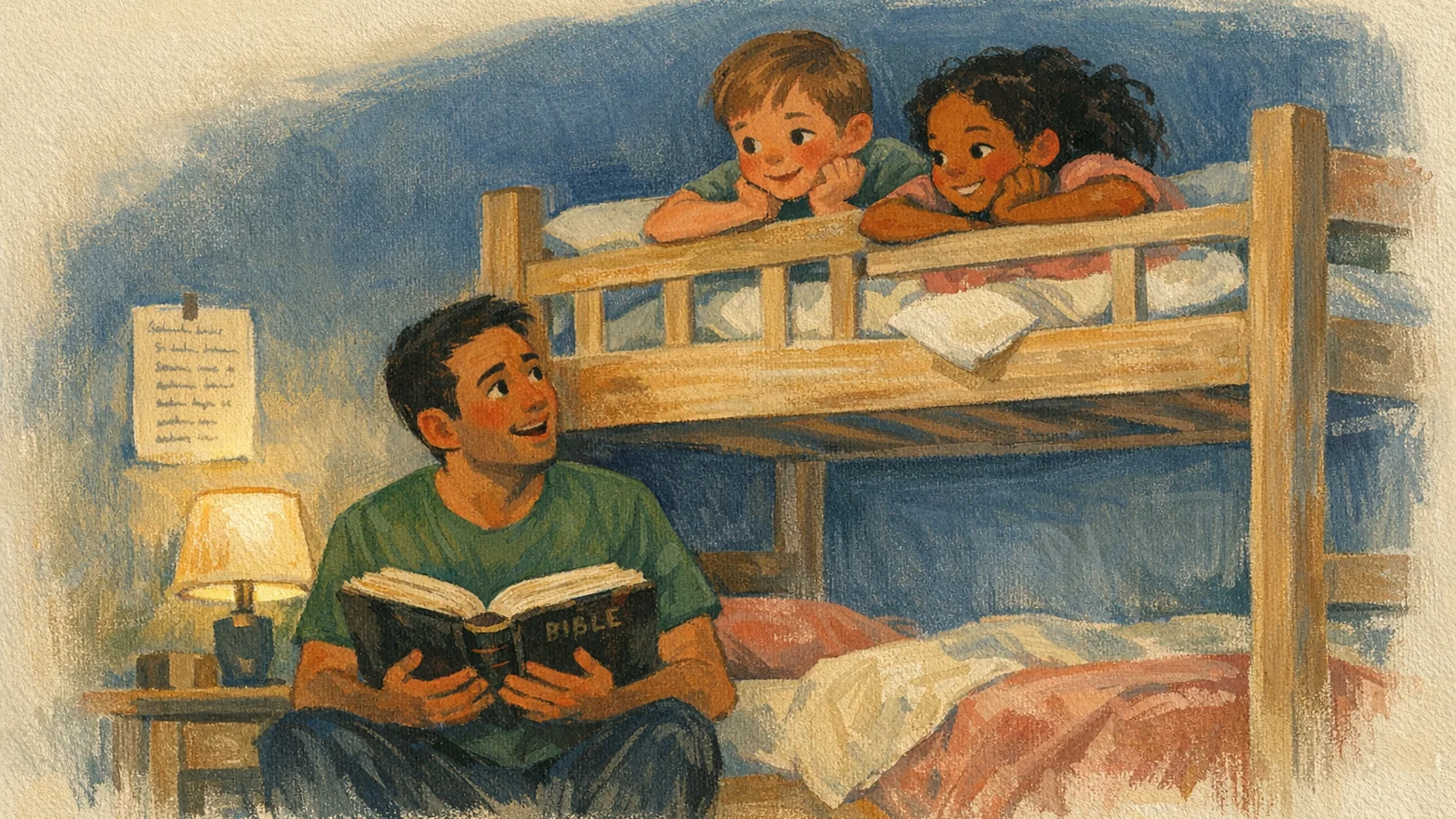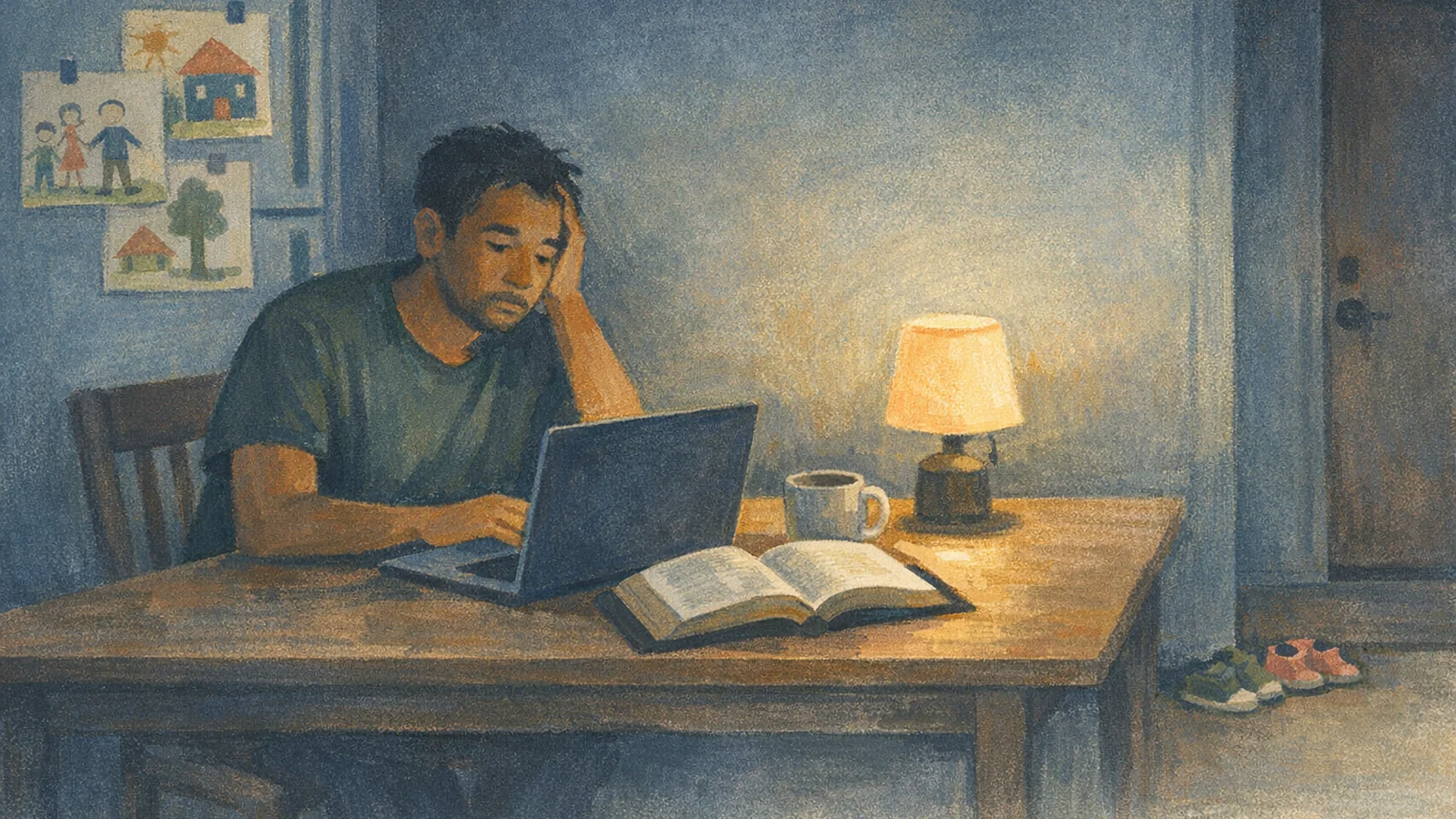
I am a Christian father, and I built a Bible app because I could not find the one I wanted for my own children. That sentence is true, and it is also the kind of sentence every founder says, so let me earn it with specifics.
What I wanted
I wanted my kids to know the Bible as one story. Not a shuffled deck of greatest hits, Noah and David and Daniel and Jesus in whatever order a publisher thought was cute, but Genesis to Revelation, in order, so that by the time they reached the manger they knew why a manger mattered. Most children's Bible material does not do this. It is organized for a Sunday, not for a year.
I wanted the pieces short. A weeknight in a real family has about two minutes of attention in it between dinner and the bath, and I would rather have two honest minutes every night than a thirty-minute "family devotion" that happens twice and dies of guilt.
I wanted each piece to end with a question, because I had noticed that my children could watch something attentively and retain nothing, and the only reliable way I knew to find out was to ask. And I wanted no ads, nothing autoplaying, no feed, for reasons I have written about elsewhere.
I looked. There are good things out there, and some of them are free, and I say so on our own comparison pages. None of them did all four. So I made one.
What it actually is
Faithful Kids is a library of more than 300 short video lessons that walk through the Bible in order, Old Testament first. Each lesson runs about two minutes, measured, not guessed. Each one is followed by a short quiz and then a reflection question for the child to answer in their own words. A parent can see, per child, what was watched, how the quiz went and what the child wrote. There are no ads and nothing a child can buy; the subscription sits behind a parental gate and is bought by a parent.
The lessons are narrated. The scripts retell the passage closely, and the Scripture reference is on screen so a parent can open the real text and check us. We publish a short statement of faith that is deliberately generalizable, because the families using this are Catholic, Protestant and Orthodox, and the catechesis is their church's job, not ours.
That is the whole product. I describe it plainly because the plain description is the best argument for it, and because I would rather you judge it on what it is than on what a landing page says.
The part that is hard to defend
The lessons are presented by an AI-generated narrator, and in the Bible lessons that narrator portrays Jesus.
I know how that lands. I have had the conversation many times, and the objection comes in two forms. The first is reverence: should a synthetic face and voice be standing in for the Lord at all? The second is accuracy: if a machine is involved, how do you know what it is saying is true?
Let me take the second first, because it has a clean answer. The machine does not write the theology. People write the scripts, from the text, with the reference. The narration is generated, the way a printed Bible is generated by a press rather than copied by a monk; the words are what matter, and the words are checkable, on screen, against the passage. If we get a word wrong, a parent can see it and tell us, and we fix it in the open.
The first objection is harder, and I do not think it should be waved away. Christians have argued about images of Christ for most of church history, and serious people land in different places. Here is where I landed, and you may land elsewhere. Children's Bibles have drawn Jesus for centuries. Films have cast actors as him. A narrated video lesson is in that tradition, not outside it. What would be wrong is pretending: presenting a generated voice as something it is not. So we say it is AI, plainly, and we treat the portrayal the way a reverent illustrator would, as a way of putting a child inside the story, never as a claim to be anything more than that. If your conscience says no to any depiction, I respect it completely, and our two hundred written story retellings and all of our printables are free, with no narrator in sight.
I would rather tell you exactly what this is and let you decline than soften it and have you find out later.
What it is not
It is not a church. It does not replace a Sunday school teacher who knows your child's name, and I would be alarmed by a parent who thought it did. It is not a curriculum in the full sense; it is the daily, ordinary, two-minute habit that a curriculum assumes and families struggle to build. It is not for every family; the pages where we compare ourselves to other Bible apps say honestly where the others are better, including the ones that are free.
And it is not finished. I answer the support email myself, and the most useful thing in my inbox is a parent telling me what their child got wrong, or what a story missed, or where the quiz asked a bad question. Some of those have come from children in churches that use the app, and they have been right. That is the review process I trust most, and this section of the site exists partly so those voices have somewhere to be heard with their names on.
Why I am telling you this here
Parenting at Faithful Kids is meant to be a place where parents, pastors and teachers write honestly, under their own names, about raising children in the faith. It would be strange to launch that with a founder essay that read like an advertisement. So this is the other kind: the reasons, the limits, and the objection I still think about. If you read it and decide this is not for your family, the essay has done its job. If you read it and have something to say back, there is a form for that, and I read every submission myself.
Sources
Disclosure. I founded Faithful Kids and own Catterfly LLC, the company that publishes it. This piece describes my own product. I have tried to give the objections their full weight.
From Faithful Kids
- What Faithful Kids is, in plain facts
- 200 free Bible stories for kids, no account needed
- About the app
Faithful Kids publishes this section. Our Bible stories and printables are free for every family.