Forty-six percent. That is the share of people who, asked where Mary laid the baby Jesus after he was born, chose the manger. Not strangers stopped in a car park. People who had gone looking for a Bible quiz, found one on a Christian children's site, and sat down to play it. One hundred and twenty-eight of them answered that question between the middle of September and the start of November, and fewer than half got it right.
I want to be careful about what that number is and is not, because it would be easy to make it say more than it does. Since September 15 our free Bible trivia games have graded 26,395 answers from 2,576 players over 51 days. Those players are not a sample of anyone. They are parents, Sunday school teachers, homeschoolers, teenagers and children who chose to play, and we do not know any player's age, so none of this is a children's score or an adult's score. Every question is four-option multiple choice with the options shuffled, so guessing scores 25 percent. Each figure in this piece shows how many answers it rests on, and the full study shows every question and the method.
With all of that said: the people most motivated to know the Bible scored 53 percent on the main game across the 100 questions that were answered at least 30 times. Nine of those 100 questions were answered correctly 75 percent of the time or better. Forty-two came in below half. Three scored worse than guessing. And the shape of which stories survived and which did not is the most useful thing I have learned this year about how we teach children the Bible.
The stories we tell at five are safe for life
Look at the top of the table and you see every picture Bible ever printed. Finish "For God so loved the world that he gave his one and only": 86 percent (118 answers). The first man and woman: 85 percent (112). Who built the ark: 82 percent (113). The garden's name: 82 percent (124). What Jesus turned water into: 79 percent (112). What David used against Goliath: 77 percent (116).
These are the stories a child hears at four, colours in at five, acts out at six and hears again every year after. They are told so often, in so many rooms, that they become furniture. Nobody forgets furniture. That is good news, and it is also the whole lesson, because it tells you exactly what it takes for a Bible story to stay: it has to be told, early, and then told again.
The middle goes missing
Now look at what sits between Genesis and the Gospels. Who was Israel's first king: 34 percent (111 answers). The woman who defeated Sisera with a tent peg: 37 percent (90). Which city's walls fell to trumpets: 38 percent (96). What fell from heaven to feed Israel in the desert: 39 percent (111). How many soldiers God let Gideon keep: 39 percent (116).
Then the early church. In which city were believers first called Christians: 20 percent (74 answers), the lowest score in the data and well below the 25 percent you would get by closing your eyes. The three languages on the sign over the cross: 25 percent (105). Ruth's sister-in-law who turned back: 25 percent (69).
Judges, the kings and the early church are not forgotten. They were never told. You cannot lose what you were never handed.
I do not think these players are careless. I think they were never given these stories as children, because most of us were not either. Children's Bible teaching runs from Creation to Joseph, jumps to Moses, pauses at David and Daniel, and then goes straight to Bethlehem. The book of Judges, with Deborah and Gideon and Samson, is a few hundred pages that almost no child hears as a sequence. The rise and fall of the kings, which is the spine of the Old Testament, becomes one shepherd boy and one slingshot. Acts becomes Pentecost and Paul's shipwreck. What is not told at five is not known at thirty-five, and the quiz is simply measuring the shape of what we hand over.
Even the stories we do tell, we tell as the picture-book version. Asked how many of each clean animal Noah took aboard, only 35 percent (108 answers) chose seven pairs, which is what Genesis 7:2 says. The rest picked two, because the ark on the nursery wall has two of everything. The outline survived. The text did not.
The Christmas story is closer to the middle than to Eden
This is the part I expected to be safe, and it was not. Where Mary laid the baby: 46 percent (128 answers). The town where Jesus was born: 52 percent (131). The three gifts: 50 percent (126). What the wise men followed: 62 percent (127). And asked how many wise men the Bible says visited Jesus, 55 percent (78) gave the right answer, which is that Matthew never gives a number. He counts the gifts, not the givers. The other 45 percent confidently picked one.
How can the most-told story in the world score like Jericho? I think because it is told to us, not by us. We hear it sung, staged, printed on cards and played in shops from November onward, and that constant background hum feels like knowing. Then someone asks a plain question about Luke 2 and it turns out we know the pageant, not the passage. That is worth sitting with, a few weeks before Advent begins.
One more number, with a caveat. Asked where the Bible says "God helps those who help themselves", 65 percent (139 answers) correctly said it does not. That question lives in our blog games, where the article's own text sits on the same page, so treat the figure generously. Even so, a third of motivated players believed a proverb was Scripture.
What a parent can do about it this Advent
None of this calls for a new curriculum. It calls for telling the stories that do not get told, and for reading the one that does.
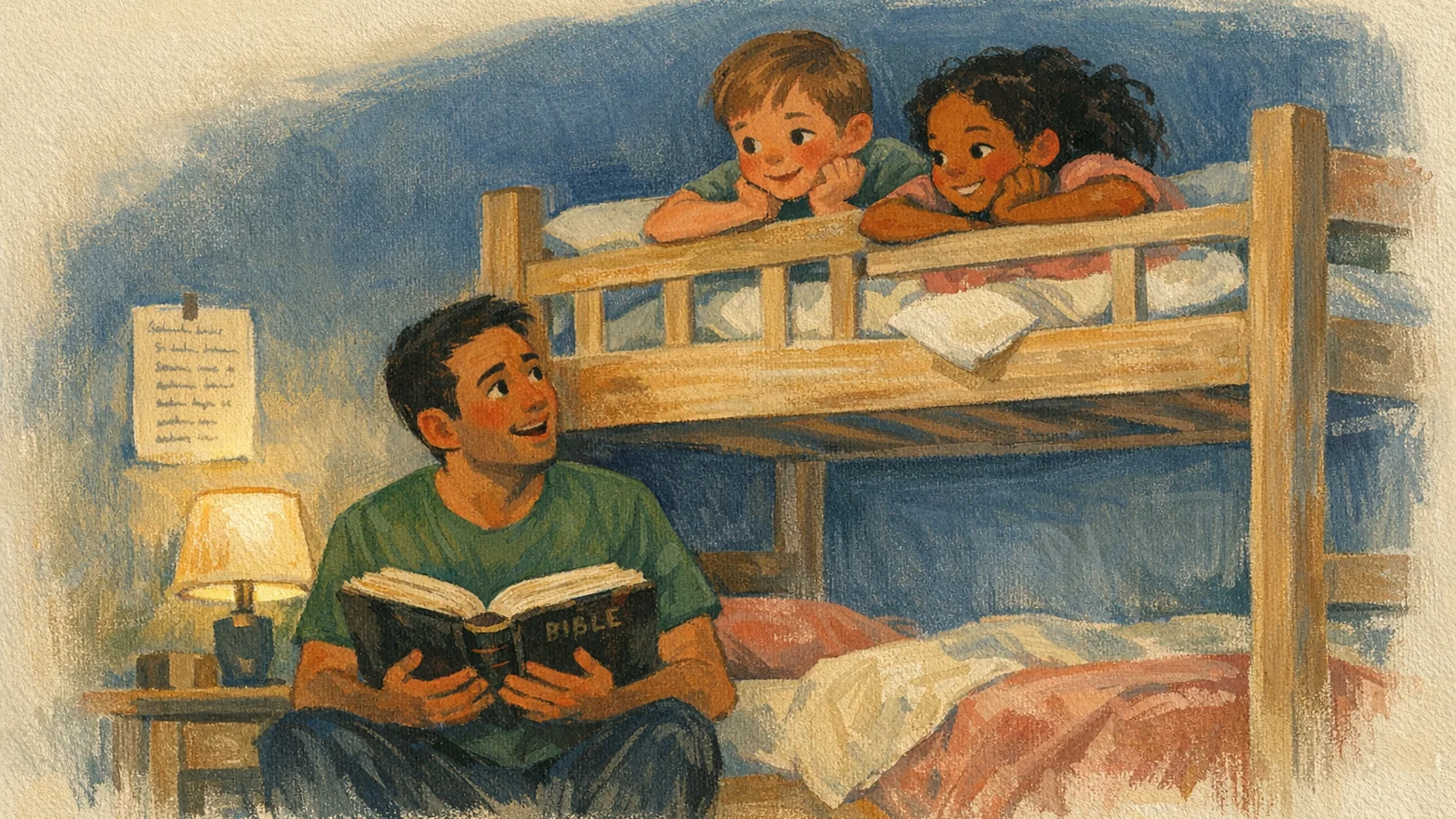
- Read the nativity from the Bible, not from memory. Luke 2 and Matthew 2, aloud, at the table, once each in December. Count the gifts with your children and let them notice that nobody counts the kings. It takes ten minutes and it will correct things you did not know you had wrong.
- Give the middle a seat. One story a week from the part of the Bible nobody told you: Deborah and Jael, Gideon's three hundred, the people shouting for a king and getting Saul, Elijah on Carmel, the believers in Antioch getting their name. Four weeks of Advent is four stories. Children find Judges thrilling, because it is.
- Let them catch you not knowing. The best thing in our data is not a score. It is how many families play the quiz together and discover, out loud, that the grown-up did not know either. A parent who says "I had no idea, let's look it up" has taught a child what to do with the Bible for the rest of their life.
- Play it. The quiz that produced these numbers is free and takes about ninety seconds, with rounds for kids, teens and adults. Take it together, then go find the questions you missed in the book.
Why I am publishing this
Faithful Kids makes Bible videos for children, so I have an interest in people thinking their kids need more Bible, and you should weigh this piece with that in mind. But the data would be worth publishing if we sold nothing at all. We will rerun it at Easter and say plainly whether anything moved.
For now, the finding is simple and I think it is hopeful. The stories we tell children survive. All of them. The gaps in the data are not gaps in memory. They are a map of the stories we have not told yet, and there is time before Christmas to start.
Sources
Disclosure. I founded Faithful Kids, which runs the free quiz this data comes from. The study page shows the method and every figure.
From Faithful Kids
- Take the quiz yourself: free, no signup, rounds for kids, teens and adults
- The full study, with every question and its sample size
- 200 free Bible stories for kids, in order
Faithful Kids publishes this section. Our Bible stories and printables are free for every family.