Pick up any children's Bible and flip through it. Creation, Noah, Abraham, Joseph. Moses and the sea. Maybe Joshua at Jericho, maybe Samson, almost certainly David and his sling. Then Daniel and the lions, Jonah and the fish, and a hard cut to a stable in Bethlehem. Between the Red Sea and the manger there are roughly a thousand pages of the actual Bible, and the picture book has spent eight of them.
I understand why. Judges is violent. Kings is a list of men with similar names doing similar wrong things. Leviticus is Leviticus. If you have five minutes at bedtime and a child who will not sit still, you reach for Noah, and I did too, for years.
Then two things happened. The first was that our five-minute routine, the one I wrote about here before, had run long enough that we had read the famous stories several times each and my oldest said, in the flat voice of a ten-year-old, "we know this one." The second was a set of numbers from this site's own quiz. Among people who went looking for Bible trivia on a Christian kids' platform, 34 percent could name Israel's first king (111 answers), 37 percent knew the woman who finished off Sisera with a tent peg (90), and 39 percent knew how many men God let Gideon keep (116). Players chose to play and nobody knows their ages, so those are not children's scores. But they told me something I already suspected about my own house: the parts we skip do not get learned later. They just stay skipped.
So we stopped skipping. Here is what that has looked like, what we still leave out, and why I think the boring parts are the best thing we have done for our children's faith.
The boring parts are not boring
This is the first discovery and it is the whole argument. The stories children's Bibles omit are, with a few exceptions, the most gripping material in the book.
A woman invites an exhausted general into her tent, gives him milk, covers him with a blanket, waits until he sleeps, and drives a tent peg through his head (Judges 4:17-22). My seven-year-old sat bolt upright. God tells Gideon his army is too big, and whittles thirty-two thousand men down to three hundred by watching how they drink from a river (Judges 7:1-8). A donkey sees an angel its rider cannot, refuses to move, gets beaten, and then speaks (Numbers 22:21-34). Israel demands a king, God gives them Saul, and when the moment comes to present him to the people, the tallest man in the country is found hiding in the luggage (1 Samuel 10:20-24). A Syrian commander with leprosy is told to wash in a muddy river and nearly refuses because the cure is too ordinary (2 Kings 5:1-14).
These are not stories you have to sell to a child. You have to stop a child from asking for them again. The reason they are left out of the picture books is not that children find them dull. It is that adults find them awkward: too violent, too strange, too hard to end with a tidy moral. Which brings me to the second discovery.
Awkward is where the conversations are
Noah's ark, as children's books tell it, has no loose ends. Animals, rain, rainbow, done. Jael has nothing but loose ends. Was it right? She broke every rule of hospitality in the ancient world. The song in the next chapter calls her "most blessed of women." My daughter asked whether God wanted her to do it, and I had to say that the Bible praises her and does not explain her, and that we are allowed to sit with that.
That conversation did more for my children's understanding of Scripture than a year of tidy stories. They learned that the Bible is not a book of fables with the lesson printed at the bottom. It is a record of God working through real, strange, frightened, violent, faithful people, and it trusts the reader to think. A child who meets Jael at seven, with a parent beside them, is far better prepared for the hard questions at seventeen than a child who thinks the whole book is as smooth as the ark.
The parts we skip are not the parts children find dull. They are the parts adults find awkward, and awkward is where the real conversations live.
How we actually do it
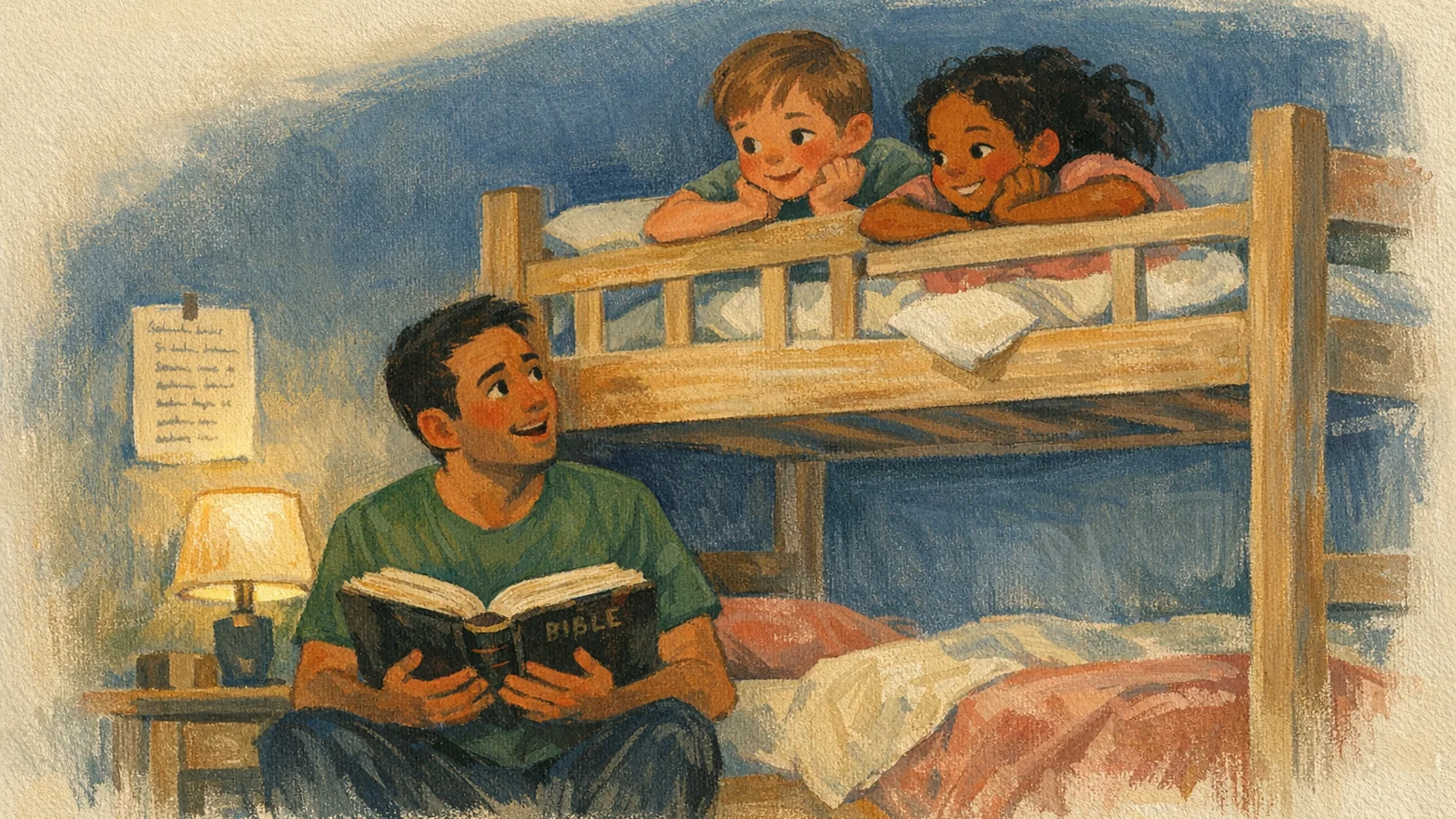
Nothing about the routine changed. It is still five minutes, still attached to bedtime, still cheap to miss. What changed is the map.
- We read in order, one book at a time, and we read the actual text. A good modern translation, aloud, a few paragraphs a night. Children's Bibles are excellent at three and four; by six or seven most children can follow the real thing, and they can tell the difference. They know when they are being given the pudding version.
- We skip within books, not around them. Judges has a few chapters I will not read to a seven-year-old, and I say so: "The next part is for when you're older." Children accept this completely, and it teaches them that the Bible is a grown-up book they are growing into, not a children's book they will grow out of. The genealogies we read quickly, out loud, as a game: who can hear a name they recognise?
- One question, not a lesson. The same rule as before. After Gideon's three hundred: why would God want a smaller army? After Naaman: why was he angry about the river? Then lights out. The question does more work overnight than any explanation would.
- We let the hard ones stay hard. When my son asked why God told Saul to destroy the Amalekites, I did not have a clean answer and I did not pretend to. I told him it is one of the hardest passages in the Bible, that Christians have thought about it for two thousand years, and that we would keep thinking about it together. He nodded and went to sleep. The honesty was the lesson.
- We keep a running list of names. A sheet of paper on the fridge: Deborah, Jael, Gideon, Jephthah, Ruth, Hannah, Samuel, Saul, Jonathan, Abigail, Nathan. Children love a list, and a list of people they have met is a list of stories they own.
What we leave out, honestly
I am not reading Leviticus aloud to a seven-year-old, and I do not think anyone should feel bad about that. The long legal sections, the tabernacle measurements, the later prophets at full length: we summarise, we read a famous passage, we move on. The goal is not completeness. The goal is that my children grow up knowing that the Bible has a middle, that the middle is full of people, and that the people are as real and as complicated as the ones in the Gospels.
Paul told Timothy that "all Scripture is God-breathed and is useful for teaching" (2 Timothy 3:16). All of it. Not the eight stories with good illustrations. I used to read that verse as a statement about authority. I read it now as a dare.
What happened
Eighteen months on, my children's favourite Bible stories are, in order: the talking donkey, Jael, Ehud and the very fat king, and Elisha and the bears, which I am still not sure I should have read them. None of those are in the picture Bible on their shelf. Noah is still in there, and they still like him. But when a visiting cousin said he knew all the Bible stories, my daughter asked him about the tent peg, and he had never heard of it, and she told him, accurately, in full, with the milk and the blanket.
That is a child who owns a story. She will not forget it, and she will not be surprised, later, to find that the Bible is stranger and larger than the book she was handed at four. If the quiz numbers say anything about how we pass Scripture on, they say that the stories we tell survive and the stories we skip vanish. We decided to stop skipping. It costs five minutes a night and it has been the best five minutes of the day.
Sources
From Faithful Kids
- The Five-Minute Family Devotion That Lasts All Year, the routine this grew out of
- Could You Pass a Children's Bible Quiz? Most Cannot.
- 200 free Bible stories for kids, in order
Faithful Kids publishes this section. Our Bible stories and printables are free for every family.