Ages 5+·21 min read··By Faithful Kids Team·Updated August 19, 2026
These are 60 of the most common questions people ask about the Bible, each answered in two to four plain sentences. No seminary vocabulary, no ten-paragraph detours -- just the kind of answer you could read out loud to a curious eight-year-old and have it land.
That simplicity is the point. Most Bible Q&A pages are written for adults who already know the story. This one is written so that a parent, a Sunday school teacher, or a kid reading over your shoulder can all get a clear answer fast. Where Christians genuinely disagree on a question, the answer says so honestly instead of picking a side.
The questions are grouped into four sections: the Bible itself, the people in it, Jesus, and the big questions kids ask that stop parents in their tracks. Use the list as a reference, a dinner-table conversation starter, or a warm-up before a round of 100 Bible trivia questions and answers.
Questions About the Bible Itself
1. Who wrote the Bible?
About 40 different people wrote the Bible over roughly 1,500 years -- shepherds, kings, fishermen, a doctor, and a tentmaker among them. Christians believe God guided each writer, which is why 2 Timothy 3:16 calls Scripture "God-breathed." So the Bible has many human authors but, in the Christian view, one divine one.
2. What does the word "Bible" mean?
It comes from the Greek word biblia, which simply means "the books." That fits, because the Bible is not one book -- it is a library of 66 books collected into one volume.
3. How many books are in the Bible?
Most Protestant Bibles have 66 books: 39 in the Old Testament and 27 in the New Testament. Catholic and Orthodox Bibles include several additional books, often called the deuterocanonical books. All Christian Bibles share the same core 66.
4. What are the two parts of the Bible called?
The Old Testament and the New Testament. The Old Testament tells the story of the world's beginning and God's people Israel before Jesus; the New Testament tells about Jesus' life, death, and resurrection, and the early church. "Testament" is an old word for a covenant -- a solemn promise.
5. What language was the Bible written in?
Three languages. Most of the Old Testament was written in Hebrew, with a few passages in Aramaic, and the New Testament was written in Greek. That is why English Bibles are translations.
6. What is the oldest book in the Bible?
Genesis describes the earliest events, starting with Creation itself. But many scholars think Job may have been written down earliest, possibly around the time of Abraham. Nobody knows the exact dates, and the Bible itself doesn't say.
7. What is the longest book in the Bible?
Psalms has the most chapters -- 150. But by word count, Jeremiah is actually the longest book. Either one is a safe trivia answer, depending on how you measure.
8. What is the shortest book in the Bible?
By verse count, 2 John is the shortest, with just 13 verses. By word count in the original language, 3 John edges it out. Both are one-page letters you can read in under two minutes.
9. What is the shortest verse in the Bible?
"Jesus wept" (John 11:35). Just two words in English -- and they come at the moment Jesus cries at the tomb of his friend Lazarus, showing that God understands grief from the inside.
10. What is a Gospel?
"Gospel" means "good news." The four Gospels -- Matthew, Mark, Luke, and John -- are the four accounts of Jesus' life, teachings, death, and resurrection at the start of the New Testament. Each tells the same story from a different angle, like four witnesses to the same events.
11. Who divided the Bible into chapters and verses?
The original writers didn't -- those numbers were added much later so people could find passages easily. Stephen Langton added chapter divisions around the year 1200, and Robert Estienne added verse numbers in the 1550s. That's why a "verse" sometimes cuts a sentence in half.
12. Why are there so many different Bible translations?
Because the Bible was written in Hebrew, Aramaic, and Greek, every English Bible is a translation, and translators make different choices between word-for-word accuracy and easy readability. The NIV, ESV, KJV, and others all carry the same message in slightly different English. For kids, an easy-to-read translation like the NIrV or NLT is a great start.
13. Is the Bible the best-selling book of all time?
Yes -- by a wide margin. Billions of copies have been printed, and the full Bible has been translated into more than 700 languages, with portions in over 3,000. No other book comes close.
14. What was the Bible written on before printed books existed?
Scrolls made of papyrus (a paper-like material from reeds) and parchment (treated animal skin). Scribes copied them by hand, letter by letter, for centuries. The printing press didn't exist until the 1450s -- and the first major book ever printed on it was the Bible.
15. What is the last book of the Bible?
Revelation, written by John. It is a vision of the end of the story: Jesus returning, evil defeated for good, and God making "a new heaven and a new earth" where he wipes every tear from his people's eyes (Revelation 21:1-4).
Questions About People in the Bible
16. Who were the first people God created?
Adam and Eve. Genesis says God formed Adam from the dust of the ground and made Eve as his partner, and they lived in the Garden of Eden (Genesis 2). Everything was good until they chose to disobey God -- which is where the Bible's whole rescue story begins.
17. Who built the ark?
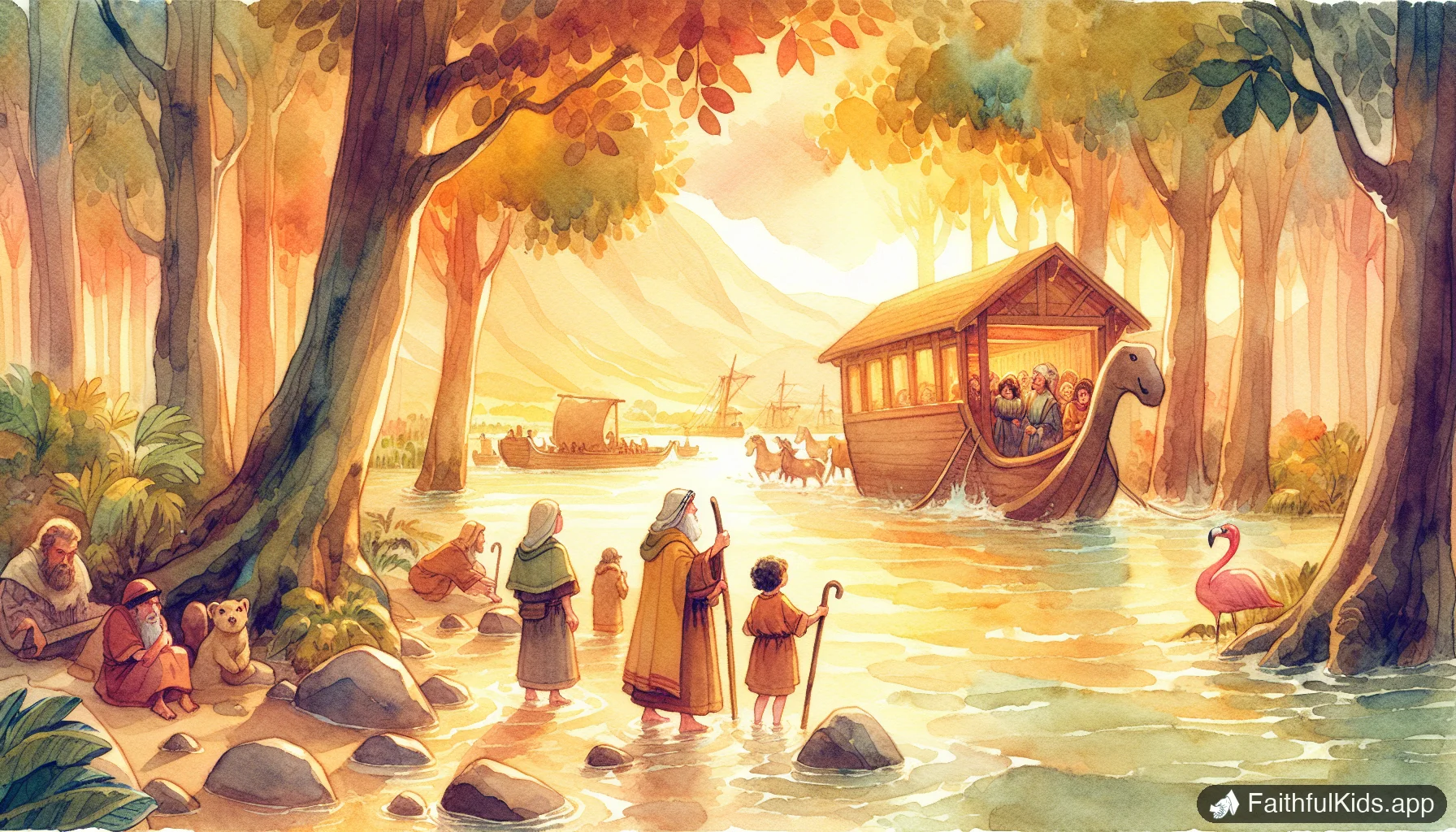
Noah. God told him a flood was coming and gave him the exact measurements for a huge boat to save his family and the animals (Genesis 6). It rained forty days and forty nights, and afterward God set the rainbow in the sky as a promise.
18. Who was Abraham?
Abraham was the man God chose to start his special family, promising that through him "all peoples on earth will be blessed" (Genesis 12:3). He left his home and followed God without knowing where he was going. Jews, Christians, and Muslims all trace their story back to him.
19. Who was Moses?
Moses led the Israelites out of slavery in Egypt after God sent ten plagues and parted the Red Sea (Exodus 14). On Mount Sinai, God gave him the Ten Commandments. He is traditionally credited with the first five books of the Bible.
20. Who was the strongest man in the Bible?
Samson, whose God-given strength let him defeat a lion with his bare hands (Judges 14). His strength was tied to his promise to God, symbolized by his uncut hair -- and when he broke that promise, the strength left him. His story is a warning that gifts from God come with responsibility.
21. Who killed Goliath?
David, while he was still a shepherd boy too young to join the army. He refused the king's armor and used a sling and a single stone, saying the battle belonged to God (1 Samuel 17). He later became Israel's greatest king.
22. Who was the wisest king in the Bible?
Solomon, David's son. When God offered him anything he wanted, Solomon asked for wisdom to lead well instead of riches or long life -- and God gave him all three (1 Kings 3). He built the first temple in Jerusalem and wrote much of Proverbs.
23. Who was swallowed by a great fish?
Jonah. He ran from God's instruction to preach in Nineveh, got thrown off a ship in a storm, and spent three days and nights inside the fish before praying and getting a second chance (Jonah 1-2). Note the Bible says "a huge fish" -- it never says whale.
24. Who survived a night in the lions' den?
Daniel. He was thrown in for continuing to pray to God when the king's law forbade it, and God sent an angel to shut the lions' mouths (Daniel 6). He walked out without a scratch.
25. Who was Esther?
A Jewish girl who became queen of Persia and risked her life to stop a plot to destroy her people. Her cousin Mordecai told her she may have become queen "for such a time as this" (Esther 4:14). Esther is one of only two books of the Bible named after a woman.
26. Who was Ruth?
A young widow from Moab who refused to abandon her mother-in-law Naomi, saying "Where you go I will go... your God my God" (Ruth 1:16). She became the great-grandmother of King David -- which makes her an ancestor of Jesus.
27. Who baptized Jesus?
John the Baptist, in the Jordan River. John had spent his life telling people to get ready for the Messiah, and when Jesus came up out of the water, God's voice said, "This is my Son, whom I love" (Matthew 3:13-17).
28. Who were the twelve disciples?
The twelve close followers Jesus chose to learn from him and carry on his work -- including the fishermen Peter, Andrew, James, and John, plus Matthew the tax collector, Thomas, and Judas Iscariot, among others (Matthew 10:2-4). "Disciple" means student or apprentice.
29. Who was Paul?
A man who started out arresting Christians -- back when his name was Saul -- until the risen Jesus appeared to him in a blinding light on the road to Damascus (Acts 9). He became the early church's greatest missionary and wrote thirteen letters that are now books of the New Testament.
30. Who betrayed Jesus?
Judas Iscariot, one of the twelve disciples, handed Jesus over to his enemies for thirty pieces of silver, identifying him with a kiss (Matthew 26:14-16, 47-49). Peter also failed Jesus that night by denying he knew him three times -- but Peter was forgiven and restored, which is one of the Bible's best pictures of second chances.
Questions About Jesus
31. Where was Jesus born?
In Bethlehem, a small town near Jerusalem, because Mary and Joseph had traveled there for a census (Luke 2:4-7). There was no guest room available, so Mary laid the newborn Jesus in a manger -- a feeding trough for animals. You can read the whole scene, told for kids, in the Christmas story for kids.
32. Where did Jesus grow up?
In Nazareth, a small village in the region of Galilee, which is why he was called "Jesus of Nazareth" (Matthew 2:23). It was such an unimportant town that one of his future disciples asked, "Can anything good come from Nazareth?" (John 1:46).
33. Who were Jesus' parents?
Mary was his mother, and Joseph, a carpenter, raised him as his father. Christians believe Jesus had no human biological father -- the angel Gabriel told Mary her child would be conceived by the Holy Spirit and would be called the Son of God (Luke 1:35). The story of that announcement is a great one to read with kids: an angel visits Mary.
34. What work did Jesus do before he began teaching?
He worked as a carpenter, the same trade as Joseph (Mark 6:3). Jesus spent roughly thirty years living an ordinary, hardworking life before his public ministry began -- which means God knows what ordinary days feel like.
35. What was Jesus' first miracle?
Turning water into wine at a wedding in the village of Cana, after the hosts ran out (John 2:1-11). It was a quiet miracle -- most guests never knew -- and John says it was the first sign that revealed his glory.
36. What miracles did Jesus do?
He healed the sick and the blind, calmed a storm with a command, walked on water, fed more than five thousand people with five loaves and two fish, and raised his friend Lazarus from the dead (John 11). The Gospels record about three dozen miracles and say he did many more.
37. What is a parable?
A short, everyday story Jesus told to teach a big truth -- like the Good Samaritan, the Prodigal Son, or the Lost Sheep. Parables stick in your memory the way facts don't, which is exactly why Jesus used them. He told around forty of them.
38. What does "Christ" mean?
It is not Jesus' last name -- it is a title. "Christ" is Greek for "anointed one," the same as the Hebrew word "Messiah": the rescuer-king God had promised for centuries. Calling him "Jesus Christ" means "Jesus, the promised King."
39. Did Jesus ever sin?
No. The Bible says Jesus "has been tempted in every way, just as we are -- yet he did not sin" (Hebrews 4:15). That means he understands how hard temptation is, and it is also why he could take our place: only someone with no wrongs of his own could pay for someone else's.
40. What is the greatest commandment?
Jesus was asked exactly this, and he answered: love God with all your heart, soul, and mind -- and the second is like it: love your neighbor as yourself (Matthew 22:37-39). He said everything else in the Bible hangs on those two.
41. Why did Jesus have to die?
Because sin separates people from God, and someone had to pay for it -- so Jesus, who had no sin, took the punishment in our place out of love. "God so loved the world that he gave his one and only Son, that whoever believes in him shall not perish but have eternal life" (John 3:16). The cross wasn't a defeat; it was a rescue.
42. What happened three days after Jesus died?
He rose from the dead. On the first Easter morning, his followers found the tomb empty, and Jesus appeared alive to them -- and later to more than five hundred people at once (1 Corinthians 15:6). The resurrection is the center of the Christian faith: it is God's proof that death doesn't get the last word.
43. Where is Jesus now?
The Bible says he ascended to heaven forty days after his resurrection and is with God the Father (Acts 1:9-11). Before he left, he promised his followers two things: the Holy Spirit would come to be with them, and "surely I am with you always" (Matthew 28:20).
44. Will Jesus come back?
Yes -- the Bible promises he will return to set everything right (Acts 1:11). But it also says plainly that no one knows the day or hour, not even the angels (Matthew 24:36). Christians differ on the details of how it unfolds, but the promise itself is one all Christians share.
45. What is the Lord's Prayer?
The prayer Jesus taught his disciples when they asked him how to pray: "Our Father in heaven, hallowed be your name..." (Matthew 6:9-13). It covers praising God, asking for daily needs, seeking forgiveness, and asking for protection -- a complete prayer in about thirty seconds, simple enough for a child to memorize.
See what they get
Watch a Real Lesson From the App
Press play on Daniel in the Lions Den — a complete lesson exactly as your child sees it. 300+ episodes cover the whole Bible in order, each ending in a fun quiz to check what they learned.
A real lesson from the app — watch the whole thing free.
Big Questions Kids Ask
46. Who made God?
No one. God has always existed -- he had no beginning and will have no end (Psalm 90:2). It is a hard idea for anyone to picture, kids and grown-ups alike, because everything we know has a starting point. But if someone had made God, that someone would be God.
47. Can we see God?
Not with our eyes -- the Bible says "no one has ever seen God" (John 1:18). But Jesus said, "Anyone who has seen me has seen the Father" (John 14:9), so looking at Jesus is how we know what God is like. We also see what God does, the way we see wind by watching the trees.
48. Does God hear my prayers?
Yes -- every single one, spoken out loud or thought silently (1 John 5:14). God answers in different ways: sometimes yes, sometimes no, sometimes wait. A "no" or a "not yet" is still an answer from a Father who knows more than we do.
49. What is sin?
Sin is choosing our own way over God's way -- in what we do, say, or think. The Bible says everyone sins, without exception (Romans 3:23), which is why everyone needs forgiveness. The good news is that God promises to forgive anyone who is honest with him about it (1 John 1:9).
50. Why do bad things happen?
Because the world is broken -- when people turned away from God, sadness, sickness, and death came in with them. God didn't cause the brokenness, and he didn't stay away from it either: Jesus came right into it and suffered too. The Bible promises God will one day end all of it -- "no more death or mourning or crying or pain" (Revelation 21:4). We answer this one at kid level in why do bad things happen?.
51. What is the Trinity?
Christians believe there is one God who exists as three persons: the Father, the Son (Jesus), and the Holy Spirit. Not three gods, and not one person wearing three masks -- one God, three persons. It is a mystery no illustration fully captures, and that's okay; we have a whole guide on explaining the Trinity to a child.
52. What is the Holy Spirit?
The Holy Spirit is God's own presence living with and in his people. Jesus called him "the Advocate" -- a helper, comforter, and teacher who reminds us of everything Jesus said (John 14:26). The Spirit is not a force or a feeling; the Bible speaks of him as a person.
53. What is faith?
Faith is trusting God -- his character and his promises -- even when you can't see him. The Bible defines it as "confidence in what we hope for and assurance about what we do not see" (Hebrews 11:1). It is less like believing in magic and more like trusting a parent who has never let you down.
54. How does someone become a Christian?
By trusting Jesus -- believing that he died for your sins and rose again, and asking him to forgive you and lead your life. The Bible puts it simply: "If you declare with your mouth, 'Jesus is Lord,' and believe in your heart that God raised him from the dead, you will be saved" (Romans 10:9). Churches celebrate and mark this step in different ways, but the heart of it is that simple trust.
55. What is baptism?
Baptism uses water as a sign of belonging to Jesus -- a picture of being washed clean and starting a new life with him. Jesus himself was baptized and told his followers to baptize others (Matthew 28:19). Christians practice it differently -- some baptize babies, some wait until a person can choose for themselves; some sprinkle, some fully immerse -- but in every church it points to the same Jesus.
56. What is communion?
Communion (also called the Lord's Supper or Eucharist) is when Christians share bread and the cup to remember Jesus' death, because at his last meal he said, "Do this in remembrance of me" (Luke 22:19). Different churches understand the details differently, but all of them are obeying the same instruction from the same night.
57. What is heaven like?
Heaven is being with God -- and the Bible says that where God is, there is "no more death or mourning or crying or pain" (Revelation 21:4). Scripture gives glimpses rather than a map: a feast, a city with open gates, a world made new. The best one-sentence answer for a child: heaven is where everything sad comes untrue and we are with God forever.
58. What happens when we die?
The Bible's focus is on a promise rather than a diagram: Jesus told a dying man, "Today you will be with me in paradise" (Luke 23:43), and said, "The one who believes in me will live, even though they die" (John 11:25). Christians trust that those who belong to Jesus are safe with him, and that one day God will raise his people to life in a renewed world. Christians hold different views on some of the in-between details, and that's honest to admit.
59. Do animals go to heaven?
The Bible doesn't answer this one directly -- so the honest response is "we don't know for sure." What we do know is that God made animals, cares for them (Matthew 6:26), and paints his renewed world as full of them, with the wolf living with the lamb (Isaiah 11:6). A good answer for a grieving child: God loves everything he made, and heaven will not be missing anything good.
60. Why do we go to church?
Because church isn't a building -- it's the people, and faith was never meant to be practiced alone. The Bible tells believers to keep meeting together to encourage one another (Hebrews 10:25). At church we worship God, learn the Bible, and become part of a family that shows up for each other.
How to Use These Questions With Kids
Don't read all 60 in a sitting -- pick one question at dinner or bedtime and let the follow-up conversation go where it goes. The follow-ups are the good part: a child who asks "but who made God?" is doing real theology, and "I don't know, but I believe God does" is always an allowed answer. For age-by-age language on the biggest question of all, see our guide on how to explain God to a child.
If your kids like learning this way, that's exactly how Faithful Kids works: short animated video lessons on every major Bible story, each followed by a quiz and a reflection, for ages 7-15. It turns questions like these into a daily habit that feels like screen time.
Many of these questions come up at bedtime, right when the lights go out. Our free Bedtime Bible Kit gives you seven nights of short stories, a question to whisper about, and a goodnight prayer for exactly those moments.
The same bank runs our play-along Bible quiz -- pick easy, medium, or hard and chase the streak.
Frequently Asked Questions
What age are these Bible questions and answers for?
The answers are written so a child of about 7-8 can follow them when read aloud, but the questions themselves are the ones adults ask too. Use them as-is with kids ages 7 and up, simplify further for ages 4-6, and let teens read the list on their own -- the "Big Questions" section is where they'll camp.
How is this different from Bible trivia?
Trivia tests recall of facts ("How many days did it rain?"); these are understanding questions ("Why did Jesus have to die?") answered in plain language. Use this list to build understanding first, then use a trivia list like our 100 Bible trivia questions to make reviewing it fun.
What if my child asks a question that isn't on this list?
Treat it as a win -- a question means they're thinking. Answer what you can simply, look up what you can't together, and never fake certainty; "I don't know, but let's find out" builds more trust than a bluffed answer. Most kid questions are variations of the fifteen in the "Big Questions" section above.
Are these answers tied to one denomination?
No. The answers stick to what the Bible plainly says and what virtually all Christians have agreed on for two thousand years. On genuinely contested questions -- baptism, communion, the details of the end times -- the answer names the disagreement honestly instead of picking a side.
Where should a beginner start reading the Bible?
Start with the Gospel of Mark or John to meet Jesus first -- Mark is the shortest and fastest-moving, John explains the most. Then go back to Genesis and Exodus for the beginning of the story. A kid-friendly translation like the NIrV makes any starting point easier.
How do I answer a Bible question when I don't know the answer?
Say so, then search together -- it models honesty and shows that grown-ups are still learning about God too. "That's a great question, and people have wondered that for thousands of years" is a truthful and satisfying opener for almost any hard question. Then check this list, ask a pastor, or read the passage itself as a team.
🌙 Free: The Bedtime Bible Kit
Seven nights of five-minute stories — a story, a prayer, and one question to whisper about.
Free printable + a few helpful emails. Unsubscribe anytime.