The best Bible stories about obedience for kids are Noah building the ark, Abraham leaving home, Joshua marching around Jericho, and Jonah learning the hard way what happens when you run -- stories where someone obeys God before the reason makes sense, and the reason shows up later. Below are 10 of these stories retold simply for ages 5-12, each with the obedience lesson drawn out and a conversation question to ask your child.
Why Teach Kids About Obedience Through Bible Stories?
Obedience is a hard sell to kids because they mostly experience it as losing -- stop playing, go to bed, put that down. The Bible tells a different story: obedience as trust in someone who sees what you can't. That reframe matters, because you're not ultimately raising a child to obey you -- you're raising a child who trusts that God's instructions are for their good even when they can't see why. These ten stories also include the honest counterexamples (Jonah, the golden calf) that show what disobedience costs, which kids need to see just as much.
1. Noah Builds the Ark (Genesis 6-9)
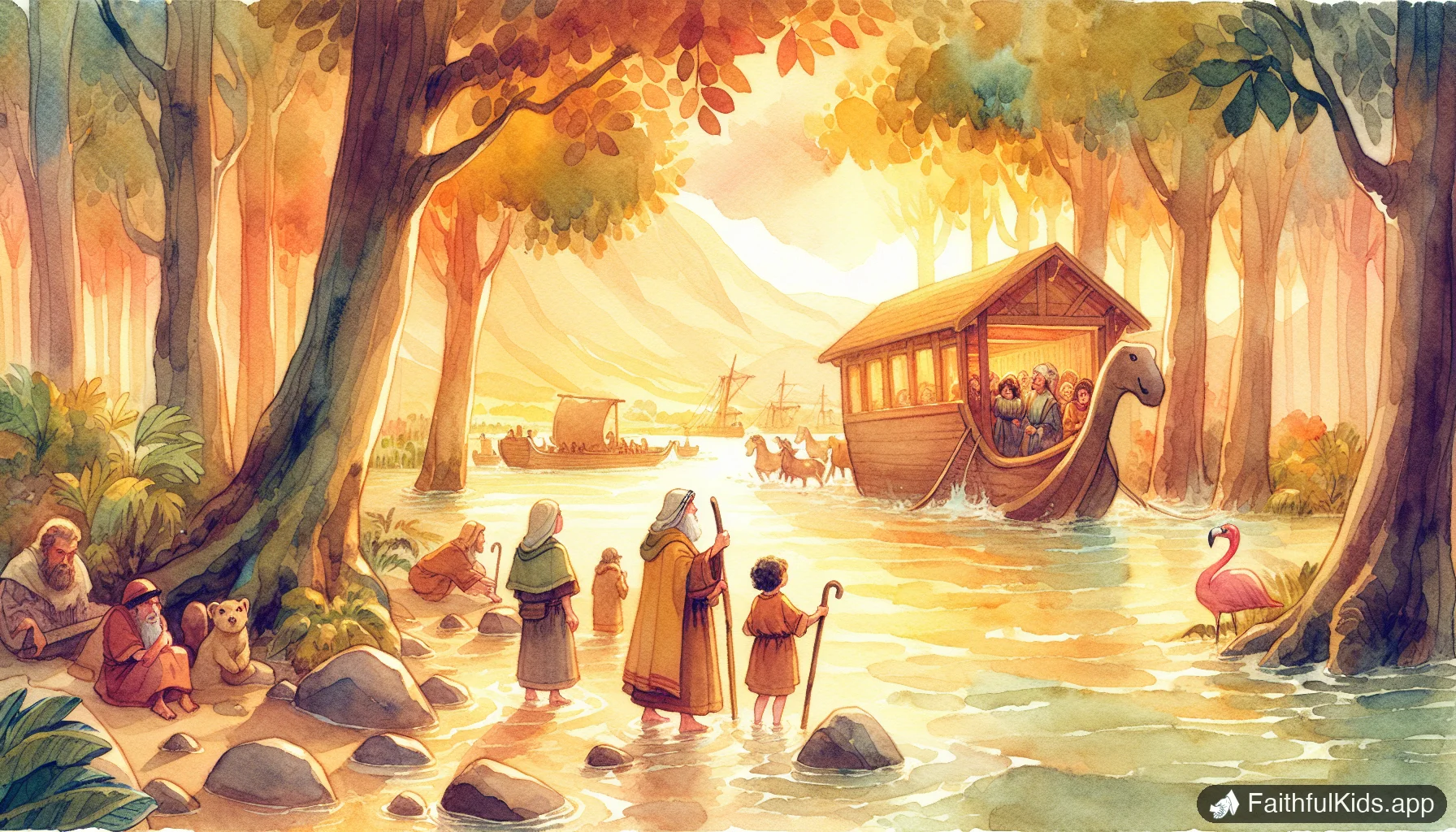
God told Noah to build a boat the length of one and a half football fields -- nowhere near a sea, for a flood no one had ever seen. Noah built it anyway, plank by plank, likely for decades, while everyone around him carried on as usual. Genesis repeats the key line twice: "Noah did everything just as God commanded him." When the rain came, the ark was ready.
The obedience lesson: Obedience often looks strange right up until the moment it saves you.
Ask your child: "Noah obeyed for years before the rain came. What's harder -- obeying once, or obeying for a long time with no proof?" (Full retelling: Noah and the great flood.)
2. Abraham Leaves Home (Genesis 12)
God told 75-year-old Abraham: "Go from your country, your people, and your father's household to the land I will show you." The destination was a blank. Abraham packed up everything and went anyway, and God built a nation, and eventually the whole story of salvation, on that one obedient departure.
The obedience lesson: Sometimes God gives the first step without the whole map, and obedience means moving anyway.
Ask your child: "Could you leave everything familiar without knowing where you were going? What would make it possible?" (More: God calls Abraham.)
3. Moses Goes to Pharaoh (Exodus 3-4)
At the burning bush, God gave Moses the assignment: confront the most powerful ruler on earth and demand he free his slave workforce. Moses produced five separate objections -- Who am I? What if they don't believe me? I can't speak well. Please send someone else. God answered every one, and Moses went -- the man who begged out of public speaking ended up confronting Pharaoh ten times.
The obedience lesson: You can obey God while still feeling unqualified. Moses' excuses were real; he just didn't let them win.
Ask your child: "Which of Moses' excuses sounds most like one of yours?"
4. Joshua at Jericho (Joshua 6)
God's plan for conquering the fortress city of Jericho contained no ladders, no battering rams, and no fighting: march around the walls in silence once a day for six days, seven times on the seventh, then shout. Joshua followed the instructions exactly -- and the walls collapsed flat.
The obedience lesson: Obeying instructions that make no sense to you is the purest test of who you actually trust. (Full story: the walls of Jericho.)
Ask your child: "Day five, walls still standing, people staring. Do you keep marching? Why?"
5. Jonah Runs the Other Way (Jonah 1-3)
God said, "Go to Nineveh." Jonah bought a ticket to Tarshish -- the opposite end of the map. What followed was a storm, a terrified crew, an overboard prophet, and three days inside a great fish, praying. The fish spat him onto the beach, God repeated the instruction word for word, and Jonah walked to Nineveh, where the whole city repented.
The obedience lesson: This is the Bible's great counterexample -- running from God doesn't cancel the assignment; it just makes the trip worse. And notice the mercy: Jonah got a second chance.
Ask your child: "God asked Jonah twice. What does it tell you about God that disobedience got a do-over?" (More: Jonah running from God.)
6. Daniel Keeps Praying (Daniel 6)
The new law was clear: pray to anyone but the king and be thrown to the lions. Daniel faced a choice between obeying the king's law and obeying God -- and he chose God, praying at his open window three times a day exactly as before. God shut the lions' mouths.
The obedience lesson: When human rules and God's ways collide, God comes first. Kids should know this category exists -- obedience to God outranks every other obedience.
Ask your child: "Daniel could have prayed secretly. Why do you think he didn't hide it?"
7. Mary Says Yes (Luke 1:26-38)
An angel told a teenage girl in a small town that she would carry the Son of God -- news that would upend her engagement, her reputation, and her entire life. Mary asked one honest question ("How will this be?"), got a partial answer, and gave the bravest yes in Scripture: "I am the Lord's servant. May it be to me as you have said."
The obedience lesson: Obedience can ask questions -- Mary did. But when the answer is "trust me," obedience says yes anyway.
Ask your child: "Mary's yes cost her a lot. Is obedience still obedience if it's easy?"
8. The Rich Young Ruler Walks Away (Mark 10:17-27)
A wealthy young man ran to Jesus asking how to get eternal life. He'd kept the commandments since childhood. Jesus looked at him, loved him, and named the one thing: "Sell everything you have, give to the poor, and follow me." The man's face fell, and he walked away sad.
The obedience lesson: Partial obedience isn't obedience -- and Jesus didn't chase him or lower the price.
Ask your child: "He obeyed nine rules but not the one that cost him. Do we get to pick which instructions count?"
9. Peter Lets Down the Net (Luke 5:1-11)
Peter had fished all night -- his profession, his water, his expertise -- and caught nothing. Then a carpenter told him to push out and let down the nets again. Peter's reply is the perfect obedience sentence: "Master, we've worked hard all night and haven't caught anything. But because you say so, I will let down the nets." The catch nearly sank two boats.
The obedience lesson: "Because you say so" -- obeying even when your own experience argues otherwise. That sentence is worth teaching kids word for word.
Ask your child: "Peter was the fishing expert, and he obeyed anyway. Is it harder to obey in the things you're good at?"
10. The Golden Calf (Exodus 19-32)
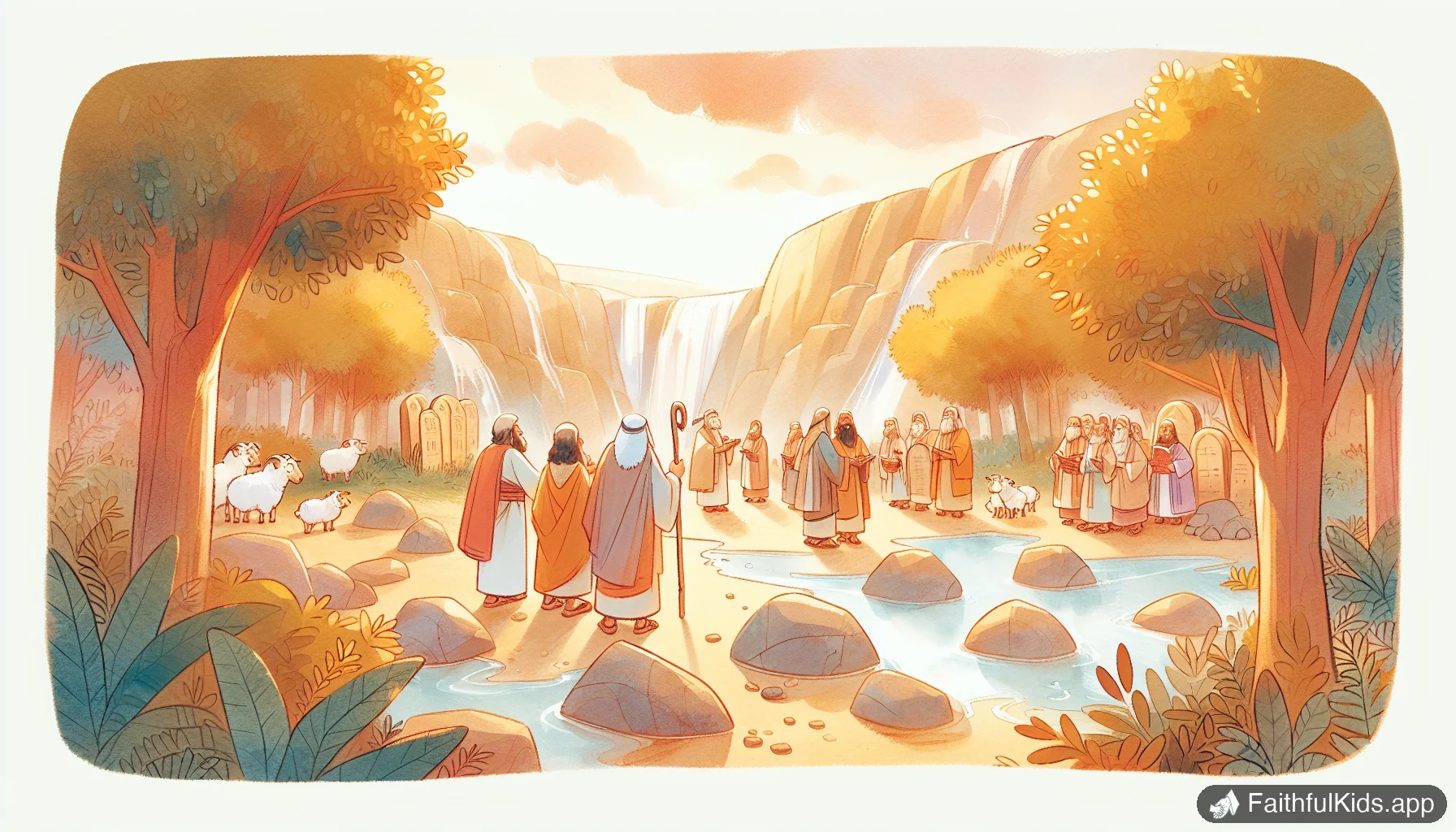
At Mount Sinai the people heard God's commandments and promised together: "Everything the Lord has said we will do." Forty days later, with Moses still up the mountain, they melted their gold earrings into a calf idol and threw a party for it. The first commandment they'd promised to keep was the first one they broke -- and the consequences were severe.
The obedience lesson: Promising to obey is the easy part. This story teaches kids that obedience is proven in the waiting, not the promising. (Background: the Ten Commandments for kids and the golden calf.)
Ask your child: "They forgot their promise in forty days. What helps you keep a promise when the waiting gets long?"