Ages 5+·12 min read··By Faithful Kids Team·Updated August 19, 2026
Noah's ark is the most colored story in the Bible, and most sets get it wrong in the same way -- one boat, two giraffes, a rainbow, done. The story in Genesis 6-9 has at least fourteen distinct scenes worth a page, and coloring them in order is what turns a cute animal picture into a child who actually knows what happened and why. Below are those fourteen described scenes plus eight hands-on activities that extend the story off the paper.
Straight answer first: we do not host downloadable coloring PDFs. Nothing here is a click-to-download link, and we'd rather tell you that than waste your time. These are page ideas, described concretely enough that a parent with a marker or a teacher with a photocopier can produce any of them in a few minutes. What we do have finished and free is listed further down.
14 Noah's Ark Coloring Page Ideas
In story order, because the sequence is the lesson.
1. A World Gone Wrong (Genesis 6:5-8)
A crowded, chaotic town scene with one small quiet house at the edge. Genesis 6:8 lettered underneath: "But Noah found favor in the eyes of the Lord." The page nobody draws, and the one that explains why the flood happens at all.
2. God Speaks to Noah (Genesis 6:13-14)
Noah kneeling in an open field with radiant lines coming from above, an empty stretch of ground behind him where the ark will be. Leave that ground blank on purpose -- kids will want to fill it, and that's the point.
3. The Blueprint (Genesis 6:15-16)
A technical-drawing page: the ark in side view with its three decks, one door, and one window, and the dimensions labeled -- 300 cubits long, 50 wide, 30 high. Older kids love this one, and it quietly teaches that the ark was a barge, not a bathtub boat with a curly bow.
4. Building the Ark (Genesis 6:22)
A half-finished wooden hull with scaffolding, Noah and his sons working with saws and hammers, wood shavings on the ground. Draw the ribs of the hull as long open bands so a child can color plank by plank.
5. The Neighbors Watch (Genesis 6-7, implied)
A giant boat on dry land with a crowd standing around pointing and laughing. This is the page that makes the story land emotionally for a kid who's ever been the odd one out.
6. The Animals Come (Genesis 7:8-9)
The classic: a long line of animal pairs walking up a ramp toward the ark door. Draw at least fifteen species so there's real variety to color, and leave two blank silhouettes at the back for the child to invent their own.
7. Loading the Supplies (Genesis 6:21)
Baskets of grain, water jars, bundles of hay, and sacks being carried aboard. A quiet, detail-rich page, and a good conversation opener: feeding every animal on earth for a year was the hard part.
8. God Shuts the Door (Genesis 7:16)
The ark's single door closing, seen from outside, with a hand-shaped glow at its edge and rain just beginning to fall. One of the most striking verses in the chapter -- the Lord shut him in -- and a page that gives it weight.
9. Forty Days of Rain (Genesis 7:12)
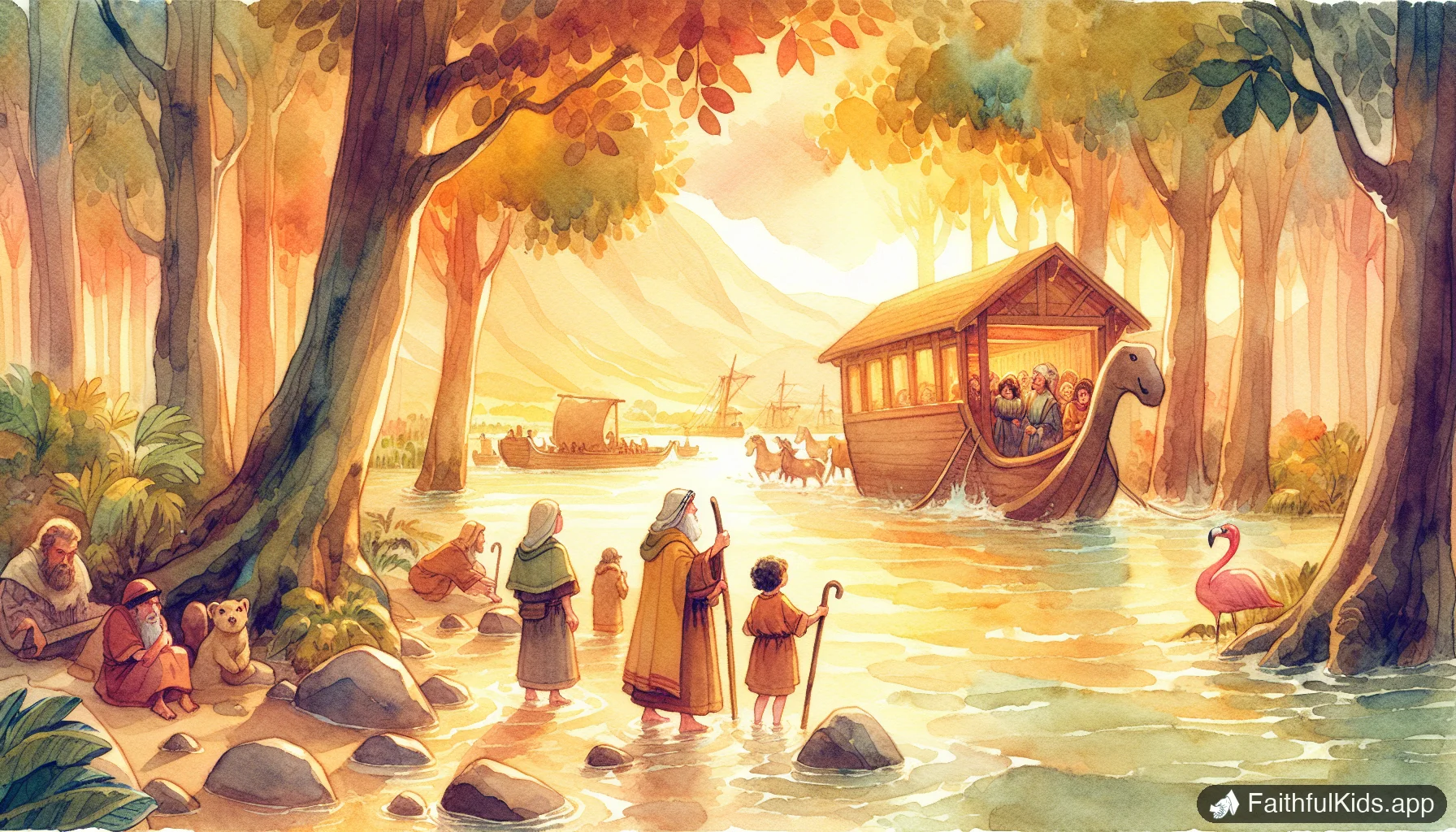
The ark tossed on dark water with heavy vertical rain lines, no land anywhere. Fill the whole page edge to edge with water and sky. Encourage grays and deep blues so the rainbow page later feels like a release.
10. Inside the Ark (Genesis 7:23)
A three-deck cutaway with animals in stalls, hay bales, Noah's family eating together, lanterns hanging. This is the page kids spend forty-five minutes on. Draw as many small compartments as you can fit.
11. The Raven and the Dove (Genesis 8:6-9)
Noah at the window releasing a bird over an endless gray sea, another bird circling in the distance. Two birds, two attempts, no landing spot yet.
12. The Olive Leaf (Genesis 8:11)
A close-up of the dove returning with a freshly plucked olive leaf in its beak, Noah's hands reaching to receive it. Small scene, huge moment, and it colors beautifully with just green and white.
13. Stepping Onto Dry Ground (Genesis 8:18-19)
The ark resting on a mountainside with the ramp down and animals scattering out into open country in every direction. Motion everywhere. The relief of this page is the whole payoff of page 9.
14. The Rainbow Covenant (Genesis 9:13)
A wide rainbow arcing over the ark and Noah's family with hands raised, Genesis 9:13 lettered along the arc. Draw the bands wide and label them so younger kids get color order practice while they work. This is the page that goes on the wall.
8 Noah's Ark Activity Ideas
Coloring is one channel. These eight put the story in kids' hands, and each one carries a specific teaching point rather than just filling time.
1. Tape the ark's real footprint on the floor. Using an 18-inch cubit, the ark was roughly 450 feet long and 75 feet wide. Mark 45 feet of it down a hallway with painter's tape and walk it. Nothing else communicates the scale so fast, and kids stop picturing a rowboat forever.
2. Two-by-two animal matching. Print or draw animal pairs, cut them apart, shuffle, and have kids find the matches and line them up. For toddlers this is a sorting game; for older kids, add a rule that each pair has to be named aloud before it boards.
3. Float test. Fill a bin with water and test which shapes hold the most weight without tipping -- a rounded boat, a flat raft, and a long rectangular box. The box wins, which is exactly the shape Genesis describes. Real science, real text, one afternoon.
4. Rainbow coffee-filter craft. Color a flat coffee filter with washable markers in rainbow bands, spray lightly with water, and watch the colors bleed and blend. Pinch and fold into an arc. It looks like weather because it basically is weather.
5. The 40-day rain chart. Draw 40 raindrops on a sheet and let kids color one per day for forty days, reading a short verse each time. It gives a real sense of how long forty days actually is, which is the detail every retelling flattens.
6. Build an ark from a shoebox. Cut one door and one window -- only one of each, as the text says -- add three cardboard decks, and load it with toy animals. The build itself teaches the specs better than reading them twice.
7. Animal sound charades. One child acts out an animal, the rest guess, then the pair "boards." Chaotic, loud, and the fastest way to get a wiggly group through a review of the story. More structured craft-and-lesson pairings live in our guide to Bible crafts for kids with lessons.
8. Trivia round to close it out. Finish a Noah unit with questions -- how many of each clean animal did Noah take, what bird went out first, what did the dove bring back. Our Genesis Bible trivia set has the flood questions with references, so the answers are checkable rather than argued.
How to Use These Pages to Teach the Story, Not Just Fill Time
Noah's ark has a specific teaching hazard: it is so cute in decoration form that kids can color it for years without ever registering that it's a story about judgment and rescue. The fix is not to make it grim. It's to color the whole arc, in order, and talk while they work.
Read two or three verses before each page. Short. Out loud. Then hand over the crayons.
Ask one question per page, not five. "Why do you think God told Noah exactly how big to build it?" "How would it feel to hear the door shut?" One good question beats a quiz every time.
Narrate while they color. This is when to mention that Noah took seven pairs of the clean animals, not just two (Genesis 7:2), or that the raven went out before the dove. Kids absorb detail sideways, while their hands are busy, far better than head-on.
Keep the pages in order. Post them in a row: chaos, calling, blueprint, building, mockery, animals, supplies, door, rain, inside, birds, leaf, dry ground, rainbow. Seeing the sequence is what teaches that the rainbow means something -- it's a promise at the end of a hard story, not a decoration.
Ask for the retell. "Tell me your page." A child holding their own drawing will retell a story they'd otherwise shrug at, and retelling is where retention actually forms.
Press play on Walking on Water — a complete lesson exactly as your child sees it. 300+ episodes cover the whole Bible in order, each ending in a fun quiz to check what they learned.
A real lesson from the app — watch the whole thing free.
Printing Tips
Use 24 lb paper at minimum, or light card stock for markers. Standard 20 lb copy paper bleeds through instantly, and the ark pages are exactly the ones kids attack with markers.
Print grayscale in draft or economy mode. These are line drawings; color ink on black outlines is money burned, and draft mode roughly halves consumption with no visible loss on line art.
Print the rainbow page on the heaviest stock you have. It's the one that gets framed, gifted, or taped to a bedroom wall for two years.
Batch all fourteen at once. A folder of ready pages gets used; a plan to print later does not.
Laminate the ark outline and hand over dry-erase markers for the child who wants to color it daily. One sheet, a whole month of quiet.
Scale to 85 percent and staple into a booklet if you want the finished set to live on a shelf rather than in a pile.
What Faithful Kids Actually Offers Today
Hosted coloring sheets are something we're working toward and haven't built. Here's what is finished, free, and printable right now:
The Bible Trivia Pack -- 100 questions in easy, medium, and hard rounds, each answer with its Scripture reference.
The Bedtime Bible Kit -- seven short, calming readings built for the wind-down you already do every night.
If you only print one thing from this page, print the Bedtime Bible Kit. An ark coloring session needs a table and a free hour; a bedtime reading rides a routine that already exists, which is why it's the one that actually survives a normal week. Print the free Bedtime Bible Kit and start tonight.
For coloring beyond the flood, our story-by-story guide to Bible coloring pages for kids covers 20 scene themes across both testaments, and free Bible printables for kids sorts every printable type by age and use. Families using Faithful Kids often watch the flood story on video first, then color it -- the video supplies the mental picture, and the finished pages come out noticeably more detailed.
Short on prep time? Our Bible coloring pages are one click from the page to the printer.
Ages 3 to 9 is the core range, and the story's popularity with toddlers is why it's usually the first Bible page a child ever colors. Under 5, use single large elements: one ark, one rainbow, two big animals. Ages 6 to 9 handle full scenes like the cutaway interior or the animals boarding. Older kids often prefer the blueprint page, which reads as a real technical drawing.
How big was Noah's ark really?
Genesis 6:15 gives it as 300 cubits long, 50 wide, and 30 high. Using a common 18-inch cubit, that's roughly 450 feet by 75 feet by 45 feet -- about one and a half football fields long. Marking even a portion of that out with tape is the single most effective ark activity there is, because kids picture a small boat until they walk the length.
How many animals did Noah take on the ark?
Two of every kind, and seven pairs of every clean animal and of the birds (Genesis 7:2-3). Most coloring sets show only pairs, which is a fine simplification for young kids and a great detail to add for older ones. It's also a reliable trivia question that catches adults.
Do you have Noah's ark coloring pages to download?
Not yet. Our three free downloads today are the Bible Trivia Pack, the 30-Day Family Bible Challenge, and the Bedtime Bible Kit. Every scene above is described specifically enough to draw by hand or to search for in an existing set, which is the honest answer rather than a dead link.
How do I teach the hard part of the Noah story to young children?
Keep it truthful, brief, and framed by rescue. Something like: "People had become very cruel to each other, and God decided to start again -- and he saved Noah's family and the animals." Don't dwell on the destruction with a five-year-old, and don't erase it either, because the rainbow at the end only means something if there was something to be rescued from. Older kids can handle the fuller weight and usually want it.
What does the rainbow actually mean in the story?
It's the sign of a covenant, a promise God makes never again to destroy the earth by flood (Genesis 9:13-15). That's worth saying plainly while kids color it, because a rainbow is otherwise just a pretty arc to them. The point isn't the colors -- it's that God bound himself to a promise and gave a visible reminder of it.
🌙 Free: The Bedtime Bible Kit
Seven nights of five-minute stories — a story, a prayer, and one question to whisper about.
Free printable + a few helpful emails. Unsubscribe anytime.