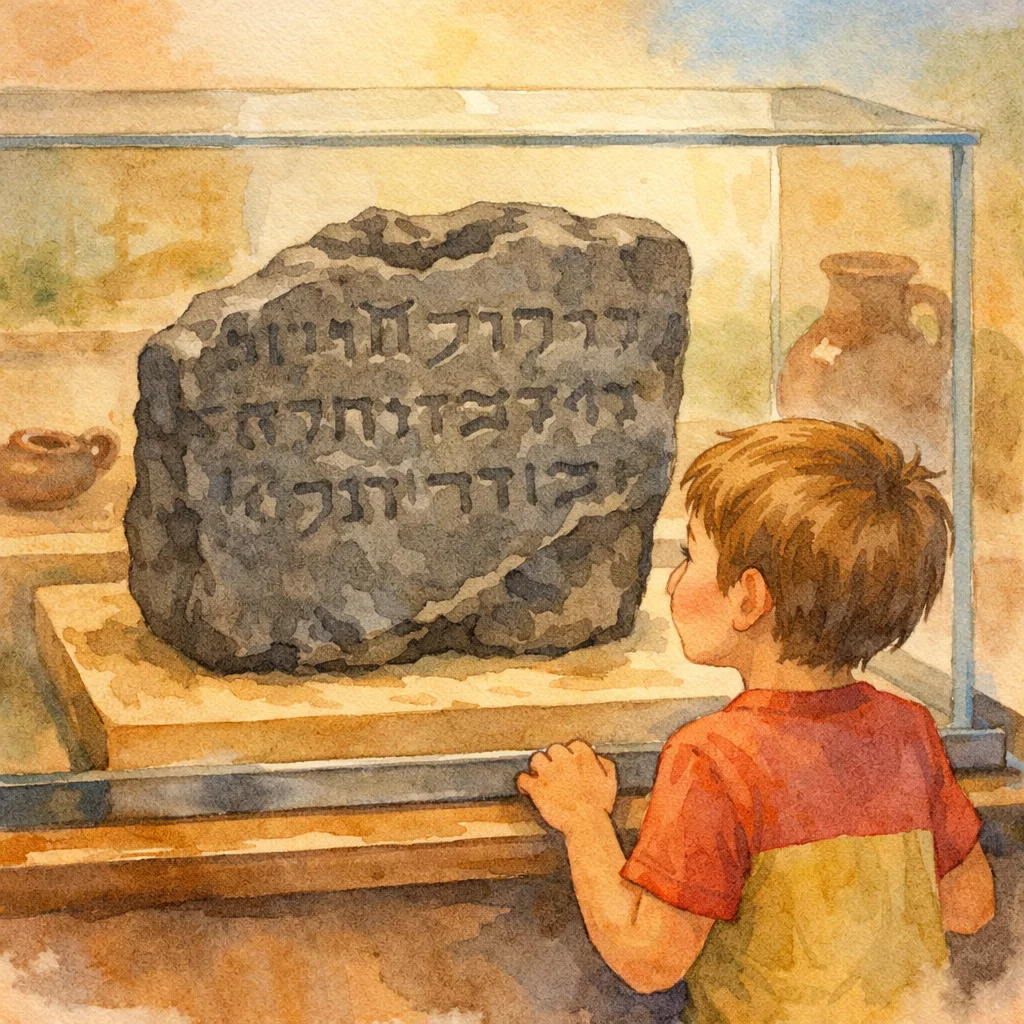
Was King David real? Christians believe King David was a real person, because the Bible tells his life as history and Jesus himself was called the "Son of David" (Matthew 1:1). Unlike many Bible figures, David also has support outside the Bible: a stone inscription from the 9th century BC, found at Tel Dan in northern Israel, mentions the "House of David," meaning the royal family he founded.
That is a good, honest answer to give a child. Most scholars, including many who do not share our faith, accept that David was a real ruler. What they still argue about is how big and powerful his kingdom was.
If your child has asked "Was David real, or is he like a fairy-tale hero?", this guide gives you the Bible's story, the real evidence, the real limits, and simple scripts you can use at every age.
What the Bible says about King David
David's story fills most of 1 Samuel, all of 2 Samuel and the start of 1 Kings, and he is named across the rest of the Bible. In brief:
The shepherd boy. God sent the prophet Samuel to anoint the youngest son of Jesse in Bethlehem. "People look at the outward appearance, but the Lord looks at the heart" (1 Samuel 16:7, NIV).
David and Goliath. As a young man, David faced the Philistine champion with a sling, trusting God rather than armor (1 Samuel 17).
Friendship and waiting. David and Jonathan, King Saul's son, became loyal friends. When Saul turned against him, David refused to harm the king (1 Samuel 18-26).
King in Jerusalem. David became king of Judah, then of all Israel, and made Jerusalem his capital (2 Samuel 5).
God's promise. God promised that David's family line would last forever (2 Samuel 7). Christians see that promise kept in Jesus.
The songwriter. About half of the psalms carry David's name, including Psalm 23, "The Lord is my shepherd."
The Bible is honest that David also sinned badly. When the prophet Nathan confronted him, David confessed and asked God for a clean heart (2 Samuel 12; Psalm 51). The Bible still calls him a man after God's own heart (Acts 13:22), which tells kids that God's love is bigger than our worst mistakes.
Jesus, the Son of David
For Christian families, this is the heart of the answer. The New Testament ties Jesus to David again and again:
Matthew opens with "Jesus the Messiah the son of David" (Matthew 1:1, NIV).
Jesus was born in Bethlehem, "the town of David" (Luke 2:11).
Crowds and people asking for healing called out "Son of David" (Mark 10:47; Matthew 21:9).
Jesus himself quoted a psalm of David when teaching about the Messiah (Mark 12:35-37).
So for a child, the bridge is simple: "Jesus came from David's family. God kept his promise to David."
Was King David real? What history and archaeology can (and cannot) tell us
Here is the honest picture, without overclaiming in either direction.
The Tel Dan Stele: the "House of David"
In July 1993, a member of archaeologist Avraham Biran's team found a broken piece of a stone inscription at Tel Dan in northern Israel. Two more pieces turned up in 1994. The inscription is written in Old Aramaic and is generally dated to the 9th century BC. Most scholars think it was set up by Hazael, a king of Aram-Damascus, though his name is not on the surviving pieces. The king boasts of defeating a king of Israel and a king of the "House of David," written bytdwd.
That phrase matters. "House of David" was a way of naming a royal dynasty after its founder, so a foreign king, an enemy of Israel, was using David's name to describe Judah's ruling family well over a century after David's lifetime. Most scholars accept this reading. A minority have proposed other meanings, partly because there is no word divider between byt ("house") and dwd ("David"). You can tell an older child that the stele is on display today at the Israel Museum in Jerusalem.
The Mesha Stele: a possible second mention
The Mesha Stele is a stone set up by King Mesha of Moab around 840 BC. It was found in 1868 at Dhiban in modern Jordan and is now in the Louvre in Paris. In 1994, the French scholar André Lemaire proposed that damaged letters in line 31 read "House of David." This one is genuinely debated. In 2019, Israel Finkelstein, Nadav Na'aman and Thomas Römer argued the name is more likely Balak, while other scholars defended Lemaire's reading. The fair way to say it: possible, not certain.
Khirbet Qeiyafa: a fortress from David's time?
Khirbet Qeiyafa is a fortified hilltop town overlooking the Valley of Elah, the very valley where 1 Samuel 17 places David and Goliath. Archaeologists Yosef Garfinkel and Saar Ganor began excavating it in 2007. They dated it to roughly 1020-980 BC using pottery and burned olive pits, and they argue it was a fortress of David's kingdom. Other archaeologists disagree. Some see it as Canaanite, and Finkelstein and others link it to the northern kingdom of Israel instead. It is an exciting site, but it does not have David's name on it.
The big debate: how big was David's kingdom?
Scholars fall roughly into two camps on this question:
More skeptical scholars (sometimes called "minimalists") point out that 10th-century BC Jerusalem has left limited remains. Israel Finkelstein and Neil Asher Silberman, for example, have argued that Judah was thinly populated then, Jerusalem was small, and David was at most a local chieftain.
Scholars more confident in the Bible's picture (sometimes called "maximalists") argue for a real and growing kingdom. Archaeologist Amihai Mazar described it as a "state in development," and William Dever has said the reigns of Saul, David and Solomon are "reasonably well attested."
Here is the part worth repeating to your child: even many skeptical scholars accept that David was a real person. The argument is about the size of his kingdom, not whether he lived. The Tel Dan Stele is the main reason.
How Christians read the story of David
Catholic, Orthodox and Protestant Christians all affirm David as a real king, a prophet-poet of the psalms, and an ancestor of Jesus. On some details they differ:
How big his kingdom was. Some Christians take the Bible's descriptions of David's reign at face value. Others are comfortable with archaeologists who picture a smaller kingdom, since the Bible's main point is God's faithfulness, not the size of an empire.
Which psalms David wrote. The psalm titles name David as author of many psalms. Some Christians read every title as authorship; others see some as "for David" or "in David's tradition."
Our statement of faith says the Bible is the inspired, true Word of God, and on details like these we leave room for families to follow their own church.
See what they get
Watch a Real Lesson From the App
Press play on Noah and the Great Flood, a complete lesson exactly as your child sees it. 300+ episodes cover the whole Bible in order, each ending in a fun quiz to check what they learned.
A real lesson from the app, watch the whole thing free.
How to answer your child, by age
Ages 5-7
"Yes, David was a real person. He was a shepherd boy who loved God, and God made him a king. A long, long time ago, people carved his name into a stone, and you can still see it in a museum today. And guess what? Jesus came from David's family."
Tip: Little ones love the "shepherd boy" part. Read Psalm 23 together and tell them David wrote it.
Ages 8-11
"Christians believe David was real because the Bible tells his story and Jesus is called the Son of David. Archaeologists also found a stone at a place called Tel Dan, from more than a hundred years after David, where an enemy king wrote about the 'House of David.' That means people outside Israel knew David's family was the royal family. Want to look up a picture of it?"
Tip: Search for "Tel Dan Stele" images together. A real object with real letters turns a doubt into a discovery.
Ages 12-15
"There's an inscription from the 9th century BC that names the 'House of David,' and most scholars accept it, which is why most historians think David really lived. Where they disagree is how big his kingdom was. Some think he was more like a chieftain over a small area; others think he ruled a growing state, like the Bible describes. Christians can follow that debate with confidence. The Bible was never trying to impress us with David's empire. It shows us God keeping his promise through an imperfect man."
Tip: Teens respect honesty about debates. Telling them where scholars disagree makes them trust you more on what is well supported.
🕯️ Free: 25 Days of Advent Bible Readings
December 1 to 25, one short reading a night, from the first promise to the manger. Printable for the fridge.
Free printable + a few helpful emails. Unsubscribe anytime.
Questions kids ask next
"Where is David buried?"
The Bible says David was buried in the City of David in Jerusalem (1 Kings 2:10). Nobody knows for certain exactly where his tomb is today.
"Did David really write the psalms?"
Many psalms carry his name in their titles, and Jesus quoted one as David's (Mark 12:36). Christians differ on how many he wrote personally.
"Why did God choose David?"
Because God looks at the heart (1 Samuel 16:7). David was young and overlooked, but he trusted God.
"Was David a good person?"
He loved God deeply and also made serious mistakes. He was sorry, asked God to forgive him, and God did (Psalm 51). That is good news for all of us.
Watch the story together
Our Who Was David? lesson tells his life in kid-friendly language, and episodes like God Chooses David, David and Goliath and David Becomes King each have a free two-minute video lesson with a quiz. Watching one together is an easy way to turn a big question into a good conversation. Faithful Kids has 300+ short Bible video lessons for ages 5-15, Genesis to Revelation, each with a quiz.
Frequently Asked Questions
Was King David real?
Christians believe King David was a real person because the Bible presents his life as history and Jesus is called the Son of David. The Tel Dan Stele, from the 9th century BC, mentions the "House of David," and most scholars accept that David existed.
What is the Tel Dan Stele?
It is a broken stone inscription in Old Aramaic, found at Tel Dan in northern Israel in 1993 and 1994. Most scholars read a phrase on it as "House of David," the earliest widely accepted mention of David outside the Bible. It is displayed at the Israel Museum.
Is there archaeological evidence for King David?
Yes, though it is limited. The Tel Dan Stele names his dynasty, the Mesha Stele may name it too (that reading is debated), and sites like Khirbet Qeiyafa are argued over as possibly belonging to his kingdom.
Do historians think King David existed?
Most do, though not all. The main debate is whether he ruled a sizeable kingdom, as the Bible describes, or something closer to a small chiefdom.
When did King David live?
Scholars generally place David around the 10th century BC, roughly 3,000 years ago. The Bible does not give dates in our modern calendar.
Why is Jesus called the Son of David?
Because Jesus was born into David's family line, and God had promised David that his kingdom would last forever (2 Samuel 7:16). Christians believe Jesus is the King who fulfils that promise.