Blog/What Does the Bible Teach Kids? 15 Life Lessons
Guide
What Does the Bible Teach Kids? 15 Life Lessons
Ages 5+·10 min read··By Faithful Kids Team·Updated August 16, 2026
The Bible teaches kids the character traits every parent is already trying to build -- courage, kindness, forgiveness, honesty, patience -- but it teaches them through stories about real people, which is exactly how children learn best. Below are 15 life lessons the Bible teaches children, each paired with the story that carries it, a short retelling, and a question to open the conversation.
One note first: the Bible is not primarily a book of morals -- it is the story of God rescuing His people, and every lesson below sits inside that bigger story. Kids who only hear "be brave like David" miss David's own point: his courage came from God, not himself. Teach the trait and the Source together.
1. Courage -- David and Goliath
A giant taunted God's army for forty days while trained soldiers hid. David, a shepherd boy, ran at him with a sling and five stones -- not because he was fearless, but because he knew whose name he carried. Kids learn that courage is not about size; it is about trust. For more on this trait, see our Bible stories about courage for kids.
Scripture: 1 Samuel 17:45Talk about it: "What's a 'Goliath' in your life right now -- and what would facing it with God look like?"
2. Kindness -- The Good Samaritan
A traveler lay beaten on the roadside, and two respected religious men crossed the street to avoid him. The hero of Jesus' story was a Samaritan -- someone the audience despised -- who stopped, bandaged the stranger, and paid for his care. Kindness, kids learn, is something you do, especially for people who are different from you.
Scripture: Luke 10:37Talk about it: "Who is someone at school everyone walks past? What would 'stopping' look like for you?"
3. Forgiveness -- The Prodigal Son
A son took his inheritance early, wasted all of it, and came home rehearsing an apology. His father saw him from far off and ran to embrace him, then threw a feast. This is Jesus' picture of how God receives anyone who comes home -- the foundation under every story in our list of Bible stories about forgiveness.
Scripture: Luke 15:24Talk about it: "Why did the father run instead of waiting? How does God feel when we say sorry?"
4. Honesty -- Ananias and Sapphira (ages 8+)
Ananias and Sapphira sold some land, kept part of the money -- which was completely allowed -- and then lied to look more generous than they were. The lie, not the money, was the sin, and it cost them everything. Intense, and best for older kids, but unforgettable: God takes truth seriously.
Scripture: Acts 5:4 -- "You have not lied just to human beings but to God."Talk about it: "Why do we lie to look better than we are? Who does a lie actually hurt?"
5. Patience -- Joseph's Journey
Sold by his brothers, falsely accused, and left in prison, Joseph waited roughly thirteen years between the pit and the palace. He kept working and trusting, and eventually saved the very family that betrayed him. Waiting is not wasted: God is working even when nothing seems to be happening.
Scripture: Genesis 50:20 -- "You intended to harm me, but God intended it for good."Talk about it: "What are you waiting for right now? What could God be building in you while you wait?"
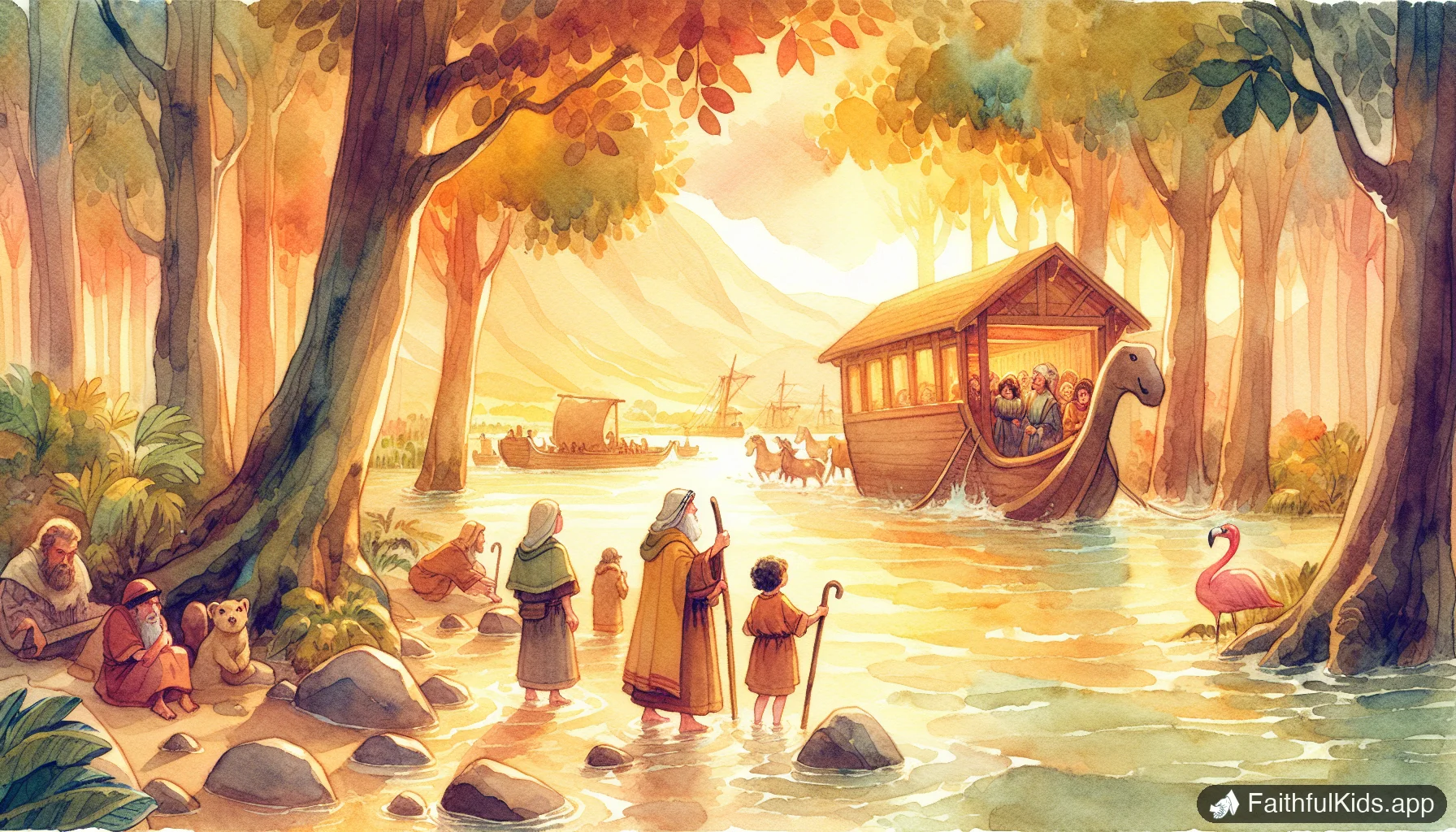
6. Obedience -- Noah's Ark
God's instructions must have sounded absurd: build a massive boat, far from any sea, for a flood no one had ever seen. Noah obeyed anyway -- for years, board by board -- and his obedience saved his family. Obeying someone who loves you, even without full understanding, is often exactly what protects you.
Scripture: Genesis 6:22Talk about it: "When is obeying hardest -- when it's boring, embarrassing, or when you don't understand why?"
7. Generosity -- Feeding the Five Thousand
Thousands were hungry, and the only food was one boy's lunch: five small loaves and two fish. He handed it over, Jesus gave thanks, and everyone ate with twelve baskets left over. No gift is too small once it is placed in Jesus' hands.
Scripture: John 6:9-11Talk about it: "What 'small lunch' do you have -- time, toys, talent -- that God could multiply?"
8. Loyalty -- Ruth and Naomi
When Naomi lost everything, Ruth refused to leave her: "Where you go I will go." She left her homeland and worked long days gleaning grain to feed them both -- and God wove her loyalty into the family line of King David and of Jesus. Real loyalty shows up when things are hard.
Scripture: Ruth 1:16Talk about it: "Who sticks with you on your worst days? Who are you that person for?"
See what they get
Watch The Sermon on the Mount Come Alive
The Sermon on the Mount is one of 300+ short narrated video lessons your child will love. Watch the whole episode right here — in the app, every lesson ends with a fun quiz to check what they learned.
A real lesson from the app — watch the whole thing free.
9. Humility -- Jesus Washes the Disciples' Feet
On the night before the cross, the Teacher took the servant's job: He knelt with a towel and basin and washed His disciples' dirty feet, then told them to do the same for each other. The greatest person who ever lived measured greatness by service.
Scripture: John 13:14-15Talk about it: "What's one job in our house nobody wants? What if you did it without being asked?"
10. Trust -- Abraham Leaves Home
God told Abraham to leave everything familiar -- destination unspecified: "Go... to the land I will show you." Abraham packed and went, trusting the Guide instead of demanding the map. Sometimes following God means taking the first step before you can see the path.
Scripture: Genesis 12:1Talk about it: "What's something new that feels scary because you can't see how it turns out?"
11. Perseverance -- Paul's Shipwreck
Sailing to Rome as a prisoner, Paul endured a two-week storm so violent the crew gave up all hope. Paul stood up mid-storm and told 276 terrified men to take courage, because God had promised every life would be spared -- and every life was. Perseverance is holding God's promise inside the storm.
Scripture: Acts 27:25Talk about it: "When everything goes wrong at once, what do you do first? What did Paul do?"
12. Love -- 1 Corinthians 13
Not a story but a definition, and kids need it because the world hands them a fuzzy one: love is patient and kind, does not envy or boast, keeps no record of wrongs, always protects, always hopes. Try reading it aloud with your child's name in place of "love" -- the gaps are where the conversation lives.
Scripture: 1 Corinthians 13:4-7Talk about it: "Which phrase is hardest for you -- 'patient,' 'kind,' or 'keeps no record of wrongs'?"
13. Wisdom -- Solomon's Request
Offered anything he wanted, young King Solomon didn't ask for riches or victory -- he asked for a discerning heart to know right from wrong. God was so pleased that He gave the wisdom and the riches. Asking for wisdom is the wisest thing you can do, and God loves to answer that prayer (James 1:5).
Scripture: 1 Kings 3:9Talk about it: "If God offered you anything tonight, what would you honestly ask for?"
14. Conviction -- Daniel Keeps Praying
When the king made prayer illegal, Daniel went home, opened his windows toward Jerusalem, and prayed three times that day -- just as he always had. He didn't hide and didn't quit, and God shut the lions' mouths. Daniel wasn't loud; he was simply unmovable.
Scripture: Daniel 6:10Talk about it: "Is there something right that kids get laughed at for? What would 'open windows' look like for you?"
15. Hope -- The Empty Tomb
The women walked to the tomb at dawn expecting death and found angels asking, "Why do you look for the living among the dead?" Jesus was alive. This is the lesson under all the others: because the worst thing that ever happened became the best thing that ever happened, no dark chapter is ever the end of the story.
Scripture: Luke 24:6Talk about it: "What's the saddest you've ever felt? What does Easter say to that feeling?"
How Do Kids Actually Absorb These Lessons?
Through repetition and conversation, not one-time lectures. A child needs to meet Joseph several times, at different ages, before "God's timing is right" becomes their own belief rather than your slogan. So pair each lesson with its story, ask the talk-about-it question and wait out the silence, and revisit the same stories yearly -- they read differently at six and at ten. Anchoring a verse from each lesson helps too; our guide to Bible verses for kids to memorize includes most of the references above.
For going deeper, our roundup of Bible stories with moral lessons organizes dozens more stories by trait, and the fruit of the Spirit for kids covers the nine traits Scripture itself lists as evidence of God at work in a person. And if your child learns best by watching, every story on this page is available as a short video with a comprehension quiz on Faithful Kids.
Frequently Asked Questions
What are the most important Bible lessons for kids?
Start with four: God loves you (John 3:16), be kind to everyone (the Good Samaritan), forgiveness is always available (the prodigal son), and courage comes from trusting God (David and Goliath). Everything else builds on those, and all four can be grasped by a five-year-old.
Does the Bible just teach kids to be good?
No -- and the distinction matters. The Bible's core message is what God has done, and the character lessons flow out of that. Kids taught "be good like Bible heroes" get moralism; kids taught "God loves you, and here is how loved people live" get the gospel.
What age can kids start learning these lessons?
Ages 3-5 absorb the stories themselves (Noah obeyed, David was brave) without abstract labels. Ages 6-9 can name the traits and connect them to their own lives -- the sweet spot for the talk-about-it questions above. Ages 10 and up can wrestle with the harder ones, like Ananias and Sapphira or the long wait in Joseph's story.
How do I teach a Bible lesson without lecturing?
Tell the story, ask one question, and stop. The questions above are designed to be asked once and left open -- in the car, at dinner, at lights-out. A child who reaches the conclusion through conversation owns it; a child who hears it as a lecture files it under "things adults say."
Which lesson should I start with for a child who's struggling?
Match the story to the struggle. A fearful child needs David and the empty tomb; a child who lied needs the prodigal son before Ananias and Sapphira -- grace first, then truth-telling; a child crushed by waiting needs Joseph. These lessons land hardest as good news for a specific moment, not as a curriculum.
Are these lessons different from secular character education?
The traits overlap, but the root differs. Secular character education says "be kind because it works." The Bible says "be kind because God has been kind to you, and every person carries His image" -- a reason that survives the days when kindness doesn't pay off.
🌙 Free: The Bedtime Bible Kit
Seven nights of five-minute stories — a story, a prayer, and one question to whisper about.
Free printable + a few helpful emails. Unsubscribe anytime.