Blog/How to Teach Kids the Bible (Without Being an Expert)
Guide
How to Teach Kids the Bible (Without Being an Expert)
Ages 5+·9 min read··By Faithful Kids Team·Updated August 20, 2026
To teach kids the Bible, you need three things: stories told in the right order for their age, questions instead of lectures, and a short daily routine anchored to something you already do. You do not need a theology degree, and you do not need to have read the Bible cover to cover -- you only need to stay one story ahead of your child.
That last sentence is worth sitting with, because the number one reason Christian parents never start is the feeling of being unqualified. But no parent waits to feel qualified before teaching a child to swim, apologize, or cross the street. You learn alongside them. The Bible works the same way, and this guide gives you the plan.
Where Do You Start When Teaching Kids the Bible?
Start with stories, not rules or doctrine. Kids are wired for narrative -- "let me tell you about a boy who fought a giant" opens a door that "the Bible is important and we should read it" never will. Doctrine is the fruit of years of stories; it is not the entry point.
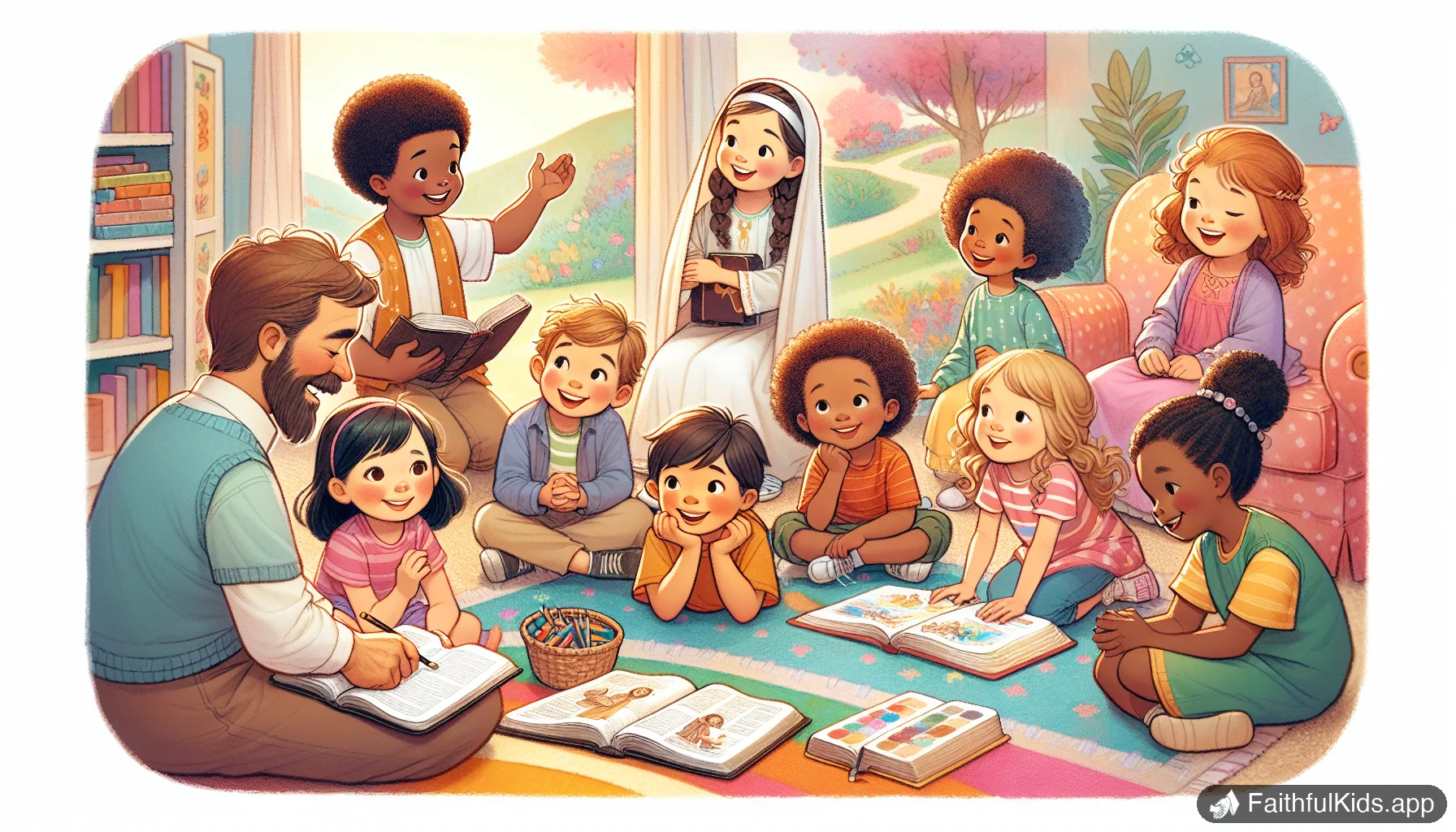
Practically, that means your first month looks like this: one story per session, told or read with energy, followed by two or three questions and nothing else. No application lecture, no moralizing, no "and that's why you should share with your sister." Let the story do its own work. Kids who associate Bible time with a good story keep showing up; kids who associate it with a lecture in disguise start negotiating their way out.
If you are unsure which stories to open with, our ranked list of the best Bible stories for kids is built exactly for first exposure -- start at the top.
What Should You Teach First at Each Age?
Ages 2-4: Creation, Noah's ark, baby Moses, baby Jesus. Concrete, visual, animal-heavy stories with simple arcs. Use a picture storybook Bible and keep each session under five minutes. The win at this age is warmth, not comprehension.
Ages 5-7: Add David and Goliath, Daniel in the lions' den, Jonah, the birth and miracles of Jesus. Kids this age can follow cause and effect ("Daniel kept praying, so the officials trapped him") and start asking real questions. Answer them at their altitude -- our guide on how to explain the Bible to a child covers the questions that stump parents most. This is also the age to start memory work, using verses short enough to say in one breath.
Ages 8-10: Move from isolated stories to the connected storyline: Genesis to Revelation, in order. This is the age when kids can grasp that Joseph comes before Moses, that the whole Old Testament points to Jesus, and that the Bible is one story rather than a box of fables. Add a weekly memory verse from our list of Bible verses for kids to memorize.
Ages 11+: Shift from you teaching to you discussing. Read the actual text together in an easy translation, let them push back and ask hard questions, and resist tidy answers. A preteen who is allowed to say "that seems unfair" out loud during Bible time will keep talking to you at sixteen.
How Do You Teach Without Lecturing?
Ask questions and outlast the silence. After a story, three questions do more than any lecture:
"What was your favorite part?" (comprehension, disguised as opinion)
"What do you think God was doing in this story?" (theology, disguised as wondering)
"When have you felt like that person?" (application, disguised as conversation)
Then wait. Kids need five to ten seconds of silence to form a real answer, and most adults refill the gap in three. If you get "I don't know," offer your own answer first -- "I think I'd have been scared to get out of the boat" -- and watch how often they build on it.
Two lecture-traps to avoid. First, do not correct small errors mid-story ("actually, it was five loaves, not four") -- momentum matters more than trivia. Second, never turn their honest answer into a gotcha. A child who says "I think the older brother in the prodigal son was right to be mad" has just engaged with Scripture at a deeper level than a child who recites the expected moral. Say "tell me more," not "well, actually." A deep bench of story-specific prompts lives in our bank of Bible discussion questions for kids.
See what they get
Watch a Real Lesson From the App
Press play on In the Beginning Creation — a complete lesson exactly as your child sees it. 300+ episodes cover the whole Bible in order, each ending in a fun quiz to check what they learned.
A real lesson from the app — watch the whole thing free.
How Do You Build a Bible Routine That Actually Survives Real Life?
Anchor it to an existing habit, keep it under ten minutes, and plan for failure in advance.
Anchor it. Habits attach to habits. Breakfast, the drive to school, and bedtime are the three natural anchors -- pick the one where your family is already reliably together. "Bible after teeth-brushing" survives; "Bible sometime in the evening" dies within two weeks. Our walkthrough on how to start family Bible time covers the first thirty days in detail.
Keep it short. A five-minute story every day beats a thirty-minute study once a month by an enormous margin, because faith forms through repetition, not intensity. If your kids are groaning, the session is too long -- shrink it before you scrap it.
Plan for failure. You will miss days. The families that keep going are the ones with a re-entry rule decided in advance: miss a day, just do the next story tomorrow -- no doubling up, no restarting, no guilt. The routine is a rhythm, not a streak.
End with prayer, briefly. One sentence from you, one from them if they are willing. Story plus prayer teaches kids that the Bible is a conversation with a Person, not a subject. If praying aloud with your kids feels awkward, our guide on how to pray with kids gives you the on-ramp.
What If Your Child Asks a Question You Can't Answer?
Say "great question -- I don't know, let's find out," and mean it. This answer feels like failure to parents, but it is actually the lesson: your child learns that faith can handle hard questions and that adults keep learning too. The parent who bluffs teaches kids that the Bible is fragile; the parent who says "let's find out" teaches them it is solid.
Keep a running "questions we're working on" note on your phone. Bring answers back within the week -- ask your pastor, check a study Bible, look it up together. Some questions ("why did God let my hamster die?") need a hug more than an answer; give the hug first.
Do You Need Tools, or Just a Bible?
Just a Bible is enough -- but the right tools remove the two failure points where most families quit: not knowing what to teach next, and not knowing whether anything is sinking in. A storybook Bible solves sequencing for little kids. A reading plan solves it for older ones. And if you would rather follow something already written out, our free Sunday school lessons print out and work just as well at a kitchen table as in a classroom. And if your kids respond better to screens than read-alouds, Faithful Kids walks through the entire Bible in order with short video lessons and a quiz after each one, so the "what's next" and "did they get it" problems are handled for you -- start your free trial.
Whatever tools you use, keep one thing non-negotiable: your presence. A video, an app, or a workbook can teach the story, but only you can show your child that this actually matters to someone they love. Press play, stay in the room, ask the question at dinner. That is the teaching.
Frequently Asked Questions
What if I don't know the Bible well enough to teach my kids?
Stay one story ahead -- that is genuinely all it takes with children. Read tomorrow's story tonight (five minutes), and let honest "I don't know, let's find out" answers cover the gaps. Parents who learn alongside their kids often model faith better than experts, because kids watch you take the Bible seriously in real time.
What age should I start teaching my kids the Bible?
Start as early as age 2-3 with picture-Bible stories like Creation, Noah, and baby Jesus. There is no "too early," because the early goal is atmosphere, not comprehension -- a child who cannot remember a time before Bible stories has already learned something important. Ages 5 and up can handle the full range of stories with simple discussion.
How long should Bible time with kids be?
Five to ten minutes daily for kids under 10, up to fifteen or twenty for preteens who are engaged. Consistency beats duration every time -- the family that does five minutes every night covers vastly more Scripture in a year than the family that attempts an hour on occasional Sundays.
Should kids read the Bible themselves or be taught?
Both, staged by age. Under 7: you read or tell, always. Ages 8-10: alternate -- they read a paragraph, you read a paragraph, in an easy translation like the NIrV. Ages 11+: they read independently, and your role shifts to discussing what they read. Handing a 7-year-old a full Bible and saying "go read" is how kids learn the Bible is boring.
What is the best Bible translation for teaching kids?
For ages 3-7, a storybook Bible (The Jesus Storybook Bible is a common favorite). For ages 8-12, the NIrV (written at a 3rd grade level) or NLT. Save the ESV, NIV, or KJV for teens unless your child is a strong reader -- comprehension is the goal, not translation prestige.
How do I keep my child interested in Bible stories?
Tell stories with energy, keep sessions short enough to end before attention does, and let your child make choices -- which story tonight, who reads, who prays. Rotate formats (read-aloud, video, acting it out, drawing it) when a format goes stale. If you have never tried teaching with a household object, here is a plain-English definition of how that works -- it is often the format that revives a stalled routine fastest. Boredom almost always means the delivery needs changing, not that the child has rejected the content.
🌙 Free: The Bedtime Bible Kit
Seven nights of five-minute stories — a story, a prayer, and one question to whisper about.
Free printable + a few helpful emails. Unsubscribe anytime.