Ages 5+·6 min read··By Faithful Kids Team·Updated November 2, 2026
Poor Thomas. He followed Jesus for three years, said one of the bravest sentences in the Gospels, and ended up making the greatest confession of faith in the book of John, and the world remembers him for one week of doubt. "Doubting Thomas" is the nickname that stuck.
His story is told almost entirely in John's Gospel, and it's one of the most useful stories in the Bible for kids, because every kid (and every adult) eventually has a Thomas week.
The Brave Thomas Nobody Remembers (John 11:1-16)
Thomas was one of the twelve apostles, called "Didymus," which means "the twin" in Greek, Thomas means the same in Aramaic. Before his famous doubt, John shows us his courage.
When word came that Lazarus was dying in Bethany, the disciples were alarmed that Jesus intended to go, Bethany was two miles from Jerusalem, where the authorities had just tried to stone him. Going back looked like walking into death.
It was Thomas who spoke up: "Let us also go, that we may die with him" (John 11:16).
That's not a doubter talking. That's a loyal, gloomy realist who expected the worst and chose to go anyway. Thomas' faith was never casual, it was all-or-nothing, which explains everything that happened later.
Key lesson for kids: The same person can be brave one day and doubting another. People are not one word. Remember that before you nickname anybody, including yourself.
The Honest Question (John 14:1-7)
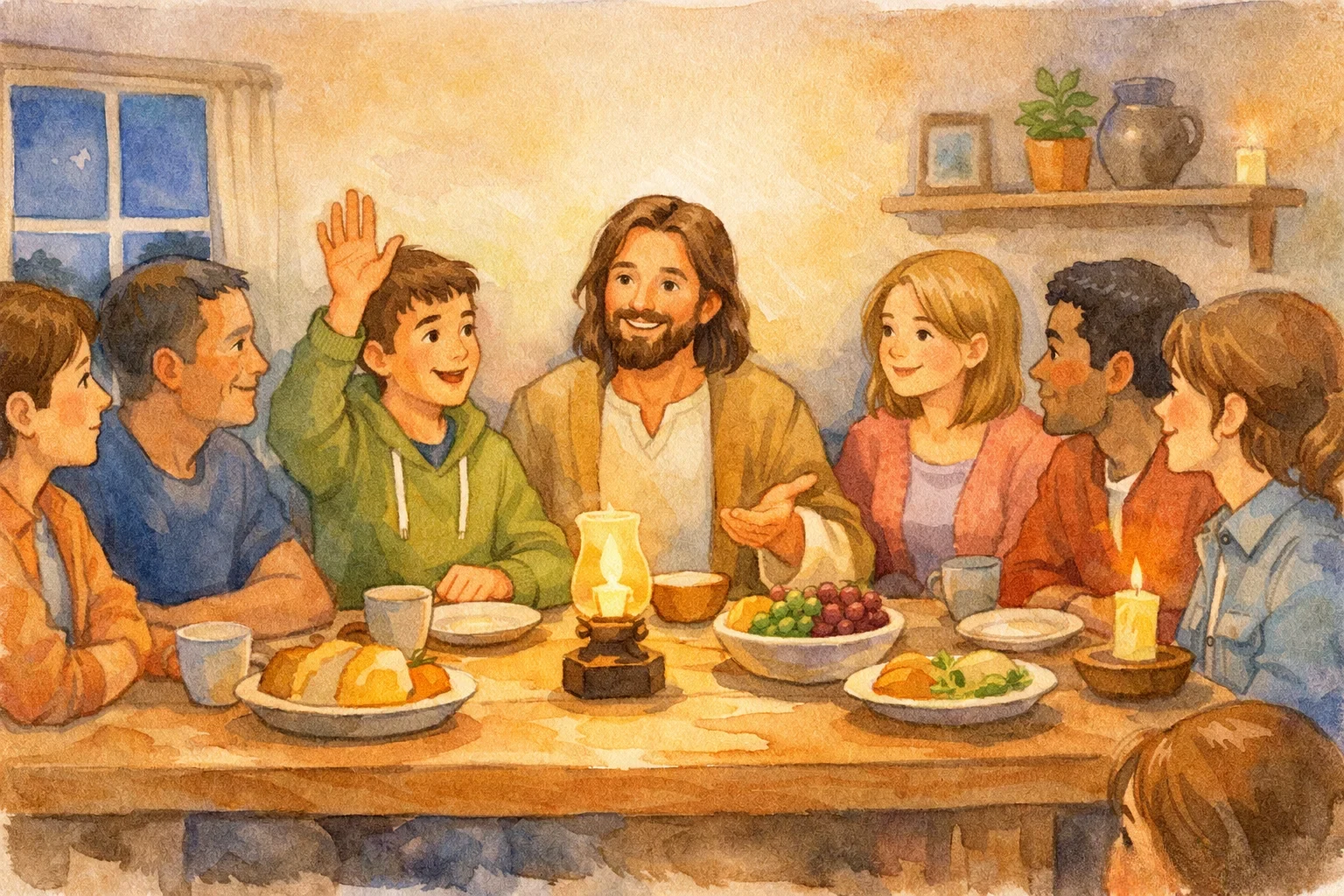
At the Last Supper, Jesus told the disciples he was going to prepare a place for them, and that they knew the way. Everyone else nodded.
Thomas raised his hand: "Lord, we don't know where you are going, so how can we know the way?" (John 14:5).
Because Thomas asked the honest question, we have one of the most important sentences Jesus ever said: "I am the way and the truth and the life. No one comes to the Father except through me" (John 14:6).
Key lesson for kids: The kid who asks "wait, I don't get it" is doing everyone a favor. Thomas' honest confusion pulled one of the Bible's greatest answers out of Jesus. Never be embarrassed to ask.
The Famous Week of Doubt (John 20:19-25)
On the evening of the resurrection, Jesus appeared to the disciples behind locked doors. One apostle was missing: Thomas.
When the others told him, "We have seen the Lord!" Thomas drew a hard line: "Unless I see the nail marks in his hands and put my finger where the nails were, and put my hand into his side, I will not believe" (John 20:25).
Be fair to him. The others hadn't believed the women's report either until they saw Jesus themselves (Luke 24:11). Thomas was asking for exactly the evidence they had already received. And then came the hard part: a full week of waiting, the only disciple still in the dark, while everyone around him glowed.
Key lesson for kids: Doubt in the Bible isn't treated as a crime, but notice what Thomas did with his: he stayed. He didn't leave the group. If you're struggling to believe, the worst move is walking away from the people and places where the answer will find you.
See what they get
Watch a Real Lesson From the App
Press play on Noah and the Great Flood, a complete lesson exactly as your child sees it. 300+ episodes cover the whole Bible in order, each ending in a fun quiz to check what they learned.
A real lesson from the app, watch the whole thing free.
"My Lord and My God!" (John 20:26-29)
A week later, same room, doors locked again, and Jesus came and stood among them. He turned straight to Thomas, and his words show he had heard every syllable of the doubt: "Put your finger here; see my hands. Reach out your hand and put it into my side. Stop doubting and believe."
John never says Thomas actually touched him. Seeing was enough. Thomas answered with the highest statement anyone makes about Jesus in all four Gospels: "My Lord and my God!" (John 20:28).
Then Jesus said the sentence that reaches out of the page to every kid who will ever read it: "Because you have seen me, you have believed; blessed are those who have not seen and yet have believed" (John 20:29). That's us. (Doubting Thomas retells the scene for younger children.)
Key lesson for kids: Jesus didn't scold Thomas, he showed up for him, with exactly the proof Thomas had asked for, and a gentle push to step over the line. God can handle your questions; bring them to him instead of hiding them.
🕯️ Free: 25 Days of Advent Bible Readings
December 1 to 25, one short reading a night, from the first promise to the manger. Printable for the fridge.
Free printable + a few helpful emails. Unsubscribe anytime.
Why Thomas Matters
His doubt bought our assurance. Because Thomas demanded evidence, the resurrection accounts include a hands-on examination offered by Jesus himself, every skeptic since has Thomas to thank.
His confession is the Gospel of John's summit. "My Lord and my God" is where the whole book has been heading since "the Word was God" in chapter 1.
He shows that loyalty and doubt can live in the same person. The man of John 11 and the man of John 20 are the same man, like the empty tomb witnesses, faith grew out of honest confusion.
Strong tradition says he took the gospel to India, the ancient "Thomas Christians" of India trace their church to him. The doubter became one of the farthest-traveling missionaries of all. Quiz the Gospel he stars in with our John Bible trivia.
Watch on Faithful Kids
Your kids can watch Thomas' story, the locked room, the scars, the confession, in short animated episodes on Faithful Kids, about two minutes each with a quiz and reflection after every story.
Jesus told him to "stop doubting and believe" (John 20:27), so the doubt wasn't meant to be permanent, but notice that Jesus answered it rather than condemning it. Thomas' doubt was honest (he said exactly what he needed), stated inside the community (he didn't leave), and surrendered the moment the evidence came. That's a healthy pattern for any doubter: be honest, stay close, and follow the evidence where it leads.
Why was Thomas called "the Twin"?
Both his names mean twin, Thomas from Aramaic, Didymus from Greek (John 11:16). The Bible never tells us who his twin was, and speculation hasn't settled it. It was simply how he was known, the way we might call someone by a family nickname.
Did Thomas actually touch Jesus' wounds?
John doesn't say he did. Jesus offered, "put your finger here", but the next thing recorded is Thomas' confession, "My Lord and my God!" (John 20:27-28). Many readers through history have concluded that seeing Jesus, alive and bearing the scars, was all the proof Thomas needed. The offer itself was the point: Jesus met the exact terms of Thomas' doubt.
What happened to Thomas after the resurrection?
The New Testament last names him in the upper room before Pentecost (Acts 1:13). Strong and very early tradition says he carried the gospel east, to Syria, Persia, and famously to India, where the "Saint Thomas Christians" of Kerala have traced their origins to his preaching since ancient times, and where tradition says he died a martyr. The man who once demanded proof spent the rest of his life giving it.
🕯️ Free: 25 Days of Advent Bible Readings
December 1 to 25, one short reading a night, from the first promise to the manger. Printable for the fridge.
Free printable + a few helpful emails. Unsubscribe anytime.