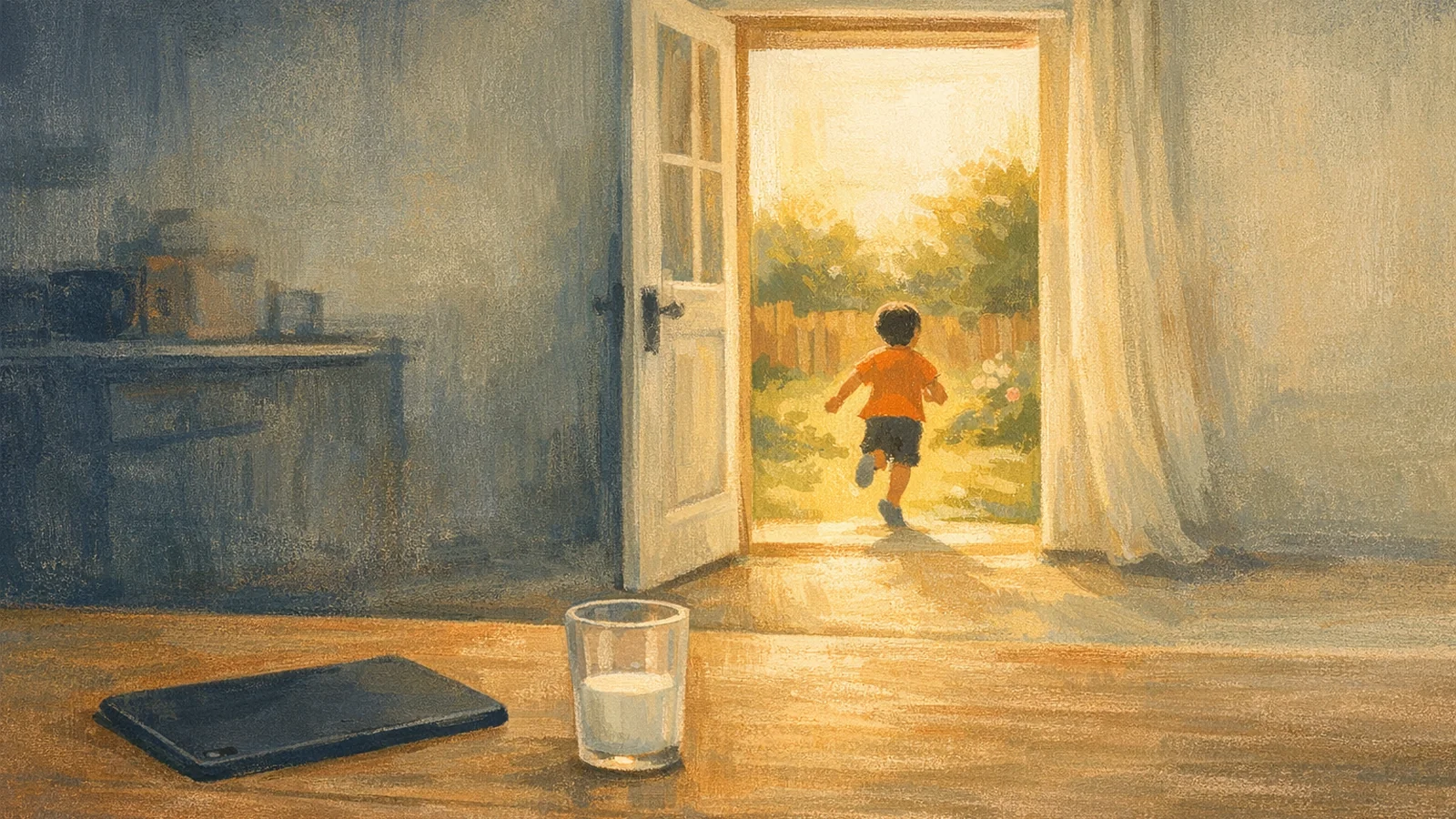
Picture the sequence from a child's height. Somebody cannot find a shoe. Somebody is told to hurry for the fourth time, louder. A parent's voice has the edge it only gets on this one morning of the week. The car is quiet in the way that is not peaceful. Then the doors open at church, and the same parent turns to a greeter and smiles as if the last hour had not happened.
Children read that sequence perfectly. They may not have words for it, but they have the conclusion: church is the place where we go to pretend. The thing we say matters most is the thing that makes the adults angriest, and the anger has to be hidden the moment we arrive. Whatever the sermon says that morning, it will be heard through that lesson.
I do not think most of us intend to teach it. I think it is the natural product of trying to get several people out of a house on time, on the one morning when everyone is tired and the stakes feel spiritual. But intending and teaching are different things, and children are taught by what happens, not by what was meant.
The posture is the lesson
"I rejoiced with those who said to me, 'Let us go to the house of the Lord'" (Psalm 122:1). It is one of the most quoted lines about worship in the Bible, and it describes a mood, not a liturgy. The psalmist is glad to be going. The gladness is the point.
A child cannot be instructed into that gladness. They can only catch it, and they catch it from the posture of the adults in the house during the hour before. A parent who is harried, resentful and rushing is not failing a moral test; they are a tired person with a hard logistics problem. But the child is not grading effort. The child is absorbing a posture, and the posture says: this is a chore that makes us unhappy.
That is a heavy thing to have taught by the age of eight, and it has very little to do with the quality of the children's ministry or the preaching. The most beautiful service in the world cannot undo an hour of being yelled at on the way to it.
What is actually going wrong
Almost always, three things.
The morning is doing too much. Clothes, breakfast, hair, shoes, a bag for the nursery, a lost Bible, two children who woke up at different times. All of it compressed into a window with a hard stop. No household handles that gracefully on a weekday either; we just notice it more on Sunday because we expected better of ourselves.
Sunday is treated as sacred and the Saturday before it is not. The scramble is almost entirely a Saturday-night problem wearing Sunday clothes. Nothing was laid out. Nothing was decided. The morning inherits every decision that was not made the night before.
We arrive with nothing left. By the time the family is in the pew, the adults have spent the patience they were hoping to bring to worship on the car ride. The child notices that too.
The most beautiful service in the world cannot undo an hour of being shouted at on the way to it.
A different hour
None of this needs a system. It needs a few decisions moved to Saturday and a slightly lower standard for Sunday.
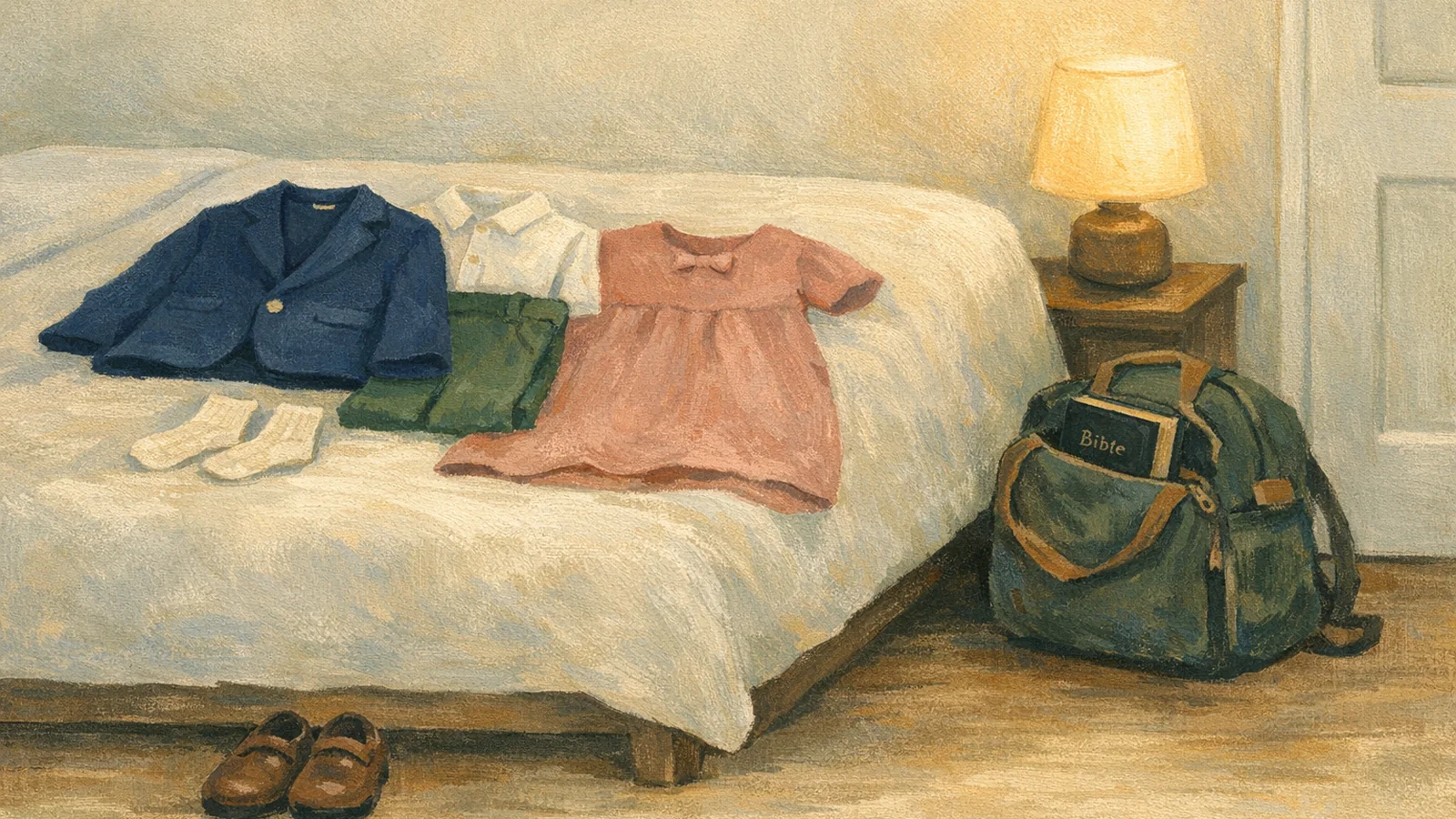
- Saturday night does the work. Clothes out, down to the socks. Bags packed by the door. Breakfast decided, ideally something that needs no cooking. If there is a Bible to bring, it is in the bag. Every one of these is a fight that now cannot happen in the morning.
- Aim to be early, so that late is still on time. Families who plan to arrive ten minutes early arrive on time, calm. Families who plan to arrive on time arrive late, furious. The difference is the same ten minutes; it just decides who spends them.
- Lower the dress code before you lower your voice. If the choice on a given morning is a child in the wrong shirt or a child in the right shirt who was shouted at, choose the shirt. Nobody in the pew behind you will remember the shirt.
- Say one true sentence in the car. Not a devotion, not a lecture. "I am glad we are going today." Or, on the mornings that went badly, "That was a rough hour. I am sorry. I am still glad we are going." Children can absorb a bad morning if it is named; they cannot absorb one that is denied at the church door.
- Let the arrival be slow. A family that walks in with two minutes to spare and sits down together has had a different morning from one that scatters children to rooms while a parent sprints for a seat. If that means missing the first song for a season, miss it.
Why it is worth the trouble
Hebrews tells believers not to give up meeting together but to keep "spurring one another on toward love and good deeds" and "encouraging one another" (Hebrews 10:24-25). The habit of gathering is the thing being protected, and habits are built in childhood, from the inside. A child who grew up glad to go will go, long after they have forgotten any particular sermon. A child who grew up dreading the hour before will find reasons not to, and will not be able to tell you why.
Which means the hour before church is not the obstacle to the spiritual part of Sunday. For your children, it is the spiritual part of Sunday. It is where they are deciding, week by week, whether this is something their family loves or something their family survives. The good news is that the hour is yours to change, and most of the change happens on Saturday night.
Sources
From Faithful Kids
- The Bible Lesson Your Kids Remember Is the One Where You Apologized
- Sunday school lessons for kids
- How to make church fun for kids
Faithful Kids publishes this section. Our Bible stories and printables are free for every family.