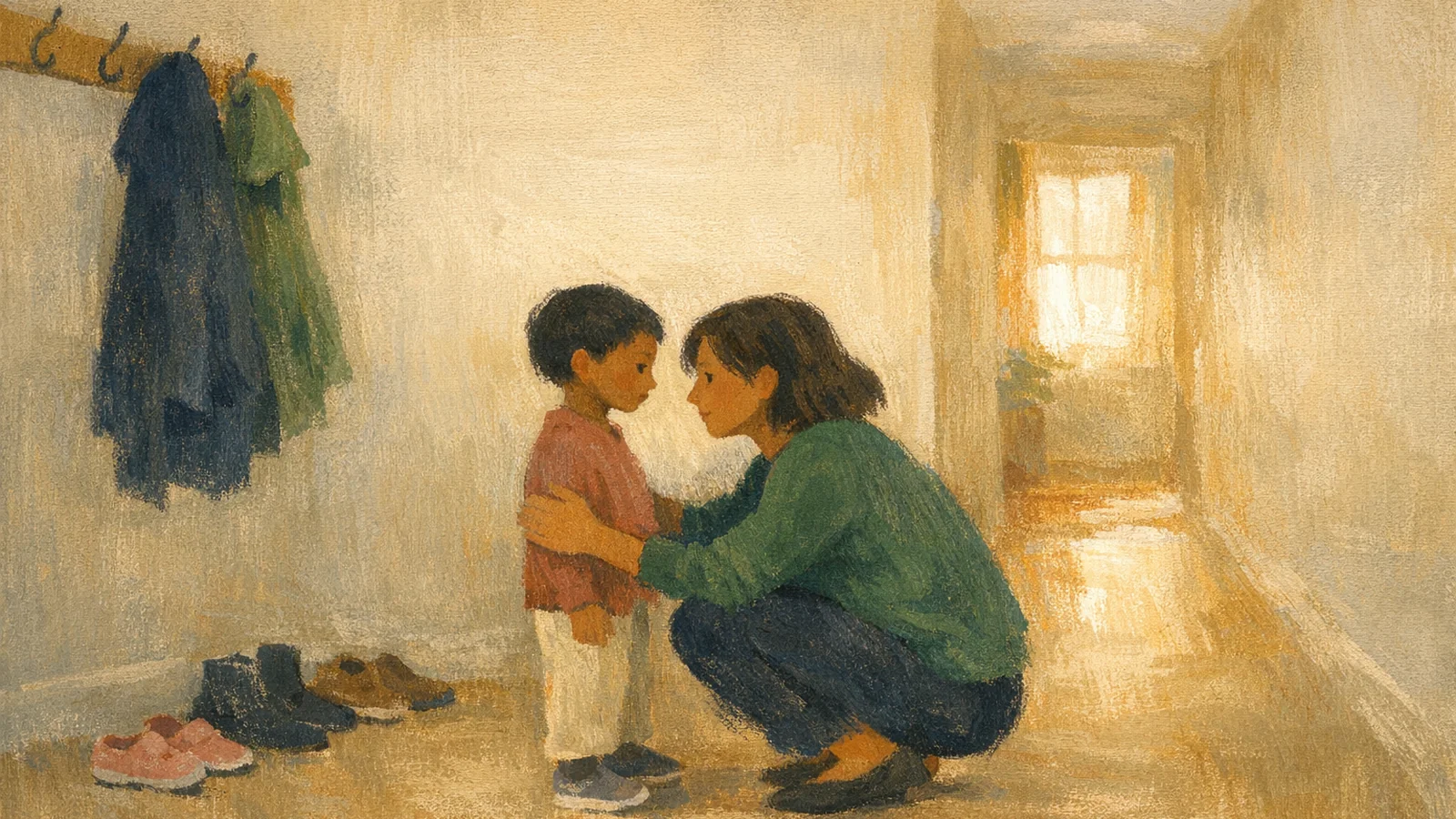
There is a particular silence in a house after a parent has lost their temper. The child has gone quiet. The parent is replaying the last ninety seconds and finding no version in which they come out well. And in that silence a decision gets made, usually without anyone noticing, about what the children in that house will believe about God.
That sounds too large. It is not. We tell children that God forgives those who confess. We tell them the prodigal's father ran down the road. We tell them that Peter denied Jesus three times and was restored over breakfast. And then the most powerful adult in their world does something wrong, in front of them, and either names it or pretends it did not happen. Whichever one we choose, that is the lesson. The stories are the footnotes.
Children believe what they see modelled, not what they are told
Anyone who has spent time with small children knows that they are not primarily listeners. They are watchers. They learn language, manners, fear and humour by watching the adults they are attached to, and they learn theology the same way. A child whose parent never apologises does not conclude that the parent is perfect. Children are not fools. The child concludes that being wrong is shameful, that strong people hide it, and that confession is for the weak or the caught.
Now put that child in Sunday school and tell them that "if we confess our sins, he is faithful and just and will forgive us" (1 John 1:9). They will nod. They may even memorise it. But the verse is competing with years of evidence from the people they trust most, and the evidence usually wins.
The reverse is also true. A child who has heard a parent say "I was wrong to shout at you, and I am sorry, will you forgive me?" has felt, in their own body, what confession and forgiveness are. They have been on the receiving end of a request for grace from someone bigger than them. When they later hear that God invites the same thing, it is not a new idea. It is a familiar one with a larger name.
What a real apology to a child sounds like
Most adults were not apologised to as children, so we tend to get this wrong in predictable ways. A real apology has four parts and no "but."
Name the thing. "I shouted at you about the shoes." Not "I'm sorry if I was a bit short." A child cannot forgive a fog.
Own it without a trailer. "That was wrong of me." The moment you add "but you had been asked three times," you have turned an apology into a verdict against the child, and they know it. Their behaviour may need dealing with. Deal with it separately, later, when you are not the one in the dock.
Ask. "Will you forgive me?" This is the part that costs something, and it is the part that teaches the most. You are a parent asking a seven-year-old for something you cannot take. That is exactly the posture Scripture describes between us and God, and the child feels the weight of it even if they cannot say so.
Let them answer. Sometimes the answer is a shrug, or "fine," or a hug that comes a minute later when they think you are not looking. Take whatever is offered. Forgiveness is theirs to give, and part of the lesson is that it is not owed on demand.
You can teach grace with a hundred stories. A child learns it the first time a parent says sorry and means it.
What an apology is not
It is not abdication. Apologising for shouting does not mean the shoes did not need to go on. Children can hold both: my parent was wrong to yell, and I still need to get ready. In fact they hold it more easily than adults do, because they have not yet learned to use one wrong to cancel another.
It is not a performance of guilt. A parent who apologises in a way that makes the child feel responsible for cheering them up has simply found a new way to make the moment about themselves. Say it plainly, ask, and then be normal. The child does not need to see you suffer. They need to see you repent, which is a different and quieter thing.
And it is not rare. If the only apologies in a house are for catastrophes, children learn that confession is for catastrophes. The small ones matter more: "I said we would read tonight and I forgot, I am sorry." "I was not listening to you just now. Say it again, I am here." These cost almost nothing and they teach that being wrong is survivable, which is most of what a child needs to know before they can bring anything real to God.
The verses we quote at them
"Be kind and compassionate to one another, forgiving each other, just as in Christ God forgave you" (Ephesians 4:32). We put that one on walls. Notice that it is a description of a household, not a sermon: people forgiving each other, in both directions, because of what they have each received. There is no clause excusing the parents.
"Confess your sins to each other and pray for each other so that you may be healed" (James 5:16). Each other. The child is one of the others. A family where confession only flows downward, from child to parent, has taught the child half a verse.
Tonight
If there is something from today that needs saying, say it before the lights go out. Keep it short. Name it, own it, ask, and let them answer. You will not feel like you taught a Bible lesson. You will have taught the one they remember.
Sources
From Faithful Kids
- What the Sunday Morning Scramble Teaches Your Kids
- Bible stories about forgiveness for kids
- Object lessons on forgiveness
Faithful Kids publishes this section. Our Bible stories and printables are free for every family.