Advent Wreath Meaning for Kids: Candles + Devotions
Ages 5+·12 min read··By Faithful Kids Team·Updated August 16, 2026
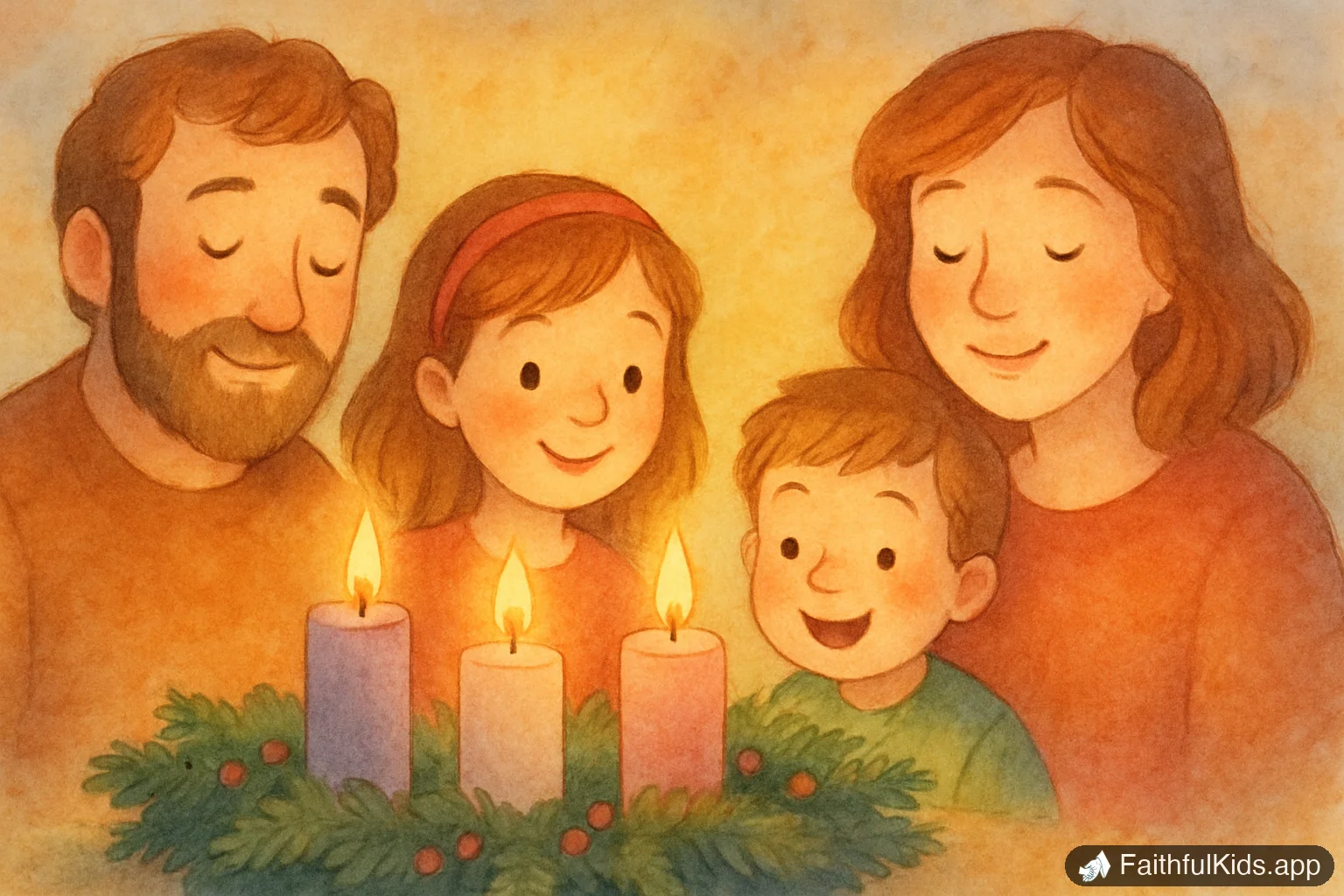
The Advent wreath's four candles stand for hope, peace, joy, and love -- one lit each Sunday before Christmas -- and the white candle in the center stands for Jesus, the Light of the World. Each week the wreath gets brighter, showing kids that Christmas, and Christ, are getting closer.
This guide explains every candle in words children understand, then gives you five short read-aloud devotions -- one for each Sunday of Advent plus Christmas Eve -- so your family can light the candles with more than "okay, someone say something."
What Does the Advent Wreath Itself Mean?
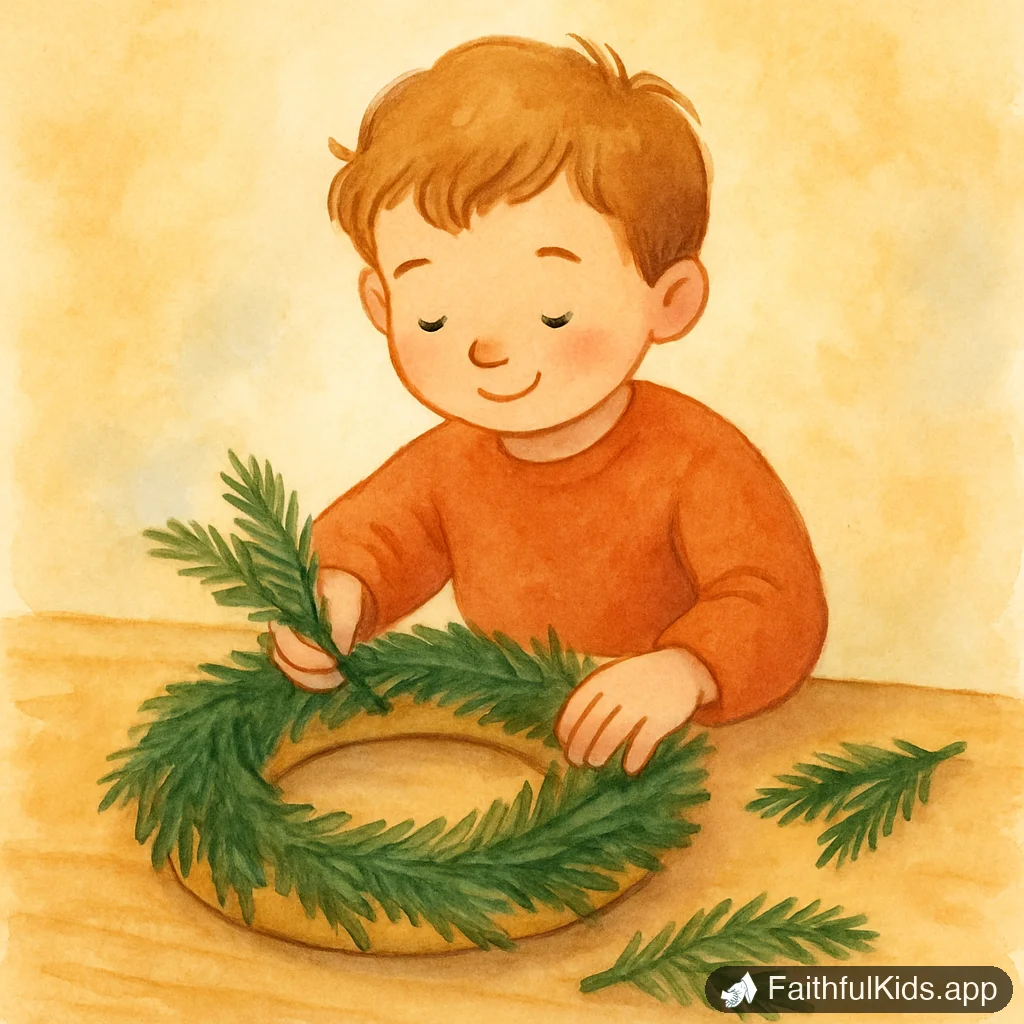
The wreath is a circle of evergreen branches, and both the shape and the plant are teaching kids something. A circle has no beginning and no end -- like God's love, which never started and will never stop. Evergreens stay green all winter while everything else looks dead -- a picture of the everlasting life Jesus gives.
Even the candlelight itself is a lesson. Jesus said, "I am the light of the world. Whoever follows me will never walk in darkness" (John 8:12). December has the darkest days of the year -- and right in the middle of that darkness, families light one more candle every week. Kids feel that message before they can explain it. (For where Advent came from and when it starts, see our explainer on what Advent is for kids.)
What Does Each Advent Candle Mean?
Each candle has a theme (hope, peace, joy, love) and a traditional nickname tied to the Christmas story. Here's the most common arrangement, explained at kid level:
Candle 1 -- Hope (the Prophecy Candle, purple). Remembers the prophets who promised, hundreds of years early, that a Savior was coming: "For to us a child is born, to us a son is given" (Isaiah 9:6). For kids: hope is believing something good is coming even though you can't see it yet.
Candle 2 -- Peace (the Bethlehem Candle, purple). Remembers Mary and Joseph's journey to the little town where Jesus, the "Prince of Peace" (Isaiah 9:6), would be born to make peace between us and God. For kids: peace is what happens when things that were fighting get put right.
Candle 3 -- Joy (the Shepherd's Candle, pink). The one pink candle! It remembers the shepherds, who heard "good news that will cause great joy for all the people" (Luke 2:10). It's pink because by week three the waiting is more than half over -- time to celebrate. For kids: joy is happiness that goes deeper than your circumstances.
Candle 4 -- Love (the Angel's Candle, purple). Remembers the angels who announced Jesus' birth, and the reason behind the whole story: "For God so loved the world that he gave his one and only Son" (John 3:16). For kids: Christmas is what God's love looks like in action.
Center Candle -- the Christ Candle (white). Lit on Christmas Eve or Christmas Day. White stands for Jesus -- pure, holy, the Light the other four candles were pointing to all along.
Week
Candle
Color
Theme
Key Verse
1
Prophecy Candle
Purple
Hope
Isaiah 9:6
2
Bethlehem Candle
Purple
Peace
Luke 2:4-7
3
Shepherd's Candle
Pink
Joy
Luke 2:10
4
Angel's Candle
Purple
Love
John 3:16
Christmas
Christ Candle
White
Jesus, Light of the World
John 8:12
Note: some churches order the middle themes differently (peace and joy sometimes swap, and some traditions use faith or preparation). None of these is "wrong" -- follow your church's pattern if you have one.
How Do You Do a Candle-Lighting Devotion With Kids?
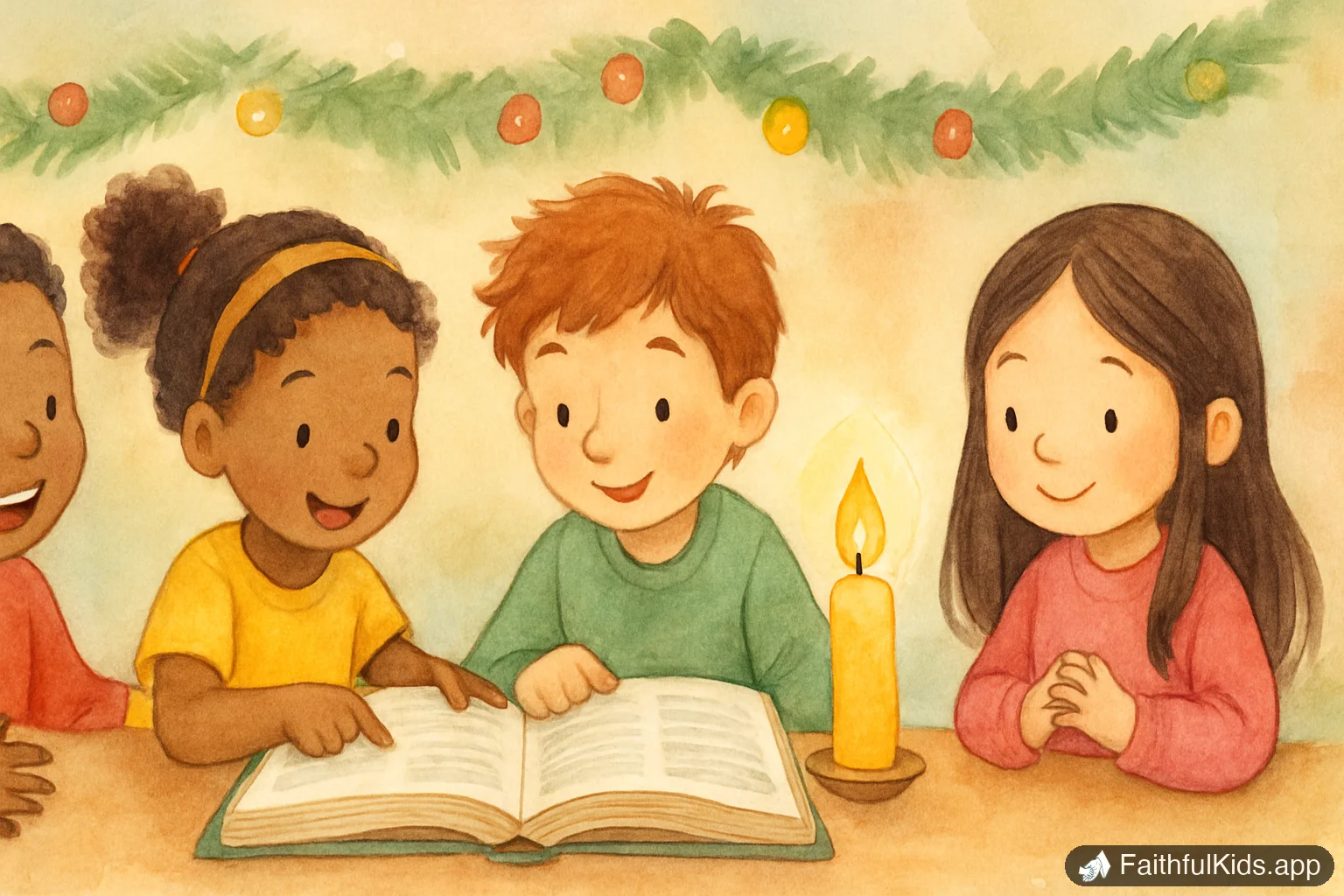
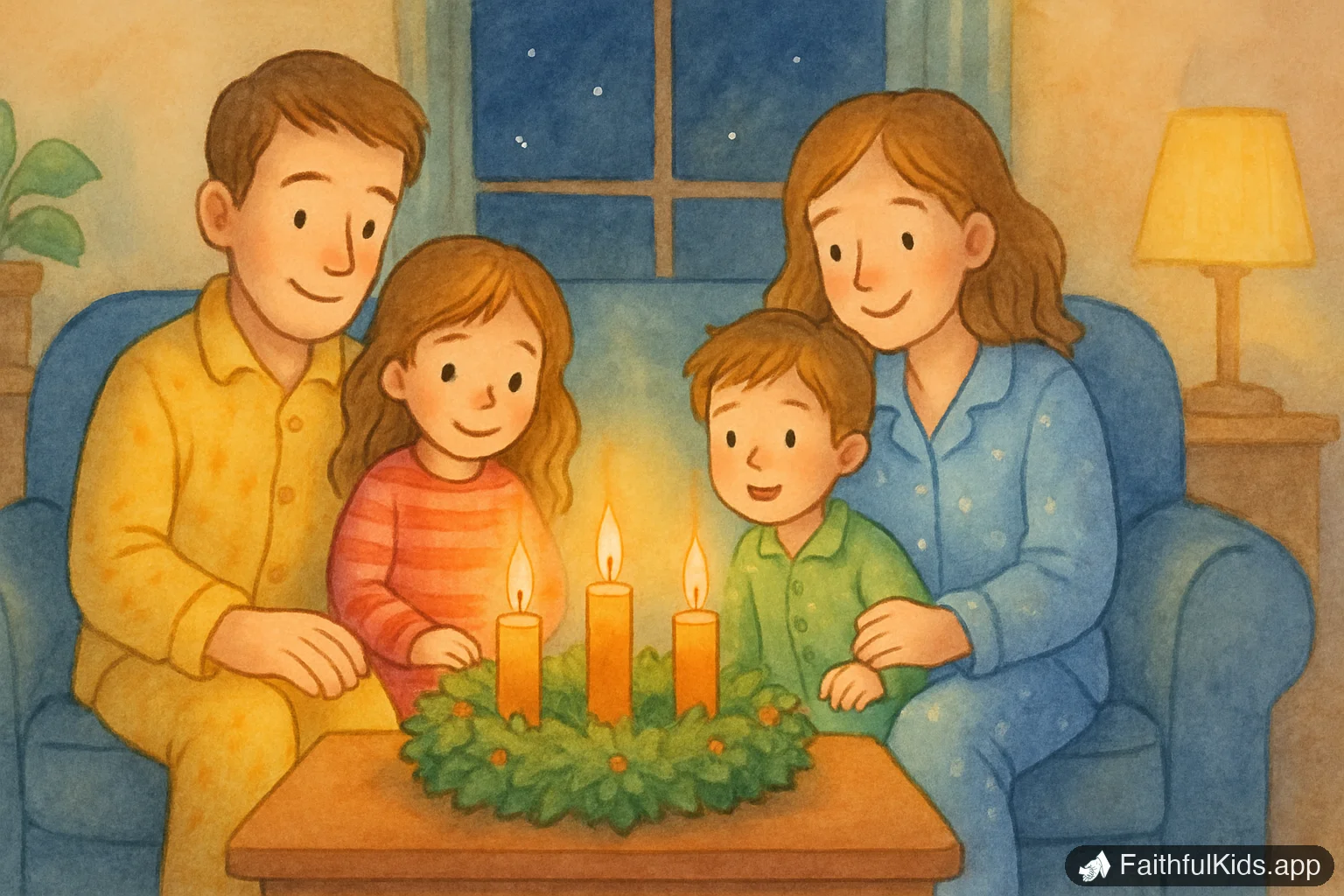
Keep it under ten minutes: light the candle, read a short passage, read or say a few sentences about it, ask one question, and pray one prayer. That's the whole liturgy. Do it at Sunday dinner while everyone's already seated -- consistency beats ceremony.
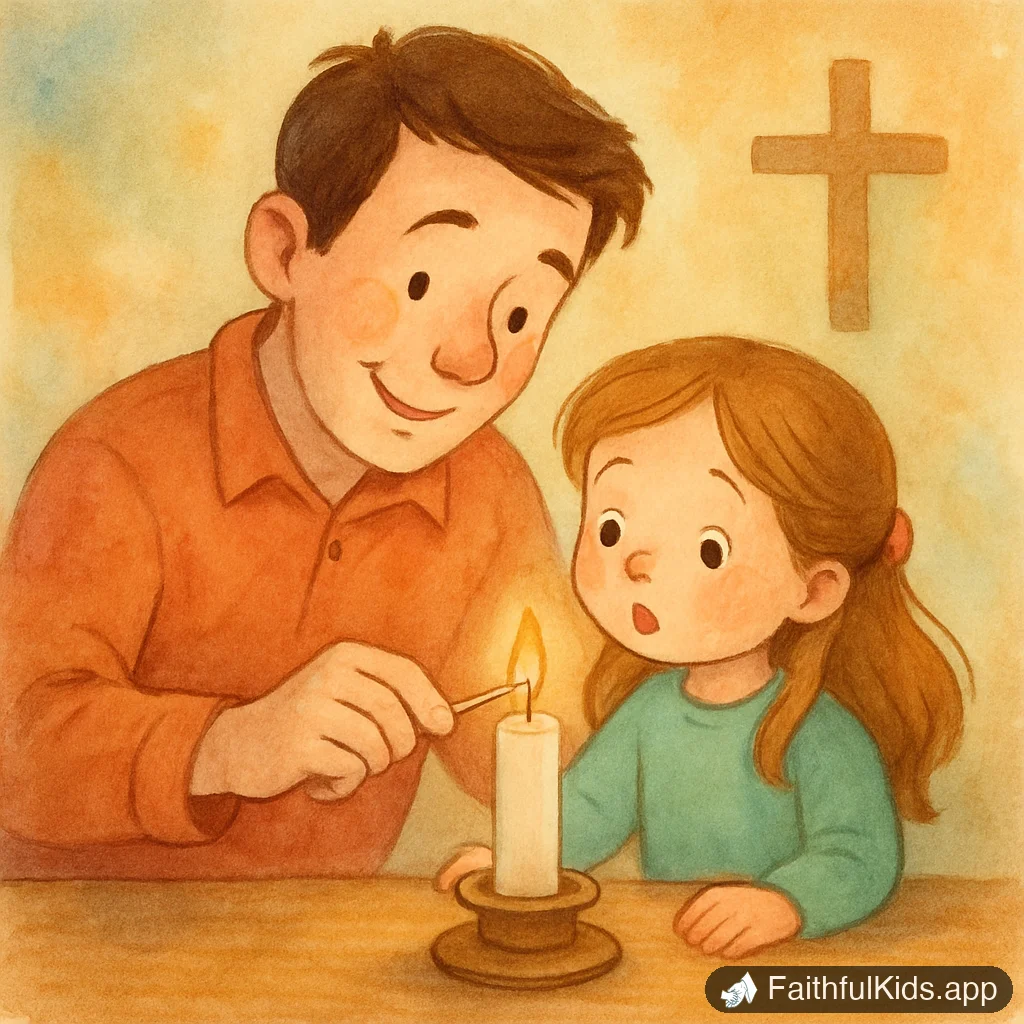
Three practical tips: let kids do jobs (one lights hand-over-hand, one reads, one blows out -- rotate weekly to prevent civil war); relight the previous weeks' candles each time, since the growing light is the point; and don't chase perfection -- kids remember the rhythm, not the polish.
The five devotions below are written to be read aloud exactly as-is. Each takes 5-7 minutes. For more read-aloud material to go deeper any week, our roundup of Advent Bible stories for kids pairs stories with each theme.
There is also a free set of Christmas coloring pages on our site, drawn for crayons and ready to print.
Families building an Advent rhythm love the printable Jesse Tree ornaments — hang one a day and walk the whole Bible story to the manger.
Planning the whole month? The Christmas hub lists every Advent devotion, story, and printable we publish.
Week 1 Devotion: Hope (Light One Purple Candle)
Read: Isaiah 9:2, 6
Light the candle and read this aloud:
Tonight we light one candle. Just one. Look how small that light is -- and look how much dark is still around it.
That's what hope felt like for God's people. For hundreds of years, they waited for the Savior God promised. Prophets like Isaiah told them: "The people walking in darkness have seen a great light" (Isaiah 9:2). Year after year went by, and they had to keep believing in a promise they couldn't see yet.
That's what hope is: holding on to God's promise while you wait. And here's the best part -- God kept His promise. The child was born. Every candle we light this month reminds us that God always keeps His word, even when the waiting is long.
Ask: What's something you've had to wait a long time for? What made the waiting easier?
Pray: God, thank You for keeping Your promises. While we wait for Christmas, help us remember that You always do what You say. Amen.
See what they get
Watch Born in a Manger Come Alive
Born in a Manger is one of 300+ short narrated video lessons your child will love. Watch the whole episode right here — in the app, every lesson ends with a fun quiz to check what they learned.
A real lesson from the app — watch the whole thing free.
Week 2 Devotion: Peace (Light Two Purple Candles)
Read: Luke 2:4-7 and Isaiah 9:6
Light both candles and read this aloud:
Two candles tonight. The light is growing.
This week we remember a little town called Bethlehem. Mary and Joseph had to travel there -- a long, dusty trip, right when Mary's baby was almost due. When they arrived, there was no proper room for them. Jesus, the King of the whole world, was born in a place where animals slept.
Isaiah called this baby the "Prince of Peace" (Isaiah 9:6). Peace doesn't just mean quiet -- it means things being put right. Jesus came to put things right between us and God, and to teach us to put things right with each other: to forgive, to say sorry first, to stop fights instead of starting them. The Prince of Peace didn't come with an army. He came as a baby, to the humblest place in town -- because peace often starts small, like one person in a family deciding to be kind first.
Ask: Where does our family need more peace this week? What's one thing you could put right with someone?
Pray: Jesus, You are the Prince of Peace. Help our family forgive quickly, speak kindly, and put things right. Amen.
Week 3 Devotion: Joy (Light Two Purple + the Pink Candle)
Read: Luke 2:8-14
Light three candles and read this aloud:
Look -- tonight we finally light the pink one! Pink is the color of joy, and this is the joy week, because Christmas is closer than ever.
This candle is for the shepherds. They were ordinary workers, out in the fields at night, watching their sheep like every other night. Nobody important ever brought news to shepherds first. But God did. An angel lit up the sky and said: "Do not be afraid. I bring you good news that will cause great joy for all the people" (Luke 2:10). Then the whole sky filled with angels praising God.
Notice who the joy was for: all the people. Not just kings. Not just grown-ups. Shepherds, kids, everyone. Joy is deeper than just feeling happy -- happiness comes and goes with good days and bad days, but joy stays, because joy comes from knowing Jesus came for you.
Ask: Why do you think God announced the biggest news in history to shepherds instead of kings?
Pray: God, thank You for good news that is for everyone -- including us. Fill our home with joy this week. Amen.
Week 4 Devotion: Love (Light All Four Candles)
Read: John 3:16 and Luke 1:30-33
Light all four candles and read this aloud:
Four candles tonight. Our wreath is almost full of light, and Christmas is almost here.
This last purple candle is for love -- and for the angels who carried God's loving message. Before Jesus was born, the angel Gabriel visited a young woman named Mary and told her the most surprising news anyone has ever received: she would be the mother of God's Son. Mary was afraid at first, but she trusted God and said yes.
Why did God do all of this -- the promises, the angels, the baby? The Bible gives the reason in one sentence: "For God so loved the world that he gave his one and only Son" (John 3:16). Christmas isn't just a story about a baby. It's the moment God's love showed up in person. He didn't send a letter or a lightning bolt. He came Himself.
When you love someone, you don't just say it -- you show it. That's exactly what God did.
Ask: What's one way you could show love to someone in our family before Christmas -- not just say it?
Pray: God, thank You for loving us enough to send Jesus. Help us show love the way You do -- with actions, not just words. Amen.
Christmas Eve Devotion: The Christ Candle (Light All Five)
Tonight, we light the candle we've been waiting for -- the white one in the middle. Every other candle was pointing to this one.
Hope: God promised a Savior. Peace: He was born in Bethlehem. Joy: the shepherds heard the good news. Love: God gave His only Son. And tonight -- He's here. "Today in the town of David a Savior has been born to you; he is the Messiah, the Lord" (Luke 2:11).
Look at how bright our wreath is now. Remember the first week, when there was just one small flame? Jesus said, "I am the light of the world" (John 8:12). The light we've been waiting for all month -- all of history, really -- has come. The waiting is over. Merry Christmas.
Ask: Now that we've waited all month -- what part of the Christmas story means the most to you this year?
Pray: Jesus, Light of the World, welcome. Thank You for coming to us. Happy birthday -- this whole celebration is for You. Amen.
Then let the youngest kid blow out the candles -- or better, leave them burning through dinner. If your family wants one more voice in the prayer, our collection of Christmas prayers for kids has short ones children can read themselves. Families using Faithful Kids often end the night with the nativity video lesson and quiz -- a fun way to see how much the kids absorbed over four weeks.
Print the Christmas word search for the table, or let them play it on screen. Either way it is free.
Frequently Asked Questions
What do the 4 Advent candles stand for?
The four Advent candles stand for hope, peace, joy, and love -- one lit on each of the four Sundays before Christmas. They're traditionally nicknamed the Prophecy Candle, Bethlehem Candle, Shepherd's Candle, and Angel's Candle. A fifth white candle in the center, the Christ Candle, represents Jesus and is lit on Christmas Eve or Christmas Day.
Why is one Advent candle pink and the rest purple?
Purple is the traditional color of preparation and royalty, while the single pink candle marks the third Sunday -- Gaudete ("rejoice") Sunday -- as a burst of joy in a reflective season. It signals that the waiting is more than halfway over. If your candles are all one color, that's fine; the meaning is in the lighting, not the dye.
What order do you light Advent candles?
Light one new candle each Sunday, and relight all previous candles too: week one has one flame, week two has two, and so on. The usual order is hope (purple), peace (purple), joy (pink), love (purple), then the white Christ candle on Christmas Eve or Christmas Day. Some churches swap the middle themes -- follow your church's pattern if you have one.
Is it safe to do Advent candles with young kids?
Yes, with normal candle rules: an adult handles the flame, kids keep hands in laps, and the wreath sits mid-table away from edges. Battery-operated LED candles are a completely legitimate option for families with toddlers -- the tradition is about the growing light, not the fire.
Do you have to have a wreath, or can you just use candles?
You can absolutely use four or five candles without a wreath -- lined up on the table or in individual holders. The wreath's circle and evergreens add lovely symbolism, but the heart of the tradition is lighting candles weekly while reading Scripture and praying together.
What should we read when we light each candle?
Read one short Scripture passage tied to the week's theme, plus a brief devotion -- the five written above cover every week and take about five minutes each. Week one pairs with Isaiah 9:2-6, week two with Luke 2:4-7, week three with Luke 2:8-14, week four with John 3:16, and Christmas Eve with Luke 2:1-20.
🌙 Free: The Bedtime Bible Kit
Seven nights of five-minute stories — a story, a prayer, and one question to whisper about.
Free printable + a few helpful emails. Unsubscribe anytime.