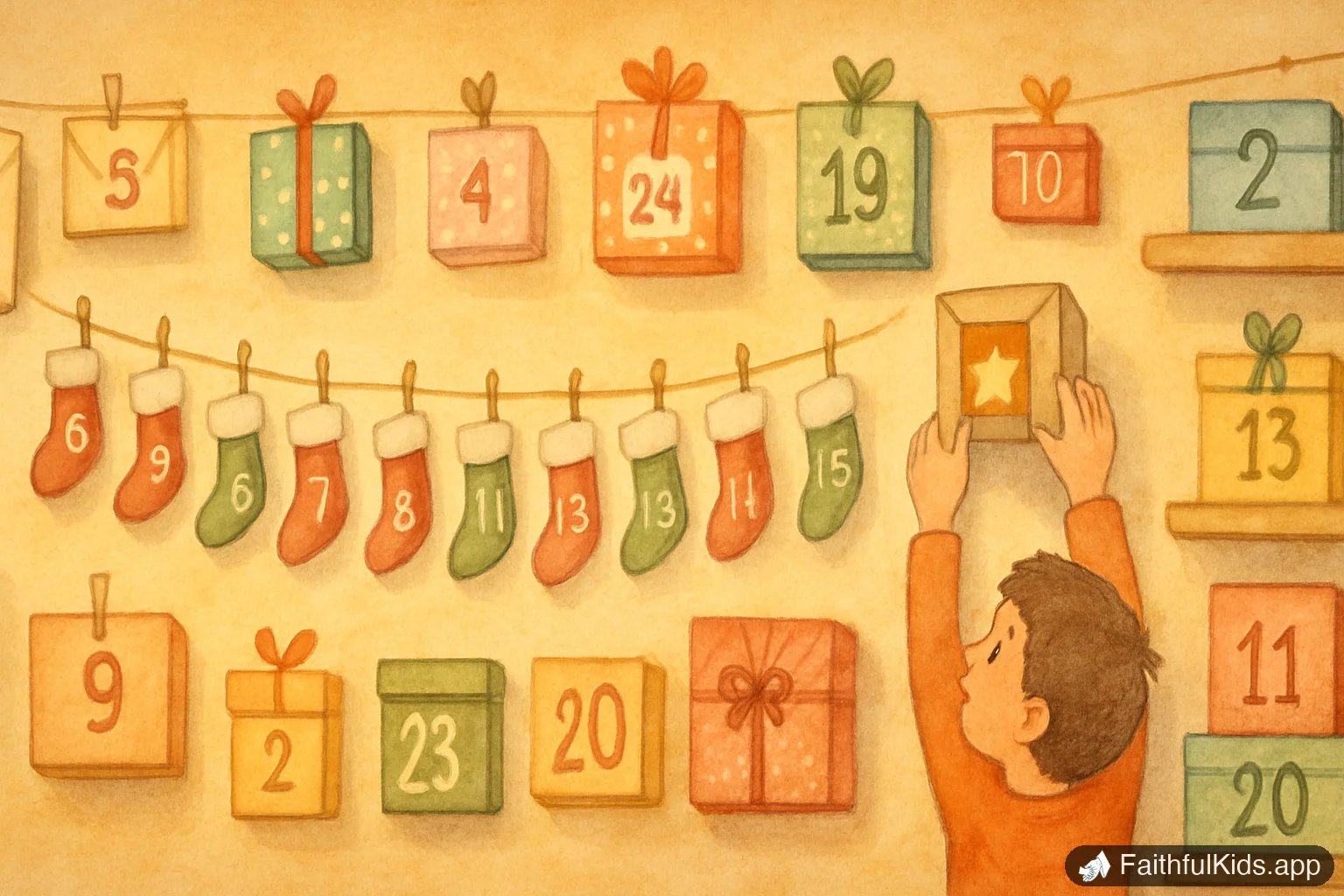
The best Advent calendar for your kids is the one you'll actually open every day -- and for most families that means picking a type first, not a product. There are five real categories worth your money (scripture calendars, activity calendars, book-a-day, chocolate-plus-devotion hybrids, and refillable wooden calendars), and the right one depends entirely on your kids' ages and how much daily effort you can honestly sustain in December.
This is a buying guide: what separates a good faith-centered calendar from a cardboard box of waxy chocolate, what to look for at each age, what things actually cost, and honest picks. Prefer to make your own? Our companion post on Advent calendar ideas for kids has 15 DIY builds with exact setup steps -- that one is for making, this one is for buying. If you're not sure what the season itself is about yet, start with what Advent is for kids.
What Makes a Good Faith-Centered Advent Calendar?
A good faith-centered Advent calendar has a daily action that takes under five minutes, a clear tie to the Christmas story, and something physical for a kid to open, move, or hang. Everything else is decoration.
Four things separate the calendars families finish from the ones abandoned by December 12:
- A story that goes somewhere. The strongest calendars move in order -- prophecy, announcement, journey, birth -- so December has an arc. A calendar with 24 unrelated verses is a vitamin; a calendar that tells a story is a serial.
- A daily action, not just a daily object. Read this, hang this, do this. Objects alone get boring by day 8.
- A parent script. The best calendars include the sentence you're supposed to say. At 7:40pm on a Tuesday, you will not want to improvise a devotion.
- Honest length. If the daily reading takes eight minutes, treat it as an eight-minute commitment for 24 straight nights. Most families overestimate. Buy for your worst week, not your best one.
The Five Types of Advent Calendar
1. Scripture and Devotion Calendars
What it is: 24 or 25 doors, each with a verse or a short reading that walks through the Christmas story.
Best for: Ages 3-10, and families who want the meaning built in rather than added on.
Honest pick: God's Big Promises Advent Calendar from The Good Book Company (by Carl Laferton) is a 25-door calendar aimed at roughly ages 3-7 that ships with a family devotional booklet, so the reading is written for you. It's the cleanest example of the category: doors plus a script.
Watch out for: Calendars that print only a verse reference behind each door with no explanation. Those look devotional and land flat, because a four-year-old cannot do anything with "Isaiah 11:1" on its own.
Typical price: $15-25.
2. Activity and Ornament Calendars
What it is: Each day has a small craft, ornament, or activity that ends with something to hang or display.
Best for: Ages 4-9, hands-on kids, and parents who'd rather do than read.
Honest picks: Truth in the Tinsel is a long-running printable/eBook Advent experience built around making one ornament a day for 24 days, with supply lists, craft templates, and talking points included -- it costs less than a boxed calendar and you print it yourself. On the premium end, Ann Voskamp's The Wonder of the Greatest Gift is a pop-up three-dimensional Jesse Tree with 25 doors at the base, each hiding an ornament to hang, paired with daily readings.
Watch out for: Craft calendars are the most rewarding and the most likely to be abandoned, because day 14 requires glue at bedtime. Read the supply list before you buy, and pre-cut everything the weekend before December.
Typical price: $8 (printable) to $35 (pop-up).
3. Book-a-Day Calendars
What it is: 24 wrapped Christmas and Bible storybooks, one unwrapped and read each night.
Best for: Ages 2-8, and any family whose bedtime routine already includes reading. This is the single lowest-friction option, because it replaces an existing habit instead of adding one.
Honest pick: There is no product to buy here, and that's the point. Boxed book-a-day sets exist and are expensive; a library card and a roll of wrapping paper cost nearly nothing, and kids do not mind re-wrapped favorites. Save the best nativity book for December 24.
Watch out for: Twenty-four brand-new picture books is a $200+ purchase. Don't let a bundle price talk you into a tradition you could build for the cost of tape.
Typical price: $0-30.
4. Chocolate-Plus-Devotion Hybrids
What it is: A traditional candy calendar where each window also carries a line of the Christmas story.
Best for: Ages 3-12, and families who want zero added steps. Also the peacekeeper option when one kid desperately wants chocolate.
Honest pick: The Real Advent Calendar from the Meaningful Chocolate Company is the clearest example: Fairtrade chocolate behind 25 windows, each with an illustrated line from the Christmas story, plus a 24-page Christmas story activity booklet in the box. It's a UK company, so check shipping and availability if you're in the US and order early -- these sell out most years.
Watch out for: Most supermarket chocolate calendars have no faith content at all. That's fine. Buy one and tape a jar of 24 question slips beside it -- a 15-second question before the candy does the same job.
Typical price: $6-20.
5. Refillable Wooden and Fabric Calendars
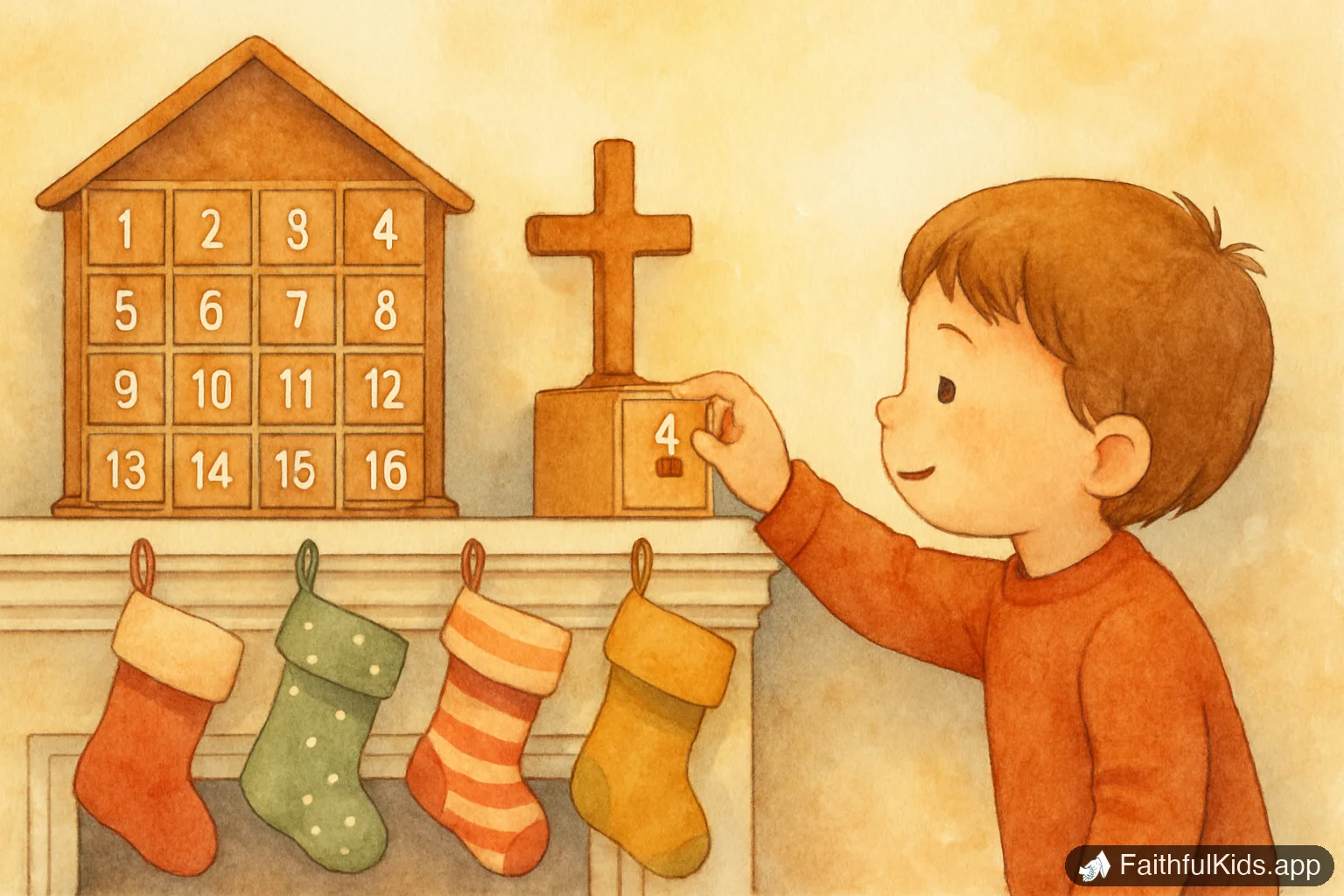
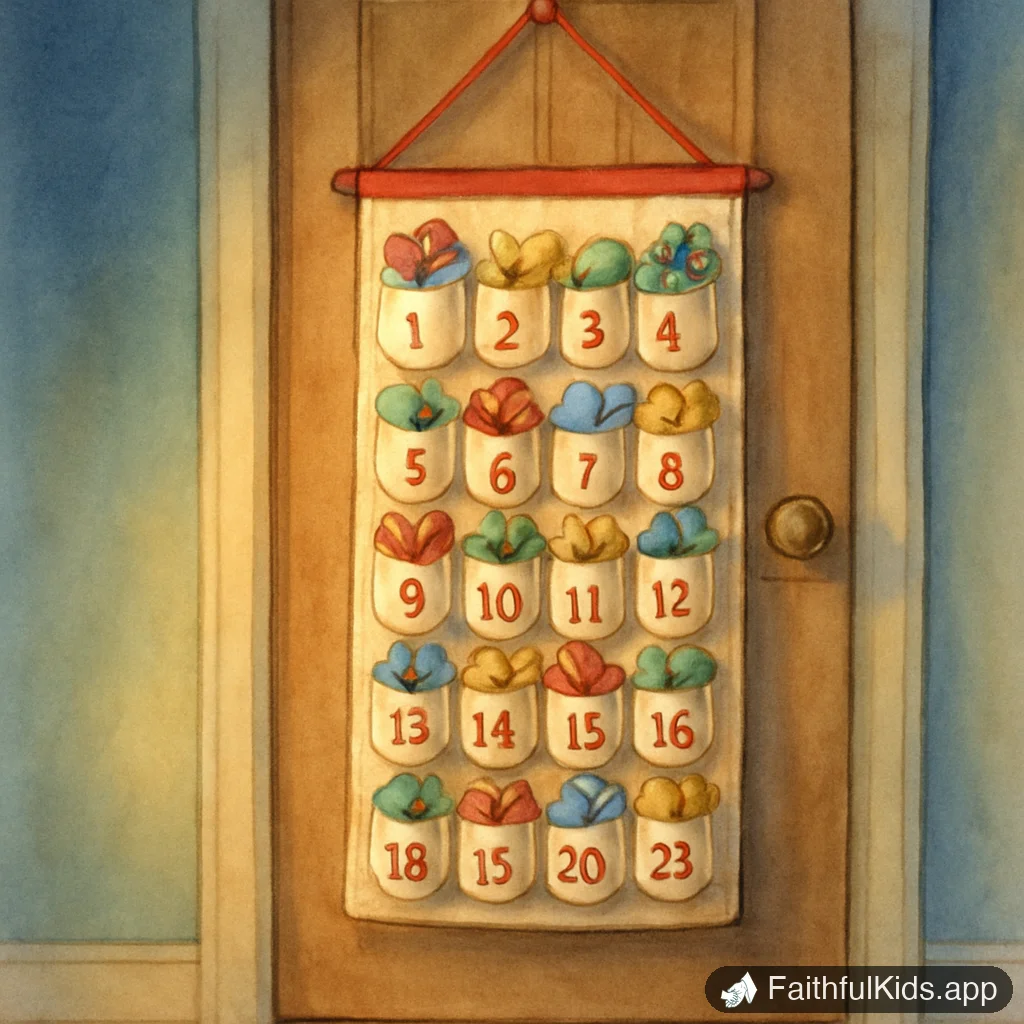
What it is: A permanent calendar -- a wooden house with numbered drawers, a fabric pocket chart, a set of numbered tins -- that you fill yourself each year.
Best for: All ages, mixed-age families, and anyone who wants to buy once and stop shopping. It's also the only type that lets you tune the content to your kids as they grow.
Honest pick: Buy the category, not a brand. Refillable wooden drawer calendars are widely available from Amazon, Walmart, Kohl's, and Wayfair (Juegoal and LampLust are two common ones, typically 24 or 25 drawers, roughly 12 inches tall). What matters is drawer size -- measure before you buy, because most drawers fit a folded slip and one small candy, and nothing bigger.
Watch out for: The empty calendar is the easy part; filling 24 drawers on November 30 is the real work. Do it in one sitting with a list in hand. Our post on what to put in an Advent calendar gives you 60 fillers so you're not staring into an empty drawer at midnight.
Typical price: $25-60, once.
What to Look For by Age
Ages 2-4. Prioritize the physical ritual over the words. A door that opens, an ornament that hangs, a nativity figure that moves. Playmobil's 1.2.3 nativity Advent calendar is a well-known toddler-safe option -- 24 doors of chunky nativity figures that build a manger scene by Christmas Eve. Keep the daily reading to one sentence.
Ages 5-7. The sweet spot for scripture and story calendars. Kids this age can follow a serialized story across a month, will ask real questions, and love being the one who opens the door. Choose a calendar with a written parent script.
Ages 8-11. Give them ownership. Kindness calendars, service calendars, and Jesse Tree calendars work because kids this age can carry out a task and report back. Let them read the verse aloud instead of you.
Ages 12+. Most boxed calendars feel babyish. Switch to a shared reading plan plus one physical element they still enjoy (the chocolate is fine, honestly), or let them run the calendar for a younger sibling -- teaching it is the best thing that can happen to a twelve-year-old's faith.
Mixed ages. Buy one calendar for the household, aim the reading at your middle child, and differentiate with the question rather than the text. Two calendars means two rituals and neither one survives.
For a daily Advent tradition, our free Jesse Tree printable set pairs 25 color-in ornaments with the Bible reading each symbol stands for.
Planning the whole month? The Christmas hub lists every Advent devotion, story, and printable we publish.
Do You Need a Christian Advent Calendar to Have a Christian Advent?
No. A $6 chocolate calendar plus one verse read aloud is a completely legitimate Advent tradition, and it beats an elaborate devotional calendar that stops on December 9.
If your December budget is already stretched, spend nothing: use a paper chain, a jar of verse slips, or a wrapped stack of library books, and put the money toward the season instead. The calendar is scaffolding. The conversation is the building.
That said, if you want the daily story handled without prep, a video-based rhythm works well for kids who'd rather watch than sit still -- the nativity series at Faithful Kids pairs each Bible story with a quiz and a reflection question, which turns the daily door into a two-minute conversation you didn't have to write.
What to Pair Your Calendar With
A calendar handles the morning excitement. Most families find it works best with one evening anchor:
Want a ready-made evening rhythm that doesn't stop when December does? Our free Bedtime Bible Kit is seven nights of short, calm readings designed to attach to a routine you already have -- print it once and it works in December and in February.
For a quieter follow-up, try the Christmas word search — twelve words hidden in the grid, answer key included.
For December, swap in our Christmas trivia questions -- the whole nativity story, easy round to expert round.
Add the kids' nativity play script -- free, ten minutes, scales from 8 kids to 40 -- and the evening plans itself.
Frequently Asked Questions
When should I buy an Advent calendar?
Buy in early to mid-November. The good faith-centered calendars are made in limited runs and regularly sell out by the third week of November, and anything shipping internationally needs the lead time. Refillable wooden calendars are the exception -- they're stocked year-round and often cheapest in January.
How much should an Advent calendar cost?
Expect $15-25 for a scripture or devotion calendar, $6-20 for a chocolate calendar, and $25-60 one time for a refillable wooden one. Anything over $60 is buying design, not content. A DIY calendar costs under $5 and works just as well, which is why the price ceiling here is entirely optional.
What's the difference between an Advent calendar and a Jesse Tree?
An Advent calendar counts down the days to Christmas, usually December 1-24. A Jesse Tree tells the whole Bible story leading to Jesus -- Creation, Noah, Abraham, David -- with one symbolic ornament per day. Many families run a Jesse Tree as their Advent calendar, since it does both jobs at once.
Should the calendar have 24 or 25 doors?
Either works. Twenty-four doors end on Christmas Eve, which suits families who do their big reading that night; 25 doors give you a Christmas morning finale, which is better if Christmas Eve is already crowded with church and travel. Pick based on which night your family is actually home.
Can we use one Advent calendar for multiple kids?
Yes, and it's usually better than one each. Rotate whose turn it is to open the door -- write the rotation on a sticky note so nobody argues -- and give the non-opener a job, like reading the verse or hanging the ornament. Two calendars means two rituals, and the second one always dies first.
What if we start late or miss days?
Skip to the current day and keep going. Never make kids catch up on four days of readings; that turns a joyful countdown into homework. A calendar started on December 8 and finished is worth far more than one started on December 1 and quit.