Blog/What Is Advent? A Simple Explanation for Kids
Guide
What Is Advent? A Simple Explanation for Kids
Ages 5+·11 min read··By Faithful Kids Team·Updated August 20, 2026
Advent is the four weeks before Christmas when Christians get their hearts ready to celebrate the birth of Jesus. The word "advent" comes from the Latin word adventus, which means "coming" or "arrival" -- so Advent is the season of waiting for Jesus to come.
If your child has ever counted down the days until a birthday or a vacation, they already understand Advent better than they think. It's a countdown -- but instead of counting down to presents, we're counting down to the greatest gift ever given.
Here's everything you need to explain Advent to your kids, from its history to the candles to what each week means.
What Does the Word "Advent" Mean?
Advent means "coming," and it refers to the coming of Jesus. Christians during Advent are actually thinking about two comings at once: Jesus' first coming as a baby in Bethlehem, and His promise to come again one day.
For kids, keep it simple: "Advent is when we remember how the whole world waited for Jesus to be born -- and we practice waiting, too."
That waiting part matters. God's people waited hundreds of years for the promised Savior. Prophets like Isaiah told them He was coming: "For to us a child is born, to us a son is given" (Isaiah 9:6). Advent lets kids feel a tiny taste of that long wait -- and makes Christmas morning mean more when it finally arrives.
When Did Advent Start? (A Kid-Level History)
Christians have been celebrating Advent for about 1,500 years. Nobody knows the exact year it began, but by the 400s and 500s, churches in Europe were setting aside the weeks before Christmas as a special season of preparation -- kind of like how athletes train before a big game.
Here's a version you can tell your kids: "A long, long time ago -- over a thousand years before your great-great-grandparents were born -- Christians decided that Christmas was too important to just show up to. They wanted to get ready. So they created a season of getting ready, and called it Advent."
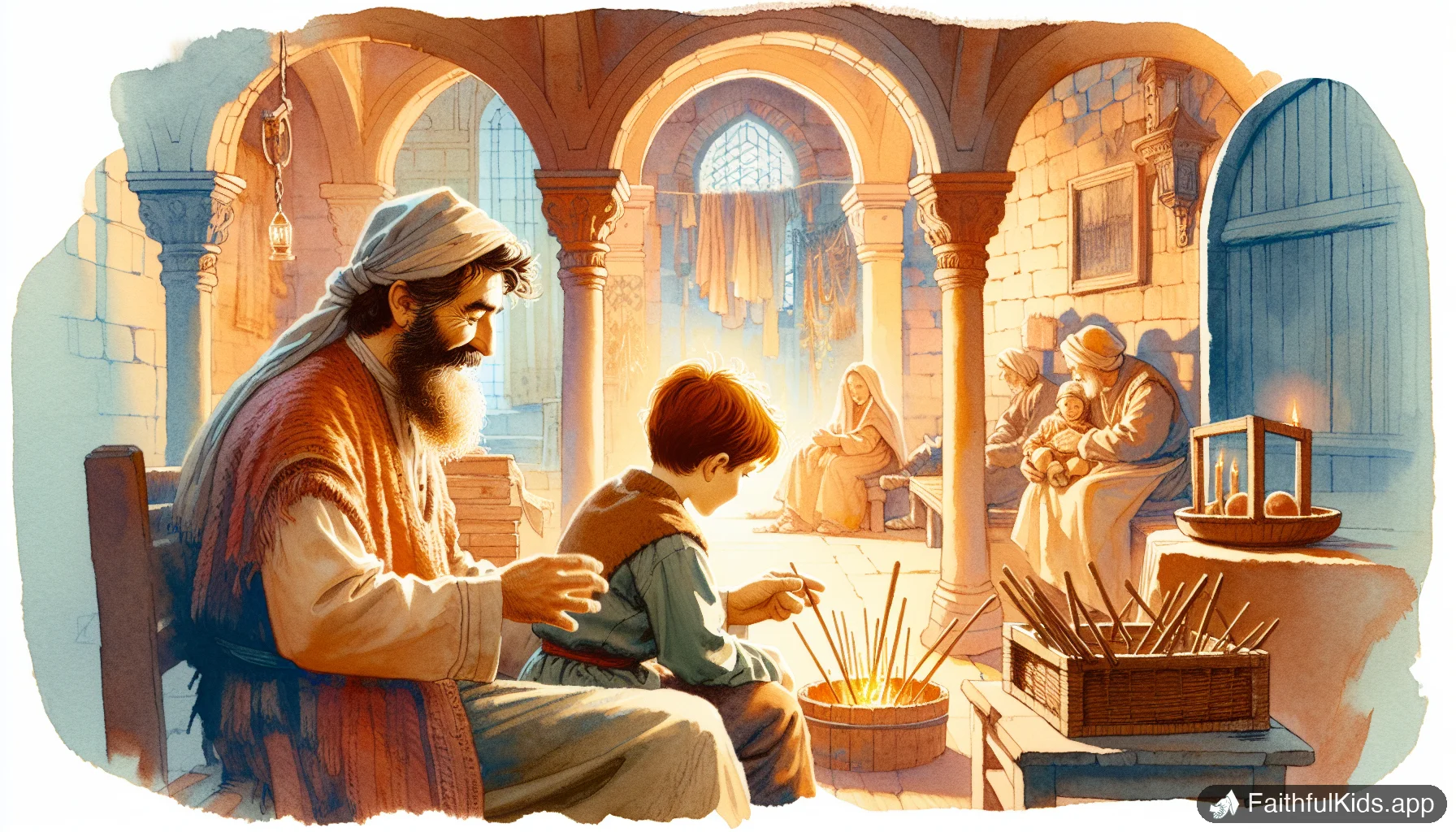
The Advent wreath tradition is younger. It became popular in Germany in the 1800s, when a pastor named Johann Hinrich Wichern cared for poor children who kept asking, "Is it Christmas yet?" He built a wooden wheel with candles so the children could see how many days were left. Families loved the idea, simplified it to four or five candles, and the Advent wreath spread around the world.
When Does Advent Begin and End?
Advent begins on the fourth Sunday before Christmas and ends on Christmas Eve. That means the start date moves around each year -- it always lands somewhere between November 27 and December 3.
An easy way to explain it to kids: "Find Christmas on the calendar, then count back four Sundays. That first Sunday is the start of Advent."
Because Advent is measured in Sundays, most family traditions center on Sunday evenings -- lighting a candle, reading a Bible story, singing a carol. But plenty of families add something daily too, like an Advent calendar. If you want daily ideas, we've collected 15 of them in our guide to Advent calendar ideas for kids.
There is a free nativity coloring page on our site too, printable on one sheet with no sign-up.
Families building an Advent rhythm love the printable Jesse Tree ornaments — hang one a day and walk the whole Bible story to the manger.
For the rest of the season, our Christmas hub collects every Advent and nativity resource in one place.
What Do the Advent Wreath and Candles Mean?
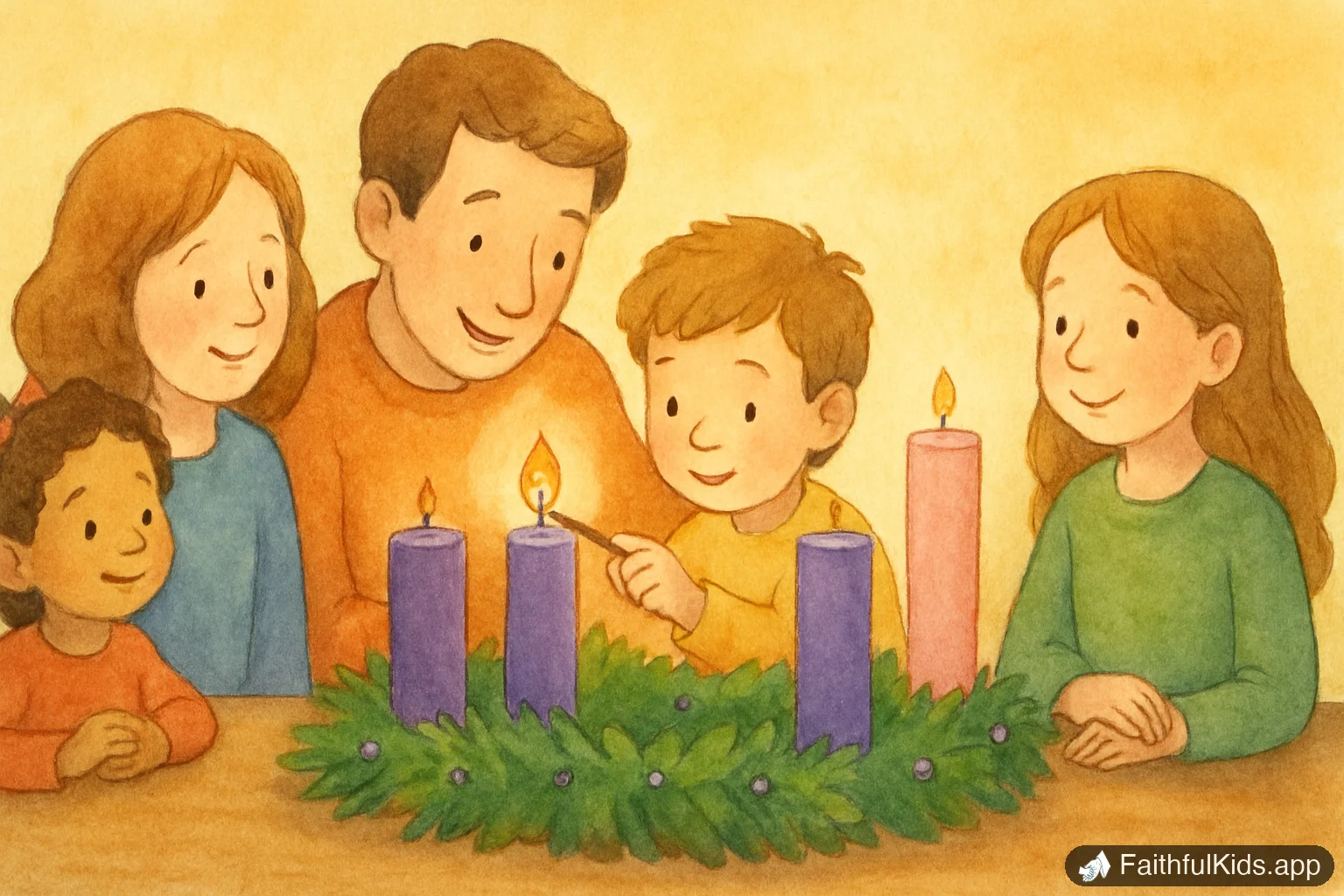
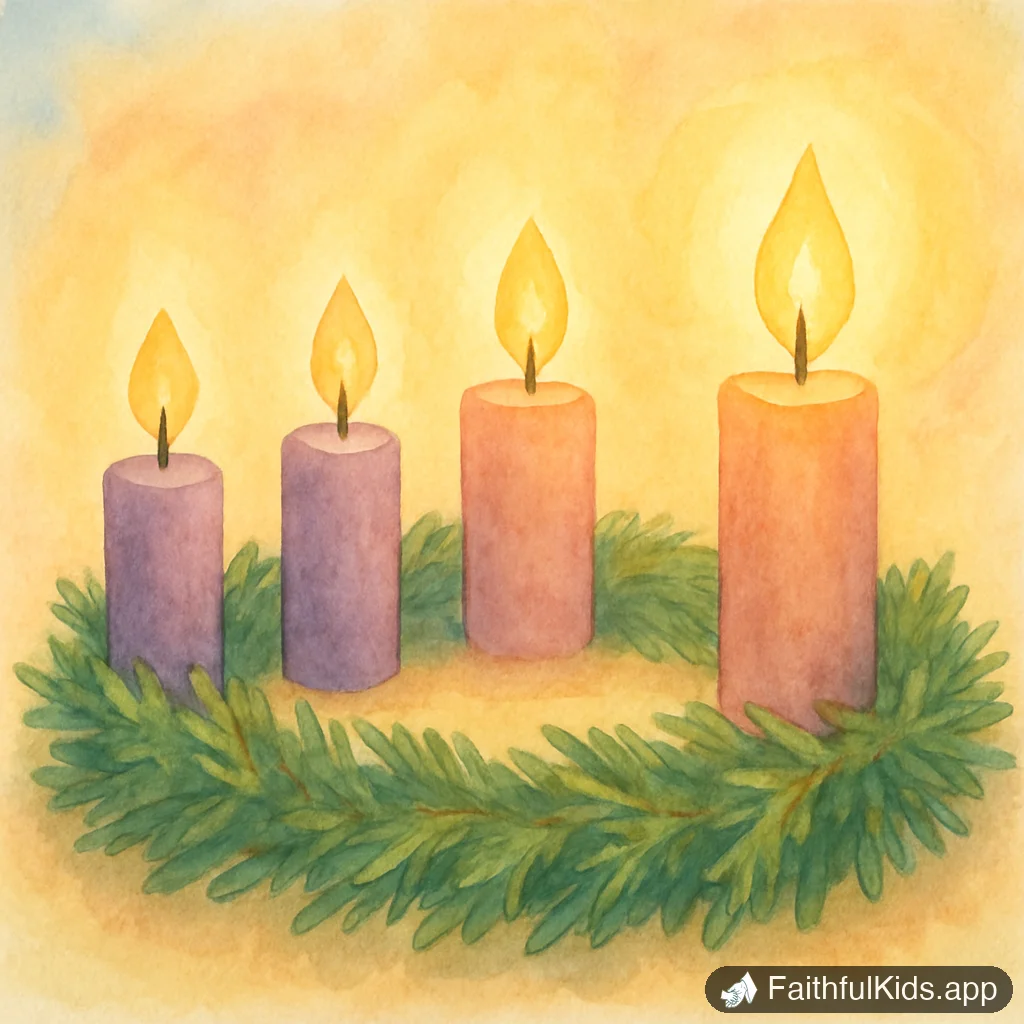
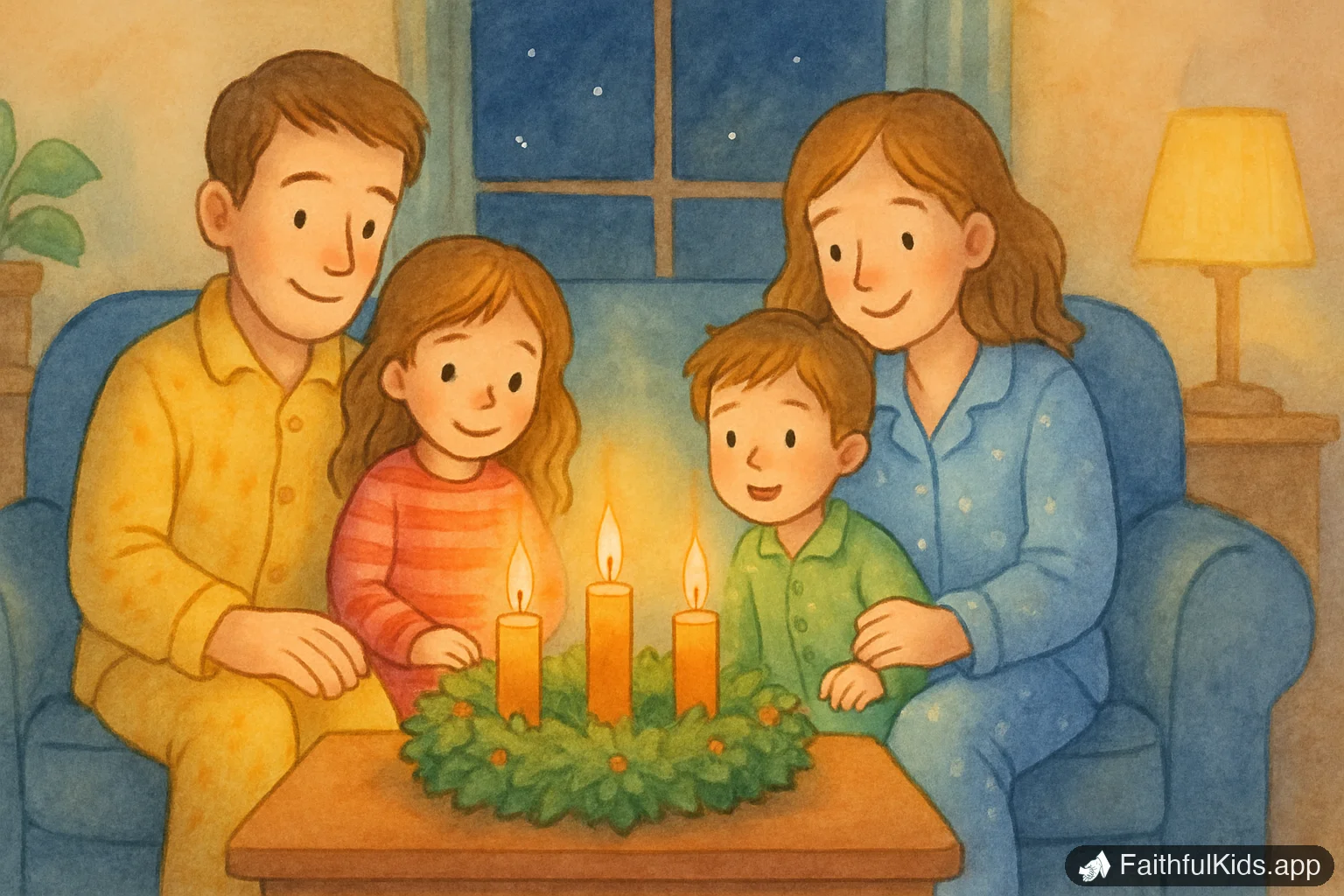
The Advent wreath is a circle of evergreen branches holding four candles -- one for each week of Advent -- plus often a fifth white candle in the center for Christmas. Every part of it is a picture kids can understand:
The circle shape has no beginning and no end -- just like God's love, which never runs out.
The evergreen branches stay green all winter when other plants look dead -- a picture of everlasting life.
The candles remind us that Jesus is "the light of the world" (John 8:12). Each week the wreath gets brighter, because Christmas is getting closer.
The colors: three candles are usually purple (the color of kings, and of getting our hearts ready), one is pink (for joy), and the center candle is white (for Jesus, who is pure and holy).
On the first Sunday you light one candle. On the second Sunday, two. By the fourth Sunday all four are burning, and on Christmas Eve or Christmas Day you light the white Christ candle in the middle. For a deeper dive into each candle -- plus read-aloud devotions for every week -- see our guide to the Advent wreath meaning for kids.
See what they get
Watch An Angel Visits Mary Come Alive
An Angel Visits Mary is one of 300+ short narrated video lessons your child will love. Watch the whole episode right here — in the app, every lesson ends with a fun quiz to check what they learned.
A real lesson from the app — watch the whole thing free.
What Does Each Week of Advent Mean?
Each week of Advent has a theme: hope, peace, joy, and love. Different churches order them slightly differently, but this is the most common pattern:
Week
Theme
Candle
What Kids Can Learn
Week 1
Hope
Purple (Prophecy Candle)
God's people hoped for a Savior, and God kept His promise
Week 2
Peace
Purple (Bethlehem Candle)
Jesus is called the "Prince of Peace" (Isaiah 9:6)
Week 3
Joy
Pink (Shepherd's Candle)
The angel brought "good news that will cause great joy" (Luke 2:10)
Week 4
Love
Purple (Angel's Candle)
"For God so loved the world that he gave his one and only Son" (John 3:16)
Christmas
Christ
White (Christ Candle)
Jesus, the Light of the World, has come
Week 1 -- Hope. Talk about the prophets who promised a Savior was coming, hundreds of years before Bethlehem. Kids get this: hope is believing something good is coming even when you can't see it yet.
Week 2 -- Peace. Jesus came to make peace between us and God, and to teach us to be peacemakers. Ask your kids: "Where does our family need more peace this week?"
Week 3 -- Joy. This is the pink candle week, sometimes called Gaudete Sunday ("rejoice!" in Latin). The waiting is more than halfway over -- time to celebrate a little.
Week 4 -- Love. Christmas is God's love in action. He didn't just say He loved the world; He sent His Son into it.
How Do Families Actually Observe Advent?
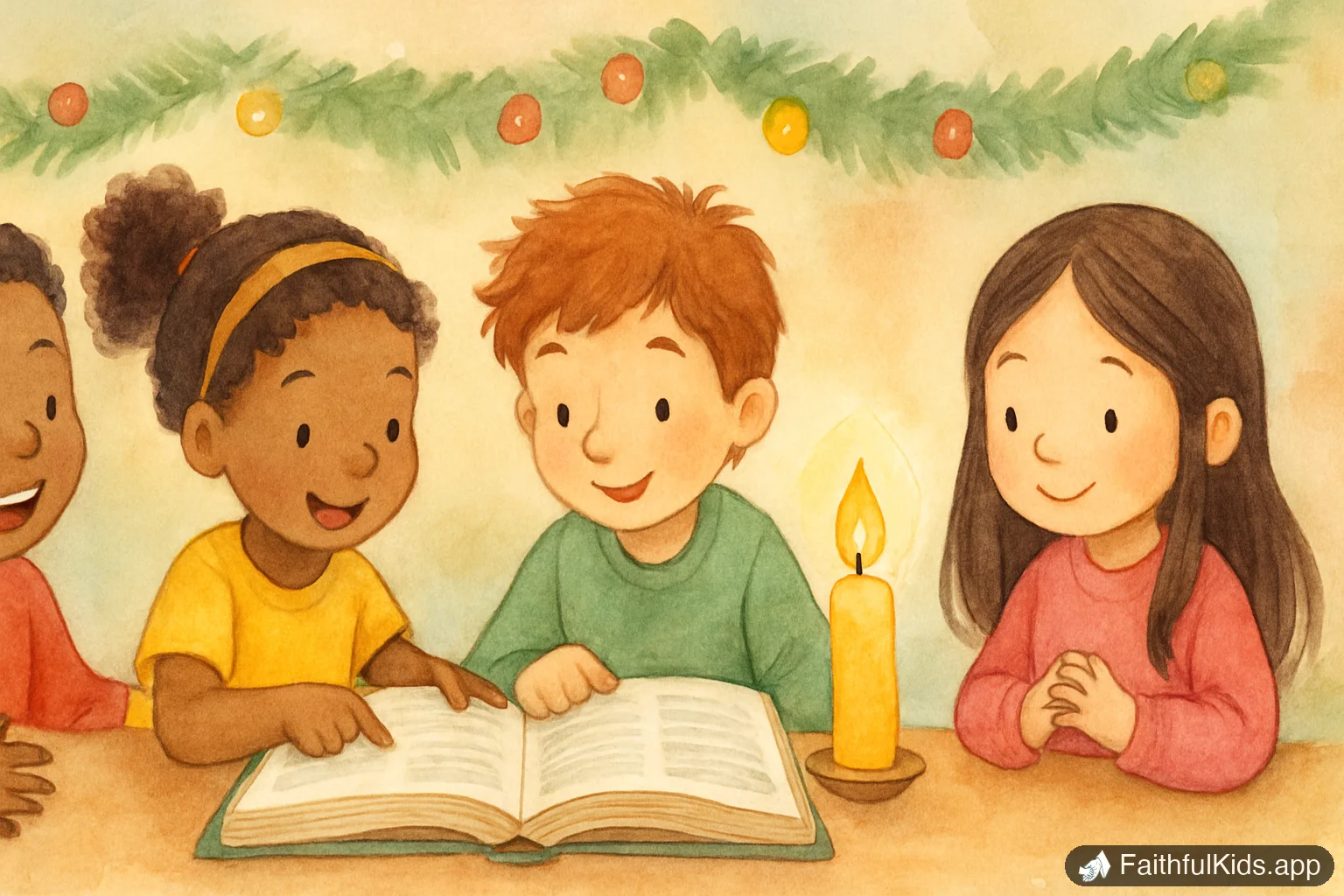
Most families observe Advent with a simple weekly rhythm: light the candle, read a short Bible passage, talk about it for a few minutes, and pray. That's it -- ten minutes on a Sunday evening is a genuine Advent tradition.
Here are the most common ways families bring Advent home:
The Advent wreath. Light the week's candle at Sunday dinner. Let kids take turns (with supervision) -- the candle-lighting job is highly coveted.
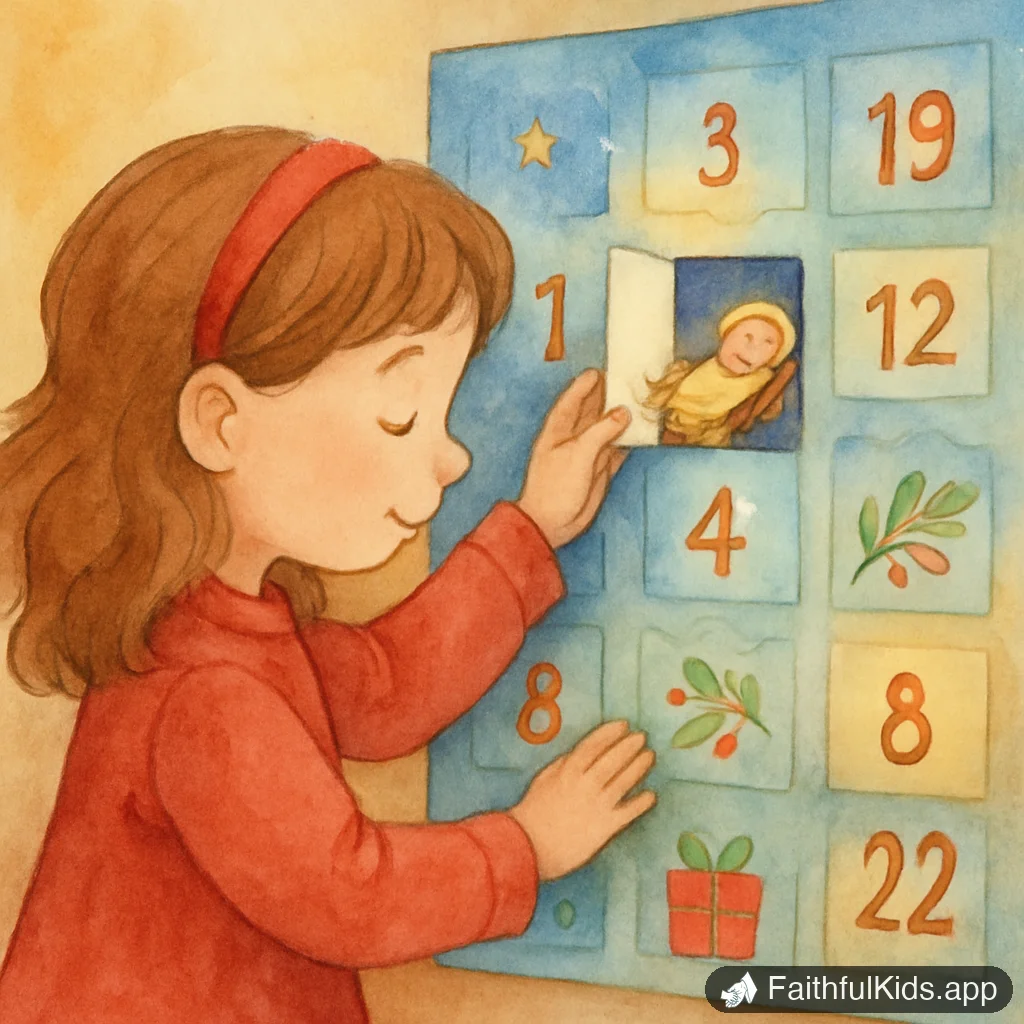
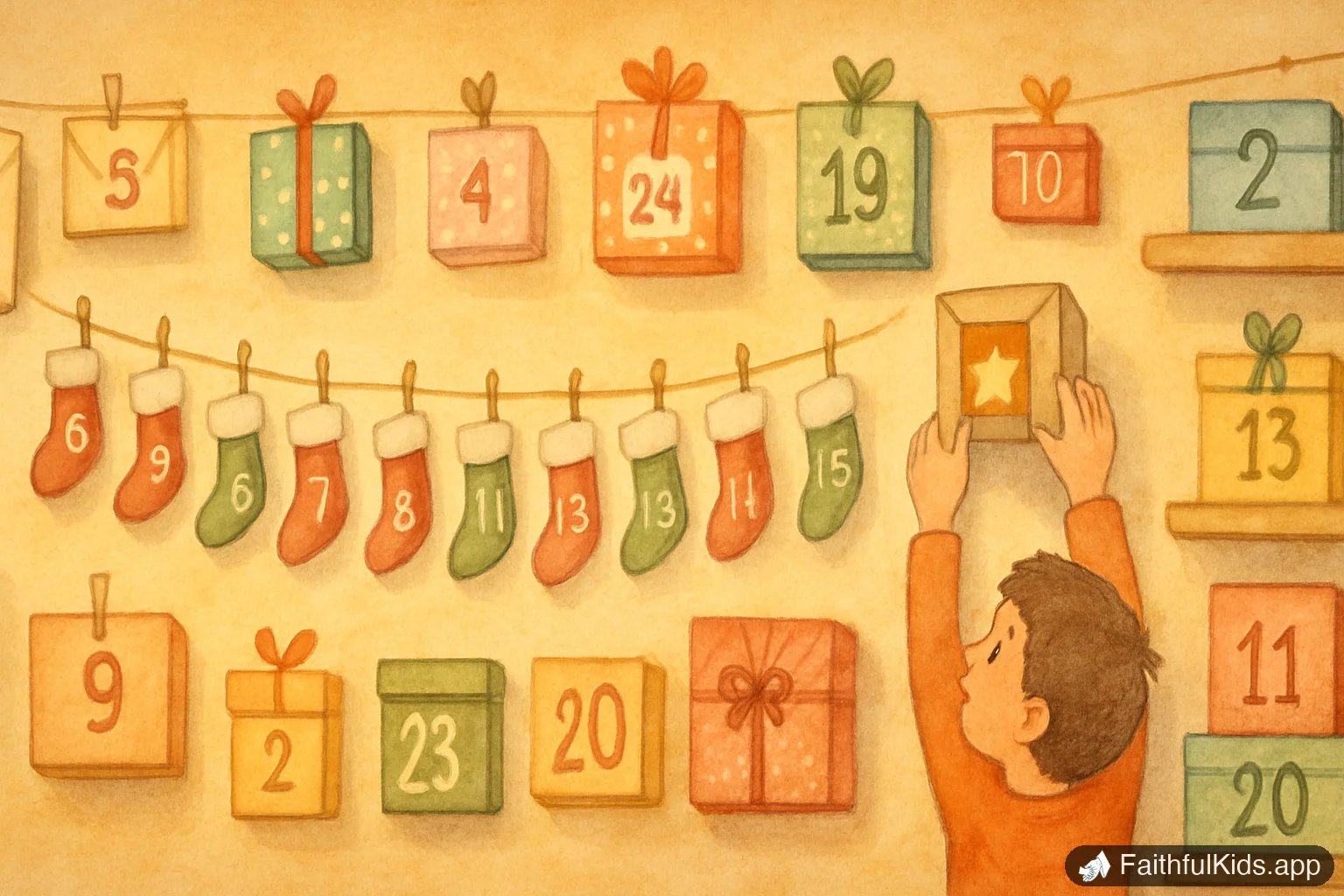
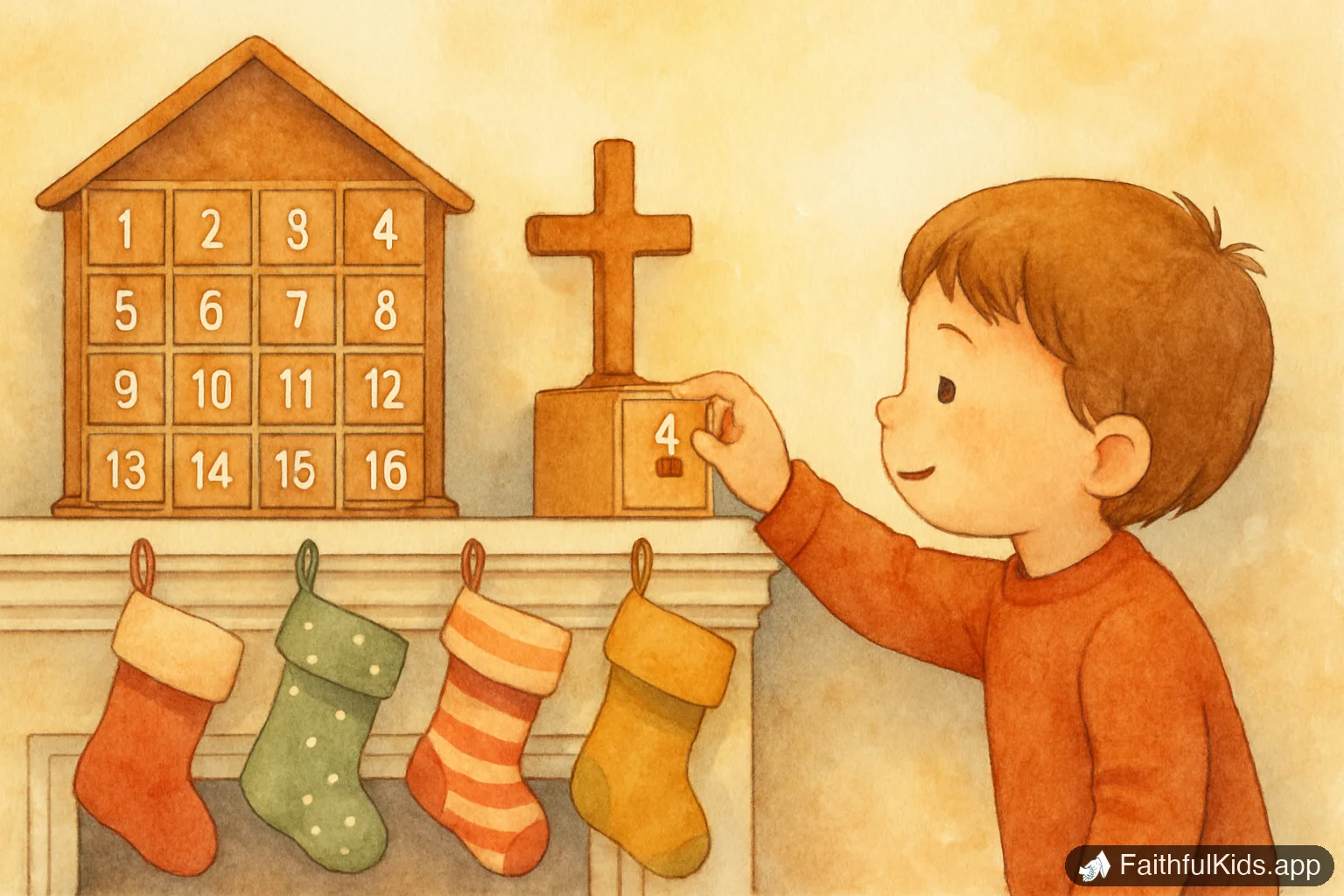
An Advent calendar. One small thing each day of December: a Scripture verse, a chocolate, an act of kindness, a story. Our list of Advent activities for kids is full of low-prep options.
A Jesse Tree. A branch or small tree with one ornament per day, each representing a Bible story from Creation to Christmas. It walks kids through the whole story of how God prepared the world for Jesus.
Reading the Christmas story in pieces. Spread the nativity story across the four weeks -- prophecy, the angel visiting Mary, the journey to Bethlehem, the birth. Our roundup of Advent Bible stories for kids maps stories to each week, and many families pair the readings with video lessons -- at Faithful Kids, each Bible story comes with a short animated video and a quiz, which works nicely as the "story" part of an Advent night.
Serving others. Advent is a season of preparing our hearts, and generosity is great heart-preparation. Pick one family service project for December: a food drive, gifts for a family in need, cookies for neighbors.
The key is picking one or two traditions, not five. A simple tradition you actually keep beats an elaborate one you abandon by December 10. And if the calendar is the tradition you land on, decide early what actually goes behind the little doors so December 1 does not sneak up on you.
How Do You Explain Advent to a Young Child?
For preschoolers, explain Advent as "the countdown to Jesus' birthday." Young kids don't need church history or Latin words -- they need something concrete they can see and touch.
Try language like this:
"Christmas is Jesus' birthday, and Advent is how we get ready for the party."
"Every candle we light means we're one week closer."
"God's people waited a long, long time for Jesus. Advent helps us practice waiting, too."
Waiting is genuinely hard for little kids -- which is exactly why Advent works so well for them. Every opened calendar door and every lit candle makes the abstract idea of "Christmas is coming" visible. And when they ask the inevitable deeper questions ("Why was Jesus born? Why in a barn?"), you'll find kid-friendly answers in our guide on how to explain Christmas to a child.
Why Does Advent Matter for Kids?
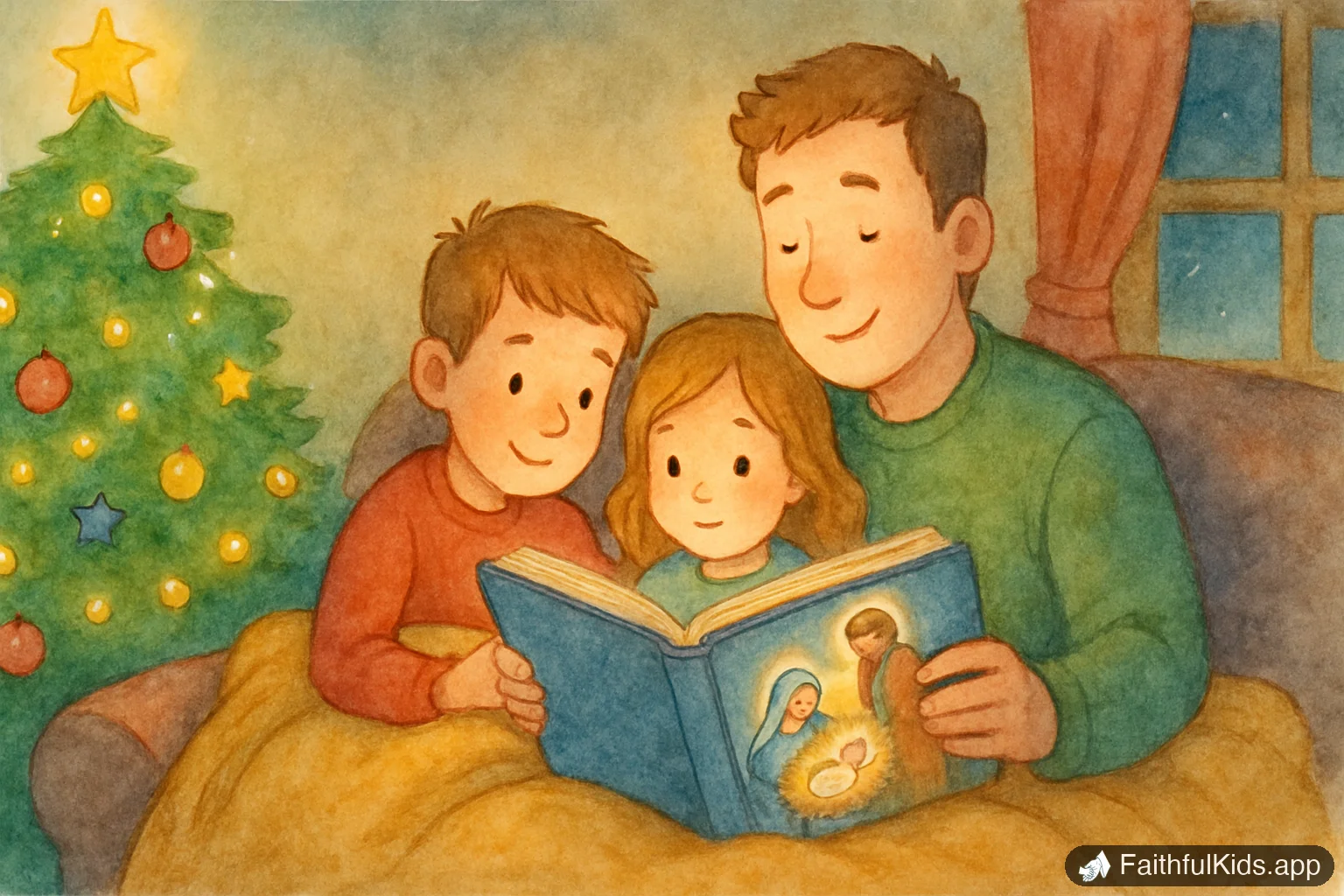
Advent matters because it puts Jesus at the center of December before anything else gets there first. Between school parties, gift lists, and elf antics, Christmas can rush past kids in a blur of sugar and wrapping paper. Advent slows it down.
Kids who grow up with Advent learn three things almost by accident:
Anticipation is part of celebration. The waiting makes the arrival sweeter.
Christmas has a story, and it started long before Bethlehem.
Faith has rhythms. Lighting candles week after week teaches kids that following Jesus isn't just for emergencies -- it's a pattern of ordinary faithfulness.
A shelf of read-aloud Advent books makes those rhythms much easier to keep during a busy December.
Advent is the four weeks before Christmas when we get ready to celebrate Jesus' birthday. The word means "coming," because we're remembering how the world waited for Jesus to come. Families often light one candle each week to count down.
What are the 4 themes of Advent?
The four weekly themes of Advent are hope, peace, joy, and love, with Christ Himself celebrated on Christmas. Most churches assign hope to week one, peace to week two, joy to week three (the pink candle), and love to week four. Some traditions order them slightly differently, and that's fine -- the point is preparing hearts for Jesus.
Why is one Advent candle pink?
The pink candle marks the third Sunday of Advent, called Gaudete Sunday, which means "rejoice" in Latin. Advent was traditionally a serious, reflective season, and the pink candle was a built-in burst of joy signaling the wait was more than halfway over. Kids usually love that "the pink candle week" is officially the joy week.
When does Advent start?
Advent starts on the fourth Sunday before Christmas Day, which falls between November 27 and December 3 depending on the year. It ends on Christmas Eve. To find it, locate Christmas on a calendar and count backward four Sundays.
Is Advent in the Bible?
The season of Advent is not commanded in the Bible -- it's a church tradition that developed in the centuries after Jesus. But everything Advent points to is deeply biblical: the prophecies of a coming Savior (Isaiah 9:6), the birth of Jesus (Luke 2), and His promise to return. Advent is simply a tool families and churches use to focus on those truths.
What's the difference between an Advent calendar and an Advent wreath?
An Advent wreath is a weekly tradition -- four candles lit one per Sunday -- while an Advent calendar is a daily countdown through December, usually December 1 to 24. Many families do both: candles on Sunday nights, calendar every morning. Neither is more "correct"; they're two tools for the same goal of keeping kids focused on Jesus before Christmas. If you are choosing a calendar this year, we compared the Advent calendars kids actually stick with.
🌙 Free: The Bedtime Bible Kit
Seven nights of five-minute stories — a story, a prayer, and one question to whisper about.
Free printable + a few helpful emails. Unsubscribe anytime.