Blog/Free Bible Journaling Printables and Starter Kit Ideas
Guide
Free Bible Journaling Printables and Starter Kit Ideas
Ages 5+·10 min read··By Faithful Kids Team·Updated August 19, 2026
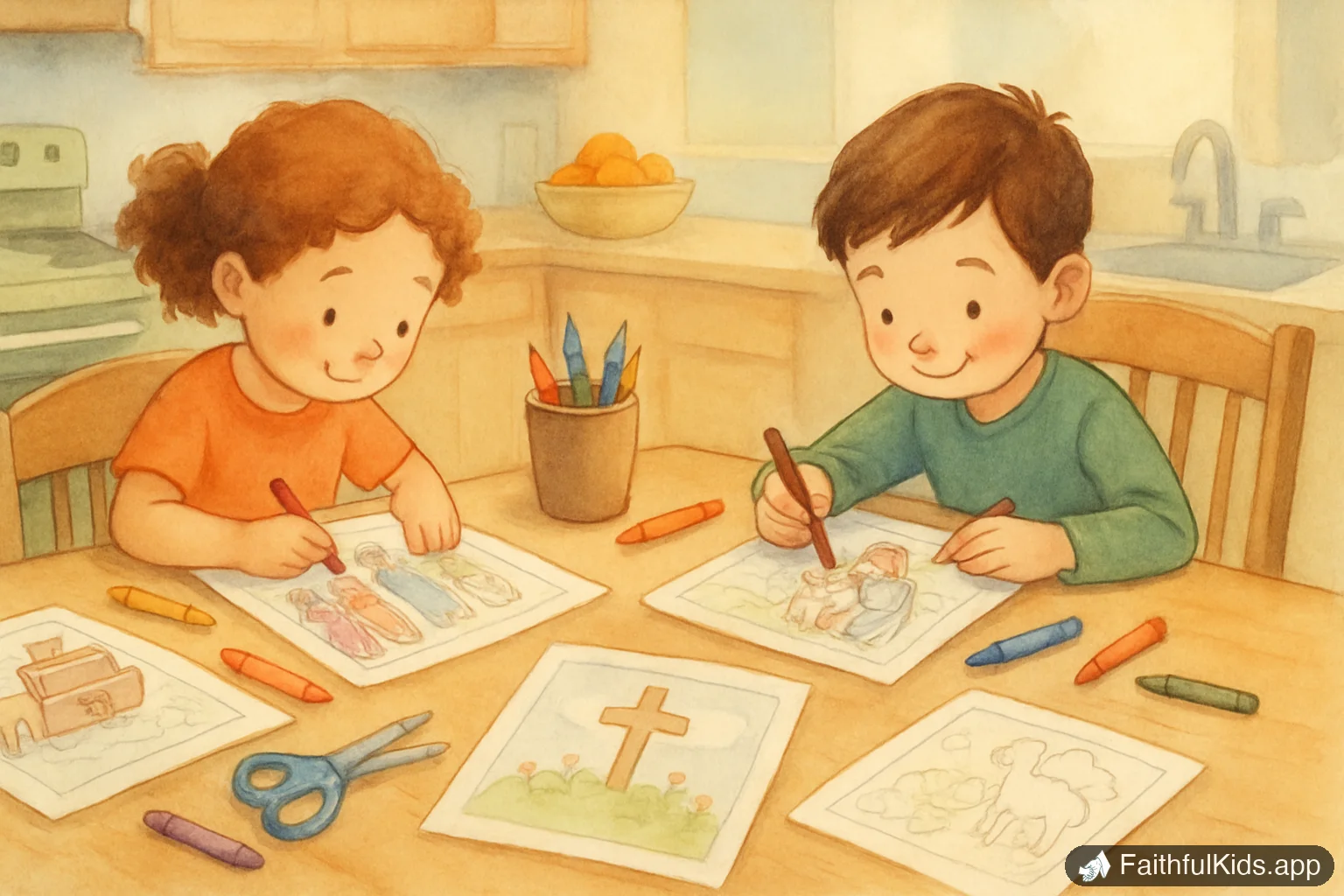
Bible journaling printables are simple page templates -- verse maps, SOAP study sheets, prayer logs, and gratitude pages -- that give you a structure to write into instead of staring at a blank notebook. You do not need to buy a kit or hunt for a download: every template below is described precisely enough that you can draw it on plain paper in two minutes or rebuild it in any word processor in ten.
That is the honest version of this topic. Most "free Bible journaling printables" pages online are a newsletter signup wearing a costume. The templates themselves are not complicated, and once you know what belongs on each page, you can print an endless supply of exactly the layout your family needs.
What Is Bible Journaling, Exactly?
Bible journaling is the practice of writing, drawing, or note-taking in response to a Bible passage, usually in a notebook or on a template page rather than in the margins of your Bible. It has two forms: art journaling (illustrating a verse with lettering and color) and study journaling (working through a passage with structured questions).
Both are useful, and they solve different problems. Art journaling slows a reader down and makes a verse memorable, which is why it works so well for kids and teens who resist "sitting down to study." Study journaling gives shape to the question every reader eventually hits: I read it, now what? A template answers that with four boxes.
The research-free but reliable principle here: writing something down is a second pass through the material, and a second pass is where retention lives. That is the same reason a coloring page beats a lecture for a 6-year-old.
What Supplies Do You Need for a Bible Journaling Starter Kit?
A starter kit costs about $20 and fits in a shoebox. Here is the full list, in order of how much it matters:
A printer and plain paper. Everything else is optional. Card stock only if you want pages to survive a binder for a year.
A three-ring binder or a folder. Loose journaling pages become clutter within a week. A binder makes them a book.
Fine-tip pens (0.3 to 0.5mm). Cheap gel pens are fine. Ballpoints bleed less than markers on thin paper.
Colored pencils, not markers, if you are journaling in an actual Bible. Markers bleed through Bible paper; pencils do not.
Highlighters in three colors with a fixed meaning: one for promises, one for commands, one for things you do not understand. The color code does more teaching than the highlighting.
A ruler. Only if you are drawing templates by hand. Boxes drawn with a ruler get used; crooked ones get abandoned.
Washi tape and stickers for kids, which are pure motivation and cost almost nothing.
Skip the expensive journaling Bible until someone in your house has journaled for a month straight. Plenty of families buy the $50 wide-margin Bible first and the habit never shows up.
See what they get
Watch a Real Lesson From the App
Press play on Walking on Water — a complete lesson exactly as your child sees it. 300+ episodes cover the whole Bible in order, each ending in a fun quiz to check what they learned.
A real lesson from the app — watch the whole thing free.
The 4 Bible Journaling Page Templates Worth Making
These four cover roughly every use case. Make one master of each, print a stack, and refill the binder when it runs low.
1. The Verse Map
A verse map takes one single verse and pulls it apart from six angles. It is the best template for teens and the best template for anyone who says the Bible feels flat.
Layout: Put the verse itself in a wide box across the top third of the page, written out by hand. Below it, six labeled boxes in a 2x3 grid:
Key words -- circle 3 to 5 words in the verse and write them here.
What it means -- the verse in your own words, one sentence.
Who wrote it, and to whom -- one line of context.
Cross-references -- 2 or 3 other verses on the same idea, pulled from your Bible's footnotes.
What it shows about God -- the most important box on the page.
What I will do -- one concrete action, today.
Why it works: the "key words" box forces slow reading, and the "what it shows about God" box keeps the exercise from collapsing into self-help.
2. The SOAP Page
SOAP is the most widely used Bible study method, and it is four letters for four steps: Scripture, Observation, Application, Prayer. As a printable it is dead simple.
Layout: Four stacked boxes down a portrait page, with the labels in the left margin and horizontal writing lines inside each box. Give Scripture about 20% of the page, Observation 30%, Application 30%, Prayer 20%. Add a small date and passage line at the very top.
S -- copy one verse or short passage word for word.
O -- what do you notice? Who is speaking? What is repeated?
A -- what does this mean for me this week?
P -- a short written prayer responding to what you read.
Why it works: the copy-it-out step is the whole trick. Kids who copy a verse remember it; kids who summarize it do not.
3. The Prayer Log
A prayer log is the template that changes how kids think about prayer, because it makes answered prayer visible. Ours has three columns and gets checked at dinner.
Layout: A landscape page with a header row and about 12 wide rows. Four columns: Date asked | What we are praying for | Verse to pray | Date answered. Leave the last column deliberately narrow and empty -- that emptiness is the point, and filling it in months later is the payoff.
Keep one family log on the fridge and, if your kids are old enough to write, a personal one in each binder. Add a "praise" section at the bottom for things you are thanking God for that were never on the list.
4. The Gratitude Page
A gratitude page is the low-barrier entry point, and the right one to start a reluctant kid on.
Layout: A single page with the month and year at the top, a small Scripture line ("Give thanks in all circumstances," 1 Thessalonians 5:18), and 30 numbered blank lines or 30 small boxes in a grid. One line per day, one thing per line, no sentences required.
Variation for younger kids: replace the lines with 30 empty circles to draw in. Variation for teens: two columns -- "grateful for" and "praying about" -- which quietly turns gratitude into prayer.
A fifth template worth making once your family has a rhythm: a sermon notes page with three boxes (main passage, one thing I learned, one question I have), which travels to church in the binder.
How Do You Start Bible Journaling With Kids and Teens?
Start with the format that matches their age, not the one that looks best on Pinterest. The progression that works:
Age
Start with
Session length
5-7
Gratitude page with drawing circles
5 minutes
8-10
Gratitude page plus a copy-the-verse line
10 minutes
10-12
SOAP page, done together at first
10-15 minutes
13+
Verse map, done independently
15-20 minutes
Four rules that keep it alive past week two:
Journal alongside them, on your own page. Kids who watch a parent write will write. Kids handed a worksheet will not.
Never grade it. No spelling corrections, no "that is not what the verse means." The page is theirs.
Pick the passage for them at first. Blank-page paralysis is real. A reading plan removes the hardest decision -- our free 30-Day Family Bible Challenge gives you a short passage and a discussion question for every day, which is exactly the input a journaling page needs.
Attach it to something that already happens. After dinner, before bed, Sunday afternoon. Journaling fails as a new obligation and succeeds as a five-minute add-on to a routine you already keep.
In our house, journaling works best right after a story rather than cold: the kids watch an episode on Faithful Kids, then fill in a SOAP page on the passage it came from. The video carries the narrative, the page makes them do something with it.
There are also seven free printable Bible crosswords -- each built from one story's own details, playable online or on paper.
Frequently Asked Questions
Where can I find genuinely free Bible journaling printables?
The most reliable source is your own printer, because every template in this guide is just labeled boxes on a page and takes ten minutes to build once in any word processor. Many ministry and blog sites do offer free journaling pages, though a large share require an email signup, so check before you click. Our own free 30-Day Family Bible Challenge requires no sign-up and gives you the daily passages to journal about.
What is the SOAP method in Bible journaling?
SOAP stands for Scripture, Observation, Application, Prayer. You copy out a verse, write what you notice about it, write what it means for your life, then write a short prayer in response. It is popular because it fits on one page, takes about ten minutes, and works for a 10-year-old and a 40-year-old with no changes.
Is Bible journaling appropriate for kids?
Yes, from around age 5 in its simplest form. Young children draw a picture of the story and copy a few words; elementary kids fill in a gratitude page or a simplified SOAP sheet; teens do verse maps and topical studies. The key is matching the template to their writing stamina -- five minutes for a 6-year-old is a win, not a failure.
Do I have to write in my actual Bible?
No, and most families should not. Writing in the Bible is one style of journaling, but a separate notebook or a binder of printable pages does the same job with none of the anxiety about ruining a Bible. If you do journal in a Bible, use colored pencils rather than markers -- Bible paper is thin and markers bleed through.
How long should a Bible journaling session take?
Ten to fifteen minutes is the sweet spot for most people, and five minutes is plenty for young children. Short and daily beats long and occasional, for the same reason two minutes of verse review at breakfast beats a twenty-minute Saturday session. If a session regularly runs long because someone is genuinely engaged, that is a good problem -- but do not design for it.
What is the difference between Bible journaling and a devotional?
A devotional gives you someone else's reflection on a passage to read; journaling makes you produce your own. They pair well -- read the devotional, then journal your response -- but journaling does more work because writing forces you to form an opinion. If your kids have been passively reading devotionals for a while and nothing seems to stick, adding a page to fill in is usually the fix.
🌙 Free: The Bedtime Bible Kit
Seven nights of five-minute stories — a story, a prayer, and one question to whisper about.
Free printable + a few helpful emails. Unsubscribe anytime.