Blog/Free Bible Study Printables for Kids and Families
Guide
Free Bible Study Printables for Kids and Families
Ages 5+·11 min read··By Faithful Kids Team·Updated August 19, 2026
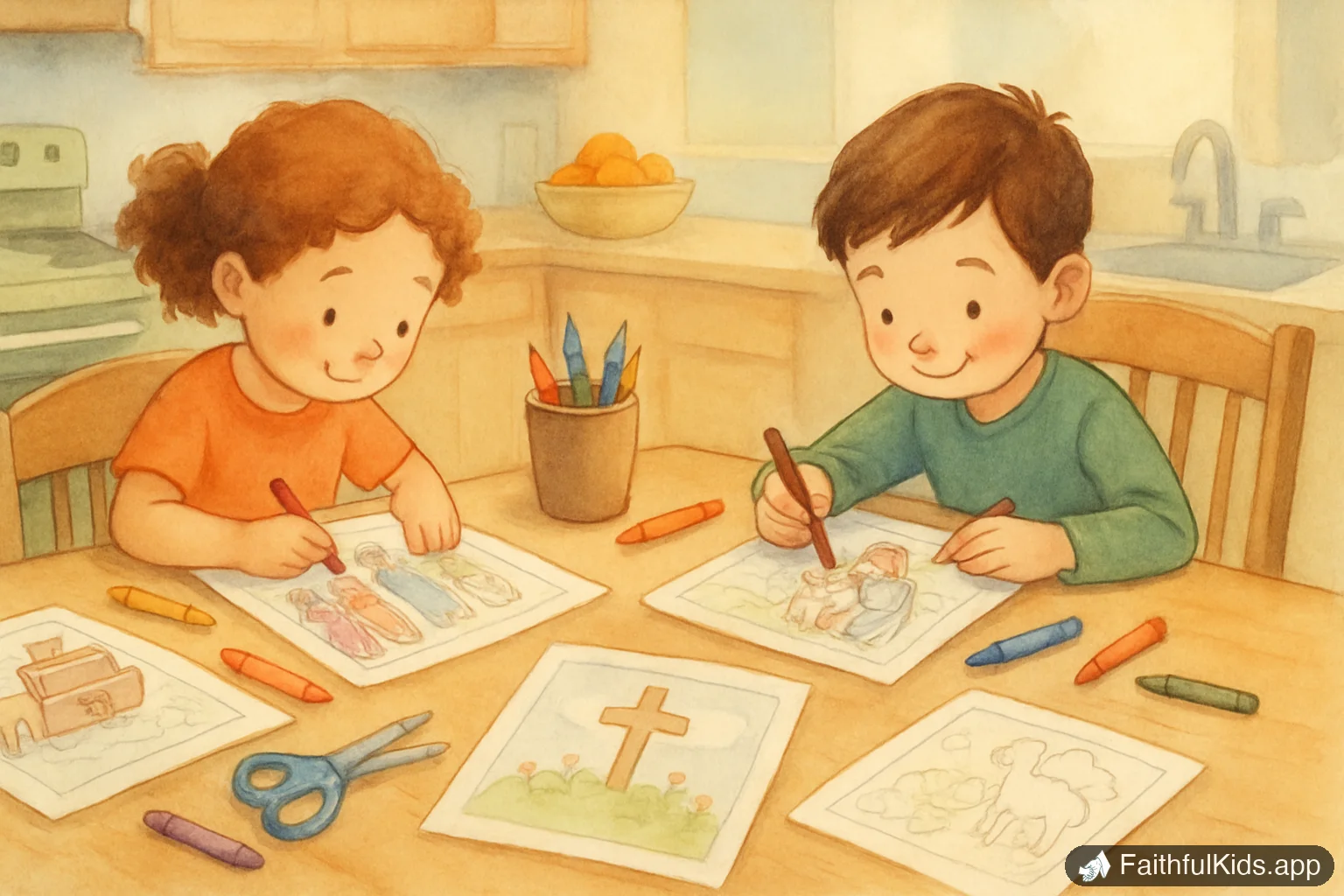
Bible study printables are one-page tools that make family Bible time run itself: a study planner so nobody has to decide what to read, a memory tracker so verses get reviewed, a reading chart so kids can see progress, discussion cards so the conversation does not stall, and a sermon notes page so church stops being forty minutes of wiggling. Below is exactly what goes on each one, so you can build them on plain paper this afternoon.
We are describing templates rather than handing you a folder of PDFs on purpose. The printables that get used in real homes are the ones matched to your family's actual reading plan, your kids' actual ages, and your church's actual service -- and those you can only make yourself. The good news is that none of them are complicated.
What Makes a Bible Study Printable Actually Get Used?
The printables that survive past week two share three traits, and the ones that end up in a recycling bin are missing at least one:
It removes a decision. "What should we read tonight?" is the question that kills family Bible time. A planner or chart answers it before anyone sits down.
It shows progress. Kids will check a box for weeks that they would not read for. Visible progress is most of the motivation.
It lives where the habit lives. On the fridge, in the Bible, in the church bag. A printable in a drawer is a printable that does not exist.
Print in grayscale, print a month at a time, and let kids do the marking themselves. That last one matters more than it sounds.
1. The Family Bible Study Planner
A family study planner is a one-page sheet that maps a week of family Bible time before the week starts, and it is the single highest-value printable on this list because it front-loads all the thinking into one ten-minute planning session on Sunday.
Layout: Landscape page, seven rows (one per day), five columns:
Day
Passage
Big idea (one sentence)
Question to ask
Who reads
Mon
Fill in Monday through Sunday on Sunday afternoon. The "who reads" column is the sneaky one -- rotating the reader turns a lecture into a shared thing, and a 7-year-old who knows Thursday is his night shows up differently.
Two upgrades:
Add a narrow "done" column at the far right with a checkbox. Do not skip it.
Add a line at the bottom of the page for a single prayer request the family carries all week.
If you are building the habit from scratch, our guide to how to start family Bible time covers the pacing and the failure modes before you print anything.
2. The Verse Memory Tracker
A memory tracker is a grid that makes verse memorization a visible streak rather than an invisible chore, and it is what separates families who memorize a verse a month from families who mean to.
Layout: A portrait page with a header ("Verses I Know") and 12 to 24 wide rows. Four columns: Verse reference | First few words | Date learned | Review checkmarks (5 small boxes).
The five review boxes are the important design choice. Memory works on spaced repetition, so a verse is not "done" when it is first recited -- it is done after it has been recited again a day later, a week later, a month later, and three months later. Five boxes, five reviews, spread out. Kids fill one box each time they recite it cleanly from memory.
How to run it: review two verses at breakfast, take about ninety seconds, and let the child hold the pen. Pair the tracker with a physical ring of cards -- our printable Bible memory verse cards guide has 20 kid-ready verses already formatted for cutting, and the game-based approaches in Bible memory verse strategies for kids are what to do when a verse will not stick.
3. The Reading Plan Chart
A reading plan chart is a grid of numbered squares -- one per reading -- that gets posted somewhere everyone walks past, and it is the printable that most reliably turns intention into habit.
Layout: One page, a title, and a grid of squares numbered 1 through 30 (or 1 through 66 for a books-of-the-Bible run, or 1 through 90 for a summer plan). Each square is big enough for a checkmark, a sticker, or a scribbled date. Under the grid, a single line: "When the grid is full, we celebrate by ." Let the kids fill in that blank.
Three plan lengths that work:
30 days, story by story: creation to resurrection, one short passage a day. The best on-ramp for a family starting from zero. This is the plan behind our free 30-Day Family Bible Challenge, which pairs every day with a summary and a discussion question so the printable comes with its own content.
66 days, one book at a time: read a short passage from each book of the Bible in order. Excellent for kids who have just memorized the book list.
A gospel in a month: Mark has 16 chapters; read half a chapter a day and you finish in a month with time to spare.
Do not print a year-long plan for a family that has never finished a week. Start at 30.
See what they get
Watch a Real Lesson From the App
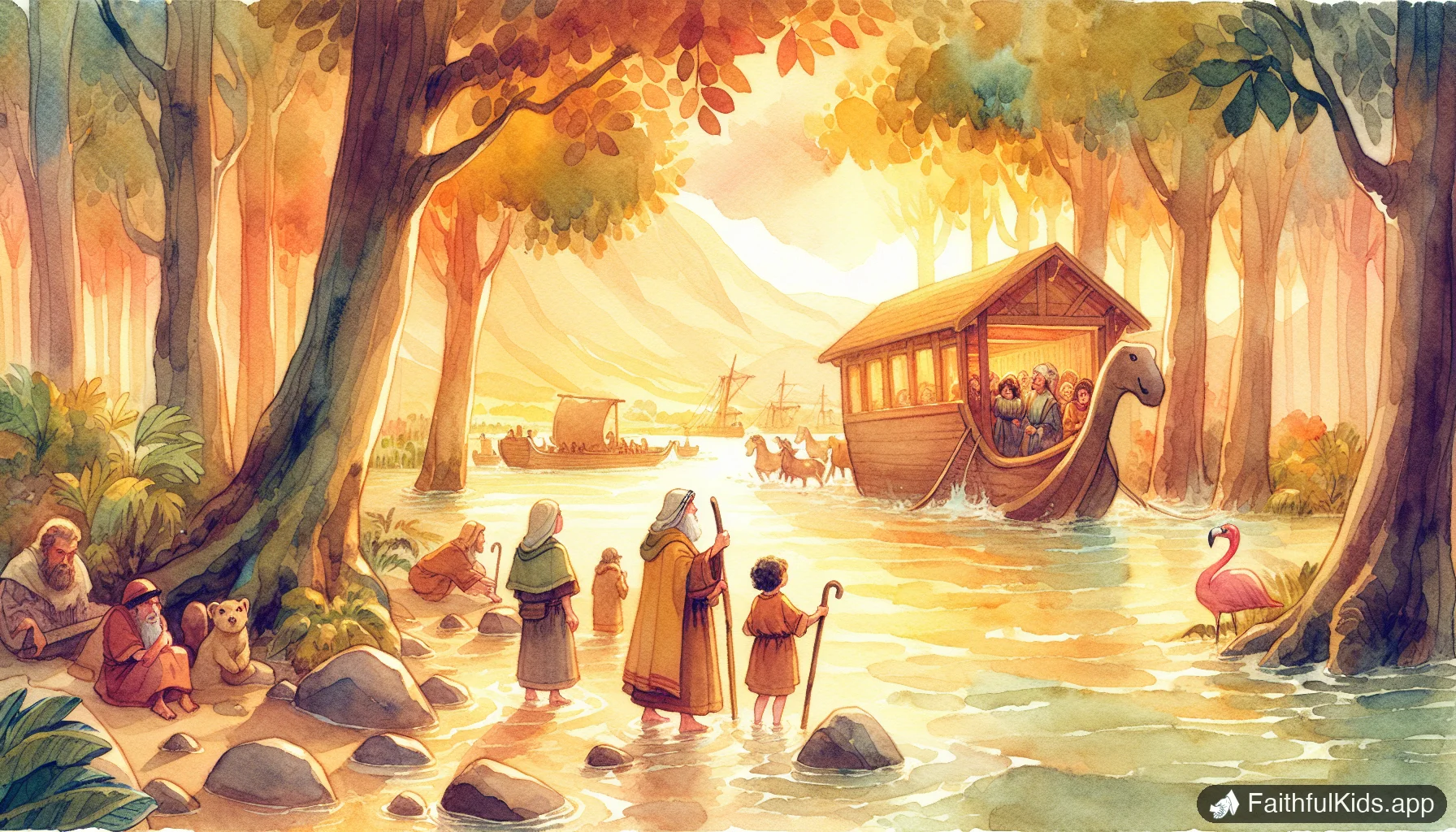
Press play on Noah and the Great Flood — a complete lesson exactly as your child sees it. 300+ episodes cover the whole Bible in order, each ending in a fun quiz to check what they learned.
A real lesson from the app — watch the whole thing free.
4. Discussion Question Cards
Discussion cards are small cut-apart cards with one open-ended question each, drawn from a jar at dinner or after a reading, and they exist to solve the most common family Bible time failure: the parent asks a question, gets a one-word answer, and the conversation dies.
Layout: Print a page of nine cards (a 3x3 grid), one question per card, in a font big enough for a kid to read aloud. Cut, drop in a jar or a small tin, and draw one after each reading.
Twelve questions that reliably produce conversation:
What surprised you in this story?
Who would you have been in this story, and why?
What does this passage show us about who God is?
Was anybody brave here? What did that cost them?
What would you have asked Jesus if you were there?
Is there anything in this that you do not understand?
What is one thing we could do differently this week because of this?
Who in our family or neighborhood needs to hear this?
What was the hardest thing anyone in this story had to do?
If this story were a movie scene, what would the music sound like?
What do you think happened right after the last verse?
What is one thing you want to remember from tonight?
Question 6 is the one to keep in every deck. Kids who learn that "I do not get it" is a welcome answer keep talking for years. For a much longer bank to build several decks from, see our Bible discussion questions for kids and our list of family dinner Bible questions.
5. Sermon Notes for Kids
A kids' sermon notes page is a simple half-sheet that gives a child a job during the service, which is the entire mechanism -- a kid with a task listens, and a kid with nothing to do fidgets.
Layout by age, because one page does not fit all:
Ages 4-6: Four big empty boxes labeled with pictures: a Bible (draw the story), a person (draw the pastor), a heart (draw something you liked), a music note (name one song). No writing required.
Ages 7-9: Top line for the passage. Three boxes: "One thing I learned," "One word I heard a lot" (a tally box next to it works wonders), and "Draw something from the sermon."
Ages 10-12: Passage line, three bullet lines for main points, a box for "one question I want to ask," and a line for "one thing I will do this week."
Teens: Passage, main points, cross-references mentioned, and a box titled "What I would push back on." Teens engage with a sermon they are allowed to argue with.
Bring a clipboard and a pencil, not a pen. Collect the pages in a binder and read the year's stack in December -- it is a surprisingly moving record of what a kid was thinking about.
Sermon notes have a second use worth knowing: they work identically for video lessons. Our episodes at Faithful Kids end with a quiz and a reflection, and a kid filling in a notes page while watching processes far more than one watching passively.
For the rest of the printable landscape -- coloring pages, word searches, bingo, mazes -- see our complete roundup of free Bible printables for kids. Sunday school teachers building lessons around these sheets should also look at our Bible lesson plans for Sunday school.
All five printables on this page are ours, free, with no email wall — and they pair with the rest of the Faithful Kids free printables: coloring pages, word searches, and quiz PDFs with answer keys.
How Do You Fit All Five Into One Week?
You do not use all five at once. A realistic week for a family with elementary-age kids:
When
Printable
Time
Sunday afternoon
Fill in the study planner
10 min
Sunday morning
Sermon notes page
During service
Weekday breakfast
Verse memory tracker
2 min
Weeknight after dinner
Reading chart + a discussion card
10 min
That is roughly fifteen minutes a day, most of it attached to meals you were already eating. Start with two of the five -- the reading chart and the discussion cards are the highest-return pair -- and add the others only once those two run without reminders.
Our Bible trivia for adults page does the same thing for grown-up groups, opening with questions where the popular version of the story and the text disagree.
And when the room needs to get quiet, hand out a Bible crossword -- seven free story-based puzzles, no sign-up.
Frequently Asked Questions
Where can I find free Bible study printables?
Church websites, homeschool blogs, and Sunday school curriculum publishers all offer free study sheets, though many require an email signup first. The templates in this guide are deliberately simple enough to rebuild yourself in a word processor, which lets you match them to your family's actual reading plan. Our free 30-Day Family Bible Challenge is a complete daily plan with discussion questions and requires no sign-up.
What age are Bible study printables for?
Roughly ages 5 through 15, with the format shifting rather than the concept. Young kids need drawing boxes and checkmarks; elementary kids can handle a reading chart and simple sermon notes; middle schoolers and teens do well with verse maps, written reflections, and question prompts they can argue with. The tracker and the reading chart work at every age with no changes.
How is a Bible study printable different from a worksheet?
A worksheet tests what a child already read; a study printable structures the reading itself. That distinction matters because worksheets tend to produce right answers and no conversation, while a planner, a discussion card, or a notes page produces conversation and no grade. If a printable has an answer key, it is a worksheet.
Can I use these printables for Sunday school or a co-op?
Yes -- every template here scales to a classroom, and the discussion cards and sermon notes pages are especially good in groups. Make one master, photocopy a class set, and keep them in a folder with the curriculum. If you use printables downloaded from other creators, check their terms: most allow unlimited printing for church and classroom use but prohibit resale or re-hosting the files.
How long should family Bible study actually take?
Ten to fifteen minutes for elementary-age kids, and five is fine for preschoolers. The most common mistake families make is designing a forty-minute study, running it twice, and quitting. A short reading, one question from the card jar, and a checkmark on the chart is a complete session -- and one you can sustain on a Tuesday when everyone is tired.
What if my kids resist family Bible time entirely?
Shrink it and give them a job. Resistance almost always drops when the session is under ten minutes and the child has a role: reading a verse aloud, drawing the card from the jar, marking the chart. Start with the printables that require the least output -- the reading chart and a discussion card -- and hold off on anything that asks a reluctant kid to write until the routine itself is uncontroversial.
🌙 Free: The Bedtime Bible Kit
Seven nights of five-minute stories — a story, a prayer, and one question to whisper about.
Free printable + a few helpful emails. Unsubscribe anytime.