Bible mazes and puzzles turn Scripture review into brain games kids actually want to do -- and you can make every type in this guide with nothing but paper and a pencil. Below you'll find the six main puzzle types (mazes, crosswords, cryptograms, word ladders, scrambles, and sequence puzzles), plus 10 ready-to-use puzzle ideas with the answers fully worked out, so you can hand one to your child tonight.
Puzzles work because they flip the direction of learning. A lesson pushes information at a kid; a puzzle makes the kid pull the information out -- decode the verse, remember the story order, recall the name. That retrieval is exactly what makes things stick. They're also blessedly quiet, which makes them perfect for church pews, restaurants, and the rainy-afternoon activity rotation.
What Types of Bible Puzzles Work Best for Kids?
Six puzzle types cover nearly everything, and each suits a different age and skill:
| Puzzle Type | Best Ages | What It Practices |
|---|
| Mazes | 4-8 | Story settings and journeys |
| Word searches | 6-10 | Name and word recognition |
| Scrambles and anagrams | 6-10 | Spelling Bible names |
| Crosswords | 8-12 | Story facts and recall |
| Cryptograms and ciphers | 8-12 | Verses, letter by letter |
| Word ladders and sequence puzzles | 9-12 | Logic plus story order |
Mazes are the entry point -- even pre-readers can trace Jonah's path to Nineveh. Ciphers are the crown jewel for the 8-12 crowd: there's something irresistible about a "secret code," and a child who decodes a verse one letter at a time has effectively copied it into memory without noticing. (Word searches deserve their own deep-dive -- we've got ready-made grids in our
Bible word search for kids guide.)
Now, the 10 puzzles. Each one is described fully enough to make in five minutes, and every answer is included.
10 Ready-to-Use Bible Puzzle Ideas (With Answers)
1. Jonah's Journey Maze
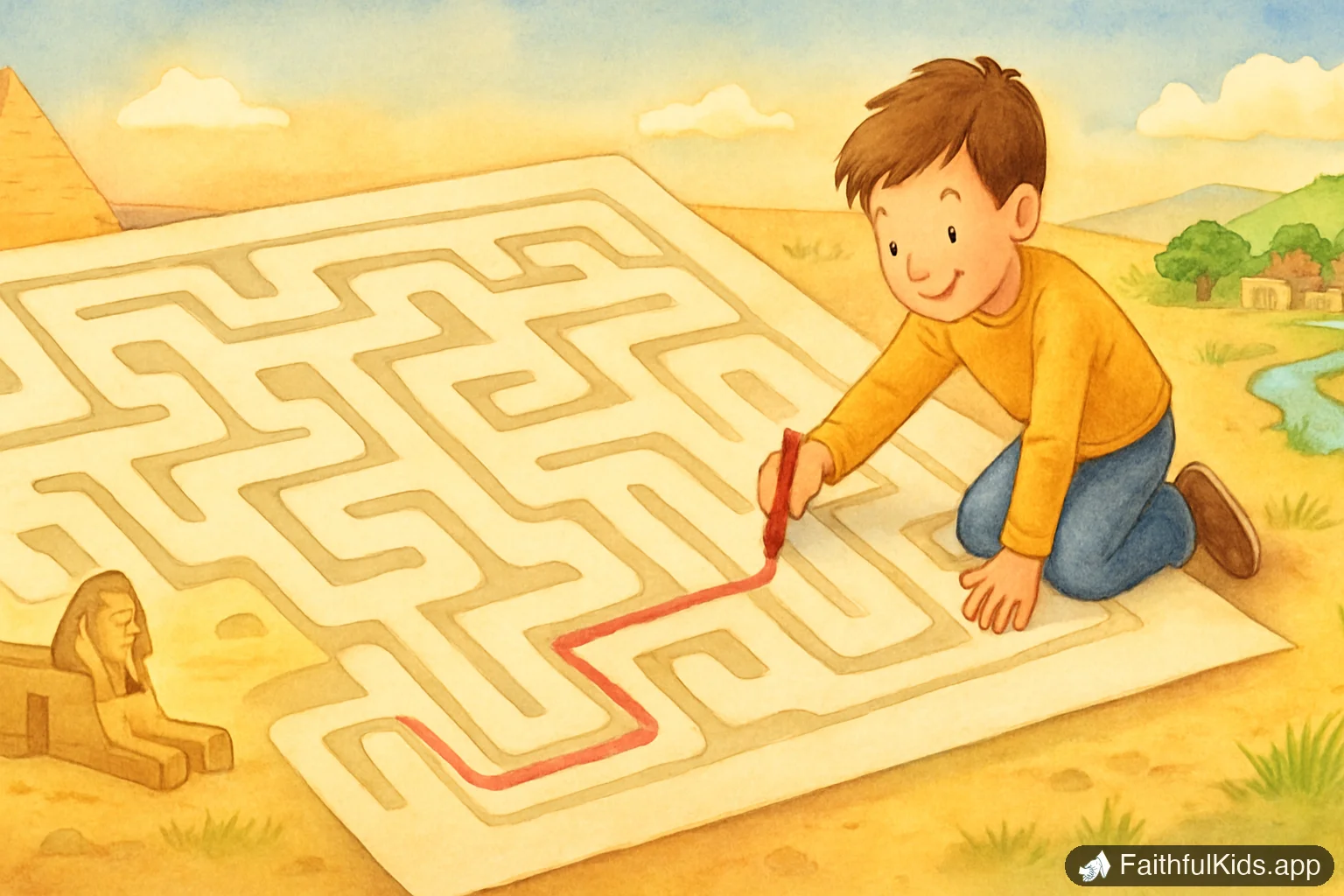
Draw a maze where the start is labeled "Joppa" (with a little boat) and the finish is "Nineveh." Add three dead-end paths labeled with the story's detours: "Tarshish," "The Storm," and "The Big Fish." As your child solves it, the maze retells the story -- Jonah tried every wrong path before God got him to Nineveh (Jonah 1-3). Answer: the open path from Joppa to Nineveh; the lesson is that the dead ends are literally Jonah's dead ends. For drawing it, a simple spiral or grid maze from a free maze generator works fine -- the labels do the teaching.
2. Red Sea Crossing Maze
Draw two wavy "walls of water" down the page with a channel of paths between them. Start: "Israelites" (stick-figure crowd). Finish: "The far shore." Dead ends are labeled "Pharaoh's chariots." Read Exodus 14:21-22 together when they finish -- the visual of walls of water on each side is exactly what the verse describes. Answer: the single dry path through the middle.
3. Mini Bible Crossword (5 clues)
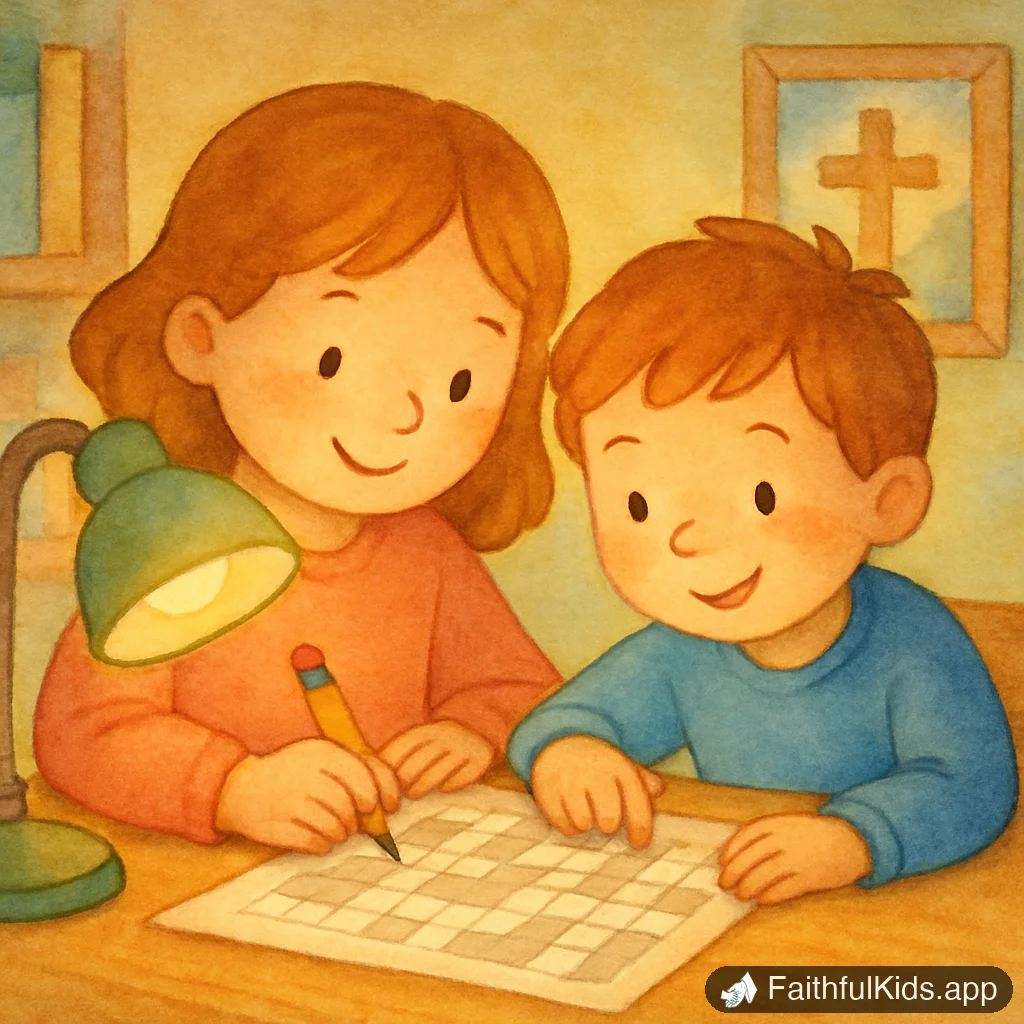
Draw a small crossword grid (or just have kids write answers on lines). Clues:
- Across: He built an ark before the flood. (4 letters) -- NOAH
- Across: The strongman whose hair was his secret. (6 letters) -- SAMSON
- Down: The queen who saved her people. (6 letters) -- ESTHER
- Down: He interpreted dreams in Egypt and wore a colorful robe. (6 letters) -- JOSEPH
- Down: The sea Moses stretched his hand over. (3 letters) -- RED
Grid tip: NOAH and ESTHER can share an H; SAMSON and JOSEPH can share an S or O. Or skip the grid entirely -- kids care about the clues, not the layout.
4. Number Code Cryptogram: Decode the Verse
Give kids the key "A=1, B=2, C=3 ... Z=26," then this coded message:
10-5-19-21-19 23-5-16-20
Answer: "JESUS WEPT" (John 11:35) -- J=10, E=5, S=19, U=21, S=19, then W=23, E=5, P=16, T=20. It's the shortest verse in the Bible, which makes it the perfect first decode: quick enough that kids taste success, and it opens a genuinely good conversation about why Jesus cried at Lazarus's tomb. Once they've got the system, encode longer verses yourself -- write out the verse, convert each letter using the key, and double-check two or three letters before handing it over.
5. Shift Cipher: The Next-Letter Code
Explain the trick: every letter in the code has been shifted one letter forward in the alphabet, so to decode, kids shift each letter one step back (B becomes A, C becomes B, and A wraps around from... nothing here -- pick verses without A-wrapping for young kids). The code:
HPE JT MPWF
Answer: "GOD IS LOVE" (1 John 4:8) -- H back to G, P back to O, E back to D; J back to I, T back to S; M back to L, P back to O, W back to V, F back to E. Older kids can then encode their own secret messages for each other, which is where this puzzle really takes off -- you'll find them passing shifted-cipher notes for weeks.
6. Word Ladder: Turn HATE into LOVE
A word ladder changes one letter at a time, and every step must be a real word. Challenge: turn HATE into LOVE in four steps.
Answer: HATE → LATE → LANE → LINE → LIVE → LOVE. (That's five steps -- tell kids "five or fewer" and celebrate any valid ladder.) The devotional hook writes itself: changing hate into love happens one small step at a time, and Jesus said, "Love your enemies and pray for those who persecute you" (Matthew 5:44). For a one-step starter with younger kids: turn SIN into SON (change one letter) -- a tidy echo of the prodigal son's homecoming in Luke 15.
7. Missing Vowels Verse
Write a verse with every vowel removed and have kids restore it:
TH LRD S M SHPHRD
Answer: "THE LORD IS MY SHEPHERD" (Psalm 23:1). This one looks impossible for about ten seconds and then cracks open all at once -- a great confidence-builder. Any short, familiar verse works; the more familiar the verse, the younger the child who can solve it, which makes this a sneaky test of which verses your kids actually know by heart.
8. Bible Name Scrambles
Unscramble these five Bible names:
- SEMOS -- MOSES
- HAON -- NOAH
- VIDAD -- DAVID
- THERES -- ESTHER
- LINEAD -- DANIEL
Level it up for older kids: after unscrambling, they must say one fact about each person to "unlock" the next scramble. Making your own is easy -- write the name, then reorder the letters, avoiding arrangements that accidentally spell something else.
9. First-Letter Acrostic: The Hidden Name
Kids answer five questions, then read the first letters of their answers from top to bottom to reveal a hidden word:
- The city whose walls fell down after seven days of marching. -- JERICHO
- The garden where Adam and Eve lived. -- EDEN
- The mountain where Moses received the Ten Commandments. -- SINAI
- Abraham's hometown, where God first called him. -- UR
- The region where Jesus talked with the woman at the well. -- SAMARIA
Hidden word: J-E-S-U-S. The reveal moment is genuinely delightful, and the puzzle quietly teaches five Bible places. Build your own acrostics for any name -- pick the target word, then find a Bible answer starting with each letter.
10. Story Sequence Scramble
Write the six days of creation on separate slips, shuffle them, and have kids arrange them in order:
Light -- Sky and waters -- Land, seas, and plants -- Sun, moon, and stars -- Fish and birds -- Animals and people
Answer: that exact order, from Genesis 1: Day 1 light, Day 2 sky, Day 3 land and plants, Day 4 sun/moon/stars, Day 5 fish and birds, Day 6 animals and people. The classic stumper is that plants (Day 3) come before the sun (Day 4) -- expect a debate, and settle it by reading the chapter. The same format works for the plagues of Egypt, Joseph's life, or Holy Week.
When Should You Use Bible Puzzles?
Use puzzles as review after a story, not as a substitute for it -- a child who doesn't know Jonah's story yet will solve the maze without learning anything. The winning sequence is story first, puzzle second: read the passage or watch the story told well (our video lessons at Faithful Kids cover these stories with a quiz built in), then hand over the puzzle while the story is fresh.
Practically, puzzles fill the gaps other activities can't: the 15 minutes before dinner, the church service a wiggly 7-year-old is sitting through, the long car ride, the Sunday school early-finisher problem. Keep a folder of five or six ready to go. And rotate formats -- a cipher is thrilling the first three times and routine the tenth, so cycle through mazes, codes, scrambles, and Bible riddles to keep the novelty alive.
One more tip: let kids make puzzles for you. A child who encodes a verse into a number cipher for Dad to solve has processed that verse far more deeply than one who merely decoded it. Puzzle-making is the advanced class disguised as a game.
We drew a set of free Bible coloring pages to go with these — 16 scenes from Creation to the empty tomb, no email needed.
Sunday school leaders: the Bible word searches print one to a sheet with the answer key included.
Frequently Asked Questions
What age are Bible mazes and puzzles good for?
Mazes work from age 4, word searches and scrambles from about 6, and crosswords, ciphers, and word ladders hit their sweet spot at ages 8-12. The reliable rule: if your child can do the puzzle type in a school workbook, they can do the Bible version. Start one notch easier than you think and let them ask for harder.
Do I need to buy Bible puzzle books, or can I make my own?
You can make every puzzle in this article yourself with paper and pencil in about five minutes each, and homemade puzzles let you match the content to exactly what your child is learning this week. Puzzle books are worth buying for volume -- car trips and church bags burn through pages fast -- but the ideas here cover a full month of activities for free.
How do Bible ciphers and cryptograms work?
A cipher replaces each letter of a verse with a number or a different letter according to a simple key -- like A=1, B=2, or "shift each letter one forward" -- and kids reverse the key to decode the message. Decoding forces kids to reconstruct the verse letter by letter, which is why a decoded verse is often half-memorized by the time they finish. Start with short verses like John 11:35 ("Jesus wept").
Are Bible puzzles actually educational or just busywork?
They're genuinely educational when they require retrieval -- remembering names, reconstructing verses, sequencing story events -- and busywork when they don't, so choose puzzles where the Bible content is the answer, not just the decoration. A maze with story-labeled dead ends teaches; the same maze with no labels is just a maze. The puzzles in this guide are all built around retrieval.
How do I make a Bible puzzle harder or easier?
Adjust the scaffolding, not the content: give younger kids the cipher key, a word bank, or the first letter of each answer, and take those supports away for older kids. For ciphers specifically, longer verses and two-step codes (numbers plus a shift) raise difficulty fast. One puzzle written once can serve a 6-year-old and an 11-year-old with different hint sheets.
What's a good first puzzle for a child who's never done one?
Start with a story maze (like Jonah's journey to Nineveh) for ages 4-7, or the "Jesus wept" number cryptogram for ages 8 and up. Both deliver a quick win in under ten minutes, and quick early wins are what turn a one-time activity into a requested one.