Did Jesus have siblings? The Bible names four "brothers" of Jesus (James, Joseph or Joses, Judas and Simon) and says he had "sisters" too (Mark 6:3, Matthew 13:55-56). Christians agree on that. Where they differ is on what kind of brothers and sisters these were.
Catholic and Orthodox Christians believe Mary remained a virgin all her life, so they understand these brothers and sisters as close relatives: cousins, or children Joseph had before he married Mary. Many Protestant Christians read them as younger children born to Mary and Joseph after Jesus. Both readings come from people who love Jesus, honor Mary and take the Bible seriously.
So you can give your child a simple, true answer: "The Bible says Jesus had brothers and sisters in his family. Christians understand that in different ways." Then, if you like, explain what your own church teaches.
This guide covers what the Bible says, how the different traditions understand it, and simple words to use at every age.
What the Bible Says About Jesus's Brothers and Sisters
The people in Nazareth
When Jesus taught in his hometown synagogue, the people who had watched him grow up were amazed. Mark records them asking: "Isn't this Mary's son and the brother of James, Joseph, Judas and Simon? Aren't his sisters here with us?" (Mark 6:3, NIV). Matthew tells the same scene and lists the brothers as "James, Joseph, Simon and Judas," then asks, "Aren't all his sisters with us?" (Matthew 13:55-56, NIV).
The name sometimes appears as Joses rather than Joseph. Joses is a shorter form of the same name, and some translations use it in Mark. Judas here is not Judas Iscariot. Christian tradition identifies him with Jude, author of the short letter of Jude near the end of the New Testament, who calls himself "a brother of James" (Jude 1:1, NIV).
The sisters are never named in the Bible.
During Jesus's ministry
At first, Jesus's brothers did not understand him. John says plainly, "For even his own brothers did not believe in him" (John 7:5, NIV). Mark describes a time when his mother and brothers came looking for him while he was teaching (Mark 3:31-35).
After the resurrection
Something changed. After Jesus rose and returned to the Father, the disciples gathered to pray "along with the women and Mary the mother of Jesus, and with his brothers" (Acts 1:14, NIV). Paul says the risen Jesus appeared to James (1 Corinthians 15:7), and when Paul visited Jerusalem he met "James, the Lord's brother" (Galatians 1:19, NIV). This James became a leader of the church in Jerusalem (Acts 15:13) and has traditionally been named as the author of the letter of James.
This is one of the most hopeful threads in the New Testament: the brothers who once doubted Jesus became leaders who followed him.
Outside the Bible
The Jewish historian Josephus, writing around AD 93-94, describes the death of "James, the brother of Jesus, who was called Christ" in AD 62. Historians almost universally accept this line as genuine, so James is one of the best-attested people connected to Jesus outside the Gospels. (See Was Jesus a Real Person? for more on Josephus.)
Did Jesus Have Siblings? How Christians Understand It
The Bible's word for "brother" in Greek is adelphos. It can mean a brother from the same mother, but in the Bible it is also used for wider family members and even for fellow believers (Christians still call each other "brothers and sisters"). So the word itself does not settle the question. Context and tradition do the rest, and here the traditions differ. There are three main views, often named after early church writers who defended them.
View 1: Cousins (the Catholic teaching)
The Catholic Church teaches that Mary remained a virgin all her life, and that Jesus was her only child. The fourth-century scholar Jerome, who translated the Bible into Latin, argued that the "brothers" were Jesus's cousins. The Catechism of the Catholic Church explains that James and Joseph, called "brothers of Jesus," are "the sons of another Mary, a disciple of Christ" (paragraph 500), pointing to the "other Mary" the Gospels mention at the cross and the tomb (Matthew 27:56, 28:1). It describes them as close relations, using a way of speaking found in the Old Testament, where "brother" can mean a relative, as when Abram speaks of himself and his nephew Lot as brothers (Genesis 13:8, where the NIV translates the Hebrew as "close relatives").
View 2: Joseph's children from an earlier marriage (the Orthodox teaching)
The Eastern Orthodox Church also teaches that Mary was ever-virgin. The Second Council of Constantinople (AD 553) gave her the title Aeiparthenos, "ever-virgin," which the Orthodox still use. The Orthodox view, defended by the fourth-century bishop Epiphanius of Salamis, is that the brothers and sisters were Joseph's children from a marriage before he married Mary, so they were Jesus's older step-siblings. An early Christian writing from the mid-second century, the Protoevangelium of James, already describes Joseph as an older widower with sons.
View 3: Younger children of Mary and Joseph (a common Protestant reading)
Many Protestant Christians today read the brothers and sisters as children born to Mary and Joseph after Jesus. They often point to Matthew 1:25, which says Joseph did not have marital relations with Mary "until" she gave birth, and to Luke 2:7, which calls Jesus her "firstborn." This view was argued in the fourth century by a writer named Helvidius.
Those who hold Views 1 and 2 answer that "firstborn" was a legal title for a first son whether or not other children followed, and that "until" in the Bible does not have to imply that something changed afterward. Scholars generally say the grammar of Matthew 1:25 does not settle the question either way.
It is not simply Catholic versus Protestant
Interestingly, the early Protestant reformers Martin Luther and Huldrych Zwingli both believed Mary remained a virgin, and so did John Wesley, the founder of Methodism. Many Anglicans and Lutherans still hold that view. Many evangelical and non-denominational Christians today hold View 3.
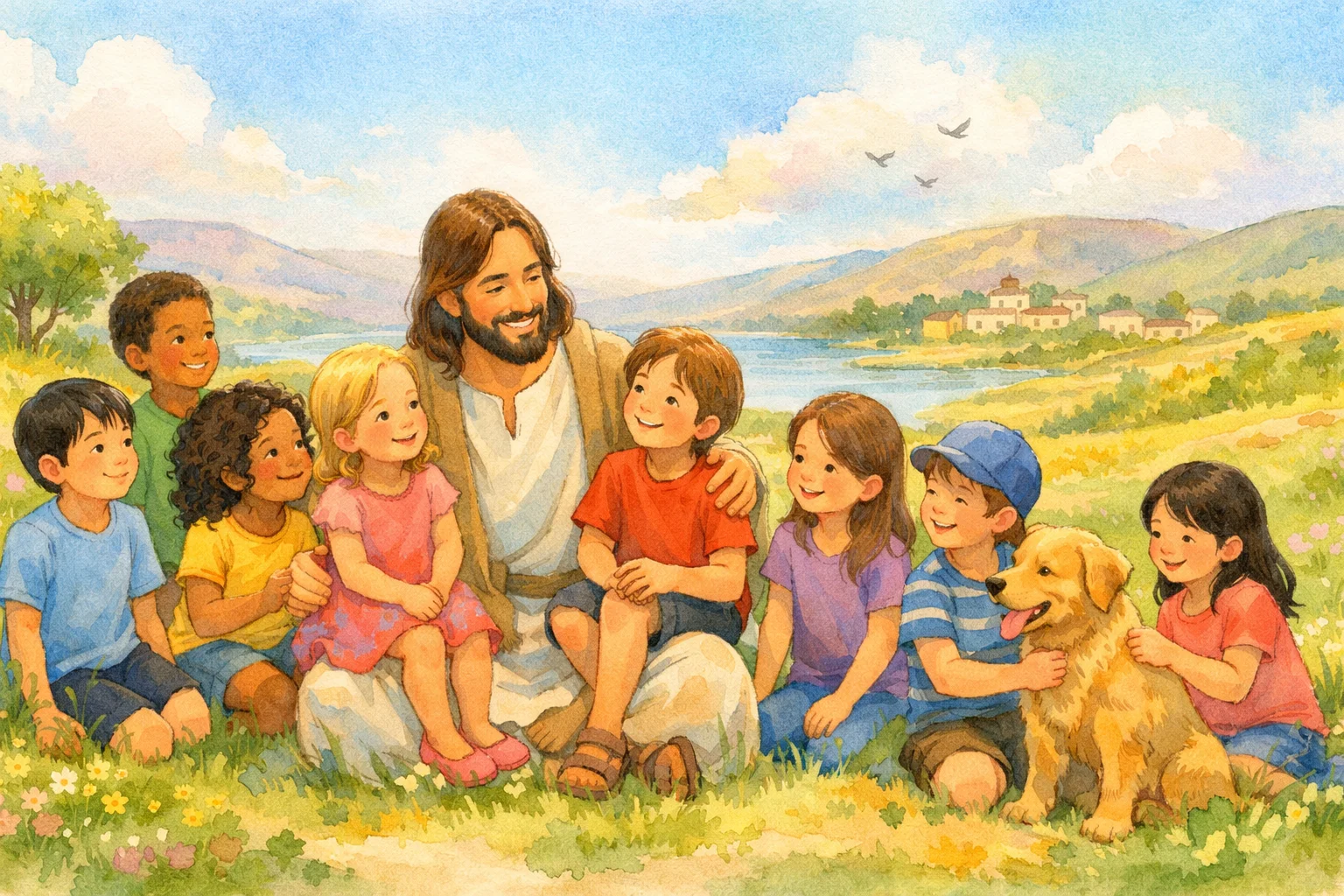
All three views agree on what matters most for children: Jesus grew up in a real family, in a real town, with people who loved him, and some of them, after the resurrection, became his faithful followers.
How to Answer Your Child, by Age
Ages 5-7
"The Bible says Jesus had brothers and sisters in his family. Two of his brothers were named James and Jude. At first they didn't understand who Jesus was, but later they believed in him and told other people about him. Isn't that wonderful?"
Tip: Young children relate to Jesus as a child in a family. Use this to remind them that Jesus knows what family life is like, including the hard parts.
Ages 8-11
"The Bible names four brothers of Jesus, James, Joseph, Judas and Simon, and says he had sisters too. Christians understand those words in different ways. Some Christians believe they were Mary and Joseph's younger children. Catholic and Orthodox Christians believe Mary had only one child, Jesus, so they think these were cousins or Joseph's children from before he married Mary. In Bible times, 'brother' could mean a relative, not just a brother like yours."
Tip: If your church holds one view, say so warmly: "In our church we believe..." Then add that other Christians who love Jesus see it differently. Kids learn charity from how we describe others.
Ages 12-15
"Mark 6:3 and Matthew 13:55 name Jesus's brothers, and Galatians 1:19 calls James 'the Lord's brother.' The Greek word can mean a full brother or a close relative. Catholics follow Jerome's view that they were cousins, the Orthodox follow Epiphanius's view that they were Joseph's sons from an earlier marriage, and many Protestants read them as Mary's younger children. Even Luther believed Mary stayed a virgin. Christians have discussed this for 1,600 years and still love each other. What everyone agrees on is that James went from doubting Jesus to leading the church."
Tip: This is a great chance to show a teen how to handle a question where faithful Christians disagree: look at the texts, understand each view at its strongest, and hold your own with humility.
See what they get
Watch a Real Lesson From the App
Press play on In the Beginning Creation, a complete lesson exactly as your child sees it. 300+ episodes cover the whole Bible in order, each ending in a fun quiz to check what they learned.
A real lesson from the app, watch the whole thing free.
Questions Kids Ask Next
"Was Jesus the oldest?" In the Protestant reading, yes. In the Orthodox view, the brothers and sisters were Joseph's older children. In the Catholic view, they were cousins, and Jesus was Mary's only child.
"Did Jesus fight with his brothers?" The Bible does not tell us about their childhood. It does say they did not believe in him at first (John 7:5), so family life was not always easy, even for Jesus.
"Why did Jesus ask John to take care of his mother?" On the cross, Jesus entrusted Mary to his disciple John (John 19:26-27). Catholic and Orthodox Christians often see this as a sign that Mary had no other sons to care for her; many Protestants suggest it was because his brothers did not yet believe. Either way, it shows how much Jesus loved his mother.
"Did Jesus's brothers write books of the Bible?" Christian tradition links the letter of James to James, the Lord's brother, and the letter of Jude to Jude, who calls himself "a brother of James."
🕯️ Free: 25 Days of Advent Bible Readings
December 1 to 25, one short reading a night, from the first promise to the manger. Printable for the fridge.
Free printable + a few helpful emails. Unsubscribe anytime.
Watch the Story Together
The scene where the people of Nazareth name Jesus's brothers is told in Rejected in Nazareth, and you can learn more about his mother in Who Was Mary, Mother of Jesus?. Each has a free two-minute video lesson with a quiz you can do together. Faithful Kids has 300+ short Bible video lessons for ages 5-15, Genesis to Revelation, each with a quiz.
Frequently Asked Questions
Did Jesus have siblings?
The Bible names four brothers of Jesus (James, Joseph or Joses, Judas and Simon) and mentions sisters (Mark 6:3, Matthew 13:55-56). Catholic and Orthodox Christians understand them as cousins or Joseph's children from an earlier marriage; many Protestants see them as Mary and Joseph's younger children.
What were the names of Jesus's brothers?
James, Joseph (also written Joses), Judas (traditionally identified with Jude) and Simon. His sisters are not named in the Bible.
Did Mary have other children?
Catholic and Orthodox Christians teach that Mary remained a virgin and that Jesus was her only child. Many Protestant Christians believe Mary and Joseph had other children after Jesus. Faithful Christians hold both views.
Who was James, the brother of Jesus?
James was a leader of the early church in Jerusalem (Galatians 1:19, Acts 15:13). The Jewish historian Josephus records his death in AD 62. Tradition links him with the letter of James.
Did Jesus's brothers believe in him?
Not at first (John 7:5). But after the resurrection they were praying with the disciples (Acts 1:14), and James became a leader of the church.