Did Jesus rise from the dead? Christians believe he really did. Three days after he died on the cross, his tomb was found empty, and over the following weeks his friends saw him alive, talked with him and ate with him (Luke 24:36-43). This is the center of the Christian faith, and it is the reason Easter is the happiest day of the Christian year.
The apostle Paul was honest about how much rests on it. He wrote that if Christ has not been raised, the Christian faith is "futile" (1 Corinthians 15:17, NIV). Christians have never treated the resurrection as a side detail. It is the good news itself.
So when your child asks "Did Jesus really rise from the dead?", you can answer with joy and with honesty. Yes, Christians believe he did. There are real reasons people give for believing it, and there is also a part that is trust, the same way we trust anyone whose word we have good reason to believe.
This guide covers what the Bible says, the reasons Christians point to, what history can and cannot show, and simple words to use with kids of different ages.
What the Bible Says About the Resurrection
All four Gospels tell the Easter story (Matthew 28, Mark 16, Luke 24, John 20). The details differ in the way honest eyewitness accounts often do, but the main events are the same.
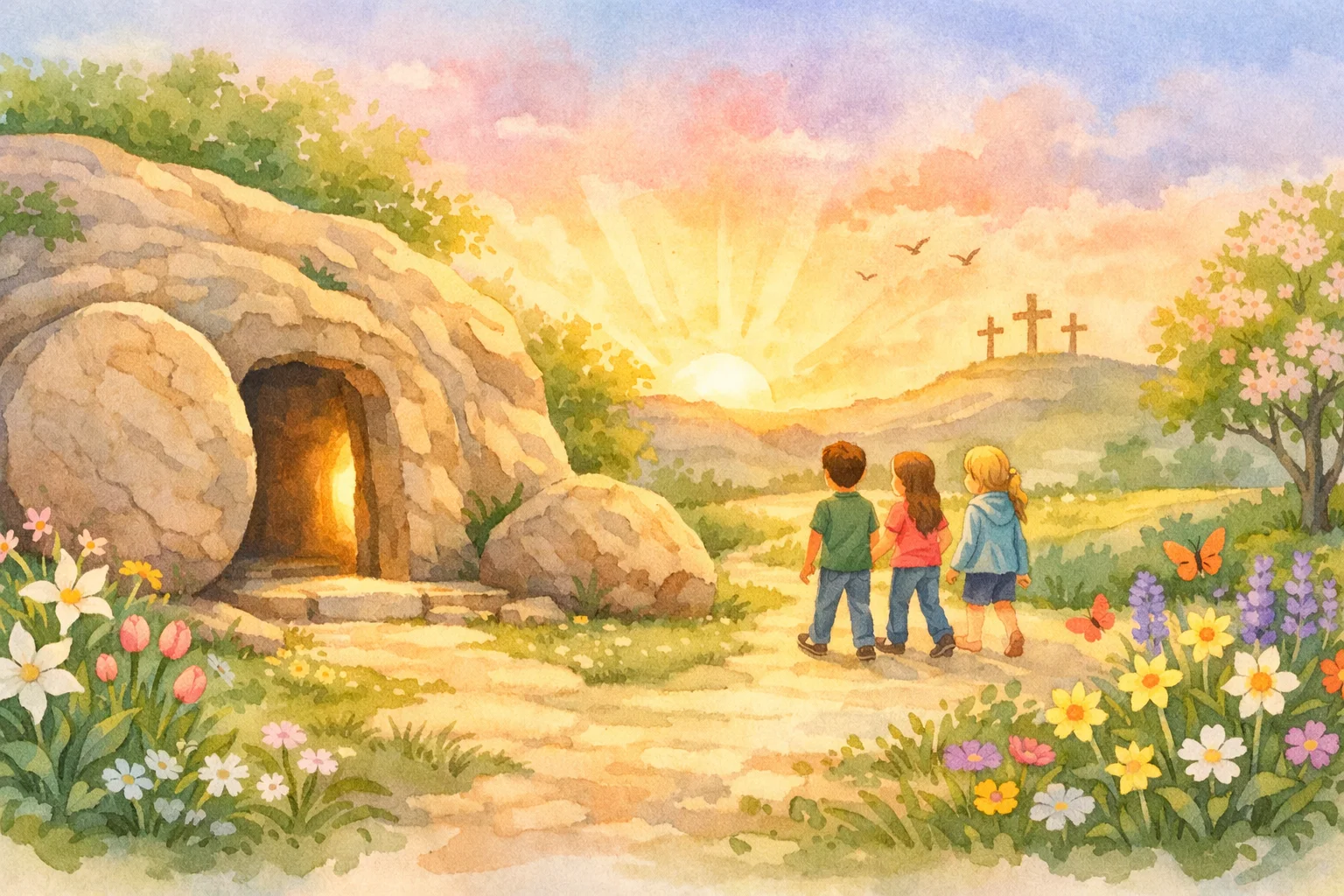
Early on Sunday morning, women who had followed Jesus went to his tomb. The large stone was rolled away and the tomb was empty. An angel told them, "He is not here; he has risen" (Matthew 28:6, NIV). Mary Magdalene was the first person to see the risen Jesus, and at first she did not recognize him until he said her name (John 20:11-16).
Then Jesus appeared to his disciples. He showed them his hands and side, and he even ate a piece of fish in front of them to show he was not a ghost (Luke 24:39-43). Thomas, who had doubted, saw him a week later and said, "My Lord and my God!" (John 20:28, NIV). Jesus walked and talked with two friends on the road to Emmaus (Luke 24:13-35), and cooked breakfast on the beach for his fishermen friends (John 21:9-14).
Paul gives the earliest written list of who saw Jesus alive. He says Jesus appeared to Peter, then to the twelve, then to "more than five hundred" people at the same time, most of whom were still living when Paul wrote, then to James, and then to all the apostles (1 Corinthians 15:3-8). In other words: go and ask them.
Did Jesus Rise From the Dead? The Reasons Christians Give
Christians believe the resurrection because God's Word says it happened. But the New Testament itself invites people to look at the reasons, and Christians through the centuries have pointed to several.
The empty tomb
The first Christians preached that Jesus had risen in Jerusalem, the same city where he had been buried. Matthew records that the response of Jesus's opponents was not to point to a body but to say the disciples had taken it (Matthew 28:11-15). Christians see that as a quiet admission that the tomb was empty.
The first witnesses named in every Gospel are women, led by Mary Magdalene. Scholars such as Dale Allison argue that this detail, once treated with suspicion, actually supports the story: a story made up to persuade people would hardly have been told that way. Christians believe the Gospels name these women because that is what happened.
Many people saw him, many times
The appearances were not a single sighting. They happened to individuals and groups, indoors and outdoors, over several weeks (Acts 1:3). Paul's mention of more than five hundred people at once, most still alive, was an open invitation for readers to check.
The disciples were changed
On the night Jesus was arrested, his friends ran away and hid (Mark 14:50). A few weeks later, Peter was standing up in front of crowds in Jerusalem saying that God had raised Jesus from the dead (Acts 2:22-24). The disciples spent the rest of their lives telling people Jesus was alive, even when it brought them hardship. Something turned frightened people into fearless ones, and they said that something was seeing Jesus alive.
A very early creed
The words Paul passes on in 1 Corinthians 15:3-8 are not his own. He says he "received" them and handed them on (1 Corinthians 15:3). Scholars widely see this passage as an early Christian creed, a short summary of the faith that believers memorized.
What makes it remarkable is how early it is. Many scholars, including some who do not believe in a bodily resurrection, date the formation of this creed to within a few years of the crucifixion. N. T. Wright places it within the first two or three years after Easter; James Dunn suggests within months; Gerd Lüdemann, who rejects a bodily resurrection, places it within the first two years. Not every scholar agrees on how precise those dates can be. Bart Ehrman, for example, cautions against assuming too much. But the general point is widely shared: belief that Jesus had risen was there from the very start, not added decades later.
What History Can (and Cannot) Tell Us
It helps to be clear in your own mind about what history can and cannot do here.
History can show:
Jesus was a real person who was crucified under Pontius Pilate. Almost all historians agree on this, and the Roman historian Tacitus mentions it. Our guide Was Jesus a Real Person? walks through that evidence.
His followers very quickly and sincerely proclaimed that he had risen, as the early creed in 1 Corinthians 15 shows.
The Christian movement grew fast from that starting point, in the same city where Jesus died.
History alone cannot prove:
That God raised Jesus from the dead.
Historians study what usually happens and look for natural causes. A resurrection, by its nature, is God doing something that does not usually happen. So historians can examine the claims, the witnesses and the dates, but the final step is a step of faith.
That is not a weakness to hide from your kids. It is how trust works. Jesus said to Thomas, "blessed are those who have not seen and yet have believed" (John 20:29, NIV). Christians are not asked to believe without reasons. They are asked to trust witnesses who had good reasons, and who staked their lives on what they saw.
Why the Resurrection Is Such Good News
For a child, the most important part of this question is not the evidence. It is what it means.
Christians believe the resurrection shows that Jesus is who he said he was, the Son of God (Romans 1:4). It shows that God accepted Jesus's sacrifice for our sins and that we can be forgiven (1 Corinthians 15:3). And it shows that death is not the end. Jesus said, "I am the resurrection and the life" (John 11:25, NIV), and Christians believe that because he lives, everyone who trusts him will live too.
That is why Christians all over the world, Catholic, Orthodox and Protestant, gather on Sunday mornings. It is why Easter has lilies and sunrise services and the greeting "He is risen!" with the answer "He is risen indeed!" The resurrection is joy.
See what they get
Watch a Real Lesson From the App
Press play on The Good Samaritan, a complete lesson exactly as your child sees it. 300+ episodes cover the whole Bible in order, each ending in a fun quiz to check what they learned.
A real lesson from the app, watch the whole thing free.
How to Answer Your Child, by Age
Ages 5-7
"Yes! Jesus died, and then on the third day God made him alive again. His friends found his grave empty, and then they saw him, talked with him, and even ate breakfast with him. Jesus is alive right now, and that is why we celebrate Easter."
Tip: Keep the focus on Sunday morning. Young children do not need the details of the cross to understand Easter. The empty tomb, the surprised women and the happy disciples are the story they will remember.
Ages 8-11
"Christians believe Jesus really rose from the dead. Lots of people saw him, not just one or two. Once, more than five hundred people saw him at the same time. His friends were so sure he was alive that they spent their whole lives telling everyone, even when it was hard. That is one reason we believe them."
Tip: Read Luke 24:36-43 together and ask, "Why do you think Jesus ate the fish?" Kids love working out that he was showing them he was really, physically there.
Ages 12-15
"Historians agree Jesus was crucified, and that his followers began saying he had risen almost immediately. One creed Paul quotes is dated by many scholars to within a few years of the crucifixion. History cannot prove a miracle, because historians look for ordinary explanations. But Christians look at the empty tomb, the many witnesses and how the disciples changed, and believe the best explanation is that it really happened. You can ask hard questions. The disciples did too."
Tip: Teens respect honesty about limits. Tell them plainly that faith is involved, then show them that faith here is trust based on reasons, not a leap in the dark.
🕯️ Free: 25 Days of Advent Bible Readings
December 1 to 25, one short reading a night, from the first promise to the manger. Printable for the fridge.
Free printable + a few helpful emails. Unsubscribe anytime.
Questions Kids Ask Next
"Where is Jesus now?" Christians believe that after forty days Jesus went back to his Father in heaven (Acts 1:3, 9-11), and that he is with us now by his Spirit. That is why we can pray to him anywhere.
"Did Jesus have the same body?" Yes and no. He could be touched and he ate food, and he still had the marks in his hands (John 20:27). But his body was also new and glorious, and sometimes his friends did not recognize him at first (Luke 24:16).
"Will I rise from the dead too?" Christians believe that one day everyone who belongs to Jesus will be raised with a new body, just as he was (1 Corinthians 15:20-22). Jesus going first is the promise that we will follow.
"Why did Jesus have to die first?" Christians believe Jesus gave his life out of love, to take away our sin, and that rising again showed his love was stronger than death (Romans 5:8). Our gospel explained for kids post walks through this gently.
"Why do we have eggs at Easter?" Many Christian families like to use the egg as a picture of new life breaking out, like Jesus coming out of the tomb. For ways to teach the real Easter story at home, try these resurrection activities for kids.
Watch the Story Together
The best way for kids to grasp the resurrection is to see the story. Watch The Empty Tomb together, a free two-minute video lesson with a quiz you can do afterward. If your child is ready for the whole Easter story, The Cross comes just before it. Faithful Kids has 300+ short Bible video lessons for ages 5-15, Genesis to Revelation, each with a quiz.
Frequently Asked Questions
Did Jesus rise from the dead?
Christians believe he did. The Gospels say his tomb was found empty on the third day and that he appeared alive to many people over forty days, including more than five hundred at once (1 Corinthians 15:6).
What evidence do Christians give for the resurrection?
Christians point to the empty tomb, the many people who said they saw Jesus alive, the sudden change in his frightened disciples, and an early creed in 1 Corinthians 15 that many scholars date to within a few years of the crucifixion.
Can historians prove the resurrection?
No. Historians can examine the claims and agree that Jesus's followers proclaimed his resurrection very early, but proving a miracle is outside what historical methods can do. Believing it is an act of faith based on the witnesses' testimony.
Why is the resurrection important to Christians?
Paul wrote that without the resurrection the Christian faith would be futile (1 Corinthians 15:14, 17). Christians believe it shows Jesus is the Son of God, that sins can be forgiven, and that death is not the end.
How do you explain the resurrection to a young child?
Keep it simple and joyful: Jesus died, God made him alive again on the third day, his friends saw him, and he is alive now. Focus on Easter morning rather than the details of the cross.
Who saw Jesus after he rose?
Mary Magdalene and other women, Peter, the disciples, Thomas, two friends on the road to Emmaus, James, and a group of more than five hundred people (Matthew 28; Luke 24; John 20-21; 1 Corinthians 15:5-7).