Did Moses part the Red Sea? The Bible says God parted the sea: Moses stretched out his hand, and "all that night the Lord drove the sea back with a strong east wind and turned it into dry land" (Exodus 14:21, NIV). Christians believe it really happened, because Scripture records it as history and later books of the Bible look back on it as a real event (Hebrews 11:29).
So the most accurate answer for your child is: Moses obeyed, and God did the parting. Nobody knows for certain exactly where it happened, and Christians differ on whether God used a natural force like the wind or worked in a purely supernatural way. Both views treat it as a miracle, because the timing, the place and the rescue all came from God.
What the Bible says happened at the Red Sea
The story is in Exodus 13-15. Here it is in brief:
God chose the route. After Pharaoh let Israel go, God did not lead them the short way through Philistine country, but "around by the desert road toward the Red Sea" (Exodus 13:17-18, NIV).
They camped by the sea. God told them to camp near places called Pi Hahiroth, Migdol and Baal Zephon (Exodus 14:2).
Pharaoh changed his mind. He chased them with his chariots, and the people were terrified (Exodus 14:10).
God protected them. The pillar of cloud moved behind Israel and stood between the two camps all night (Exodus 14:19-20).
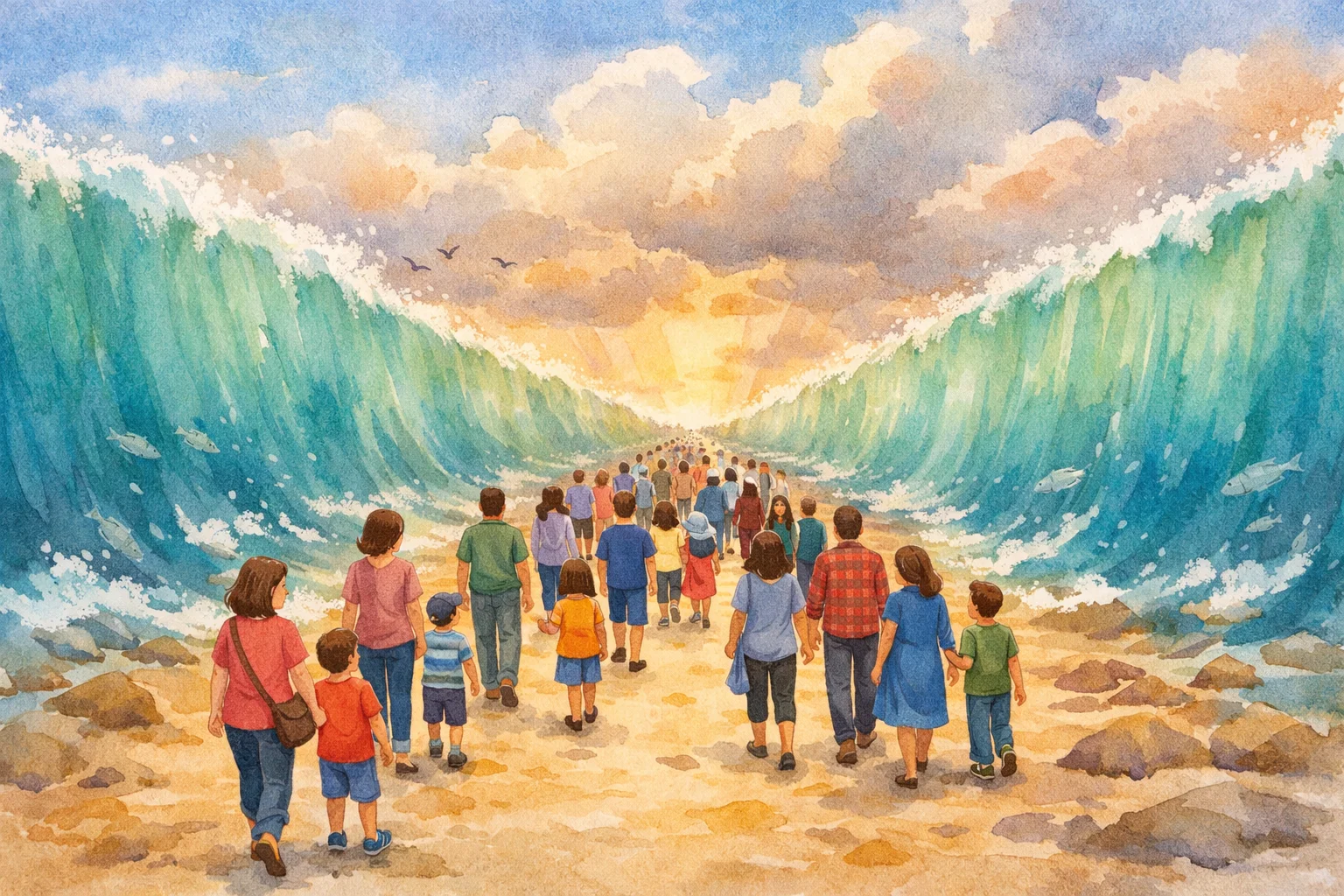
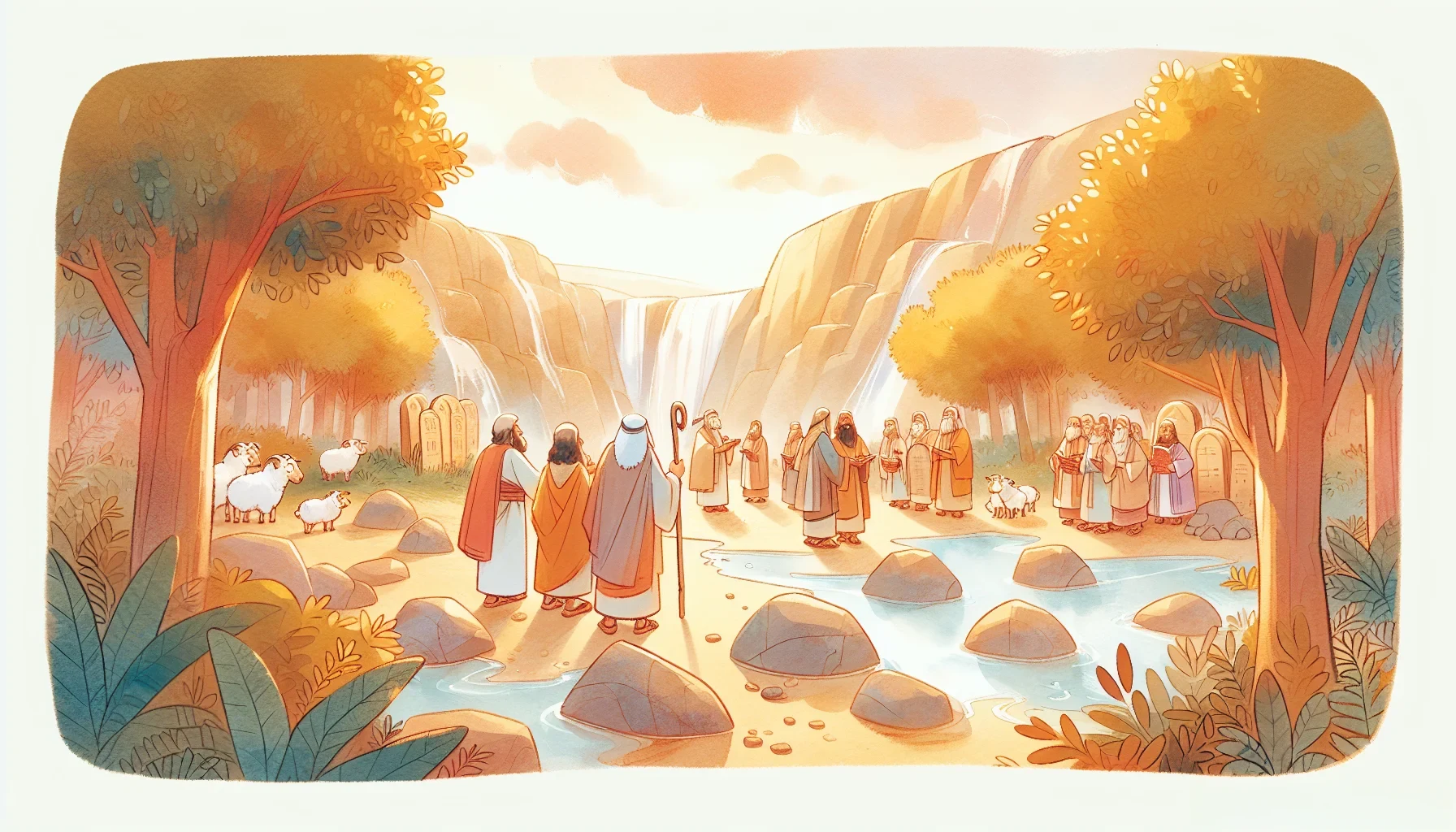
The sea opened. God told Moses to raise his staff and stretch out his hand (Exodus 14:16). Moses did, a strong east wind blew all night, and the Israelites crossed "on dry ground, with a wall of water on their right and on their left" (Exodus 14:22, NIV).
The water returned. At daybreak Moses stretched out his hand again, the sea went back to its place, and Pharaoh's army was lost (Exodus 14:27-28).
Israel sang. Moses and the people sang a song of praise to God (Exodus 15:1-21).
With little ones, you can talk about the Egyptian soldiers gently: they chose to chase God's people into the sea, and the water came back. The Bible doesn't celebrate death; it celebrates that God kept his people safe.
Why did Moses part the Red Sea?
Kids often ask "why" before they ask "how", and the Bible answers "why" very clearly:
To rescue his people. Israel was trapped between the sea and an army. Moses told them, "Do not be afraid. Stand firm and you will see the deliverance the Lord will bring you today" (Exodus 14:13, NIV), and "The Lord will fight for you; you need only to be still" (Exodus 14:14, NIV).
So everyone would know who God is. God said that through this "the Egyptians will know that I am the Lord" (Exodus 14:4, NIV).
So Israel would trust him. When the people saw what God had done, they "feared the Lord and put their trust in him and in Moses his servant" (Exodus 14:31, NIV).
That last verse is a great one for a family to remember. The whole point of the miracle was trust.
Where did Moses part the Red Sea?
This is the most searched question, and the honest answer is that no one knows the exact spot. No ancient inscription marks it, and some of the place names in Exodus 14:2 have never been located with certainty. Here is what scholars and Bible students do know.
"Red Sea" or "Sea of Reeds"?
The Hebrew name is Yam Suph. The word suph means reeds (it is the same word used for the reeds where baby Moses was hidden in Exodus 2:3). So a literal translation is "Sea of Reeds." The ancient Greek translation of the Old Testament, the Septuagint, rendered it "Red Sea," and that name came into English Bibles. Many Bibles include a footnote; the NIV, for example, notes "Or the Sea of Reeds" (Exodus 13:18).
That doesn't make the Bible wrong. The same name, Yam Suph, is also used for the Gulf of Aqaba, an arm of the Red Sea, where Solomon built ships (1 Kings 9:26). So the name could cover a reedy lake, the Red Sea's northern gulfs, or both. That is exactly why the location is debated.
The main proposed locations
Lakes near the eastern Nile Delta. Several scholars place the crossing at a shallower body of water near Egypt's border, such as the Ballah Lakes (proposed by Egyptologist James Hoffmeier and archaeologist Manfred Bietak), Lake Timsah, or the Bitter Lakes, which lie between the Gulf of Suez and the Mediterranean. Others have suggested lakes further north near the coast, such as Lake Manzala.
The Gulf of Suez. The western arm of the Red Sea, at its northern end. Kenneth Kitchen and James Hoffmeier support a crossing somewhere along the Suez isthmus, and some researchers argue a reef in the northern gulf could have made a crossing possible.
The Gulf of Aqaba, at Nuweiba Beach. Some writers, including Ron Wyatt, Bob Cornuke and Glen Fritz, propose a crossing much further east at Nuweiba, in the Gulf of Aqaba. Others in this camp, such as Colin Humphreys, suggest the gulf's northern tip near Eilat. This view is popular in some Christian videos, but critics point out that Nuweiba lies far from the starting point the Bible describes.
A fair way to put it to your child: "The Bible tells us what happened, and the people who study it are still working out exactly where."
How did Moses part the Red Sea?
The Bible gives us two details at once: Moses stretched out his hand, and God sent "a strong east wind" that blew "all that night" (Exodus 14:21, NIV). Christians read this in two main ways.
View 1: God used a natural force in a miraculous way
Some Christians believe God worked through the wind he created, with perfect timing, in exactly the right place, on exactly the right night, for exactly the right people. Scientists have even tested whether wind could do this.
In 2010, Carl Drews of the National Center for Atmospheric Research and Weiqing Han of the University of Colorado published a computer study in the journal PLoS ONE called "Dynamics of Wind Setdown at Suez and the Eastern Nile Delta." They modeled a site in the eastern Nile Delta, where an ancient branch of the Nile flowed into a coastal lagoon called the Lake of Tanis, about 75 miles north of the Suez reef. Their model found that a wind of about 63 miles an hour blowing for 12 hours could push back water about 6 feet deep, opening a dry passage roughly 2 to 2.5 miles long and 3 miles wide for about four hours, before the water rushed back once the wind dropped. Drews said, "The parting of the waters can be understood through fluid dynamics."
It's important to be clear about what this study does and doesn't show. It shows that a crossing like the one in Exodus is physically possible at one proposed location. It does not prove the crossing happened there, and the researchers' own university noted that experts remain uncertain about the events. It is one proposal among several.
View 2: God worked purely supernaturally
Other Christians believe the wind was part of the picture, but that the "wall of water on their right and on their left" (Exodus 14:22, NIV) describes something no ordinary wind could do. On this view, the sea was held back by God's direct power in a way science cannot explain, and the wind was a sign of his presence.
Both views are miracles
Here is the key point for kids: both views say God did it. Whether God used his wind or set aside the normal rules of water, an army was stopped, a sea opened at the moment Moses lifted his hand, and it closed again when Israel was safe. Christians who hold either view agree that this was God's rescue, not a lucky weather event.
See what they get
Watch a Real Lesson From the App
Press play on Walking on Water, a complete lesson exactly as your child sees it. 300+ episodes cover the whole Bible in order, each ending in a fun quiz to check what they learned.
A real lesson from the app, watch the whole thing free.
What about the "chariot wheels" in the Red Sea?
You may have seen photos online claiming to show Pharaoh's chariot wheels on the floor of the Gulf of Aqaba. These come mostly from Ron Wyatt (1933-1999), an amateur explorer who was a nurse-anesthetist with no training in archaeology.
These claims have not held up, and it is worth saying so plainly, kindly, and as Christians who care about truth:
According to two researchers from Wyatt's own church, Russell and Colin Standish, none of the wheels or bones he said he found were ever submitted to scientific authorities for examination and testing.
Joe Zias, a curator with the Israel Antiquities Authority, pointed out that Wyatt was not an archaeologist and had never carried out a licensed excavation, and he suggested the underwater videotape appeared to be a hoax.
Most of the photos show coral formations. Even the president of Wyatt's own research group admitted, "All kinds of people are finding coral and calling it chariot parts."
Conservative Christian scholars have rejected Wyatt's claims too. As one Bible-lands teacher put it, Wyatt "was never taken seriously by archaeologists (whether conservative or liberal)."
Our faith doesn't need shaky evidence. If your child finds these photos, use them to teach that Christians care about what is true.
🕯️ Free: 25 Days of Advent Bible Readings
December 1 to 25, one short reading a night, from the first promise to the manger. Printable for the fridge.
Free printable + a few helpful emails. Unsubscribe anytime.
How to answer your child, by age
Ages 5-7
"Yes! God's people were trapped by the sea, and Pharaoh's army was coming. Moses held out his hand, and God sent a big wind that pushed the water back so everyone could walk across on dry ground. God kept them safe."
Tip: Act it out with a blue blanket held by two people. Little ones remember stories they move through.
Ages 8-11
"The Bible says God parted the sea when Moses stretched out his hand, and it says God used a strong east wind all night. People still argue about exactly where it happened, because the Hebrew name means 'Sea of Reeds' and could mean a few different places. Some scientists have even shown with a computer model that a strong wind can push water back. But only God could make it happen at just the right moment, for just the right people."
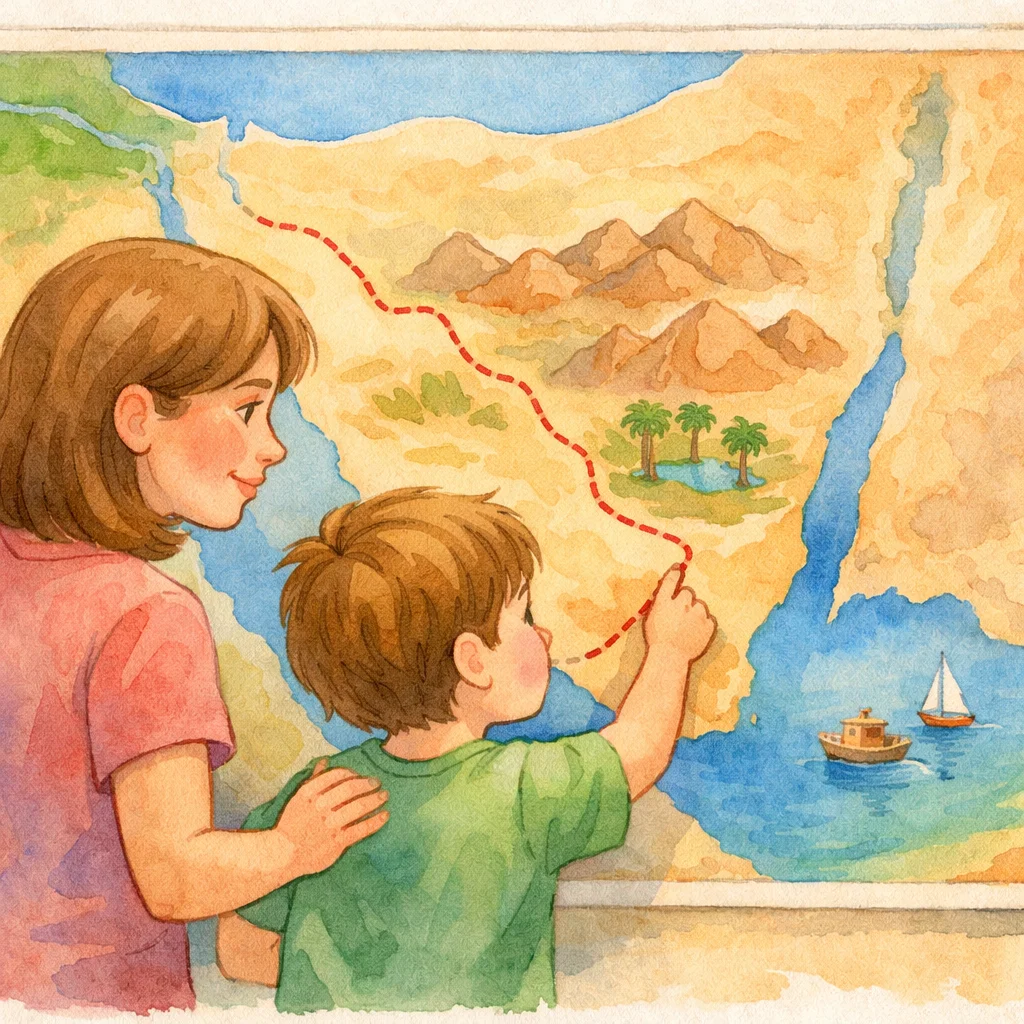
Tip: Look at a map of Egypt and the Sinai together and find the Gulf of Suez, the Gulf of Aqaba and the Nile Delta. Kids love being "detectives" over a real map.
Ages 12-15
"Christians believe the crossing really happened, because the Bible presents it as history and the rest of Scripture keeps pointing back to it. Where it happened is honestly unknown. The Hebrew is Yam Suph, 'Sea of Reeds,' and proposals range from lakes in the Nile Delta to the Gulf of Aqaba. On how, some Christians think God used the east wind, and a 2010 computer study showed wind can do that at one proposed site. Others think it was purely supernatural. Both are miracles. And be careful with those 'chariot wheel' photos online: they've been rejected by Christian and secular scholars alike."
Tip: Teens respect honesty. Showing them that you can separate solid evidence from internet myths makes your faith more believable to them, not less.
Questions kids ask next
"Where are the Egyptian chariots now?"
No confirmed remains have ever been found, and since we don't know the exact location, nobody knows where to look. The famous "chariot wheel" photos aren't reliable.
"How did they walk on the sea floor? Wasn't it muddy?"
The Bible says they crossed "on dry ground" (Exodus 14:22, NIV). The wind blew all night, which would have helped dry the path, but the Bible gives God the credit.
"Why did God let the soldiers drown?"
It's a sad part of the story. The soldiers were chasing God's people to hurt or recapture them, and God protected Israel. It's okay to feel sad about it. God cares about every person, and the Bible tells us this was about stopping a cruel army.
"Could God do something like that today?"
Yes. Christians believe God is the same today. He doesn't usually part seas, but he still rescues, protects and keeps his promises.
Watch the story together
Our Crossing the Red Sea lesson tells the story for kids, with a free two-minute video lesson and a quiz, and pairs well with The Passover and Who Was Moses?. Faithful Kids has 300+ short Bible video lessons for ages 5-15, Genesis to Revelation, each with a quiz.
Frequently Asked Questions
Did Moses part the Red Sea?
The Bible says God parted the sea when Moses stretched out his hand, using "a strong east wind" all night (Exodus 14:21, NIV). Christians believe it really happened and see it as God's power, not Moses' own.
Where did Moses part the Red Sea?
No one knows the exact spot. Proposals include lakes near the eastern Nile Delta (such as the Ballah Lakes, Lake Timsah or the Bitter Lakes), the northern Gulf of Suez, and Nuweiba Beach in the Gulf of Aqaba.
Was it the Red Sea or the Sea of Reeds?
The Hebrew is Yam Suph, which literally means "Sea of Reeds." The ancient Greek translation called it the Red Sea, and the same Hebrew name is used for the Gulf of Aqaba in 1 Kings 9:26, so both translations have support.
Is there scientific evidence the Red Sea parted?
There is no direct physical evidence of the crossing. A 2010 computer study by Carl Drews and Weiqing Han showed that a strong wind could push back shallow water at a site in the eastern Nile Delta, which shows such a crossing is physically possible there.
Were Pharaoh's chariot wheels found in the Red Sea?
No reliable chariot wheels have been found. The popular claims come from Ron Wyatt, who had no archaeological training, and his finds were never submitted for scientific testing.
Why did God part the Red Sea?
To rescue Israel from Pharaoh's army, to show that he is the Lord, and so his people would trust him (Exodus 14:13-14, 31).