The Easter Story in the Bible: A Simple Walkthrough
Ages 5+·15 min read··By Faithful Kids Team·Updated August 19, 2026
The Easter story in the Bible is told in all four Gospels, and it covers eight days: Jesus enters Jerusalem to cheering crowds on Sunday, shares a final meal with His friends on Thursday, is arrested that night, crucified on Friday, buried before sundown, and found alive on Sunday morning. You can read the whole thing in Matthew 21-28, Mark 11-16, Luke 19-24, or John 12-21.
Below is that story broken into ten scenes for reading aloud as a family. Each scene gives you the passage to look up, a short retelling in plain language, and one question to talk about. Read one scene a night for ten nights, or two a day through Holy Week, or the whole thing in one sitting on Easter Eve. The crucifixion is handled honestly but gently -- notes for younger children are included where the story gets heavy.
Scene 1: Palm Sunday -- The King on a Donkey
Read: Matthew 21:1-11
Jesus and His friends are walking up to Jerusalem for Passover, the biggest week of the year, when the city swells with visitors. Just outside town, Jesus sends two disciples to fetch a young donkey. He climbs on and rides in.
The crowds go wild. People pull off their cloaks and throw them on the road like a red carpet. Others cut palm branches and wave them. They shout "Hosanna!" which means "save us now," and "Blessed is he who comes in the name of the Lord!"
Here is the detail worth pausing on: a conquering king would have ridden a war horse. Jesus chose a donkey, the animal a king rode when he came in peace. The prophet Zechariah had described this exact scene about 500 years earlier (Zechariah 9:9). The crowd thought they were welcoming a general who would drive out the Romans. He had come to do something much bigger, and much harder.
Talk about it: The crowd wanted Jesus to fix one problem. What did He actually come to fix?
Scene 2: The Last Supper -- Bread, Cup, and a Towel
Read: Luke 22:7-20 and John 13:1-17
On Thursday evening Jesus gathers the twelve for the Passover meal. Before they eat, He does something nobody expects. He takes off His outer robe, wraps a towel around His waist, fills a basin, and washes their feet -- a job normally left to the lowest servant in the house. Peter objects. Jesus tells him that if he does not let Him do this, he has no part with Him.
Then, at the table, He takes bread, breaks it, and says, "This is my body given for you; do this in remembrance of me." He takes the cup and says it is the new covenant, poured out for them. He tells them plainly that one of them will betray Him, and that He will not eat this meal again until everything is fulfilled.
They sing a hymn together and walk out into the night.
Talk about it: Jesus was the most important person in that room. Why did He choose the dirtiest job in it?
They cross the valley to an olive grove called Gethsemane. Jesus asks most of the group to sit while He takes Peter, James, and John a little farther. Then He tells them something startling: "My soul is overwhelmed with sorrow to the point of death."
He goes off alone and falls to the ground praying. "Father, if you are willing, take this cup from me; yet not my will, but yours be done." Luke says His sweat was like drops of blood falling to the ground. An angel comes and strengthens Him.
Three times He comes back to His friends, and three times they have fallen asleep. He does not shame them. "The spirit is willing," He says, "but the flesh is weak."
This scene matters for kids because it shows Jesus was not sailing through the week untroubled. He knew what was coming, He did not want it, and He chose it anyway.
Talk about it: Jesus told God exactly how He felt and still said yes. Is there something hard you can be that honest with God about?
While Jesus is still speaking, torches appear on the path. Judas, one of the twelve, has led a crowd with swords and clubs to the garden. He has given them a signal: the one I kiss is the man. He walks up to Jesus and kisses Him on the cheek. Jesus answers him with one word: "Friend."
Peter draws a sword and cuts off a servant's ear. Jesus stops him, tells him to put the sword away, and heals the man on the spot -- the last miracle before the cross, done for someone who came to arrest Him. He reminds them He could call on twelve legions of angels if He wanted to.
Then the disciples run. Every one of them. The bravest men Jesus knew scattered into the dark, and He let them go.
Talk about it: Jesus healed someone who was there to hurt Him. When is that hardest to do?
Scene 5: The Trials -- Innocent, and Condemned Anyway
Read: Matthew 26:57-27:26 and Luke 22:54-62
Jesus is dragged through a string of hearings overnight: first to the high priest, then to the whole council at dawn, then to Pilate, the Roman governor. Witnesses contradict each other. Nothing sticks.
Outside in the courtyard, Peter is warming himself by a fire when a servant girl says she has seen him with Jesus. He denies it. Twice more, he denies it, the third time with cursing. Then a rooster crows, and across the courtyard Jesus turns and looks straight at him. Peter goes outside and weeps.
Pilate questions Jesus, finds no crime, and tries three separate times to release Him. But the crowd chants for crucifixion, and Pilate is more afraid of a riot than of doing wrong. He washes his hands in front of everyone and hands Jesus over.
Talk about it: Pilate knew Jesus was innocent and gave in anyway. What made that easier for him than doing the right thing?
This is the hardest scene in the Bible, and it should be told plainly rather than dramatically. Soldiers put a crown of thorns on Jesus and mock Him. He is made to carry His cross out of the city to a hill called the Place of the Skull, and a man named Simon of Cyrene is pulled from the crowd to carry it the rest of the way. There, at nine in the morning, they crucify Him between two criminals.
He spends six hours there. Almost everything He says is for someone else: "Father, forgive them, for they do not know what they are doing." To the criminal beside Him: "Today you will be with me in paradise." To His mother and to John: "Here is your son... here is your mother."
From noon to three, the whole land goes dark. He cries out, "My God, my God, why have you forsaken me?" Then, "It is finished." Then, "Father, into your hands I commit my spirit." And He dies. At that moment the temple curtain -- the heavy barrier separating people from the holiest place -- tears in two from top to bottom. A Roman officer standing there says, "Surely this man was the Son of God."
For younger children: "Jesus was hurt very badly by people who did not understand who He was, and He died. He could have stopped it -- He is God -- but He chose to stay, because He was taking the punishment for every wrong thing anyone has ever done. And Friday is not the end of the story."
Talk about it: Almost everything Jesus said from the cross was about someone else. What does that tell us about Him?
The Empty Tomb is one of 300+ short narrated video lessons your child will love. Watch the whole episode right here — in the app, every lesson ends with a fun quiz to check what they learned.
A real lesson from the app — watch the whole thing free.
Scene 7: The Burial -- The Quiet Saturday
Read: John 19:38-42 and Matthew 27:57-66
Two men who had followed Jesus quietly, afraid of what it would cost them, step forward in public exactly when it is most dangerous to do so. Joseph of Arimathea, a wealthy council member, asks Pilate for the body. Nicodemus brings about seventy-five pounds of spices. Together they wrap Jesus in linen cloths and lay Him in a brand-new tomb cut into rock, in a garden near the hill. A large stone is rolled across the entrance.
The next day, the religious leaders ask Pilate for a guard, because they remember Jesus saying He would rise after three days. Pilate agrees. They seal the stone and post soldiers.
Then comes Saturday: a whole day of nothing. The disciples are hiding. The women are preparing burial spices. Everyone believes it is over. That silent day is part of the story, and it is worth sitting in for a moment before turning the page.
Talk about it: Joseph and Nicodemus were secret followers who went public on the worst possible day. What made them brave right then?
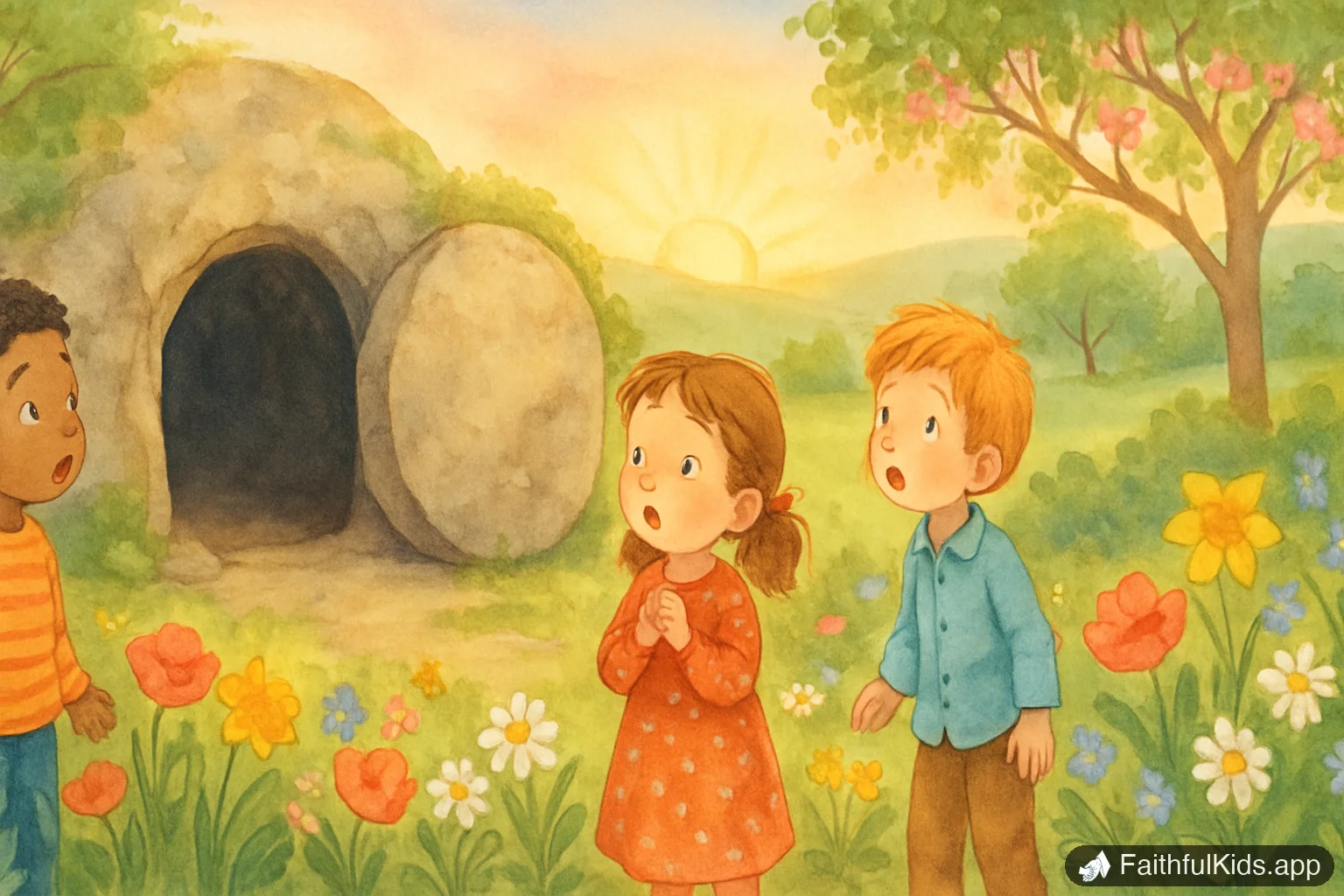
Very early Sunday, while it is still dark, several women walk to the tomb with spices, wondering aloud who will roll the stone away for them. They arrive to find it already moved. There has been an earthquake. The guards are lying on the ground like dead men. The tomb is open, and empty.
An angel says the sentence the whole Bible has been building toward: "Do not be afraid... He is not here; he has risen, just as he said. Come and see the place where he lay."
Mary Magdalene runs for Peter and John, who sprint to the tomb and find the linen wrappings lying there, the head cloth folded separately. John sees, and believes. Mary stays behind, crying, and mistakes Jesus for the gardener until He says one word: "Mary." She grabs hold of Him. Then she runs to the disciples with the first Easter sermon in history, four words long: "I have seen the Lord!"
Talk about it: The very first person to see Jesus alive had come to the grave to cry. What do you think that morning felt like for her?
Jesus does not appear once and vanish. Over the next forty days He shows up again and again. That same Sunday, two travelers on the road to Emmaus walk seven miles with Him without recognizing Him while He explains from the Scriptures why the Messiah had to suffer. They only realize who He is when He breaks the bread at dinner. "Were not our hearts burning within us?" they say.
He appears in a locked room and shows the disciples His hands and feet. He eats a piece of broiled fish so they will know He is not a ghost. Thomas, who missed it, says he will not believe until he touches the wounds himself -- and a week later Jesus walks in, holds out His hands, and invites him to. Thomas answers, "My Lord and my God!"
Paul later writes that more than 500 people saw Him alive at one time (1 Corinthians 15:6), many of them still living when he wrote it.
Talk about it: Jesus let Thomas ask for proof instead of scolding him. What does that mean for our questions?
Scene 10: The Ascension -- Go and Tell
Read: Matthew 28:16-20 and Acts 1:6-11
The last scene is on a hillside. Jesus gives His friends a job: go to every nation, teach people everything He taught, and baptize them. Then He adds the promise that holds the whole thing together -- "And surely I am with you always, to the very end of the age."
As they watch, He is lifted up and a cloud hides Him from their sight. They are still staring at the sky when two men in white ask them why they are standing there looking up. Jesus will come back the same way, they say.
So the Easter story does not end with a grave, or even with a reunion. It ends with ordinary, recently terrified people being sent out with news too good to keep -- which is how the story reached your kitchen table.
Talk about it: If you had been standing on that hill, who is the first person you would want to tell?
How to Read the Easter Story with Your Family
Ten scenes fit neatly into Holy Week: Palm Sunday and the Last Supper early in the week, Gethsemane and the arrest on Thursday, the trials and the cross on Friday, the burial on Saturday, and scenes 8-10 on Easter Sunday morning. Our Holy Week day-by-day guide for kids lays out that schedule with a reading and an activity for each day, and Lent for kids explained covers the longer run-up if your family observes it.
Two things make this land better with children. First, let the hard scenes stay hard for a moment -- kids can tell when we rush past something, and the resurrection means less if Friday costs nothing. Second, always finish a reading session on hope. If bedtime is running short, read Scene 6 and Scene 8 together rather than stopping at the cross.
If your kids do better watching than listening, the same ten scenes are animated one at a time at Faithful Kids, each with a quiz and a reflection question. Our roundup of Easter Bible stories for kids lists all of them in order.
For families who do most of their reading after lights-out, our free Bedtime Bible Kit gives you seven nights of short readings with a question and a goodnight prayer, printable in one click.
Older children who find coloring dull usually take to the Easter word search instead. It plays in the browser or prints on one sheet.
Frequently Asked Questions
Where is the Easter story in the Bible?
The Easter story is in all four Gospels: Matthew 21-28, Mark 11-16, Luke 19-24, and John 12-21. Matthew and Luke give the fullest accounts of the trials and the resurrection appearances, John gives the most detail on the Last Supper and Mary Magdalene at the tomb, and Mark moves fastest if you want the story in one sitting. 1 Corinthians 15 gives Paul's summary of what it all means.
What order do the Easter events happen in?
Palm Sunday (the triumphal entry), the cleansing of the temple, the Last Supper on Thursday evening, the prayer in Gethsemane, the arrest that night, the trials before the council and Pilate overnight and at dawn, the crucifixion on Friday, the burial before sundown Friday, the silence of Saturday, the empty tomb at dawn on Sunday, the appearances over forty days, and the ascension. The ten scenes above follow that order exactly.
How do I tell kids about the crucifixion without frightening them?
Tell it plainly rather than dramatically, keep the physical details minimal, and spend more words on why Jesus chose it than on what was done to Him. For ages 3-5, one or two sentences is enough: people hurt Jesus and He died, He chose it because He loves us, and God brought Him back to life. Never end a session on Friday -- always read to Sunday, or at least promise it before lights out.
Why is it called Good Friday if Jesus died?
Because of what that day accomplished. The word "good" here means holy or sacred, and Christians call it good because Jesus' death opened the way for anyone to be forgiven. A useful line for kids: it was the worst day that ever happened, and God turned it into the best news that ever happened.
How long was Jesus in the tomb?
By the Jewish reckoning of days, three days: buried Friday before sundown, in the tomb all of Saturday, and raised early Sunday. Any part of a day counted as a day, which is why the Gospels say "on the third day" even though it is closer to 40 hours. Jesus had predicted this timing in advance (Matthew 12:40).
What age is right for the full Easter story?
Most children can handle the whole narrative around age 7, and many are ready at 6 if they have heard it in pieces before. Under 5, focus on Palm Sunday, the empty tomb, and the simple fact that Jesus is alive. From 9 up, kids start asking the deeper questions -- why the cross was necessary, and how we know the resurrection really happened -- and those are good conversations to lean into rather than deflect.
🌙 Free: The Bedtime Bible Kit
Seven nights of five-minute stories — a story, a prayer, and one question to whisper about.
Free printable + a few helpful emails. Unsubscribe anytime.