Is the creation story true? Christians believe it is: God made everything that exists, he made it good, and he made people in his own image (Genesis 1-2). That is the heart of Genesis 1, and it is something every Christian tradition holds in common.
Where Christians differ is on how to read the days. Some believe God created the world in six ordinary 24-hour days only a few thousand years ago. Others believe the days stand for long ages, or that Genesis 1 is arranged as a carefully crafted literary picture of creation rather than a timeline. Sincere, Bible-believing Christians hold each of these views.
So if your child comes home asking "Is the creation story true?", you can say yes with confidence, and you can be honest that Christians discuss the details. This guide walks you through what the story says, how Christians read it, and what to say at each age.
What Is the Creation Story?
The creation story is the opening of the Bible, Genesis 1:1 to 2:3, followed by a closer look at the making of the first man and woman in Genesis 2:4-25. It begins with the famous line, "In the beginning God created the heavens and the earth" (Genesis 1:1, NIV).
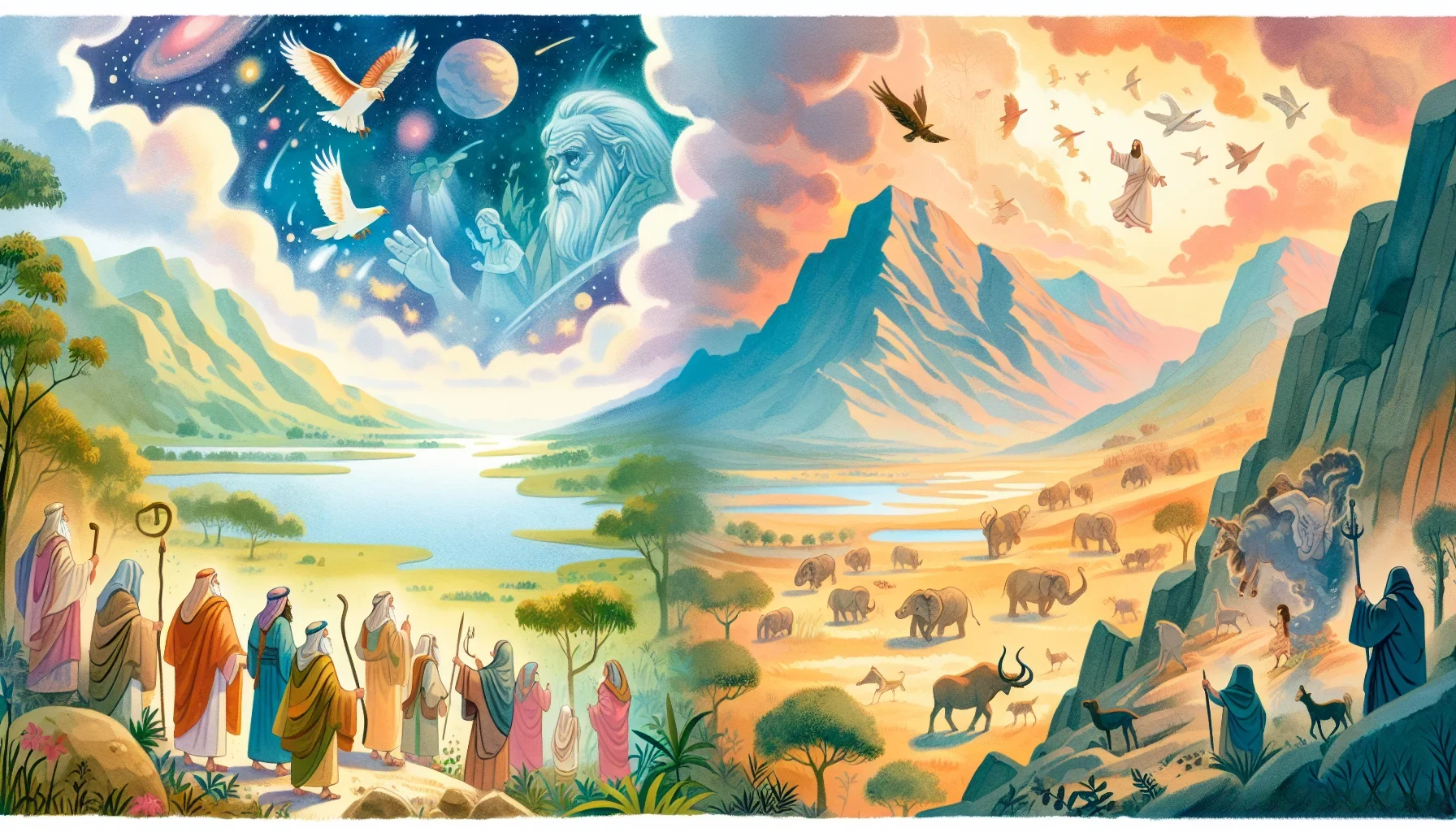
Here are the seven days in brief:
Day 1: God creates light and separates it from darkness (Genesis 1:3-5).
Day 2: God makes the sky, separating the waters above from the waters below (Genesis 1:6-8).
Day 3: God gathers the seas, lets dry land appear, and fills it with plants and trees (Genesis 1:9-13).
Day 4: God sets the sun, moon and stars in the sky (Genesis 1:14-19).
Day 5: God fills the seas with fish and the sky with birds (Genesis 1:20-23).
Day 6: God makes the land animals, and then people, male and female, in his image (Genesis 1:24-31).
Day 7: God rests and blesses the seventh day (Genesis 2:2-3).
Again and again the story says God "saw that it was good," and at the end he sees everything he made and calls it "very good" (Genesis 1:31, NIV).
What is the story about? Above all, it tells us who God is: one God, powerful and good, who speaks and things happen. It tells us the world is not an accident and not divine itself; it is God's handiwork. And it tells us people are special, made to know God and to care for his world (Genesis 1:26-28). Those truths do not depend on how long a "day" is, which is one reason Christians who disagree on the days can still read Genesis 1 side by side.
Is Genesis Literal? How Christians Read the Days
"Is Genesis literal?" is one of the most common questions parents ask. The honest answer is that faithful Christians read the days of Genesis 1 in several ways. Here are the main views, described as their own supporters would describe them.
Young-earth creation
Young-earth creationists read the days as six ordinary 24-hour days and believe the earth is roughly 6,000 to 10,000 years old, based on adding up the genealogies in Genesis. A popular date for creation, 4004 BC, comes from Archbishop James Ussher's chronology, which was printed in many Bibles from 1701 onward. Supporters point to Exodus 20:11, where the Sabbath command is tied to God making everything in six days. Well-known ministries holding this view include Answers in Genesis and the Institute for Creation Research.
Old-earth creation
Old-earth creationists believe God created directly, but over a very long time, in line with scientific estimates that the universe is about 13.8 billion years old. Two common versions:
Day-age view: each "day" is a long age of time. Astronomer Hugh Ross, founder of the ministry Reasons to Believe, is a well-known defender. Supporters often note that the Bible can use "day" for longer periods, and that "with the Lord a day is like a thousand years" (2 Peter 3:8, NIV).
Gap view: there is a long, unspecified gap between Genesis 1:1 and 1:2, followed by the six days. The Scottish minister Thomas Chalmers popularized this from 1814, and the 1917 Scofield Reference Bible spread it widely.
The framework (literary) view
The framework view sees Genesis 1 as arranged in two matching sets of three days. Days 1-3 set up realms (light, sky and sea, land), and days 4-6 fill those same realms (lights in the sky, birds and fish, animals and people). Day 7, God's rest, is the high point. On this reading the days are a God-inspired literary framework teaching that God made all things, not a stopwatch of how long it took. It was popularized in the 1950s by Dutch scholar Nicolaas Ridderbos and later defended by theologians such as Meredith Kline and Bruce Waltke.
Evolutionary creation
Evolutionary creationists (sometimes called theistic evolutionists) believe God created life through the long process science describes as evolution, and that God is the Creator just as Genesis says. The best-known organization holding this view is BioLogos, founded in 2007 by Francis Collins, the scientist who led the Human Genome Project.
The Catholic Church
The Catholic Church does not require Catholics to read the six days as 24-hour days. The Catechism of the Catholic Church says Scripture presents God's work "symbolically as a succession of six days" (CCC 337), and it welcomes scientific study of the age of the cosmos and the development of life, saying "these discoveries invite us to even greater admiration for the greatness of the Creator" (CCC 283). It also teaches that real science and faith can never truly conflict, because the same God gave both (CCC 159). In 1950 Pope Pius XII allowed Catholic research into the origin of the human body from earlier living matter, while holding that every human soul is created directly by God (Humani Generis 36). In 2014 Pope Francis told the Pontifical Academy of Sciences that evolution "does not conflict with the notion of Creation." A fun fact for older kids: the scientist who first proposed what we now call the Big Bang, Georges Lemaître, was a Belgian Catholic priest.
This is not a new conversation
Christians were discussing the days long before modern science. Around AD 415, Augustine of Hippo completed a book usually called The Literal Meaning of Genesis. He argued that God created all things at once, and that the six days describe that creation in an ordered way we can understand. He also warned Christians not to speak carelessly about the natural world, because it would make outsiders take Scripture less seriously.
Faith and humility go together here. At Faithful Kids our statement of faith affirms that the Bible is the inspired, true Word of God, and deliberately takes no side on the timeline of creation. Families from all of these traditions use our lessons.
Is the Creation Story True? What Science Can (and Cannot) Tell Us
Science studies the physical world: how old rocks and stars are, how living things change over time. Today's scientific estimates put the universe at about 13.8 billion years old, and say the non-bird dinosaurs died out about 66 million years ago. Christians respond to those findings in different ways, as you have seen above.
What science cannot answer is why there is something rather than nothing, or whether the universe has a purpose. The Catechism makes this point too: it is not only a question of knowing when and how the universe began, but what it means (CCC 284). Genesis answers those deeper questions: God made it, God loves it, and you were made on purpose.
See what they get
Watch a Real Lesson From the App
Press play on Noah and the Great Flood, a complete lesson exactly as your child sees it. 300+ episodes cover the whole Bible in order, each ending in a fun quiz to check what they learned.
A real lesson from the app, watch the whole thing free.
How to Answer Your Child, by Age
Ages 5-7
"Yes! The Bible tells us that God made everything: the sky, the oceans, the animals, and you. He looked at it all and said it was very good. And he made people extra special, so we could know him and love him."
Tip: Keep it about God and his goodness. Young children don't need a debate about days; they need to know the world was made by someone who loves them. Go outside and name things God made together.
Ages 8-11
"Christians believe the creation story is true, because it's part of God's Word. Christians agree on the big things: God made everything, it was good, and people are made in God's image. Some Christians think the days were regular days, and some think they stand for longer times. Good Christians who love the Bible think about it differently."
Tip: If they mention the Big Bang or dinosaurs from school, don't panic. Say, "That's a great question. Scientists study how things happened. The Bible tells us who made it and why." Then share what your family believes and why.
Ages 12-15
"Genesis tells us something true about God, the world and us. Christians read the days in different ways: young-earth, old-earth, a literary framework, or God working through evolution. Even Augustine, 1,600 years ago, wrote a whole book wrestling with how to read these days. What matters most is what every view agrees on: God is the Creator, and you are made in his image."
Tip: Teens can smell a dodge. Show them the views fairly, tell them which one you lean toward and why, and invite them to read Genesis 1 themselves. A teen who learns that faith can handle hard questions is far less likely to walk away when a teacher challenges them.
🕯️ Free: 25 Days of Advent Bible Readings
December 1 to 25, one short reading a night, from the first promise to the manger. Printable for the fridge.
Free printable + a few helpful emails. Unsubscribe anytime.
Questions Kids Ask Next
"Where did God come from?" Nobody made God. The Bible says God has always been, before anything else existed (Psalm 90:2). Everything else had a beginning; God did not.
"Were dinosaurs in the Bible?" The Bible doesn't name dinosaurs. Young-earth Christians believe God made them on day six and that they lived alongside people. Old-earth and evolutionary-creation Christians believe they lived and died out millions of years before humans. Either way, Christians agree God made them.
"What about the Big Bang?" Old-earth and evolutionary-creation Christians accept the Big Bang as how God began the universe, and Pope Francis said it "does not contradict the intervention of a divine creator." Young-earth Christians see it differently. All agree that "In the beginning God created" (Genesis 1:1, NIV).
"Why did God rest? Was he tired?" No. God doesn't get tired (Isaiah 40:28). Resting showed his work was complete, and it gave us a pattern of rest and worship each week (Exodus 20:8-11).
"Why are there two creation stories?" Genesis 1 gives the big picture of all creation; Genesis 2 zooms in on the garden and the first man and woman. Think of a map of the whole country and then a close-up of one town.
Watch the Story Together
The best way to start is to enjoy the story together. Our lesson In the Beginning: Creation for Kids has a free two-minute video lesson with a quiz, perfect to watch with your child and then talk about. Then carry on with The Garden and the Fall. Faithful Kids has 300+ short Bible video lessons for ages 5-15, Genesis to Revelation, each with a quiz.
Frequently Asked Questions
Is the creation story true?
Christians believe the creation story is true because it is part of God's Word: God made everything, made it good, and made people in his image. Christians differ on whether the six days are literal 24-hour days or describe creation in another way.
Is Genesis literal?
Some Christians read Genesis 1 as six literal 24-hour days a few thousand years ago; others read the days as long ages, as a literary framework, or as compatible with evolution. All of these views are held by Christians who believe the Bible is true.
What is the creation story in the Bible?
It is the account in Genesis 1-2 of God creating the world in six days and resting on the seventh: light, sky, land and plants, sun, moon and stars, fish and birds, then animals and people. God calls everything he made "very good" (Genesis 1:31).
What does the Catholic Church teach about creation?
The Catechism says Scripture presents creation "symbolically as a succession of six days" and teaches that true science and faith cannot conflict (CCC 337, 159). Catholics are free to accept scientific findings about the age of the universe, while believing God created everything and creates each human soul directly.
How do I explain creation to a child who learns about the Big Bang at school?
Explain that science studies how the world works, while the Bible tells us who made it and why. Many Christians see no conflict between the two, and others read Genesis more literally; share your family's view kindly and honestly.
Did Christians always read Genesis as six 24-hour days?
No single view has ever been universal. Augustine, writing around AD 415, argued that God created all things at once and that the days describe creation in an ordered way, while others, such as Archbishop James Ussher in the 1600s, read them as ordinary days and dated creation to 4004 BC.