The best kids Christmas program is the one your actual kids can pull off with the rehearsal time you actually have. Below are 8 proven program formats -- from the classic pageant to low-prep options like readers theater and shadow plays -- plus casting tips for shy kids, simple staging tricks, and a complete outline for a 15-minute pageant you can run with two rehearsals.
Whether you're a children's ministry director with 40 kids or a Sunday school teacher with 6, one of these formats will fit. Pick based on three things: how many kids you have, how many rehearsals you can realistically hold, and how comfortable your group is speaking in front of people.
What Are the Best Christmas Program Formats for Kids?
The eight formats below range from full-production pageants to programs that need almost no rehearsal at all. Here they are, ordered roughly from most to least preparation required.
1. The Classic Nativity Pageant
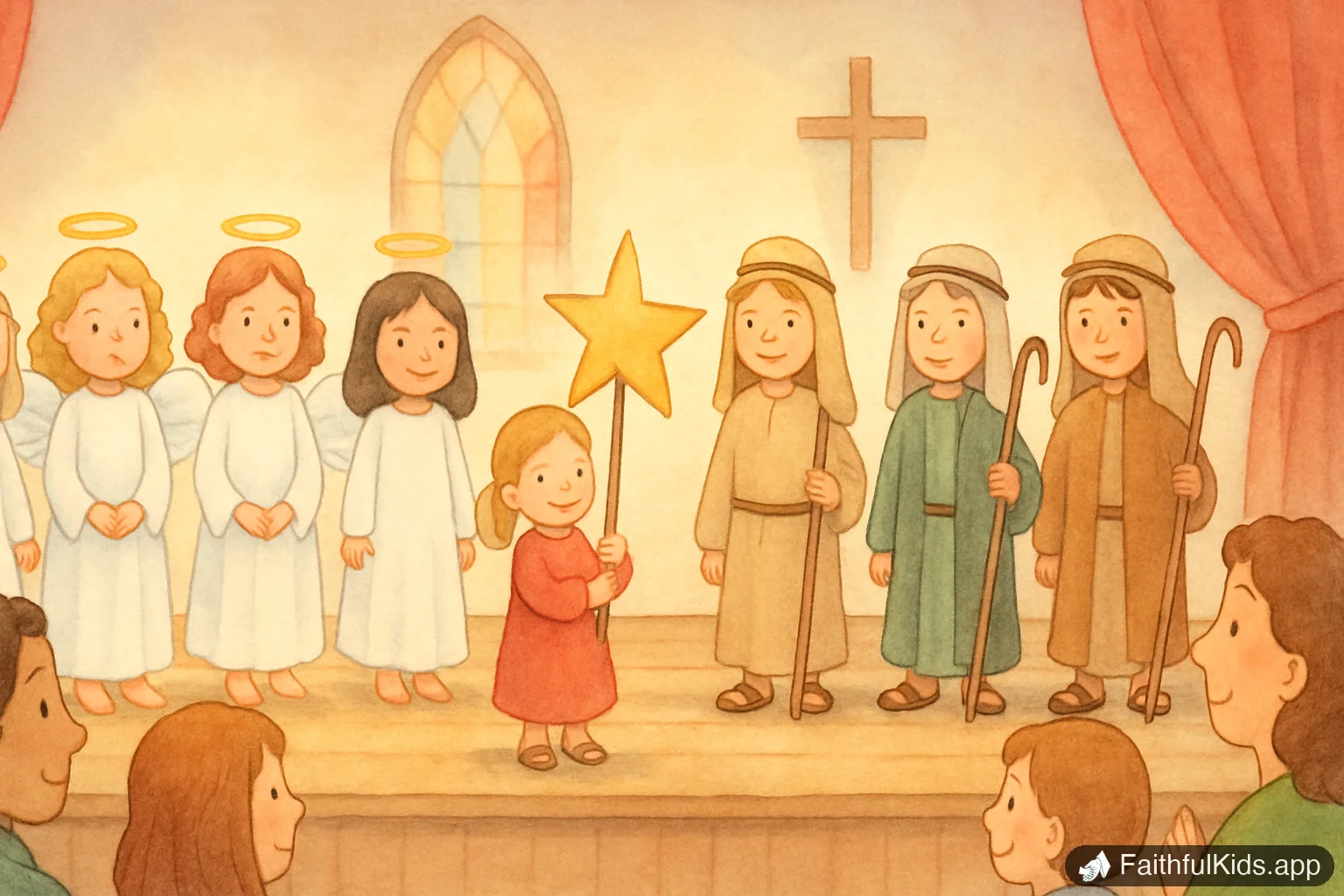
The full production: costumes, speaking parts, a manger scene, and carols. Kids play Mary, Joseph, shepherds, angels, wise men, and (always the crowd favorite) assorted animals.
Best for: 15-40 kids, 4-6 rehearsals, a church that loves tradition.
Why it works: Nothing beats it for memory-making, and every child gets a visible role. The animal and angel-choir parts absorb unlimited toddlers.
Watch out for: Line memorization stress. Keep speaking parts to 8-10 kids and give everyone else costumed non-speaking roles.
2. Readers Theater
Kids stand in a line or arc with scripts on music stands and read the Christmas story dramatically -- no memorization, no blocking, minimal costumes (a simple sash or headpiece per reader works).
Best for: 5-15 kids, 1-2 rehearsals, older elementary and middle schoolers.
Why it works: Removing memorization removes 90% of the fear. Kids who would never audition for a pageant will read a part confidently. It also puts the actual Scripture text front and center.
Watch out for: Mumbling. Spend your one rehearsal entirely on loud, slow, expressive reading.
3. Carols with Narration
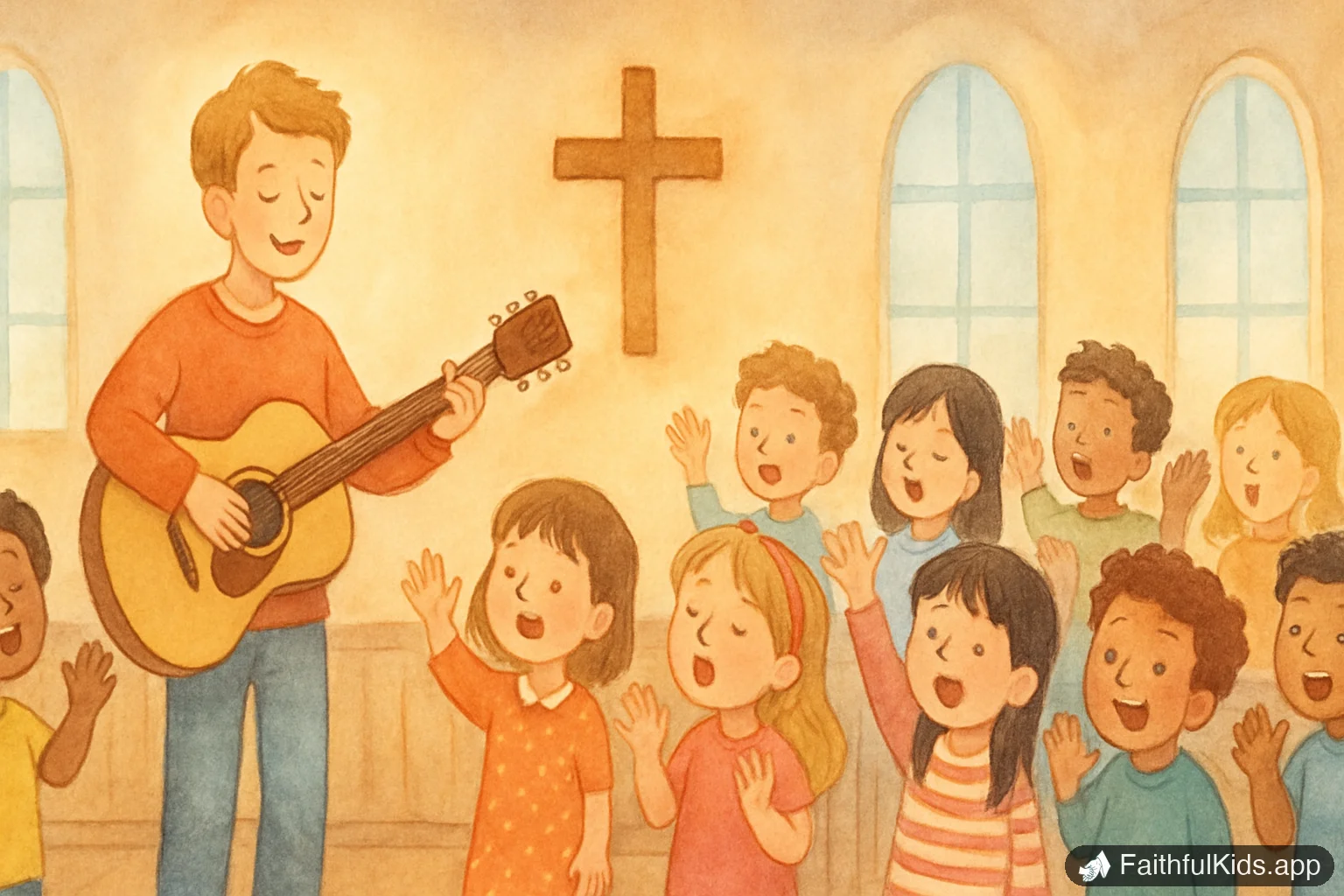
The children's choir sings 5-6 carols, and between each song, one or two kids read a short narration that advances the story: announcement, journey, birth, shepherds, wise men. The carols do the heavy lifting.
Best for: Any group size, 2-3 rehearsals (mostly music), churches with a strong music leader.
Why it works: Kids already know most carols, so rehearsal is polish rather than teaching. Only a handful of kids need to speak.
Sample sequence: "O Come, O Come, Emmanuel" (waiting) → "O Little Town of Bethlehem" (journey) → "Away in a Manger" (birth) → "Hark! The Herald Angels Sing" (shepherds) → "We Three Kings" (Magi) → "Joy to the World" (finale, congregation joins).
4. Shadow Play
Kids act out the nativity in silhouette behind a backlit white sheet while a narrator (adult or confident older kid) reads the story. Simple cardboard props -- a star, a manger, shepherd staffs -- read beautifully in silhouette.
Best for: 6-15 kids, 2-3 rehearsals, groups with very shy kids.
Why it works: Nobody's face is visible, which dissolves stage fright completely. It's also strikingly beautiful with almost zero costume budget: a bedsheet, a work light or projector, and cardboard.
Watch out for: Kids standing too far from the sheet (blurry shadows). Mark the floor with tape.
5. The Living Nativity Walk-Through
Instead of an audience watching a stage, families walk through stations -- Gabriel's announcement, the innkeeper's door, the stable, the shepherds' field -- with kids posed and delivering one or two lines at each stop.
Best for: 10-30 kids, 2 rehearsals, churches with hallways or outdoor space.
Why it works: Each child only needs one line, delivered to a small passing group rather than a big audience. Great for outreach nights -- neighbors will come walk through who wouldn't attend a service.
6. The "Interrupted" Pageant (Comedy Format)
A narrator tries to tell the Christmas story "properly" while kids keep interrupting with questions and mix-ups ("Wait, the wise men weren't at the stable?"). The comedy carries the teaching -- by correcting the mix-ups, the program teaches what the Bible actually says.
Best for: 8-20 kids with a few natural hams, 3-4 rehearsals.
Why it works: Funny programs relax everyone, and the question-and-correction structure is genuinely educational. Parents learn things too.
Tip: Build interruptions around real misconceptions -- the number of wise men isn't given, the innkeeper isn't in the Bible, the angels' song was for shepherds.
7. Christmas Around the World
Each class or small group presents how Christians in a different country celebrate Jesus' birth -- a carol from Mexico, a tradition from Ethiopia, a greeting from the Philippines -- framed by the shared nativity story.
Best for: Multi-class programs, schools, 2-3 rehearsals per group.
Why it works: It divides the program into independent 3-minute segments, so no single rehearsal needs everyone. It also makes the point that Christmas belongs to the whole church worldwide.
8. The Video-Hybrid Program
Pre-record the hardest parts -- narration by kids who freeze on stage, a class of preschoolers "interviewed" about the Christmas story (always a hit), or scenes filmed in advance -- and play them between live songs.
Best for: Small or rehearsal-starved groups, tech-comfortable churches.
Why it works: You can re-shoot until it's right, and kids who melt down live are often wonderful on camera. The live portions shrink to just songs and a finale, which need the least rehearsal.
How Do You Cast Shy Kids in a Christmas Program?
Give shy kids a role with clear physical business and no solo lines -- being on stage with a job is very different from being on stage alone with words. A few casting rules that work:
- Never assign solo lines by surprise. Ask privately: "Would you rather have a speaking part or a costume part?" Both options should sound equally honored.
- Pair every nervous speaker with a buddy. Two kids delivering a line together almost never freeze; one kid alone often does.
- Give shy kids "important quiet" roles. Mary has almost no lines in most pageants and is the most prestigious part in the show. Star-carrier, candle-lighter, and curtain-puller are jobs, not consolation prizes -- frame them that way.
- Let a shy kid narrate from offstage with a microphone, or record their part in advance (format #8).
- Cast animals generously. A sheep costume has never once caused stage fright.
The goal isn't to push every kid past their fear by Christmas Eve. It's for every kid to go home saying "I was in it."
What's the Simplest Way to Stage a Kids Christmas Program?
Use three fixed zones and never move set pieces mid-show: manger scene at center stage, "the field" on one side, "the East" on the other. Kids travel between zones; the set never changes.
- Lighting is your set. Light only the active zone if you can -- even three clamp lights switched by a volunteer beat a full set change.
- Costume formula: bathrobe + rope belt = shepherd; white shirt + tinsel halo = angel; solid-color tunic + fancy scarf = wise man. Mary wears blue, Joseph brown. Done.
- The star on a pole. One kid carrying a foil star on a broomstick, walking ahead of the wise men, solves your entire special-effects budget.
- Tape the floor. An X of tape for every child's spot eliminates half of all rehearsal chaos.
- Seat the youngest last. Preschool angels enter for the finale only, wave at their parents, and sing one song. Everyone wins.
If small hands need something to do while you read, the free baby Jesus in the manger coloring page is made for exactly that.
More for December: the Christmas Bible activities hub gathers the whole season's stories, trivia, and printables.
A Complete 15-Minute Pageant Outline (Two-Rehearsal Version)
Here is a full script outline you can adapt freely. It needs 4 narrators (reading, not memorizing), 6-10 costumed actors, and any number of angels and sheep. Total run time: about 15 minutes.
| Scene | Time | Who | What Happens |
|---|
| Opening carol | 2 min | Everyone | "O Come, All Ye Faithful," kids process in |
| 1. The Promise | 1 min | Narrator 1 | Reads Isaiah 9:6; star-carrier crosses the stage |
| 2. Gabriel & Mary | 2 min | Narrator 1, Gabriel, Mary | Gabriel: "Do not be afraid, Mary!" Mary: "I am the Lord's servant." (Luke 1:30, 38) |
| 3. Journey & no room | 2 min | Narrator 2, Mary, Joseph, Innkeeper | They cross the stage slowly; Innkeeper shakes head, points to stable |
| Carol | 1.5 min | Everyone | "O Little Town of Bethlehem," verse 1 |
| 4. The Birth | 1 min | Narrator 2 | Reads Luke 2:6-7; Mary places baby in manger; lights on center |
| 5. Shepherds & angels | 3 min | Narrator 3, angel(s), shepherds | Angel: "I bring you good news of great joy!" (Luke 2:10); angel choir enters, all sing "Hark! the Herald Angels Sing" verse 1; shepherds hurry to the manger |
| 6. The Wise Men | 1.5 min | Narrator 4, 3 wise men | Follow the star-carrier from "the East," present gifts, bow |
| 7. The Meaning | 1 min | Narrator 4 | "The shepherds returned, glorifying and praising God" (Luke 2:20). One sentence: "And that is why we celebrate -- God kept His promise." |
| Finale carol | 2 min | Everyone + congregation | "Joy to the World," house lights up |
Walk every scene in order twice, no costumes, narrators reading from scripts. Tape the floor spots.
Rehearsal 2 (dress): Full run with costumes and music, then run scenes 5 and 6 once more (they're always the messiest).
Narrators keep their scripts on Christmas Eve -- printed on card stock, it looks intentional. For narration language, pull from a kid-friendly telling of the story; our post on Christmas Bible stories for kids breaks the narrative into exactly these scenes, and An Angel Visits Mary gives you Scene 2 almost word for word.
How Do You Prepare Kids Beyond Rehearsal?
Kids perform the story better when they know the story -- not just their line. Spend five minutes of each rehearsal on the actual narrative: what happened, in order, and why it matters. A simple retelling like the Christmas story for kids works well read aloud at the start of rehearsal. Families can reinforce it at home during December with short readings -- our Christmas family devotions follow the same scenes as the pageant, and many families use video lessons like the nativity series at Faithful Kids so kids see the story before they act it. A kid who understands why the shepherds ran to Bethlehem delivers "Let's go and see!" like they mean it. After the program, keep the momentum going at home with simple Advent activities through Christmas Day.
Frequently Asked Questions
How long should a kids Christmas program be?
Fifteen to twenty minutes is the sweet spot for elementary-age performers, and thirty minutes is the absolute ceiling. Attention -- both on stage and in the pews -- drops sharply after that. If you have more content, cut scenes before you cut carols; the congregation singing along hides a multitude of pacing problems.
How many rehearsals does a children's Christmas program need?
A readers theater or carols-with-narration format needs one or two rehearsals; a full pageant needs four to six. The 15-minute outline above is specifically built for two. Whatever the format, make the final rehearsal a full dress run in the actual space with the actual sound system.
What is the easiest Christmas program for a small group of kids?
Readers theater is the easiest for a small group -- five or six kids with scripts on music stands can present the whole nativity story with one rehearsal. Add two carols for the congregation to sing and you have a complete program with zero memorization and almost no budget.
What roles work best for preschoolers in a pageant?
Preschoolers do best as angels, sheep, or stars who enter once, stay briefly, and sing one song with hand motions. Keep them offstage (with helpers) until their moment, place them in the finale rather than mid-show, and never give a child under five a solo line. Their job is to be adorable, and they will nail it.
How do you handle a child who freezes on stage?
Have an adult "prompter" in the front row who can feed any line warmly, and instruct kids in advance: if you forget, look at Miss Amy. Never let a silence stretch -- the prompter says the line, the child repeats it or just nods, and the show moves on. Afterward, praise the child for staying on stage, because that was the brave part.
Should the program use the exact Bible text or a paraphrase?
Use the exact text for the famous lines -- "Do not be afraid," "Glory to God in the highest" -- and a simple paraphrase for narration between them. Kids handle short direct quotes well, and hearing Luke's actual words gives the program its weight. Always cite what you quote so families can find it later.