Children's Church Lesson Ideas: 10 Themes + a 45-Min Plan
Ages 5+·11 min read··By Faithful Kids Team·Updated August 20, 2026
A great children's church hour has five parts -- welcome game, worship, Bible story, response activity, and closing review -- and below you'll find that 45-minute structure spelled out, plus 10 lesson themes with ready outlines you can teach this month. This is a planning guide for the volunteer who just got handed the kids' room and a Bible, not a curriculum you have to buy.
Children's church is different from Sunday school in one important way: you usually get everyone. Ages 4 through 11 in one room, energy levels from comatose to caffeinated, and a service-length block of time to fill. The structure below is built for exactly that reality -- every segment works at multiple levels at once.
How Do You Structure a 45-Minute Children's Church Service?
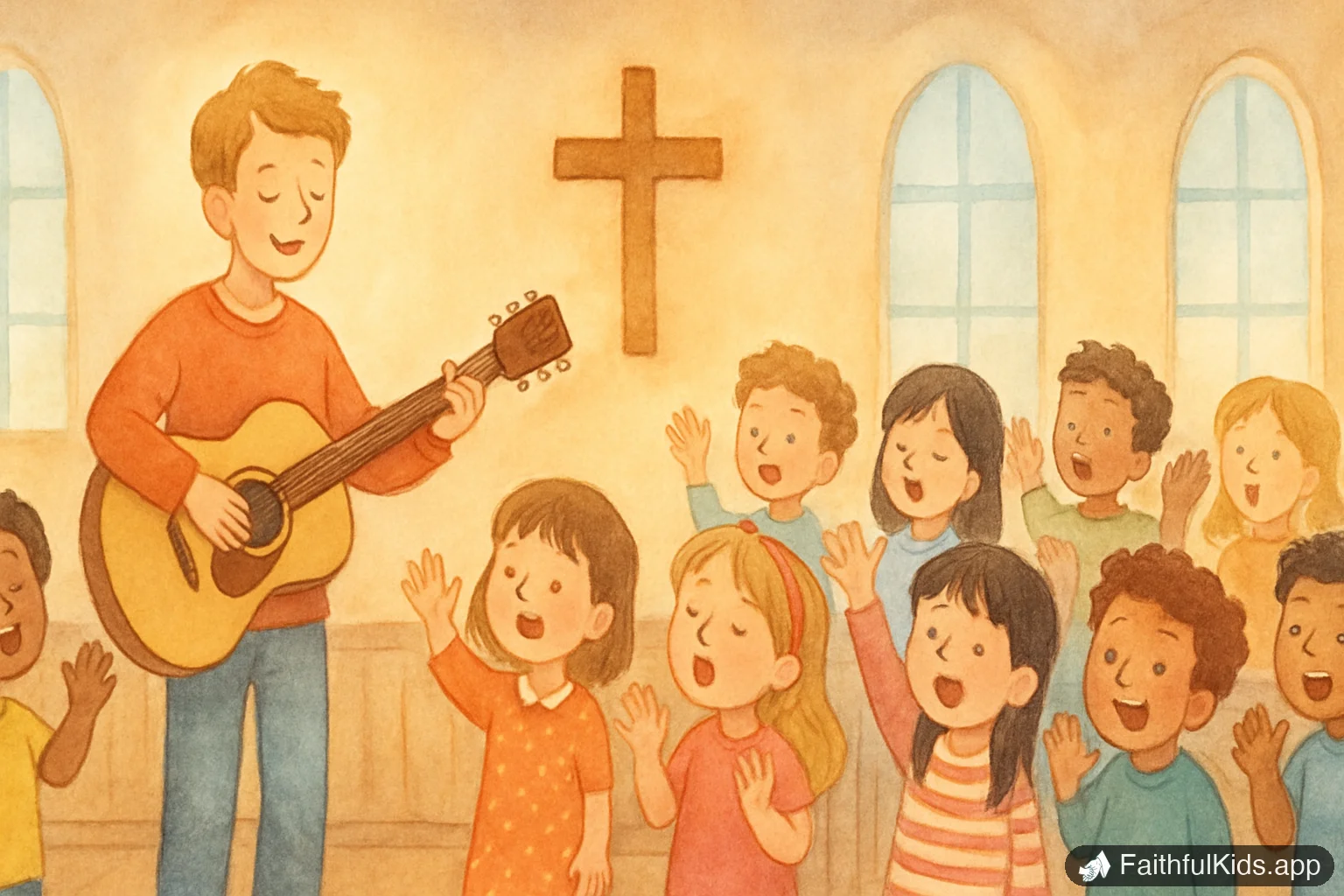
Structure it in five segments that alternate between high-energy and focused: game (8 min), worship (7 min), story (12 min), response (12 min), review and prayer (6 min). The alternation is the secret -- kids can focus deeply for about 12 minutes if you let them move before and after.
Segment
Time
What happens
Energy
1. Welcome game
8 min
A no-loser group game, loosely themed to today's lesson
High
2. Worship
7 min
2 songs with motions (one fast, one slow)
Medium-high
3. Bible story
12 min
The teaching block -- told, acted, or watched, plus the big idea
Focused
4. Response activity
12 min
Craft, skit, discussion, or stations that respond to the story
Medium
5. Review + prayer
6 min
Quick review game, takeaway line, kids pray
Calm
Three structural rules that save first-year leaders a lot of pain:
Never start with sitting. Kids arrive wound up from big church or the hallway. The opening game spends that energy on your terms.
The story block is 12 minutes, not 25. If your story needs more time, you're including too much. One passage, one big idea, one takeaway sentence.
End calm, every week. The review-and-prayer segment hands parents back a settled child, and a settled child is your best advertisement to the congregation.
Each theme below is a 4-6 week series. Multi-week themes beat one-off lessons because kids arrive already oriented ("We're still in the armor series!") and because repetition across weeks is what makes truth stick. For each theme: the big idea, the weekly breakdown, and a hook to open with. Most of these hooks are object lessons in disguise, so if the format is new to you, start with what an object lesson is and how to build one from things already in your kitchen.
1. God Made Everything (Creation series, 4 weeks)
Big idea: The world is not an accident -- God made it, and He made you on purpose.
Weeks: (1) Light, sky, and sea -- Genesis 1:1-10. (2) Plants, sun, moon, stars -- Genesis 1:11-19. (3) Animals -- Genesis 1:20-25. (4) People, made in God's image -- Genesis 1:26-31.
Hook: Bring one created thing each week in a mystery box (a plant, a shell, a photo of a child). "Guess what God made."
2. Heroes Who Trusted God (Old Testament series, 6 weeks)
Big idea: Ordinary people become heroes when they trust God.
Weeks: Noah, Abraham, Joseph, Moses, David, Daniel -- one hero per week, each with the question "What did trusting God cost them, and what did God do?"
Hook: A weekly "hero file" folder you open dramatically, with one clue about the mystery hero inside.
3. The Parables of Jesus (5 weeks)
Big idea: Jesus told stories that flip the world upside down.
Weeks: The Sower (Matthew 13), the Good Samaritan (Luke 10), the Lost Sheep (Luke 15), the Prodigal Son (Luke 15), the Wise and Foolish Builders (Matthew 7).
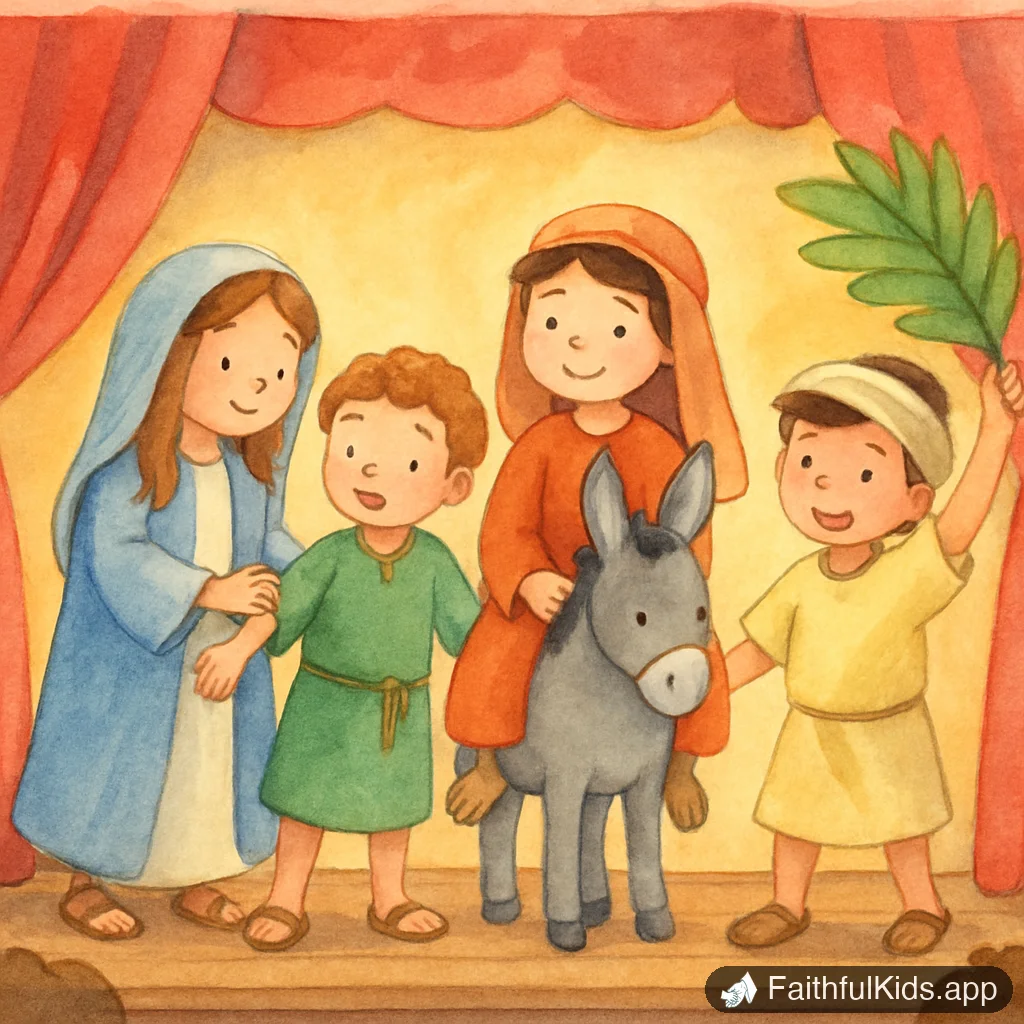
Hook: Parables beg to be acted out -- make the response segment a skit every week and rotate the casts. The Prodigal Son week lands harder with a demonstration first; a couple of our object lessons on forgiveness work in a mixed-age room without any setup.
4. Miracles of Jesus (5 weeks)
Big idea: Jesus has power over everything -- and He uses it out of love.
Weeks: Water into wine (John 2), calming the storm (Mark 4), feeding the 5,000 (John 6), walking on water (Matthew 14), healing blind Bartimaeus (Mark 10:46-52).
Hook: A "could YOU do this?" challenge each week (calm a fizzing storm-in-a-jar, split one cracker among the whole room) -- no, you can't; Jesus could.
5. The Life of Jesus (Christmas to Easter, 6 weeks)
Big idea: The whole Bible points to Jesus -- born, baptized, teaching, dying, risen.
Weeks: Birth (Luke 2), baptism (Matthew 3), calling disciples (Mark 1), teaching and healing (Matthew 5-9 highlights), the cross (Luke 23), the empty tomb (Luke 24).
Hook: Build a timeline across your wall, adding one picture per week -- by Easter the whole story is up there and the kids assembled it.
6. The Armor of God (Ephesians 6, 6 weeks)
Big idea: God equips us for hard things.
Weeks: One piece per week -- belt of truth, breastplate of righteousness, shoes of peace, shield of faith, helmet of salvation, sword of the Spirit.
Hook: Build a cardboard armor set on a mannequin (or a willing volunteer) one piece per week. Kids will drag their parents in to see it.
7. Fruit of the Spirit (Galatians 5:22-23, 5 weeks)
Big idea: When God's Spirit lives in you, good things grow.
Weeks: Love and joy; peace and patience; kindness and goodness; faithfulness and gentleness; self-control -- each paired with a Bible person who showed it.
Hook: Real fruit snack each week. Taste, then teach. (Attendance will not be a problem during this series.)
8. Prayer: Talking With God (4 weeks)
Big idea: Prayer is real conversation with a God who listens.
Weeks: (1) Jesus teaches the Lord's Prayer -- Matthew 6:9-13. (2) Daniel prays no matter what -- Daniel 6. (3) Hannah prays honestly -- 1 Samuel 1. (4) Praying together -- the early church, Acts 2:42.
Hook: A classroom "prayer wall" of sticky notes; each week, mark answered prayers together. Nothing teaches prayer like watching notes move to the ANSWERED column.
9. I Can Serve (4 weeks)
Big idea: You don't have to be a grown-up to serve God.
Weeks: (1) The boy with the loaves and fish -- John 6. (2) Jesus washes feet -- John 13. (3) The Good Samaritan -- Luke 10. (4) Serve day: kids make blessing bags or cards for the congregation.
Hook: Every week ends with one concrete "kid-sized mission" for the week ahead, reported back the next Sunday.
10. Big Questions Kids Actually Ask (4 weeks)
Big idea: God is not afraid of your questions.
Weeks: Who made God? (Psalm 90:2) -- Why do bad things happen? (Joseph's story, Genesis 50:20) -- Can God hear me? (Psalm 34:17) -- What is heaven like? (Revelation 21:1-4).
Hook: A question box kids feed all month. Answer honestly, keep it concrete, and say "that's a great mystery" when it is one. This series quietly becomes parents' favorite.
See what they get
Watch a Real Lesson From the App
Press play on Daniel in the Lions Den — a complete lesson exactly as your child sees it. 300+ episodes cover the whole Bible in order, each ending in a fun quiz to check what they learned.
A real lesson from the app — watch the whole thing free.
How Do You Teach Mixed Ages in One Room?
Teach the story to the 7-year-olds, aim discussion questions in tiers, and give the oldest kids jobs. Mixed-age rooms fail when leaders teach to one end -- the preschoolers dissolve or the preteens check out. These five habits keep everyone in:
Tier your questions. Ask a "what happened" question first (the little ones can win it), then a "why" question (middles), then a "what would you do" question (olders). Same story, three doors in.
Promote the big kids. Ages 10-11 stop rolling their eyes when they're running the slides, leading a game station, or reading the passage aloud. A bored preteen is an unemployed preteen.
Split only for the response segment. Keep games, worship, and story together; then let littles do the craft while olders do discussion or a skit. One room, two tables, same lesson.
Use motion constantly. Actions during songs and stories are camouflage: preschoolers need them, and everyone else enjoys them more than they'll admit.
Have a video option in your pocket. On the Sunday your co-leader is sick and the room is full, a short animated Bible story holds every age at once. The video lessons at Faithful Kids pair each story with a built-in quiz, which makes them a ready-made story-plus-review block -- a genuine curriculum supplement for the weeks when prep time lost to real life.
For the game segments, keep a rotation going so formats stay fresh -- our list of Sunday school games for kids covers openers, and Bible review games covers the closing segment. And if your deeper problem is kids who don't want to be there at all, start with how to make church fun for kids -- structure can't fix what tone causes.
Prepare five things, and only five: the game, two songs, the story with its one big idea, the response activity, and 5 review questions. Written on one index card, that's your whole service. Rotate a different memory verse game into the review slot each week and even that fifth item stops needing fresh thought. Leaders burn out from over-preparing decorations and under-preparing the story -- reverse that ratio. A plain room with a well-told story beats a themed room with a mumbled one, every single week.
A sustainable weekly prep rhythm for volunteers: 20 minutes early in the week to read the passage and pick the big idea, 20 minutes later to gather supplies and write review questions, 5 minutes Sunday morning to set the room. Forty-five minutes of prep for forty-five minutes of ministry is a trade most volunteers can sustain for years -- and sustainability, not spectacle, is what builds a children's church kids grow up in.
Our full list of youth group games includes the Scripture connection for every game, so the fun still points somewhere.
What's the difference between children's church and Sunday school?
Children's church replaces the main worship service for kids, so it mirrors a service -- worship, teaching, response -- while Sunday school is a classroom hour focused on lesson content. Practically, children's church usually has a wider age mix, a bigger group, and more energy to manage, which is why the five-segment structure alternates movement and focus. If you cover the classroom hour as well, our classroom-hour lessons for kids are grouped by age and drop straight into that narrower format.
How many adults do I need to run children's church?
Follow the two-adult rule as an absolute minimum -- never one adult alone with kids -- and add one helper per 8-10 children beyond the first dozen. A workable pattern for a room of 20: one leader teaching, one helper on crowd and supplies, one floater for bathroom trips and criers. Teenagers make excellent helpers but don't count toward your two adults.
What do I do with kids who don't want to be there?
Give them a job before they have a chance to opt out -- slides, props, score-keeping, holding the storybook. Resistance in kids' church is usually about autonomy, not content, and a job converts a spectator into staff. If a preteen stays checked out, quietly make them your "assistant leader" for the younger kids; responsibility succeeds where entertainment fails.
How long should the Bible story segment be?
Twelve minutes is the ceiling for a mixed-age room, including the big idea and takeaway line. Under 8 minutes usually means you summarized instead of storytelling; over 15 means you included two lessons' worth. If you use a video telling of the story, keep it to 5-7 minutes and spend the remaining time on questions -- the discussion is where the story becomes theirs.
Do I need to buy a curriculum?
No -- the structure and ten themes in this guide will carry you through a year, and your Bible is the actual curriculum. Paid curricula buy you convenience (printed visuals, pre-written scripts), which is worth it for some teams. Many small churches run a hybrid: a free structure like this one, plus video lessons with built-in quizzes as the story block on low-prep weeks.
How do I handle discipline in children's church?
Set three visible rules on week one (safe hands, listening ears, kind words), rehearse them as a call-and-response, and correct by redirection rather than confrontation -- "Marcus, come be my page-turner" beats "Marcus, stop it." Persistent disruption is almost always a bored capable kid or an overwhelmed young one; a job fixes the first, sitting near a helper fixes the second. Save parent conversations for patterns, not single Sundays.
🌙 Free: The Bedtime Bible Kit
Seven nights of five-minute stories — a story, a prayer, and one question to whisper about.
Free printable + a few helpful emails. Unsubscribe anytime.