Ages 5+·7 min read··By Faithful Kids Team·Updated November 2, 2026
Gideon's story starts with a man hiding in a hole and ends with three hundred soldiers defeating an army too big to count. In between is one of the Bible's clearest lessons: God does not choose people because they are already brave. He makes them brave along the way.
You'll find the whole story in Judges 6-8, during the dark centuries when Israel had no king and kept drifting away from God.
"Mighty Warrior": Said to a Man in Hiding (Judges 6:1-16)
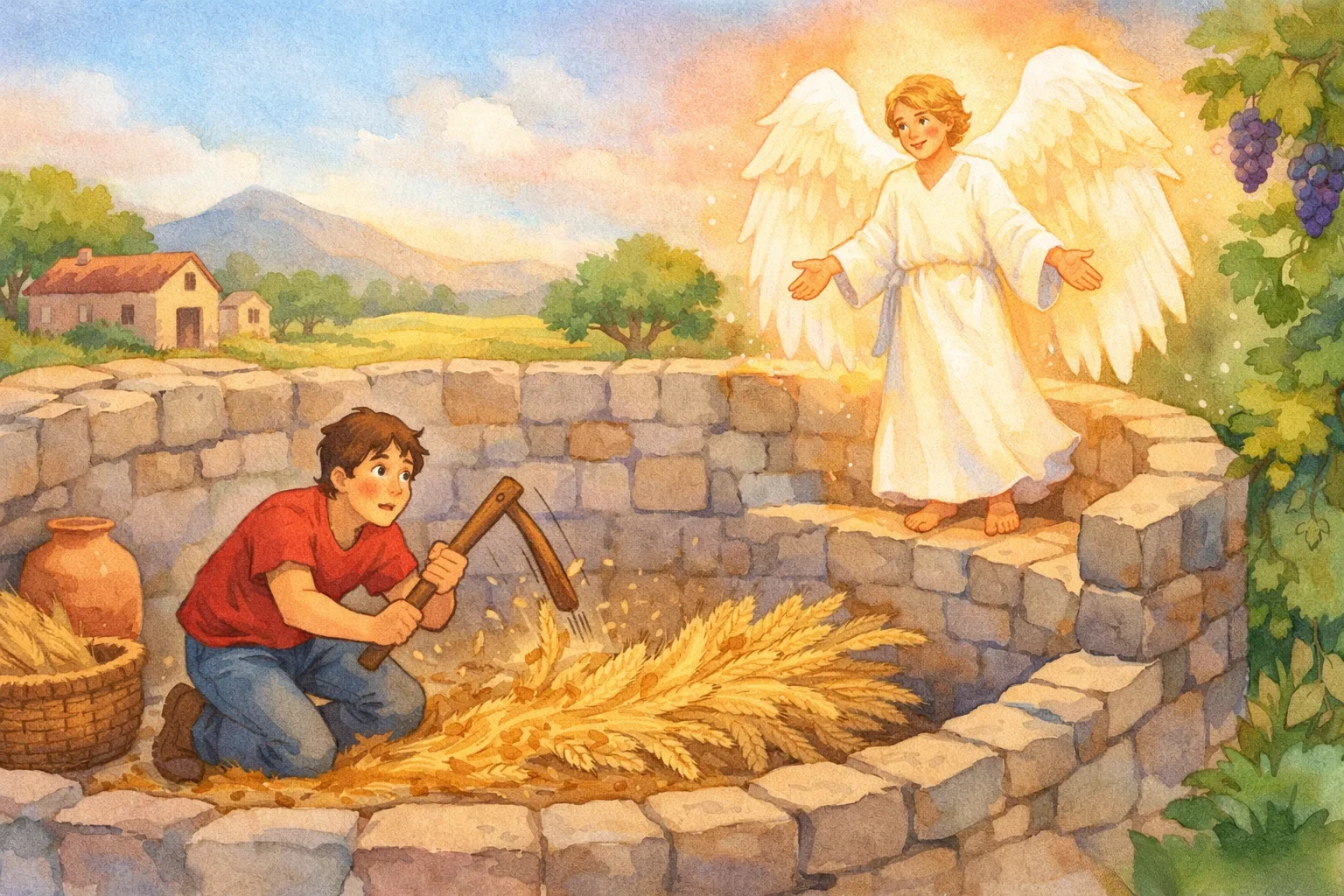
Israel had turned away from God again, and for seven years the Midianites swarmed the land every harvest like locusts, stealing crops and animals until the Israelites were hiding in caves. When we first meet Gideon, he is threshing wheat at the bottom of a winepress, a pit, so the Midianites won't see him.
That's where the angel of the Lord finds him, and the greeting is almost funny: "The Lord is with you, mighty warrior" (Judges 6:12).
Gideon's answer is anything but mighty. He asks why all this trouble has happened, points out that his clan is the weakest in Manasseh, and that he is the least in his family. God's reply ignores every excuse: "Go in the strength you have... Am I not sending you?" (Judges 6:14).
Key lesson for kids: God sees who you can become, not just who you are today. Gideon felt small and scared, and God called him a mighty warrior anyway, then made it true.
The Fleece (Judges 6:33-40)
Gideon's first act of courage happened at night: he tore down his own father's altar to the false god Baal. The townspeople wanted him dead by morning, but his father talked them down, if Baal is really a god, let Baal defend himself.
Then the Midianite army gathered in the Valley of Jezreel, and Gideon, still unsure, asked God for a sign. He laid a wool fleece on the threshing floor overnight: let the fleece be wet with dew and the ground dry, and I'll know you're sending me. God did it. Gideon asked for the reverse the next night, dry fleece, wet ground. God patiently did that too.
Key lesson for kids: God is patient with honest doubt. Gideon wasn't testing God to be difficult, he was scared and wanted to be sure. God didn't scold him; He answered. You can bring your real questions to God.
Too Many Soldiers (Judges 7:1-8)
Thirty-two thousand Israelites answered Gideon's call. And then God said something no general has ever said: "You have too many men" (Judges 7:2). If Israel won with a big army, they would brag that they had saved themselves.
So God trimmed the army twice. First, everyone who was afraid was sent home, twenty-two thousand left. Then, at the water, God kept only the three hundred men who scooped water with their hands, and sent the rest away.
Three hundred men. The Midianite camp below them was "thick as locusts," with camels like the sand on the seashore (Judges 7:12).
Key lesson for kids: God sometimes makes the odds worse on purpose, so that when the win comes, everyone knows who really did it. If you only trust God when the odds look good, that isn't trust yet.
Torches, Trumpets, and Empty Jars (Judges 7:9-25)
The battle plan sounds like a joke. No swords drawn. Each of the three hundred men carried a trumpet in one hand and a clay jar in the other, with a burning torch hidden inside the jar.
Surrounding the enemy camp in the middle of the night, at Gideon's signal, they smashed the jars, raised the torches, blew the trumpets and shouted, "A sword for the Lord and for Gideon!" (Judges 7:20).
The Midianite camp woke to light and noise on every side, the signals of a massive army, since normally only unit leaders carried trumpets and torches. In the darkness and panic, the Midianites turned their swords on each other and fled. The impossible victory was total, and it had cost Israel's three hundred men nothing but their jars. We tell this night in full in Gideon's 300.
Key lesson for kids: Obedience can look ridiculous right up until it works. Jars and trumpets are not weapons, but a plan from God doesn't need to make sense to succeed. It needs to be followed.
See what they get
Watch a Real Lesson From the App
Press play on Walking on Water, a complete lesson exactly as your child sees it. 300+ episodes cover the whole Bible in order, each ending in a fun quiz to check what they learned.
A real lesson from the app, watch the whole thing free.
The Sad Ending (Judges 8)
Gideon's story doesn't finish perfectly, and the Bible is honest about it. After the victory, Israel asked Gideon to become their king. He refused with exactly the right words, "The Lord will rule over you" (Judges 8:23), but then collected gold from the plunder and made an ephod, a priestly object, which Israel ended up worshiping. "It became a snare to Gideon and his family" (Judges 8:27).
Still, the land had peace for forty years in his lifetime, and Hebrews 11:32 lists Gideon among the heroes of faith.
Key lesson for kids: A great victory doesn't finish the story, you have to keep choosing God afterward, too. The Bible tells us its heroes' mistakes so we know it tells the truth.
🕯️ Free: 25 Days of Advent Bible Readings
December 1 to 25, one short reading a night, from the first promise to the manger. Printable for the fridge.
Free printable + a few helpful emails. Unsubscribe anytime.
Why Gideon Matters
He proves courage is grown, not born. From a winepress to a battlefield in two chapters, that transformation is what God does with willing people.
The 300 is the Bible's clearest math lesson. God + almost nothing beats everything. It's the same arithmetic as David and Goliath.
He asked for help and got it. The fleece, the secret trip to hear the enemy's dream (Judges 7:9-15), God kept reassuring him, because God works with real, nervous humans.
He belongs to the judges cycle. Like Deborah before him and Samson after, Gideon was God's rescue in a dark loop of forgetting, test the whole era with our Judges Bible trivia.
Let your kids watch Gideon go from the winepress to the night of the torches in short animated episodes on Faithful Kids, about two minutes each, with a quiz and reflection after every story.
Because he was genuinely afraid and wanted to be certain the command was from God. The first sign (wet fleece, dry ground) could almost happen naturally, since wool holds dew. The reverse, dry fleece on wet ground, could not. God answered both requests without rebuking him (Judges 6:36-40), which tells us God is patient with honest, humble doubt. It isn't a formula for decision-making today, but it is a picture of God's kindness to a scared man.
Why did God reduce Gideon's army to 300?
God says so directly: "In order that Israel may not boast against me that her own strength has saved her" (Judges 7:2). With 32,000 men, a win would look like Israel's achievement. With 300, there was only one possible explanation. The reduction wasn't about finding the best soldiers; it was about making the credit unmistakable.
Did Gideon become king of Israel?
No. When Israel offered him the crown, he refused: "I will not rule over you, nor will my son... The Lord will rule over you" (Judges 8:23). Sadly, his later choices, the golden ephod that Israel began to worship, and a son named Abimelek who seized power violently after his death, show how fragile that good answer was in practice.
What does Gideon's other name, Jerubbaal, mean?
After Gideon tore down his father's altar to Baal, the townspeople demanded his death. His father Joash answered that if Baal were really a god, he could contend for himself, so Gideon was nicknamed Jerubbaal, "let Baal contend with him" (Judges 6:31-32). The name stuck as a walking reminder that the idol had done nothing about it.
🕯️ Free: 25 Days of Advent Bible Readings
December 1 to 25, one short reading a night, from the first promise to the manger. Printable for the fridge.
Free printable + a few helpful emails. Unsubscribe anytime.