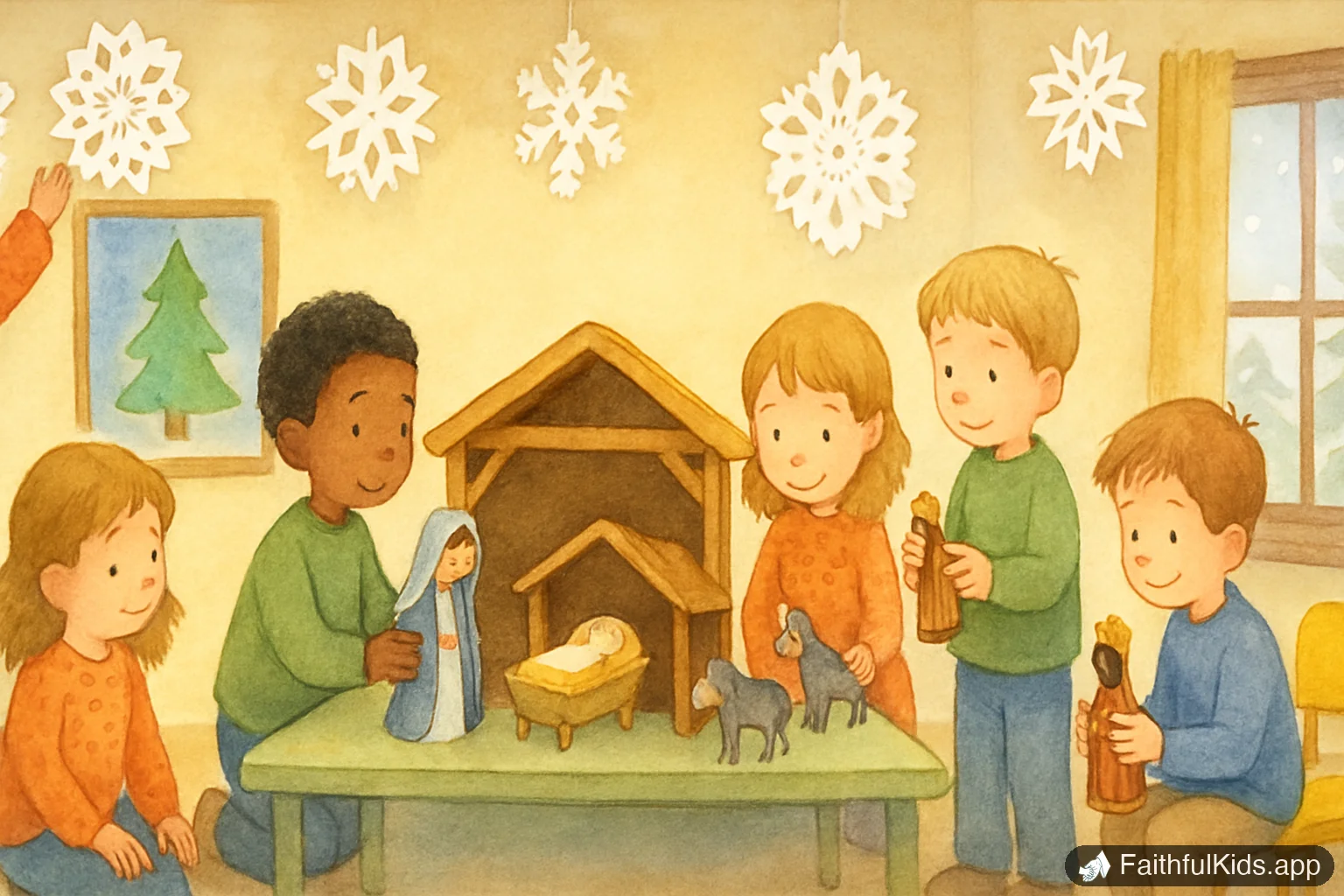
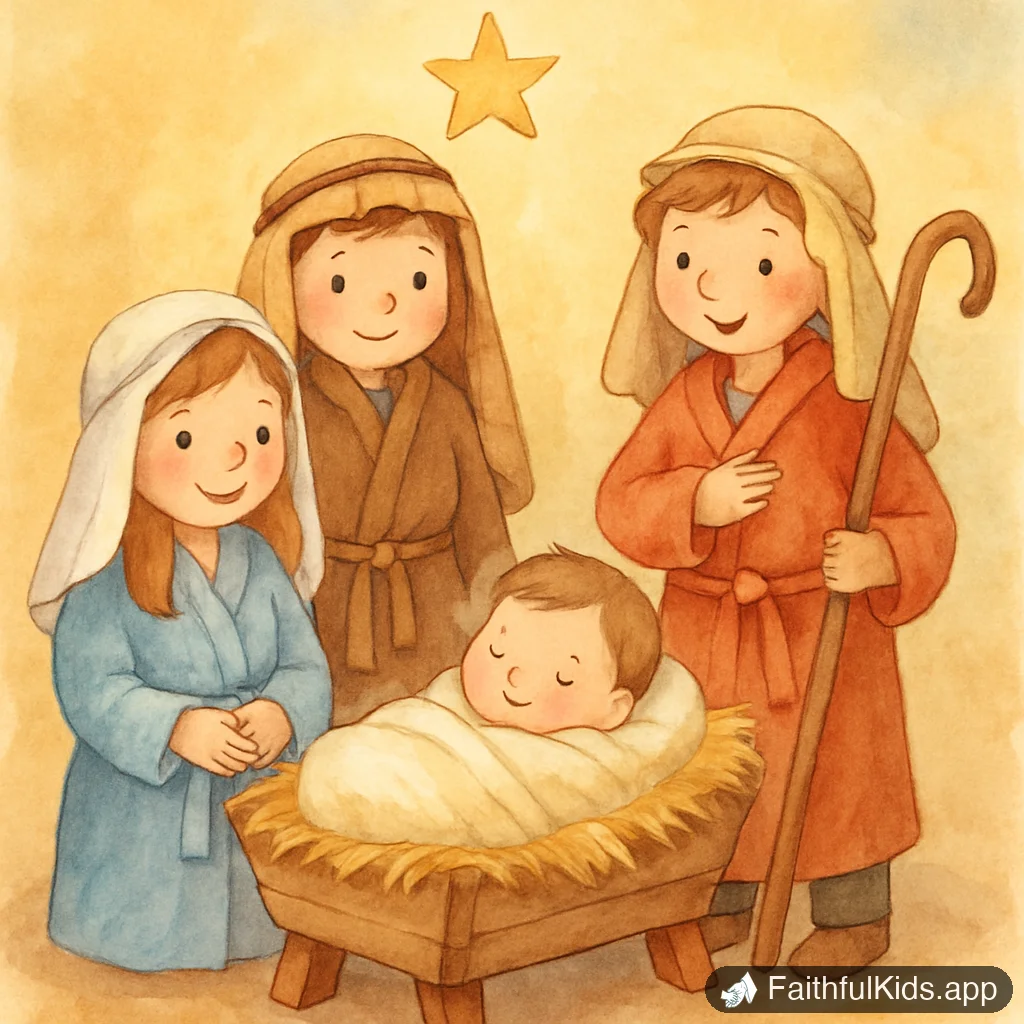
Blog/8 Christmas Sunday School Lessons (Preschool to Teen)
Guide
8 Christmas Sunday School Lessons (Preschool to Teen)
Ages 5+·21 min read··By Faithful Kids Team·Updated August 19, 2026
Here are eight complete Christmas Sunday school lessons that walk kids through the nativity story in order -- prophecy, Mary, the journey to Bethlehem, the shepherds, the magi, the gift of Jesus, the incarnation, and Jesus' family tree. Each lesson includes a story summary with Scripture reference, discussion questions, a hands-on activity, a memory verse, and an age adaptation block covering preschool through teen.
Lessons 1-6 run 30-45 minutes and are built for ages 5-11, with the Age adaptations block under each one telling you exactly what to change for a preschool room or a preteen class. Lessons 7 and 8 are written for older kids and teens, ages 11-16, who have heard the nativity every December since birth and need something they haven't already outgrown. Teach 1-6 in order and your class experiences the whole Christmas story as one unfolding narrative -- which is exactly how the Bible tells it. For the general structure behind these plans, see our guide to Bible lesson plans for Sunday school.
How Do You Structure a Christmas Sunday School Lesson?
Use a simple four-part flow: story (10 min), discussion (5-10 min), activity (15 min), and memory verse (5 min). Kids retain far more when they hear the story, talk about it, and then do something with their hands -- in that order.
A quick note on scheduling: December usually gives you four Sundays before Christmas. If that's your reality, teach lessons 1-4 on those Sundays, lesson 5 (magi) the Sunday after Christmas -- which is actually historically accurate timing -- and lesson 6 on New Year's week or as a Christmas Eve family event. Lessons 7 and 8 are not part of that sequence; they're the older-kid track, and they work best either in a separate youth class running parallel to the children's rooms, or as a midweek teen night in the two weeks before Christmas.
Lesson 1: The Promise of a Savior (Prophecy)
Scripture: Isaiah 9:2, 6; Micah 5:2
Big idea: God promised the Savior hundreds of years before Jesus was born -- and God always keeps His promises.
Story (10 min). Start with a promise kids understand: "If I promised you a pizza party in the year 2726, could I keep it? No -- I won't be here! But God made promises 700 years ahead and kept every one." Tell how God's people waited through dark times, and prophets like Isaiah brought hope: a child would be born called "Wonderful Counselor, Mighty God, Everlasting Father, Prince of Peace" (Isaiah 9:6). Micah even named the town: little Bethlehem. Then the punch line -- everything they predicted came true, exactly, in Jesus.
Discussion questions:
What's the longest you've ever waited for something? What was the waiting like?
Why do you think God told people about Jesus so far ahead of time?
Which of the four names in Isaiah 9:6 do you like best, and why?
Activity: Promise scavenger hunt. Before class, hide slips around the room, each with one prophecy (Isaiah 7:14 -- born to a virgin; Micah 5:2 -- born in Bethlehem; Isaiah 9:6 -- called Prince of Peace) and its fulfillment reference on the back. Kids hunt them down, then match each promise to its fulfillment on a poster labeled "PROMISED" and "KEPT." For younger kids, use pictures (a town, a baby, a crown).
Memory verse: "For to us a child is born, to us a son is given" (Isaiah 9:6). Add hand motions: rock a baby for "child is born," hands out for "son is given."
Age adaptations:
Preschool (3-5): Cut to one idea -- "God promised, and God did it." Hide three picture cards instead of verse slips, and let the hunt be the whole lesson.
Elementary (6-10): Teach as written.
Preteen and teen (11-16): Give them the actual texts and let them do the matching themselves. Ask the harder question: how would you know a prophecy was genuine and not written after the fact? The dates of the Isaiah and Micah manuscripts are a real conversation with this age.
Lesson 2: An Angel Visits Mary (Annunciation)
Scripture: Luke 1:26-38
Big idea: God chooses ordinary people for extraordinary things, and Mary shows us how to say yes to God.
Story (10 min). Set the scene: Nazareth was a small, unimportant town, and Mary was a young, ordinary woman. Then Gabriel appears. Act out the drama -- Mary's fear, the angel's "Do not be afraid," the announcement that her baby would be the Son of the Most High. Land on two lines kids should carry home: "Nothing is impossible with God" (Luke 1:37) and Mary's brave answer, "I am the Lord's servant" (Luke 1:38). For a read-aloud retelling to use in class or send home, use our story post An Angel Visits Mary.
Discussion questions:
How do you think Mary felt when the angel appeared? What would you have felt?
Mary asked the angel a question before she said yes. Is it okay to ask God questions?
What's something hard God might be asking you to say yes to?
Activity: "Yes, God" megaphones. Kids roll paper into cone megaphones and decorate them, then write "I am the Lord's servant" along the side. Practice announcing the news like Gabriel: each kid announces one true thing about Jesus through the megaphone ("He will be great!" "His kingdom will never end!"). Older kids can instead write a journal entry as Mary the night after the angel left.
Memory verse: "For no word from God will ever fail" (Luke 1:37). Short enough that even 4-year-olds nail it by the end of class.
Age adaptations:
Preschool (3-5): Two lines only -- "An angel told Mary she would have a special baby, and Mary said yes to God." Do the megaphone and skip the discussion.
Elementary (6-10): Teach as written.
Preteen and teen (11-16): Lead with Mary's age and social risk: she was likely 13 to 15, engaged, in a village where an unexplained pregnancy carried real danger. Teens take Mary far more seriously once they realize she was roughly their age. Use the journal-entry option instead of the megaphone.
If small hands need something to do while you read, the free empty tomb coloring page is made for exactly that.
Planning the whole month? The Christmas hub lists every Advent devotion, story, and printable we publish.
Lesson 3: The Journey to Bethlehem (Mary and Joseph Travel)
Scripture: Luke 2:1-7
Big idea: God is in charge of even the big, inconvenient events of the world -- an emperor's census brought Jesus exactly where God promised He'd be born.
Story (10 min). Tell it as an adventure with a hidden secret. Caesar Augustus -- the most powerful man in the world -- orders everyone counted. Joseph must go to Bethlehem, 90 miles away, with Mary about to have her baby. Walk the room in a circle as you narrate: dusty roads, sore feet, the crowded town, knocking on doors, no guest room, and finally -- the baby born and laid in a manger. Reveal the secret: centuries earlier, Micah said the Savior would come from Bethlehem. Caesar thought he was in charge; God was keeping a promise.
Discussion questions:
Have you ever had plans change in a way you didn't like? What happened?
Why do you think God let His Son be born in a stable instead of a palace?
What does this story teach us about who's really in charge of the world?
Activity: Journey obstacle course. Set up a route around your room: "rocky path" (paper stepping stones), "steep hill" (crawl under a table), "crowded Bethlehem" (weave between chairs), ending at a manger scene (a box with hay and a doll). Kids travel in pairs, one leading one blindfolded for the last stretch -- trusting a guide the way Mary and Joseph trusted God.
Memory verse: "She gave birth to her firstborn, a son. She wrapped him in cloths and placed him in a manger" (Luke 2:7).
Age adaptations:
Preschool (3-5): Walk the circle, knock on pretend doors, and rock a doll. Skip the blindfold entirely -- it frightens more than it teaches at this age.
Elementary (6-10): Teach as written.
Preteen and teen (11-16): Trade the obstacle course for a map and a math problem: 90 miles, roughly 20 miles a day on foot, in the third trimester. Then ask the sharper question -- why does Luke bother naming Caesar Augustus and Quirinius at all? (Because he is writing history, not legend.)
Lesson 4: Shepherds and Angels (Good News of Great Joy)
Scripture: Luke 2:8-20
Big idea: The best news in history came first to ordinary people -- and like the shepherds, we're meant to share it.
Story (10 min). Turn the lights down. Shepherds on a dark hillside, an ordinary night -- then BAM, lights on: an angel, glory blazing, terrified shepherds. Deliver the announcement like the headline it is: "I bring you good news that will cause great joy for all the people. Today in the town of David a Savior has been born to you; he is the Messiah, the Lord" (Luke 2:10-11). Then the sky full of angels, the shepherds' sprint to Bethlehem, and their becoming the first people ever to spread the news about Jesus.
Discussion questions:
Shepherds weren't rich or famous. Why do you think God told them first?
The angel said the news was "for all the people." Who does that include?
The shepherds couldn't keep the news to themselves. Who could you tell about Jesus?
Activity: Newsflash broadcast. Kids work in teams to perform a short "Bethlehem News" TV report about the birth of Jesus -- one anchor, one field reporter, one shepherd eyewitness. Give them 8 minutes to prepare, then perform for the class. Younger option: angel ornaments from paper doilies (body), cupcake liners (wings), and a wooden bead (head), while practicing the angel's announcement.
Memory verse: "Glory to God in the highest heaven, and on earth peace to those on whom his favor rests" (Luke 2:14). Sing it -- several classic carols quote it nearly word for word.
Age adaptations:
Preschool (3-5): Lights off, lights on, and one loud "Good news!" Do the doily angels. That is a complete and successful lesson for a 4-year-old.
Elementary (6-10): Teach as written -- the newsflash broadcast is the single best-loved activity in this series.
Preteen and teen (11-16): Add the social layer: shepherds were considered ritually unclean and their testimony was not accepted in court, and God made them the first witnesses anyway. Then ask who the modern equivalent is in your town. Have teens produce the broadcast on their phones instead of performing it live.
See what they get
Watch Born in a Manger Come Alive
Born in a Manger is one of 300+ short narrated video lessons your child will love. Watch the whole episode right here — in the app, every lesson ends with a fun quiz to check what they learned.
A real lesson from the app — watch the whole thing free.
Lesson 5: The Wise Men Follow the Star (Magi)
Scripture: Matthew 2:1-12
Big idea: Jesus is worth seeking, and worth our very best -- wise people still seek Him.
Story (10 min). Wise men far in the east spot a brand-new star and know what it means: a King has been born. Trace their months-long journey and their arrival asking, "Where is the one who has been born king of the Jews?" (Matthew 2:2). When the star stops, they are overjoyed. These wealthy, educated men kneel before a small child and open their treasures: gold for a king, frankincense for worship, myrrh -- a burial spice hinting that this King came to give His life. Fun fact for your class: the magi found Jesus in a house, not the stable -- they likely arrived months after the birth.
Discussion questions:
The wise men traveled a very long way to worship Jesus. What effort do we make to seek Him?
Why do you think each gift mattered? What might each one tell us about who Jesus is?
What's the best thing you could give Jesus this year that money can't buy?
Activity: Gifts fit for a King. Each kid decorates a small box (or folds a simple origami box) and writes or draws on a slip inside a non-money gift they'll give Jesus this year -- kindness to a sibling, telling a friend about Him, obeying without arguing, daily prayer. Boxes go home as ornaments. Older kids: map the journey on a printed map of the ancient Near East and estimate the distance.
Memory verse: "We saw his star when it rose and have come to worship him" (Matthew 2:2).
Age adaptations:
Preschool (3-5): A star to follow around the room and three gift boxes to open. Name the gifts; skip what myrrh means.
Elementary (6-10): Teach as written.
Preteen and teen (11-16): Go where younger classes can't: Herod's paranoia and what he did next (Matthew 2:16), and myrrh as a burial spice given to a toddler. Older kids can sit with the fact that the Christmas story contains real darkness. Use the mapping activity and let them calculate the journey.
Lesson 6: Jesus, God's Greatest Gift
Scripture: John 3:16; Matthew 1:21-23
Big idea: Jesus is the whole point of Christmas -- God's own gift of love to every one of us.
Story (10 min). Bring a beautifully wrapped gift box to class and let anticipation build. Recap the five previous lessons using kids' memories ("Who remembers what the prophets promised? Who visited Mary?"). Then teach the names: Jesus means "God saves" (Matthew 1:21), and Immanuel means "God with us" (Matthew 1:23). Open the box: inside is a mirror. "Who is God's gift for? Look inside." Land on John 3:16 -- God so loved the world that He gave.
Discussion questions:
What's the best gift you've ever received? Why was it special?
Presents get old or break. How is Jesus a gift that lasts forever?
If Jesus is a gift, how does someone receive Him?
Activity: Christmas story review relay. Split into teams for a review game covering all six lessons -- our Christmas Bible trivia for kids has ready-made questions sorted by difficulty. Teams race to sequence six picture cards (scroll, angel, donkey, shepherd, star, gift) in story order, then answer trivia to earn points. Finish by reading the whole story in one sitting -- our five-scene retelling of the Christmas story for kids takes about ten minutes and doubles as a great parent handout for Christmas Eve.
Memory verse: "For God so loved the world that he gave his one and only Son" (John 3:16).
Age adaptations:
Preschool (3-5): The wrapped box and the mirror carry the entire lesson. Open it, let each child see their own face, and say "Jesus is God's gift for YOU." Repeat it eight times.
Elementary (6-10): Teach as written.
Preteen and teen (11-16): Skip the mirror -- they'll see it coming -- and go to the receiving question instead. "If Jesus is a gift, how does a person actually receive Him?" is the most important question in this series, and 13-year-olds are old enough to answer it for themselves rather than repeat an answer.
Lesson 7: The Word Became Flesh (Ages 11-16)
Scripture: John 1:1-14; Philippians 2:5-8
Big idea: Christmas is not mainly a birth story -- it's the claim that God took on a human body, with everything that comes with one.
Story (10 min). Start by admitting the obvious: they have heard the manger story every December of their lives. Then hand them John's version, which has no shepherds, no star, and no stable. John starts before the beginning: "In the beginning was the Word, and the Word was with God, and the Word was God" (John 1:1). Then the sentence that changes everything: "The Word became flesh and made his dwelling among us" (John 1:14). Flesh means hunger, exhaustion, splinters, grief, a body that could be hurt. Paul says the same thing another way -- Jesus "made himself nothing by taking the very nature of a servant" (Philippians 2:7). Land it with Hebrews 4:15: whatever they are going through, they are not talking to a God who has to guess what it feels like.
Discussion questions:
Why do you think John skipped the manger and the shepherds entirely?
What did God actually give up to become a baby? Make a list.
Does it change anything to know Jesus was a teenager once -- with a body, a family, and a hometown that underestimated Him?
John 1:5 says the darkness "has not overcome" the light. Where does that feel true to you, and where does it feel hard to believe?
Activity: The two columns. On a whiteboard, make two columns: "What God is" (unlimited, everywhere, never tired, never dies) and "What a human body is" (limited, one place, hungry, tired, mortal). Fill both with the group. Then draw an arrow from the first column to the second and write John 1:14 across it. Sit in the silence for a second. Teens will feel the weight of that arrow more than any craft you could hand them.
Memory verse: "The Word became flesh and made his dwelling among us" (John 1:14).
Age adaptations:
Preschool and early elementary: Not this lesson -- use Lesson 6 instead. The one transferable line is "Jesus came to be right here with us."
Upper elementary (9-10): Usable if you keep only the two-column activity and drop Philippians. Ten-year-olds can grasp "God became small."
Teen (13-16): Add John 1:10-12 and the harder question of why most people missed Him.
Lesson 8: Jesus' Messy Family Tree (Ages 11-16)
Scripture: Matthew 1:1-17, with Matthew 1:21-23
Big idea: God wrote His own rescue plan through a family full of outsiders and failures -- which means nobody's history disqualifies them.
Story (10 min). Tell them you're about to read the most-skipped passage in the Christmas story: a genealogy. Then read a few names and stop at the surprising ones. Tamar, who had to trick her father-in-law to survive. Rahab, a foreign woman who ran a house in a city marked for destruction. Ruth, a Moabite -- from a nation Israel was told to keep at arm's length. And Matthew's pointed refusal to name Bathsheba, calling her instead "Uriah's wife" (Matthew 1:6), which keeps David's worst act on the page forever. Four women, in a genealogy that normally would have listed none. Matthew put them there on purpose. Finish with Matthew 1:21: the child's name would be Jesus, "because he will save his people from their sins" -- including the sins in His own family line.
Discussion questions:
Why do you think Matthew opened the whole New Testament with a list of names?
If God had asked you to pick the family line for the Messiah, who would you have cut?
What does it say about God that He didn't clean this list up?
Is there something in your family's story you'd rather not have in the record? What does this passage say to that?
Activity: Rewrite the record. Give each teen a strip of paper listing four names from Matthew 1 with one honest sentence about each. Ask them to write a fifth line for themselves -- name plus one true, unpolished sentence -- and fold it. Nobody reads them aloud; nobody collects them. Then read Matthew 1:16-17 over the group. The point is that the list keeps going. For a lighter closing, hand out our Christmas Bible trivia for kids and let them run a fast round.
Memory verse: "She will give birth to a son, and you are to give him the name Jesus, because he will save his people from their sins" (Matthew 1:21).
Age adaptations:
Preschool and elementary: Skip this lesson. The themes require a maturity that arrives around 11.
Preteen (11-12): Keep Rahab and Ruth, whose stories are adventure-shaped, and leave Tamar and Bathsheba for older groups.
Teen (13-16): Teach as written. If you're building a wider teen track around this, our guide to teaching the Bible to teenagers covers the discussion format, and Bible verses for teens gives you follow-up passages for the weeks after Christmas.
What If Kids Miss a Week?
Build a short recap into the start of every lesson -- each lesson also stands alone, so a kid who misses week two still understands week three. A recap poster helps: add one symbol per week (scroll, angel, donkey, shepherd, star, gift) and let kids retell the story-so-far from the symbols.
For reinforcement between Sundays, send parents a link for home follow-up: our library of Christmas Bible stories for kids matches these lessons story-for-story, and the video lessons at Faithful Kids pair each nativity story with a quiz kids can do in five minutes on a weeknight.
Kids who like a scoreboard tend to prefer our Bible trivia game online, which tracks the streak for them.
For older children who find coloring dull, a Bible word search holds attention longer.
If your group skews older, the youth group games list marks which games hold up with high schoolers.
Frequently Asked Questions
How many Christmas lessons do I need for December?
Four core lessons cover the Sundays of Advent, and this series gives you eight so you have material through the Sunday after Christmas and New Year's week, plus two older-kid lessons for a separate youth class. If you only have four Sundays, teach prophecy, Mary, shepherds, and the gift of Jesus, folding the journey into the shepherds week and saving the magi for after Christmas.
What age group are these lessons for?
Lessons 1-6 are written for ages 5-11, and each one carries an Age adaptations block covering preschool (3-5), elementary (6-10), and preteen and teen (11-16). Lessons 7 and 8 are written specifically for ages 11-16 and are not meant for younger rooms. For preschoolers, shorten the story to 5 minutes and go straight to the craft; for teens, use the discussion questions as the main event and cut the activity to ten minutes.
What order should I teach the Christmas story in?
Teach lessons 1-6 chronologically: prophecy, the angel's visit to Mary, the journey to Bethlehem, the shepherds, the magi, and then a wrap-up on Jesus as God's gift. That's the order the events happen in Scripture, and sequencing them builds one coherent story instead of six disconnected crafts. The lessons above are already in this order, with lessons 7 and 8 sitting outside the sequence as the older-kid track.
How do I teach Christmas to teenagers who have heard it every year?
Give them the parts of the story that were held back when they were seven. Lessons 7 and 8 exist for exactly this: John's cosmic version of Christmas with no manger in it, and the genealogy full of outsiders and scandals that most children's curricula quietly skip. Teens don't need the nativity made louder -- they need it made honest, and both of those passages reward a 15-year-old's questions in a way a felt board never will.
How long should a kids' Sunday school lesson be?
Plan for 30-45 minutes: about 10 for the story, 5-10 for discussion, 15 for the activity, and 5 for the memory verse. Attention spans roughly match age -- a 5-year-old gives you about 5 focused minutes per segment -- so shorten each block rather than cutting blocks for younger classes.
What supplies do I need for these eight lessons?
Mostly basics: paper, markers, tape, scissors, small boxes, doilies and cupcake liners (angels), a doll and box with hay (manger), picture cards, and one wrapped box with a mirror inside. Lessons 7 and 8 need almost nothing -- a whiteboard and paper strips. Nothing requires more than a church supply closet plus one dollar-store run, and every activity has a low-prep fallback -- discussion plus coloring works in a pinch.
Should the wise men be in the nativity lesson or separate?
Teach the magi as their own lesson, ideally the Sunday after Christmas -- Matthew 2 indicates they arrived at a house well after the birth night. Keeping them separate is more biblically accurate and gives you a strong post-Christmas lesson when attendance is unpredictable.
🌙 Free: The Bedtime Bible Kit
Seven nights of five-minute stories — a story, a prayer, and one question to whisper about.
Free printable + a few helpful emails. Unsubscribe anytime.