How to Start a Children's Ministry: Step-by-Step Guide
Ages 5+·14 min read··By Faithful Kids Team·Updated November 3, 2026
Somebody in your church looked around on a Sunday morning, saw children with nothing designed for them, and decided to do something about it. If that's you, this guide is the roadmap: seven stages, from the first conversation with your pastor to the season after launch, with the checklists and templates for each stage.
Two promises about how it's written. First, it's practical, built from what small and mid-size churches actually do, not what a megachurch conference says. Second, it's honest about the hard part: child safety isn't a paragraph here; it's the longest section, because it's the part you cannot improvise.
A note before you rely on it: this guide describes widely used practices, not legal advice. Requirements for background checks, mandatory reporting, and ratios differ by country, state, denomination, and insurer; we flag every place where you must verify your own local requirements.
Stage 1: Plan the Ministry (Weeks 1–4)
Start with why, in one sentence
Before rooms and rosters, write a one-sentence mission. Not a paragraph, a sentence a volunteer can repeat. Examples of the shape: "We help kids meet God in His Word and feel at home in His church." The test: does it tell a new helper what to do when a lesson flops? (Answer, with that mission: the relationship still happened; the morning still counted.)
Count the actual children
List the kids already connected to your church, members' children, regulars' grandchildren, neighborhood kids who show up at events. Note ages. This list, not a model from a book, decides your structure. Ten kids ages 4–11 is one mixed group with smart planning, not three understaffed classrooms.
Choose age groupings you can staff
Common groupings: nursery (0–2), preschool (3–5), elementary (6–11), sometimes split younger/older elementary. The rule that keeps small ministries alive: fewer, fuller groups beat more, emptier ones. Combine ages until you have at least two adults and a critical mass of kids per room; split only when a group outgrows its space or its teacher.
Get real agreement from leadership
You need three things from your pastor and board, explicitly: permission (you're authorized to do this), protection (they'll adopt the safety policy you bring them, see Stage 2), and provision (a budget line, even a small one, and rooms). Ask for all three in one meeting and take notes. A ministry that launches on vague goodwill stalls at the first conflict over space or money. (If the budget line is the sticking point, real outside money exists: see our verified guide to grants for Christian schools and Sunday schools.)
Decide the opening format
You don't have to launch Sunday school, children's church, and midweek club at once. Pick ONE recurring slot you can staff twice over (so nobody serves every single week). Most churches start with one of: children's church during the sermon, Sunday school before/after the service, or a midweek club. You can add more after the first season proves the team.
Downloads for this stage: ministry launch timeline, age-group planning worksheet (in the launch kit).
Stage 2: Child Safety: the Non-Negotiable Stage (Weeks 2–6)
This is the stage that decides whether your ministry deserves parents' trust. Do it before recruiting, because your policy shapes who you recruit and how. It is also the one stage you should not finish alone: have your draft policy reviewed by your church's insurer and, where possible, a local attorney or your denomination's safeguarding office. Requirements genuinely differ by jurisdiction.
The practices almost everyone agrees on
These are standard across major Protestant and Catholic safeguarding programs and most church insurers:
Two unrelated adults per room, always. Never one adult alone with children, not in a classroom, a hallway, a car, or a bathroom. This "two-adult rule" is the backbone of every serious policy and protects the children and the volunteers.
Screening before serving. A written application, references, an interview, and a criminal background check appropriate to your country/state for every adult who serves with minors. Many churches also require a waiting period (commonly around six months of regular attendance) before someone may serve with children.
Check-in and matching pick-up. Every child is signed in by a parent/guardian and released only to the same authorized person, a numbered tag, a sticker pair, or a sign-out signature. No exceptions for "I'm her uncle."
Open rooms. Doors with windows, or doors open; no closed, unobservable spaces with children inside.
Bathroom policy. Young children are escorted to the door, not inside; two adults in any assisted situation; older kids go in pairs.
Incident and injury reporting. A simple written form for anything beyond a band-aid, shared with the parent the same day.
Mandatory reporting. Know your local law on reporting suspected abuse, in many places, those serving children are mandated reporters, and the report goes to civil authorities, not just up the church ladder. Your policy must name who calls whom, and must never make "handle it internally" the plan.
What varies: verify locally
Adult-to-child ratios. Insurers and denominations publish recommended ratios that differ by age band; some jurisdictions regulate ratios for nurseries. Don't copy a number from the internet (including from us), adopt the ratio your insurer and denomination specify, and write it into your policy.
Background check type and renewal. What a check covers and how often it must be renewed varies by country and state, and sometimes by denomination.
Health and allergy procedures. Medication rules and food-allergy practice vary; at minimum, collect allergy information at registration and post it where food is served.
Write it down and train on it
A policy nobody has read protects nobody. Put the above into a short written document (most good ones run 4–8 pages), have leadership adopt it formally, and make reading it part of volunteer onboarding, with a signature. Re-train annually in one 45-minute session.
Accessibility and inclusion
Ask at registration whether a child has needs you should know about, sensory, mobility, learning, medical, and respond with a plan, not a policy of hoping. The most common accommodation costs nothing: a calmer corner of the room and an adult who knows the child's name.
Downloads for this stage: volunteer application outline, incident report form, check-in/pick-up procedure card (in the launch kit).
Stage 3: Recruit and Train Volunteers (Weeks 4–8)
Recruit people, not a crowd
The announcement from the pulpit recruits almost nobody. What works is a list and personal asks: write ten names of people you'd trust with your own kids, and ask them one at a time, specifically, "Would you co-teach the elementary room two Sundays a month this fall?" Specific role, specific term, real out at the end of the season.
Write the roles before you offer them
Three to five roles cover a small ministry: teacher (prepares and leads the lesson), helper (second adult, welcome, crowd, bathroom runs, no prep), check-in coordinator (the desk, the tags, the roster), floater/sub (on call), and later a coordinator who owns scheduling. People say yes to clear jobs and quietly vanish from vague ones.
Onboard like you mean the policy
Every volunteer, including the pastor's spouse: application → references → background check → read-and-sign the safety policy → a walkthrough Sunday shadowing an experienced person. It feels like friction. It is the point, the friction is the message that this church takes its children seriously, and serious people respect it.
Schedule for sustainability
The fastest way to lose great volunteers is to burn them. Build the rota so nobody serves more than two or three Sundays a month, publish it a month ahead, and make swaps easy (a group chat works). Twice a year, thank them like you mean it, publicly and specifically.
Downloads for this stage: volunteer role descriptions, training checklist, sample rota (in the launch kit).
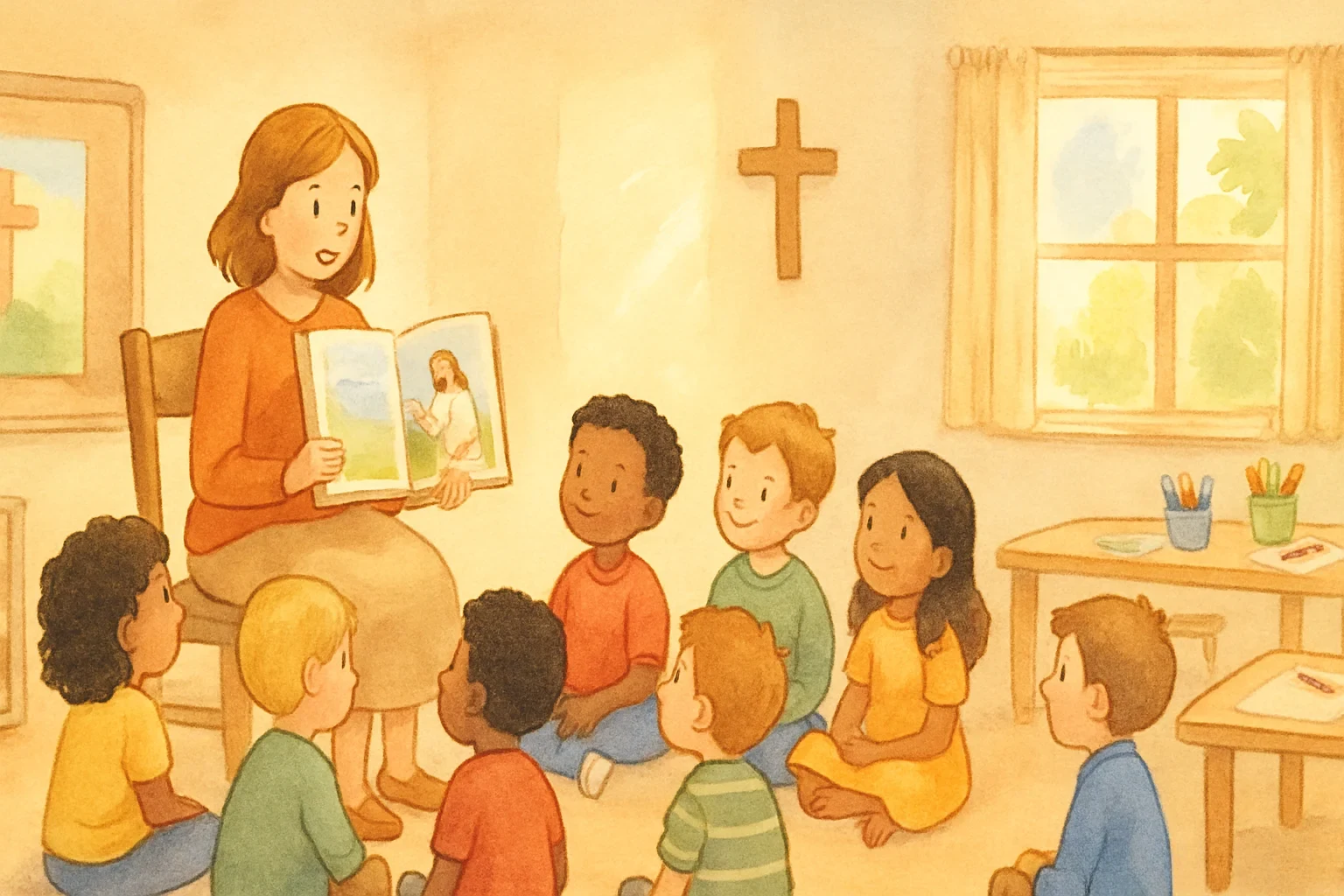
A session plan that works from age 4 to 11, in four beats: arrive & settle (a game or activity sheet as kids trickle in), the story (told well, this is the heart), respond (discussion, craft, game, or quiz connected to the story), send (one takeaway sentence and prayer). Forty-five minutes fills faster than you think.
Pick a curriculum you can actually sustain
Evaluate any curriculum, free or paid, against five questions:
Is it Scripture-first? Does a child meet the Bible's own stories, with chapter and verse, or a franchise's characters?
Can a rookie teach it Sunday after a bad week? If it needs an experienced teacher and two hours of prep, it will fail on the Sundays you need it most.
Does it cover the whole story? A curriculum that circles the same ten stories forever leaves kids with a sticker-book Bible. Look for a scope that runs Genesis to Revelation.
What does it cost, really? Per-classroom licenses, student books, and craft supply lists add up fast for a volunteer budget.
Does anything go home? The win condition is faith that survives the drive home, look for take-home pages, family questions, anything that gives parents a handle.
Where Faithful Kids fits: free for churches
This guide is published by Faithful Kids, and here is our honest pitch for this step: our library is 300+ short Bible video episodes, each about two minutes, each ending with a quiz and reflection, covering the whole Bible in order, and churches and Sunday schools get free access (the same library families pay for at home; not a trial). Many small ministries use an episode as the "story" beat and build the session around it: the video tells the story consistently well, and the teacher gets to do the part only a person can do, the conversation. Pair it with our free printables, Bible maps, and trivia games, which need no license and photocopy freely. And if you'd rather use another curriculum, our honest comparison of free options includes competitors we think are excellent, and our wider roundup of free Bible resources for children's ministry covers printables, video, music, and volunteer training.
Downloads for this stage: curriculum evaluation worksheet, sample session plan (in the launch kit).
See what they get
Watch a Real Lesson From the App
Press play on The Good Samaritan, a complete lesson exactly as your child sees it. 300+ episodes cover the whole Bible in order, each ending in a fun quiz to check what they learned.
A real lesson from the app, watch the whole thing free.
Stage 5: Organize the Operation (Weeks 6–10)
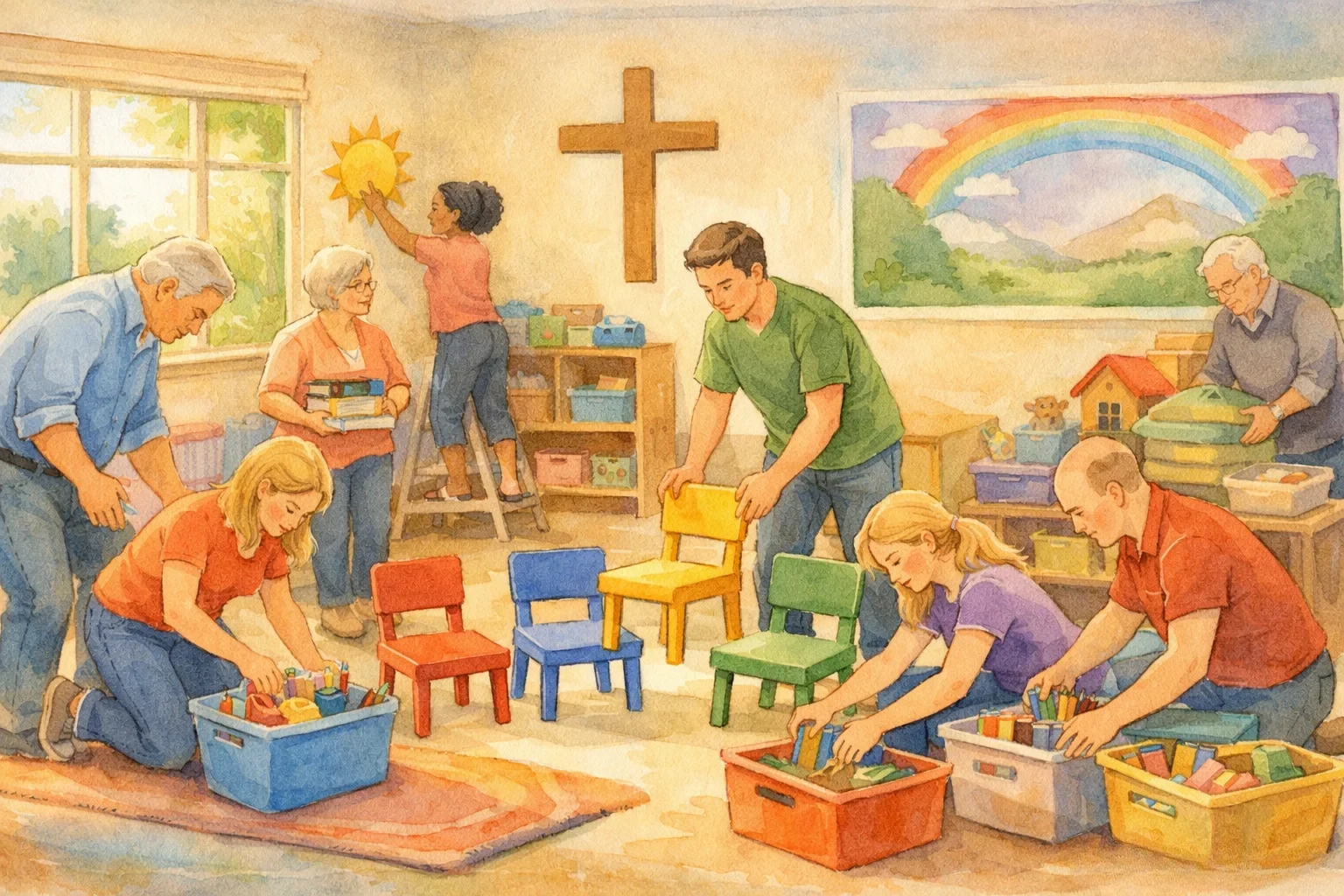
Rooms: pick the rooms that are observable (windows/open doors), near bathrooms, and escapable in an emergency; walk the route. Post the room's age group, ratio, and allergy list inside the door where adults, not children, see it.
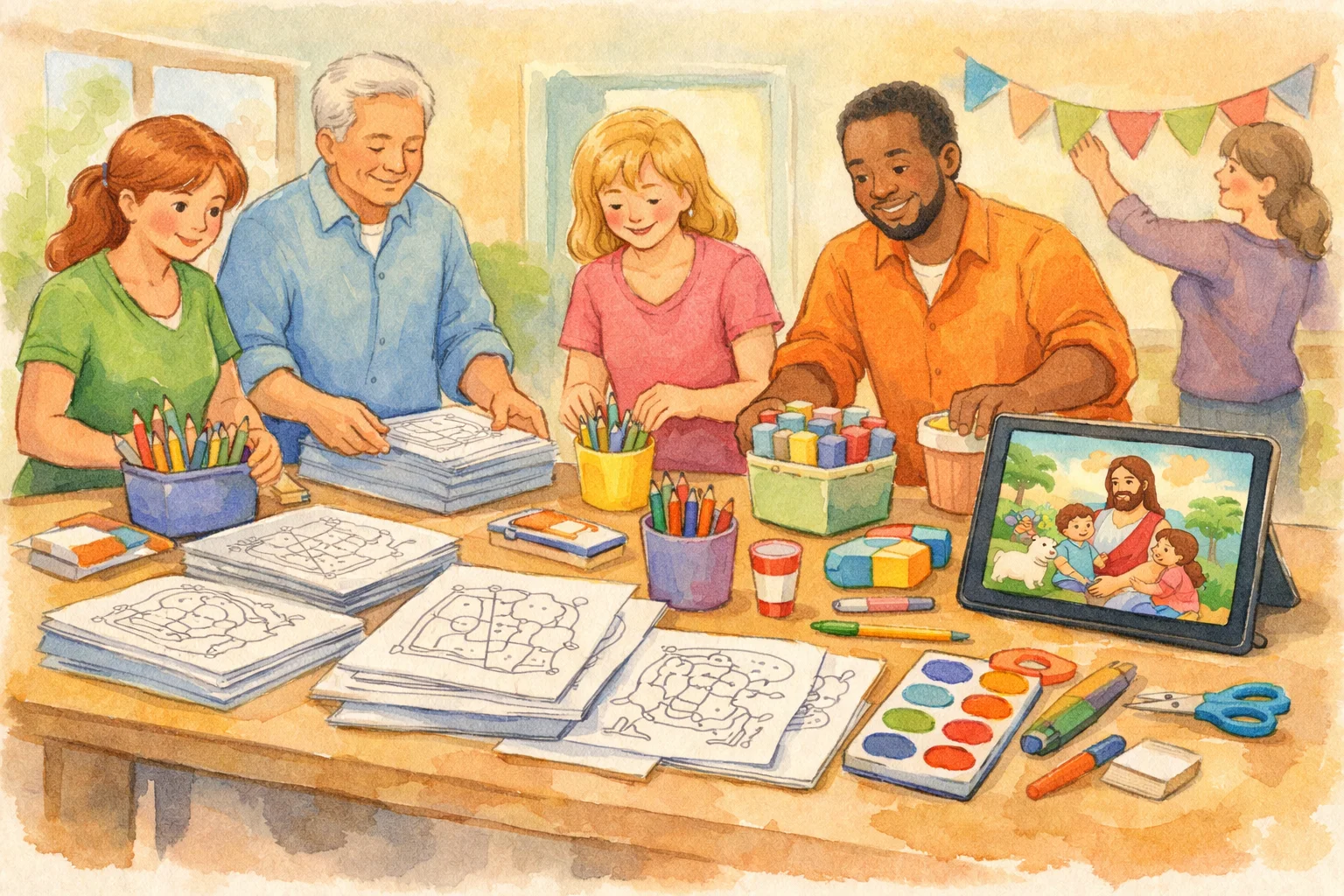
Supplies: one rolling bin per room beats a locked cupboard someone has the key to. Starter list: Bibles kids can handle, crayons/markers, paper, scissors, glue, name tags, a first-aid kit, and a printed stack of activities for the week the plan falls apart (our word searches and coloring pages exist for exactly that week).
Budget: a realistic small-church start is mostly one-time costs (bins, signage, check-in supplies, background checks) plus a small monthly line (snacks, crafts, printing). Put background checks in the budget explicitly; if money is the reason screening slips, the budget is wrong, not the policy.
Communication with parents: collect contact info and allergies at first check-in; send one short weekly message (what we taught + one question to ask at dinner). The dinner question outperforms every newsletter.
Downloads for this stage: sample startup budget worksheet, supplies checklist, parent welcome letter template (in the launch kit).
🕯️ Free: 25 Days of Advent Bible Readings
December 1 to 25, one short reading a night, from the first promise to the manger. Printable for the fridge.
Free printable + a few helpful emails. Unsubscribe anytime.
Stage 6: Launch (Weeks 10–12)
Soft launch first. Run two or three rehearsal Sundays with your core families before announcing anything. You're testing check-in flow, timing, and rooms; and the kinks will be real.
Train the whole team together once before the first public Sunday: walk the building, run check-in on each other, rehearse the emergency basics (exits, incident form, who calls parents).
The first public Sunday, one person, probably you, carries no room assignment and floats. Problems will surface; the floater absorbs them.
Afterward, debrief the same week: what confused parents, what bored kids, where the schedule slipped. Fix the top three things, ignore the rest for now.
Download for this stage: first-Sunday readiness checklist (in the launch kit).
Stage 7: Grow and Improve (Month 4 and On)
Protect the routines, same check-in, same session shape, same policy, every week. Trust compounds on consistency.
Watch the teachers, not just the kids. A monthly fifteen-minute check-in with each volunteer catches burnout before it becomes a resignation.
Measure what matters. Attendance is easy to count; better questions are "can our kids find Genesis?" and "do parents ask the dinner question?" (A curriculum with built-in quizzes gives you this for free.)
Add a season at a time: a Christmas program, a summer VBS, a midweek club, one new thing per season, launched with the same checklist discipline as the ministry itself.
Plan your succession early. The ministry that depends entirely on its founder ends when the founder moves. Your coordinator role (Stage 3) is the succession plan.
The Launch Kit
Every checklist and template in this guide lives in one free PDF pack, the Children's Ministry Launch Kit: fifteen designed pages covering the launch timeline, age-group worksheet, safety policy outline, volunteer role cards and screening tracker, training sign-off, monthly rota, curriculum comparison grid, session planner, budget and supplies worksheets, parent welcome letter, cut-out check-in and pick-up cards, an incident report form, and the first-Sunday readiness checklist. Free, photocopy at will.
Count your recurring slots and multiply: every room needs two unrelated adults every week, and nobody should serve more than two or three weeks a month. One room, one slot = a team of about four to six, plus a check-in person. If you can't staff that, shrink the plan (one combined room), not the safety standard.
How much does starting a children's ministry cost?
For a small church, plan for a few hundred dollars of one-time setup (bins, supplies, signage, check-in materials) plus the real recurring costs: background checks for each volunteer and a modest monthly supplies line. Curriculum is the swing variable; paid curricula commonly run hundreds to over a thousand dollars a year, while solid free options exist, including Faithful Kids' free church access and the free libraries our curriculum comparison reviews.
What's the right adult-to-child ratio?
The honest answer: the one your insurer and denomination specify for each age band, written into your policy; recommendations differ, and some jurisdictions regulate nursery ratios by law. The universal floor underneath any ratio is the two-adult rule: never one adult alone with children, whatever the head count.
Can we start with a mixed-age class?
Yes, most small ministries should. A well-run mixed room (roughly ages 5–11) with a strong storyteller beats three thin rooms. Aim the story at the middle, give the youngest hands-on help during response time, and give the oldest jobs, reading the passage, running the review game. Split by age only when numbers force it.
What should kids actually learn in the first year?
A first-year scope most traditions agree on: the big story in order (Creation, Abraham, Moses, David, the prophets, Jesus' life, death and resurrection, the early church), how to find their way in a physical Bible, a dozen memory verses, and the habit of praying out loud in a safe room. Resist the pressure to be novel; be chronological and clear. (Our Bible timeline and books of the Bible chart are free wall-chart versions of exactly this scope.)
Faithful Kids provides free Bible video curriculum to churches; how the church offer works. This guide may be linked, printed, and shared freely for ministry use.
🕯️ Free: 25 Days of Advent Bible Readings
December 1 to 25, one short reading a night, from the first promise to the manger. Printable for the fridge.
Free printable + a few helpful emails. Unsubscribe anytime.