Blog/How to Explain Forgiveness to a Child (Scripts + Steps)
Guide
How to Explain Forgiveness to a Child (Scripts + Steps)
Ages 5+·11 min read··By Faithful Kids Team·Updated August 16, 2026
Forgiveness means choosing to let go of getting even with someone who hurt you -- and the reason Christians forgive is that God forgave us first. For a child: "Forgiving someone means you stop trying to make them pay for what they did, because God stopped making you pay for what you did."
That one sentence carries both halves of the biblical picture: receiving God's forgiveness and passing it on to others. Kids need both. A child who only hears "you must forgive your brother" learns forgiveness as a chore. A child who first grasps "God forgives you -- completely, every time you ask" learns forgiveness as something you get to give away because you have plenty.
Here is how to teach both halves, plus a practical playbook for the place forgiveness gets tested most: sibling fights.
What Is the Simple Explanation of Forgiveness?
Here is a script you can say word for word: "When someone does something wrong to you, it is like they owe you something -- like a debt. Forgiving them means you tear up the bill. You do not pretend it did not happen, and you do not say it was okay. You decide: I am not going to pay you back, I am not going to keep bringing it up, and I am going to let God handle what is fair. We forgive because God did exactly that for us. Everyone does wrong things -- that is called sin -- and instead of making us pay, God forgave us through Jesus. So when we forgive, we are being like God."
The debt picture is Jesus' own -- His parable of the unmerciful servant (Matthew 18:23-35) is literally about canceled bills. And the logic of "forgiven people forgive" is stated plainly in Ephesians 4:32: "Be kind and compassionate to one another, forgiving each other, just as in Christ God forgave you."
One important clarification for kids: forgiveness is not the same as saying the wrong thing was fine, and it is not always the same as trusting the person again right away. If your child is still building the concept of sin itself, our guide on how to explain sin to a child is the natural companion to this one.
How Do You Explain God's Forgiveness to a Child?
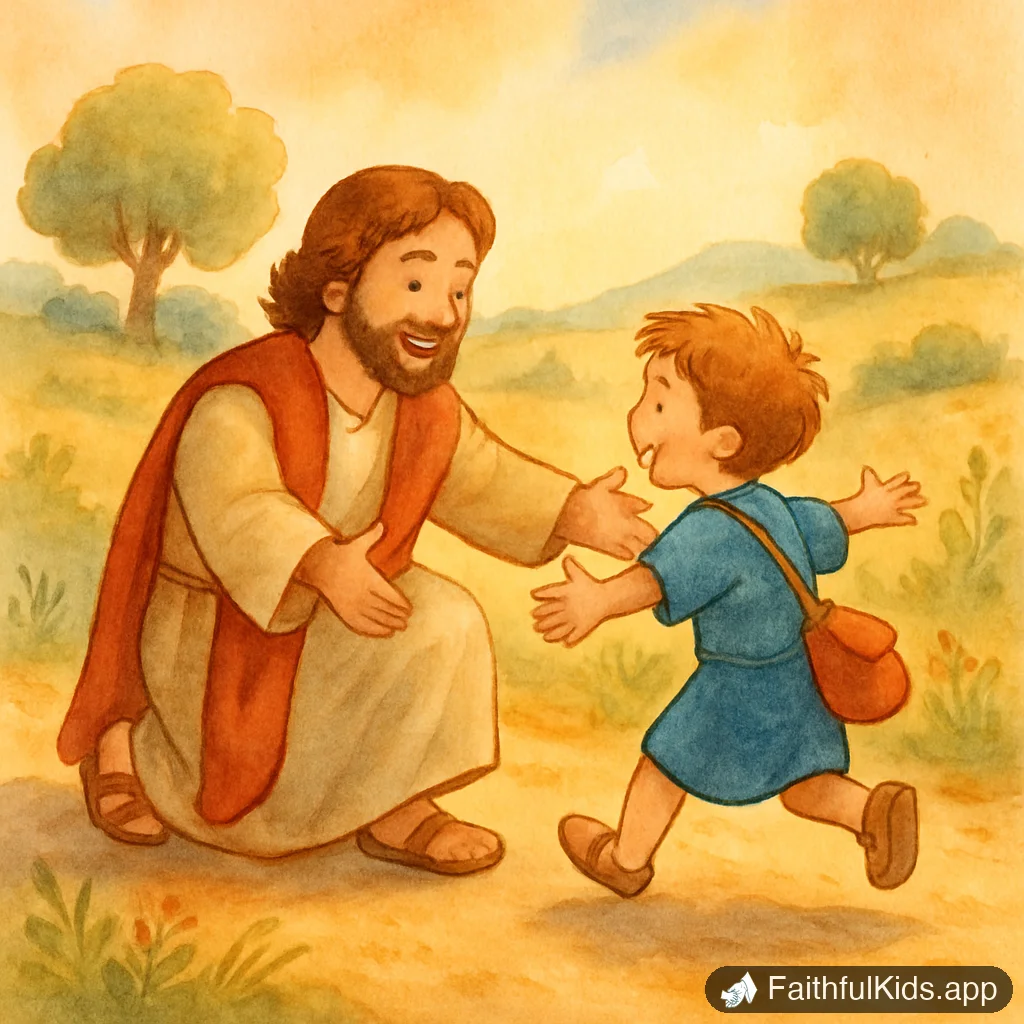
Start with the receiving side: God forgives fully, quickly, and as many times as we ask. This matters because many kids quietly believe God keeps a running tally of their failures. The Bible says the opposite: "If we confess our sins, he is faithful and just and will forgive us our sins" (1 John 1:9).
Try this at bedtime after a rough day: "Did anything happen today that you wish you could undo? You can tell God right now -- 'God, I'm sorry I did that.' And here is what the Bible promises: the moment you ask, He forgives you. He does not stay mad. He does not bring it up tomorrow. It is gone." Psalm 103:12 gives kids a picture they love: "as far as the east is from the west, so far has he removed our transgressions from us." Ask your child: "If you start walking east, when do you get to west? Never. That is how far away God puts our sins."
This is also where honesty about yourself teaches more than any lecture: when you snap at your kids, apologize and say, "I asked God to forgive me, and He did. Will you forgive me too?" A parent who visibly receives forgiveness raises kids who believe it exists.
How Do You Teach Forgiveness at Every Age?
The concept scales -- start with actions, add feelings, then add the hard cases.
Ages 4-6: Keep it behavioral and concrete. At this age forgiveness is a script and a hug: "You say 'I forgive you,' and then we do not stay mad." Use the tearing-paper trick -- write or scribble the "wrong thing" on paper, then let the child rip it up when they forgive. Physical actions make invisible ideas real. Do not expect genuine warm feelings yet; you are building the habit that forgiveness is what our family does.
Ages 7-10: Add the heart and the "why." Kids this age understand fairness intensely, which makes forgiveness genuinely hard -- honor that. "You are right, it was not fair. Forgiving does not mean it was fair. It means you hand the unfairness to God instead of carrying it." Introduce Peter's question -- "how many times shall I forgive... up to seven times?" -- and Jesus' answer, "seventy-seven times" (Matthew 18:21-22), which means: stop counting. This is a great age for Bible stories about forgiveness, especially Joseph forgiving the brothers who sold him.
Ages 11+: Tackle the real objections. Preteens will ask: "What if they are not sorry?" and "Do I have to be friends with them again?" Give straight answers: you can forgive someone who never apologizes (forgiveness is your choice; reconciliation takes two), and forgiving a person who keeps hurting you does not mean staying in range -- you can forgive AND tell a trusted adult AND keep your distance. This distinction protects kids from thinking faith requires being a doormat, especially around bullying.
We drew a printable the cross coloring page to go with this story — free, and the printed sheet includes the answer to where it came from.
How Do You Handle Forgiveness in Sibling Fights?
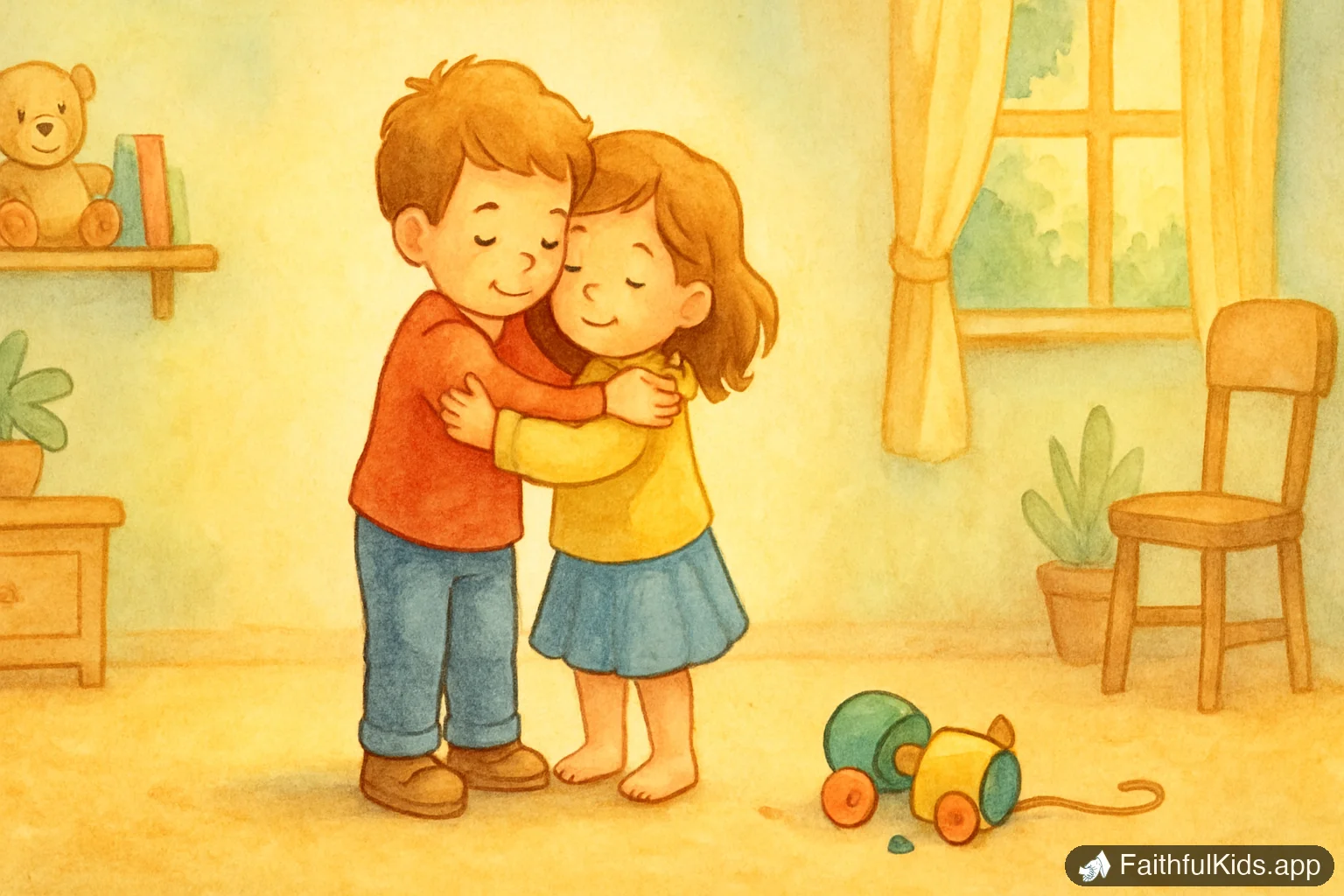
Skip the forced instant "say sorry" and use a short process instead -- mumbled apologies under duress teach kids that forgiveness is fake. Here is a five-step playbook that works on a Tuesday night:
Separate and settle first. Nobody can forgive mid-fury. "We are going to fix this, but first everyone breathes." Two minutes apart is not punishment; it is preparation.
Name the specific wrong. Each kid says what they did -- not "sorry for everything," but "I grabbed your Legos without asking." Naming it matters because forgiveness of vague things never sticks.
Apologize with the full sentence. Teach the three-part apology: "I was wrong to ___. I'm sorry. Will you forgive me?" That last question is the key -- it hands the other child a real choice, which makes their forgiveness real.
Let the forgiver answer honestly. If the wronged sibling says "I forgive you," great. If they say "I'm not ready yet," allow it -- and circle back in ten minutes. Real forgiveness that comes slightly late beats fake forgiveness on demand.
Close the case. Family rule: once something is forgiven, it is retired. No reusing it as ammo in the next fight ("well YESTERDAY you--"). This is where kids learn what Colossians 3:13 looks like at home: "Forgive as the Lord forgave you."
One more tip: praise forgiving as loudly as you praise winning. Kids repeat what gets celebrated. The quiz-and-reflection format we use at Faithful Kids leans on the same principle -- kids remember what they get to respond to, not just what they hear.
See what they get
Watch Peter is Restored Come Alive
Peter is Restored is one of 300+ short narrated video lessons your child will love. Watch the whole episode right here — in the app, every lesson ends with a fun quiz to check what they learned.
A real lesson from the app — watch the whole thing free.
What Questions Will Kids Ask About Forgiveness?
"Do I have to forgive if they're not even sorry?" "Forgiving is something you do in your own heart, so you can do it even if they never say sorry. It sets YOU free from carrying around the anger. Being close friends again -- that part takes both of you."
"If I forgive them, do they just get away with it?" "No. Forgiving means you are not the one who pays them back. God says He will handle what is fair, and parents and teachers still give consequences. Your brother can be forgiven by you and still lose screen time."
"What if I still feel mad after I forgave them?" "That is normal. Forgiveness is a decision you make once and then keep making. When the mad feeling comes back, you say, 'Nope -- I already tore up that bill,' and give it to God again. The feelings catch up to the decision."
"Does God really forgive me every time? Even the same thing again?" "Yes -- every time you honestly ask. God never gets tired of forgiving you. But loving God also means letting Him help you change, so we ask Him for help to do better, not just for erasing."
"Do I have to forgive a bully?" "You can forgive a bully in your heart AND tell a grown-up AND stay away from them. Forgiving never means letting someone keep hurting you."
Which Bible Story Should You Read Together?
Read the Prodigal Son in Luke 15:11-32 -- it is the greatest forgiveness story ever told, and it is only about twenty verses. A son takes his inheritance early (basically saying "I wish you were dead, Dad"), wastes every penny, and trudges home rehearsing an apology. And the father runs to him -- robe, ring, party -- before the apology is even finished.
Read it and ask three questions: "What did the son deserve? What did he get instead? Which person in the story is most like God?" Then land the point: "That is how God feels when you come back and say sorry -- He is not standing there with crossed arms. He is running toward you." We have a kid-friendly retelling at the Prodigal Son for kids, and a set of memory-worthy Bible verses about forgiveness for kids if you want one to put on the fridge afterward.
What Should You NOT Say About Forgiveness?
Don't say "It's okay" as a synonym for "I forgive you." It was not okay -- that is the whole point. Teach kids to answer an apology with "I forgive you" instead. Forgiveness admits the wrong was real and releases it anyway.
Don't force an instant apology-and-hug while a child is still furious. You will get compliance theater. Give a few minutes, then walk the steps. Slow and real beats fast and fake.
Don't say "God won't forgive you unless you forgive your sister" as a threat. Jesus does teach that forgiven people must forgive (Matthew 6:14-15), but wielded as a threat at a seven-year-old, it turns grace into extortion. Frame it as family resemblance: "We forgive because that is what people who have been forgiven do."
Don't say "forgive and forget." Kids know they cannot delete memories, so this phrase makes forgiveness sound impossible. Say "forgive and stop bringing it up" instead -- that is actually what Scripture calls for.
Don't teach forgiveness as reopening the door to harm. A child being repeatedly hurt needs to hear, clearly: forgiving someone and being safe from them are two different things, and God wants both for you.
Frequently Asked Questions
What is forgiveness in simple words for a child?
Forgiveness means letting go of paying someone back for what they did wrong -- like tearing up a bill they owe you. It does not mean the wrong thing was okay; it means you are not going to keep punishing them for it, because God forgave you the same way.
At what age can a child understand forgiveness?
Children as young as 3-4 can practice the actions of forgiveness (saying "I forgive you," letting go of a grudge with a hug), around 7-10 they begin to grasp the heart behind it, and 11 and up can handle the hard cases like forgiving someone who is not sorry. Teach the habit early and let understanding grow into it.
How do I teach my child to forgive a sibling?
Use a short process instead of forcing an instant "sorry": let both kids calm down, have each one name the specific wrong, teach the three-part apology ("I was wrong to ___, I'm sorry, will you forgive me?"), let the forgiver answer honestly, and then close the case for good. Consistency matters more than perfection.
Does forgiving someone mean my child has to trust them again?
No. Forgiveness is given; trust is rebuilt. A child can fully forgive a friend or bully and still keep a healthy distance, tell an adult, or need time before playing together again. Teaching this distinction protects kids from thinking forgiveness requires accepting ongoing mistreatment.
What is the best Bible story to teach kids about forgiveness?
The Prodigal Son (Luke 15:11-32) is the best starting point because it shows God's forgiveness -- the father running to welcome his son home. Joseph forgiving his brothers (Genesis 45 and 50) is the best follow-up because it shows a person forgiving a truly enormous wrong.
What if my child says "I can't forgive them"?
Take the feeling seriously instead of correcting it -- "It really hurt, didn't it?" -- then reframe forgiveness as a decision the feelings catch up to later. Pray about it together and revisit it in a day or two. Forgiveness that takes a little time is still real forgiveness.
🌙 Free: The Bedtime Bible Kit
Seven nights of five-minute stories — a story, a prayer, and one question to whisper about.
Free printable + a few helpful emails. Unsubscribe anytime.