Blog/How to Explain Angels to a Child (What the Bible Says)
Guide
How to Explain Angels to a Child (What the Bible Says)
Ages 5+·11 min read··By Faithful Kids Team·Updated August 16, 2026
Angels are God's messengers and helpers -- powerful spirit beings God created to serve Him, deliver His messages, and care for His people. They are real, they are good (except the ones who rebelled), and the Bible is full of them -- but a lot of what our culture says about angels, from chubby babies with harps to "Grandma became an angel," is not actually in the Bible.
That gap between the greeting-card angel and the biblical angel is exactly why kids need a parent to walk them through this -- and the biblical version is honestly much cooler: mighty beings whose first words are usually "Do not be afraid," because apparently people kept being afraid. Here is the simple explanation, the myths worth gently correcting, and the angel stories kids should meet first.
What Is the Simple Explanation of Angels?
Here is a script you can say word for word: "Angels are helpers God made -- like us, they are created by God, but unlike us, they are spirits, which means they do not have regular bodies and we usually cannot see them. The word 'angel' actually means 'messenger,' and that is their biggest job: when God has something important to say, He sometimes sends an angel to say it. Angels also protect God's people, praise God in heaven, and do whatever God asks. They are very powerful and very good -- but they are not God, and we never pray to them or worship them. They work for the same God we do."
Two verses anchor this. Hebrews 1:14 calls angels "ministering spirits sent to serve those who will inherit salvation" -- servants sent to help God's people. And Psalm 91:11 gives the promise kids love most: "For he will command his angels concerning you to guard you in all your ways."
What Do Angels Really Look Like in the Bible?
Not like the decorations -- biblical angels usually appear as awe-inspiring men, sometimes glowing or dazzling white, and almost never as winged babies. Some corrections worth making, gently and with a smile:
They are not chubby babies with tiny wings. Those come from Renaissance paintings, not the Bible. Biblical angels are so mighty and startling that grown soldiers fell down like dead men in front of one (Matthew 28:2-4).
Most angels in the Bible are not described with wings at all. Some heavenly beings are -- the seraphim in Isaiah 6 have six wings -- but the angels who visit people usually just look like men, sometimes shining. Hebrews 13:2 says some people have "shown hospitality to angels without knowing it," which means angels can look ordinary enough to pass for a dinner guest.
They do not earn wings. No bells, no wing ceremonies -- that is a movie invention. Angels were created complete by God, before He made people.
They are not all playing harps on clouds. In the Bible, angels are busy: delivering messages, guarding, rescuing Peter from prison, rolling away tombstones. Kid translation: "Angels are less like an orchestra and more like a royal messenger service plus a bodyguard team."
Do People Become Angels When They Die?
No -- and this is the most important myth to correct, gently. The Bible teaches that angels and humans are two different kinds of beings God made, and one never turns into the other. When someone we love dies trusting Jesus, they go to be with the Lord as a person, and one day God will raise them with a new body -- a future even better than becoming an angel.
Because this idea usually comes up right after a loss ("Grandma is an angel now"), correct the theology without bruising the comfort. Try this: "I know why people say that -- it is a sweet way of saying Grandma is with God, and that part is true! But the Bible tells us something even better. Grandma did not turn into a different kind of creature. She is still Grandma -- with Jesus, happier than ever -- and one day God will give her a brand-new body that never gets sick. We do not become angels. We become fully alive people with God forever."
If the question comes bundled with bigger questions about death, our guide on how to explain heaven to a preschooler walks through that conversation with the same age-tiered care. (One note for older kids: Jesus said people in the resurrection will be "like the angels" -- Matthew 22:30 -- meaning like them in not marrying or dying, not that we turn into them.)
Ages 4-6: Keep it simple and safe: "Angels are God's helpers. God made them, we usually cannot see them, and God sometimes sends them to protect people and deliver His messages." At this age, the headline is comfort -- God has helpers watching out for His people. Skip fallen angels entirely unless the child asks; if they do, one sentence is plenty: "A long time ago some angels chose to disobey God and became His enemies, but God is stronger than all of them, and He wins."
Ages 7-10: Add the great angel stories (below) and the fun myth-busting -- kids this age love learning "what the Bible actually says." Introduce the two named angels: Gabriel, the messenger who announced the births of John the Baptist and Jesus, and Michael, the chief angel and warrior. Set the worship boundary clearly too: when John bows to an angel in Revelation 22:8-9, the angel stops him immediately -- "Worship God!"
Ages 11+: Handle the deeper questions honestly. Do I have one specific guardian angel? The Bible shows angels guarding God's people (Psalm 91:11, Matthew 18:10) but never spells out a one-angel-per-person system, so hold that loosely. What about Satan and demons? Fallen angels are real, but a preteen should hear the proportions right: they are created, limited, already-defeated rebels -- not God's equal and opposite (1 John 4:4). Why don't we see angels today? We might have (Hebrews 13:2) -- but God's normal way of speaking to us now is Scripture, and angels were never meant to be the main event.
See what they get
Watch An Angel Visits Mary Come Alive
An Angel Visits Mary is one of 300+ short narrated video lessons your child will love. Watch the whole episode right here — in the app, every lesson ends with a fun quiz to check what they learned.
A real lesson from the app — watch the whole thing free.
What Are the Most Famous Angel Stories in the Bible?
Give kids the greatest hits -- each of these is short enough to read in one sitting:
Gabriel visits Mary (Luke 1:26-38). The most famous angel announcement ever: "Do not be afraid, Mary; you have found favor with God." Gabriel tells a teenage girl she will be the mother of the Messiah. Our retelling at an angel visits Mary for kids is a good companion read -- and an angel visited Joseph in his dreams, too.
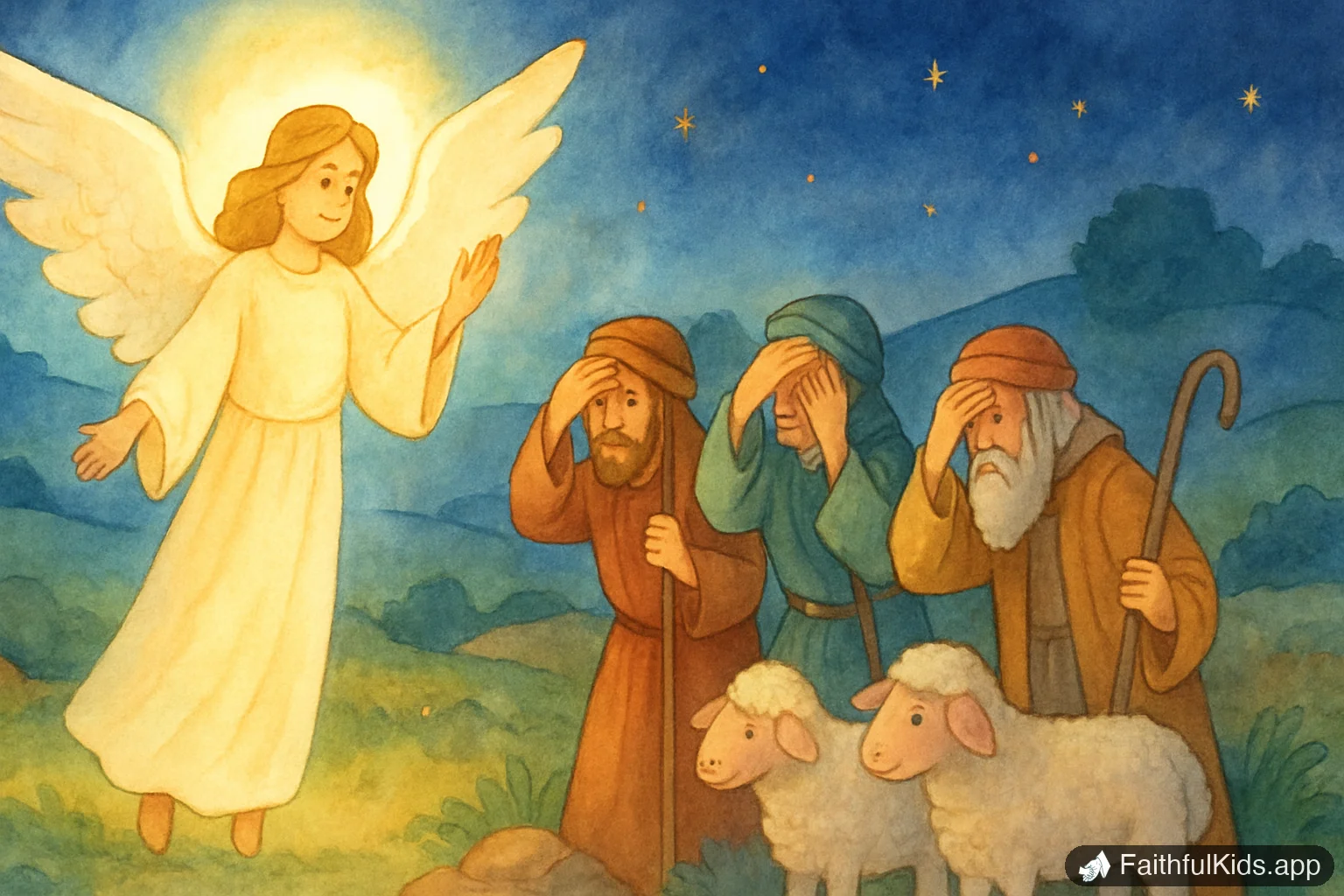
The angels and the shepherds (Luke 2:8-14). One angel appears to terrified shepherds -- "I bring you good news that will cause great joy" -- and then the sky fills with "a great company of the heavenly host" praising God. Kids love imagining the sky full of angels; we walk through it in the shepherds' song for kids.
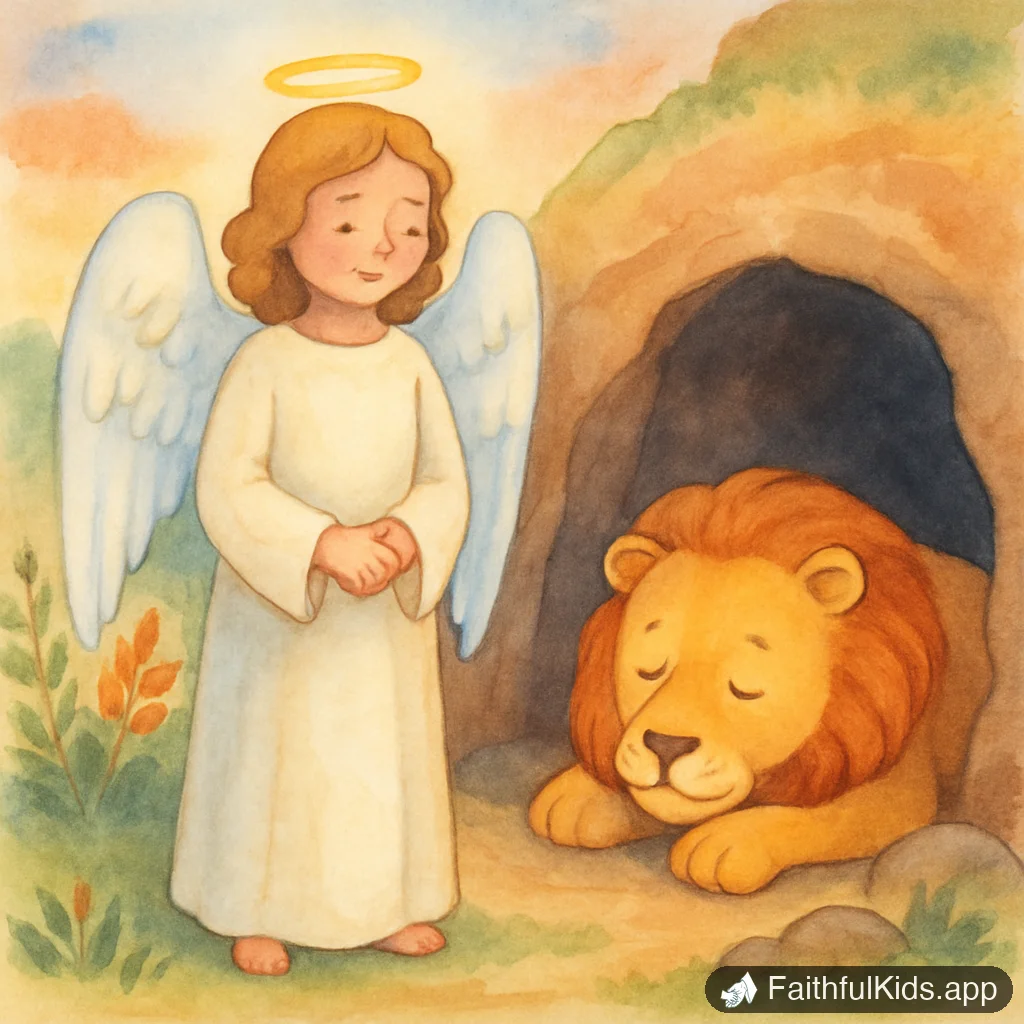
Daniel in the lions' den (Daniel 6:22). "My God sent his angel, and he shut the mouths of the lions." The clearest picture of angels as protectors.
The angel at the empty tomb (Matthew 28:2-7). An angel like lightning rolls away the stone and delivers history's best message: "He is not here; he has risen."
Peter's prison break (Acts 12:6-11). An angel wakes Peter, pops his chains off, and walks him past the guards -- and Peter thinks he is dreaming until he is standing alone in the street.
Point out the pattern across all five: angels always show up to serve GOD'S plan and point to Him -- never to get famous themselves. The video lessons at Faithful Kids cover several of these stories with quizzes, which helps the details stick during the week.
What Questions Will Kids Ask About Angels?
"Do I have a guardian angel?" "The Bible says God commands His angels to guard His people (Psalm 91:11), and Jesus said children's angels see the Father's face (Matthew 18:10). Whether it is one special angel or a whole team, the Bible does not say -- but the real promise is that GOD never takes His eyes off you."
"Why can't I see angels?" "Angels are spirits, so they are usually invisible -- like how the wind is real but you cannot see it. Once in a while God lets people see them for a special reason. And the Bible hints that sometimes angels look like regular people, so you might have met one without knowing (Hebrews 13:2)!"
"Are angels scary?" "They must be pretty overwhelming, because almost every time one shows up in the Bible, the first thing it says is 'Do not be afraid!' But God's angels are on your side -- powerful the way a firefighter is powerful."
"Can I pray to my angel?" "No -- we pray only to God. Angels are God's helpers, not little gods. The best part is you do not need a messenger anyway: because of Jesus, you can talk to God directly, anytime."
"Is Satan an angel?" "Satan was created as an angel, but he rebelled against God, and some angels followed him. They are God's enemies now -- but they are not God's equals. God has already beaten them through Jesus, and nothing they do can snatch you out of God's hand."
Which Bible Story Should You Read Together?
Read Luke 1:26-38 and Luke 2:8-14 back to back -- Gabriel's visit to Mary, then the angel army over Bethlehem. Together they take about five minutes and showcase everything angels do: deliver God's messages, calm fears ("Do not be afraid" appears in both), and burst into praise that points straight at God.
Ask your child: "What is the first thing the angel says to Mary and to the shepherds? Why do angels have to keep saying that? And who do the angels want everyone looking at -- themselves, or Jesus?" That last question lands the whole lesson: real angels are signposts, and every signpost points to God.
What Should You NOT Say About Angels?
Don't say "Grandma is an angel now." It is meant kindly, but it teaches something the Bible does not. Say instead: "Grandma is with Jesus, and she is still Grandma -- and one day God will make her completely new."
Don't use angels as surveillance. "Your angel is watching, so behave" turns a comfort into a threat. The Bible presents watching angels as protection, not informants.
Don't make angels the point. Angel figurines and angel-everything can quietly become a soft substitute for God Himself -- exactly what the angel in Revelation refused: "Worship God!" Keep angels in their lane: servants and signposts.
Don't teach kids to pray to or "contact" angels. Scripture directs every prayer to God. Anything that encourages seeking messages from spirit beings is a door the Bible tells us to leave shut.
Don't over-promise visible rescues. "An angel will always stop bad things from happening" sets up a faith crisis the first time something bad happens. The honest version: God's angels protect His people more than we know, AND God is with us even in hard things He does not stop.
Frequently Asked Questions
What are angels in simple words for a child?
Angels are God's messengers and helpers -- spirit beings God created to deliver His messages, protect His people, and praise Him. They are usually invisible, very powerful, and completely devoted to God. The word "angel" literally means "messenger."
Do people become angels when they die?
No. The Bible teaches that angels and humans are different kinds of beings God created, and humans never turn into angels. Believers who die go to be with Jesus as people, and God promises to raise them one day with new bodies -- which the Bible presents as even better than being an angel.
Does the Bible say kids have guardian angels?
The Bible strongly suggests angelic protection: Psalm 91:11 says God "will command his angels concerning you to guard you," and in Matthew 18:10 Jesus says children's angels always see the Father's face. Whether each child has one assigned angel is not spelled out, so it is best to teach the certainty (God's angels guard His people) without inventing the details.
What do angels actually look like according to the Bible?
Usually like men, sometimes shining or dressed in dazzling white -- not chubby winged babies. Some heavenly beings have wings (like the seraphim in Isaiah 6), but most angels who appear to people look human enough that Hebrews 13:2 says some have hosted angels without realizing it.
Are angels safe to teach young children about, or will it scare them?
Angels are one of the most comforting topics in Scripture for young kids when framed biblically: God has mighty helpers who watch over His people. Keep the focus on protection and good news, and save the topic of fallen angels for when a child asks -- then answer it with God's total victory front and center.
🌙 Free: The Bedtime Bible Kit
Seven nights of five-minute stories — a story, a prayer, and one question to whisper about.
Free printable + a few helpful emails. Unsubscribe anytime.