Ages 5+·11 min read··By Faithful Kids Team·Updated August 19, 2026
An object lesson on prayer turns something kids cannot see -- talking to a God who is not visibly in the room -- into something they can hold, hear, and test. These seven use props you already own: two cups and a string, a lamp, a balloon, a jar, three cups and a snack. Each takes five to ten minutes and answers one specific question kids actually ask about prayer.
Those questions are predictable, and they are good ones. Can God hear me? Does it work if I do it wrong? Why didn't I get what I asked for? What do I even say? Each lesson below is built around one of them. Pick the one matching the question your kid is currently stuck on rather than working through all seven in order.
1. The String Telephone (Can God Actually Hear Me?)
You need: two paper or plastic cups, 15-20 feet of string, a pencil or nail to poke holes
Steps: Poke a hole in the bottom of each cup, thread the string through, and knot each end inside. Walk apart until the string is tight -- this is the part kids get wrong, so make a rule of it: slack string, no sound. Have one child whisper into their cup while the other listens. It genuinely works, and the surprise on their faces is the whole lesson. Then let a third child pinch the string mid-line and try again. Nothing gets through.
Verse: "Call to me and I will answer you and tell you great and unsearchable things you do not know." (Jeremiah 33:3)
The aha moment: They whispered -- they did not shout -- and it still arrived, because the line was connected.
Takeaway line:Prayer isn't shouting at the sky. It's a line that's already connected.
2. The Unplugged Lamp (Why Pray Every Day?)
You need: a lamp with a visible cord, an outlet
Steps: Set the unplugged lamp on the table and ask a child to turn it on. Nothing. Ask what is wrong with the lamp -- kids will say the bulb, the switch, the lamp itself. Nothing is wrong with the lamp. Plug it in, flip the switch, light. Now unplug it mid-conversation and keep talking as if nothing happened. Ask, "How long does a lamp stay bright after it gets unplugged?"
Verse: "I am the vine; you are the branches. If you remain in me and I in you, you will bear much fruit; apart from me you can do nothing." (John 15:5)
The aha moment: The lamp was not broken. It was disconnected -- and those look identical from the outside.
Takeaway line:Prayer is staying plugged in, not calling for repairs.
3. The Worry Balloon (What Do I Do With Scary Feelings?)
You need: one balloon per child, a marker, a permanent marker for the adult
Steps: Have each child name a worry out loud -- a test, a move, a sick grandparent, the dark. Write one worry on each flat balloon in small letters. Now have them blow the balloon up and watch their handwriting stretch huge and distorted. Say, "That is what worry does. It does not get bigger. It just looks bigger the more we blow into it." Then, one at a time, let each child release their balloon across the room while saying, "God, this one is yours."
Verse: "Cast all your anxiety on him because he cares for you." (1 Peter 5:7)
The aha moment: The words never changed size. The air around them did.
Takeaway line:Give the worry to God instead of blowing more air into it.
4. Three Cups: Yes, No, and Wait (Why Didn't God Give Me What I Asked For?)
You need: three opaque cups, a small snack or sticker
Steps: Line up the cups and label them YES, NO, and WAIT. Put a treat under YES and under WAIT, and nothing under NO. Have a child ask you for something, then choose a cup. Discuss each one honestly. Under YES: sometimes God gives exactly what we asked. Under NO: sometimes He does not, and He is still good -- Paul asked three times for his "thorn" to be removed and God said no, and told him why. Under WAIT: the treat is still there. It just was not available yet, which is the answer kids find hardest and get most often.
Verse: "My grace is sufficient for you, for my power is made perfect in weakness." (2 Corinthians 12:9)
The aha moment: "No" and "wait" are answers. They are not silence, and they are not proof nobody was listening.
Takeaway line:God always answers -- sometimes yes, sometimes no, sometimes not yet.
5. The Answered Prayer Jar (Does This Actually Work?)
You need: a clear jar, slips of paper, a pen, two colors of marker
Steps: Every prayer request goes on a slip and into the jar with the date. That is the whole setup, and it takes two minutes. The lesson happens later: once a month, dump the jar out and read them aloud. Mark every answered one with a check and read the date. Kids forget what they prayed for within a week, which is exactly why the jar is powerful -- it is evidence they cannot argue with, in their own handwriting. Keep the unanswered slips in the jar and say so plainly.
Verse: "But God has surely listened and has heard my prayer." (Psalm 66:19)
The aha moment: They are reading their own handwriting from six weeks ago, next to something that actually happened.
Takeaway line:We forget what we prayed. God doesn't.
See what they get
Watch The Lords Prayer Come Alive
The Lords Prayer is one of 300+ short narrated video lessons your child will love. Watch the whole episode right here — in the app, every lesson ends with a fun quiz to check what they learned.
A real lesson from the app — watch the whole thing free.
6. Moses' Tired Arms (Why Do We Pray for Each Other?)
You need: two full water bottles or soup cans, a chair, a timer
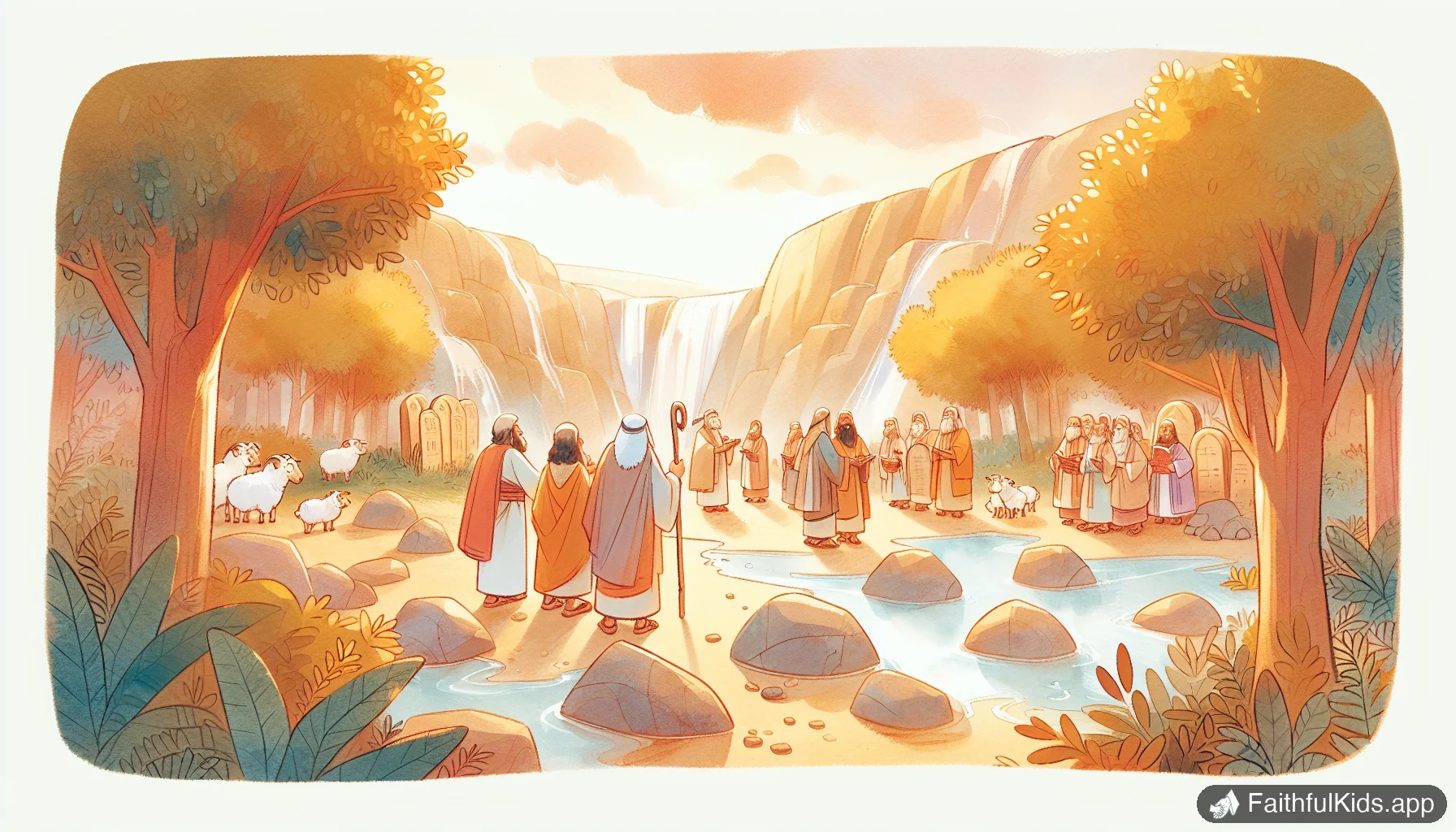
Steps: Have a volunteer stand with both arms straight out to the sides holding a can in each hand. Start the timer and tell the story of Israel fighting the Amalekites while Moses held his staff up on a hill: when his hands were up, Israel was winning, and when they dropped, they started losing. Your volunteer's arms will start shaking around the ninety-second mark, right on cue. Then, before they quit, send two friends up to stand on either side and hold their arms up. Read Exodus 17:12.
Verse: "When Moses' hands grew tired, they took a stone and put it under him and he sat on it. Aaron and Hur held his hands up." (Exodus 17:12)
The aha moment: Moses did not get stronger. He got helpers, and that was the whole solution.
Takeaway line:Nobody prays alone -- that's what friends are for.
7. The Five-Finger Prayer Hand (What Do I Even Say?)
You need: a hand -- theirs, and a paper tracing of it if you want a keeper
Steps: Have each child trace their hand on paper. Then walk through the Lord's Prayer one finger at a time, writing a word on each: thumb (closest to your heart) for praise -- "Our Father in heaven, hallowed be your name"; index finger for God's plan -- "your kingdom come, your will be done"; middle finger, the tallest, for daily needs -- "give us today our daily bread"; ring finger for forgiveness -- "forgive us our debts, as we also have forgiven our debtors"; pinky, the weakest, for help -- "lead us not into temptation, but deliver us from the evil one." Then close the hand into a fist and open it, praying it once through with fingers only, no paper.
Verse: "This, then, is how you should pray: 'Our Father in heaven, hallowed be your name.'" (Matthew 6:9)
The aha moment: They just prayed a full, balanced prayer without being told what to say -- the shape was on their hand the whole time.
Takeaway line:Jesus gave us the outline. Five fingers, five things.
This is the most-used lesson on the page because it doubles as a memory tool at bedtime. If your kids are ready for the full walkthrough of each line, we break it down phrase by phrase in the Lord's Prayer for kids explained.
How Do You Teach Prayer Without Making It Feel Like a Performance?
Model short, honest prayers out loud and let kids hear you pray about small things. The fastest way to convince a child that prayer is a performance is to only ever pray in formal voice at scheduled times. Pray in the car about a parking spot, at the sink about a friend's bad day, at bedtime in four sentences. Kids copy the tone they hear, not the theology they are taught.
Two more things that help:
Let them pray badly. A four-word prayer counts. Correcting a child's prayer -- the grammar, the theology, the length -- teaches them that praying is a test with a score.
Pray about the same thing twice. Repetition is the difference between a wish and a relationship, and it sets up the answered prayer jar to do its work.
For the practical routines that turn these lessons into habits, see how to pray with kids and our short scripts in bedtime prayers for kids. If your child is starting from zero and asking what prayer even is, start with how to explain prayer to a child before running any of these demonstrations. And for demonstrations on other topics -- sin, faith, the Holy Spirit -- our full list of Bible object lessons for kids has sixteen more.
Print the Review Round
When the lessons are done, our free Bible Trivia Pack makes an easy follow-up: 100 questions in easy, medium, and hard rounds, each answer with its Scripture reference, covering Moses, Paul, and the teachings of Jesus that these lessons come from. Print it once and it works for a classroom review or a family game night.
Frequently Asked Questions
What is a good object lesson to teach kids about prayer?
The string telephone is the best starting point for ages 5-10 because it answers the question underneath all the others: can God hear me? Kids whisper into a cup and hear a friend twenty feet away, which makes "you do not have to shout" concrete instead of theoretical. For kids who already pray but feel unanswered, use the three cups instead -- yes, no, and wait.
How do you explain unanswered prayer to a child?
Teach three possible answers instead of two: yes, no, and not yet. The three-cups lesson does this in five minutes and gives kids honest language for the experience they are actually having. Be careful not to promise that every prayer gets a yes eventually, because kids notice when that turns out to be untrue and they conclude prayer is broken rather than that the promise was wrong.
What age should kids start learning about prayer?
As soon as they can talk -- typically age 2 or 3 -- starting with one-sentence thank-you prayers at meals and bedtime. Object lessons like the balloon and the string telephone work from about age 4, while the three cups and Moses' arms need a 6-year-old's ability to sit through a story. Teenagers still benefit from the answered prayer jar, which is the only lesson on this list that gets better with age.
How long should a prayer object lesson last?
Five to ten minutes, except the answered prayer jar, which is a two-minute setup and a fifteen-minute payoff a month later. Keep the demonstration under three minutes and spend the rest on the story and the takeaway line. If kids are still talking about it after ten minutes, that is a conversation, not a lesson -- let it run.
Can I use these object lessons in Sunday school?
Yes -- all seven work in a classroom. The string telephone, worry balloon, and five-finger hand need one set per child or per pair; the lamp, three cups, and Moses' arms are single front-of-room demonstrations with volunteers. The answered prayer jar works especially well as a class jar you keep on the shelf all year and open on the first Sunday of each month.
What Bible stories go with these prayer lessons?
Pair the string telephone with Jeremiah 33:3 or Hannah's silent prayer in 1 Samuel 1, the three cups with Paul's thorn in 2 Corinthians 12, Moses' arms with Exodus 17, and the five-finger hand with the Sermon on the Mount in Matthew 6. Daniel praying at his window three times a day despite the law against it (Daniel 6) pairs well with the unplugged lamp, since both are about staying connected when it costs something.
🌙 Free: The Bedtime Bible Kit
Seven nights of five-minute stories — a story, a prayer, and one question to whisper about.
Free printable + a few helpful emails. Unsubscribe anytime.