Blog/What Are Object Lessons? (And 10 Classic Bible Examples)
Guide
What Are Object Lessons? (And 10 Classic Bible Examples)
Ages 5+·11 min read··By Faithful Kids Team·Updated August 19, 2026
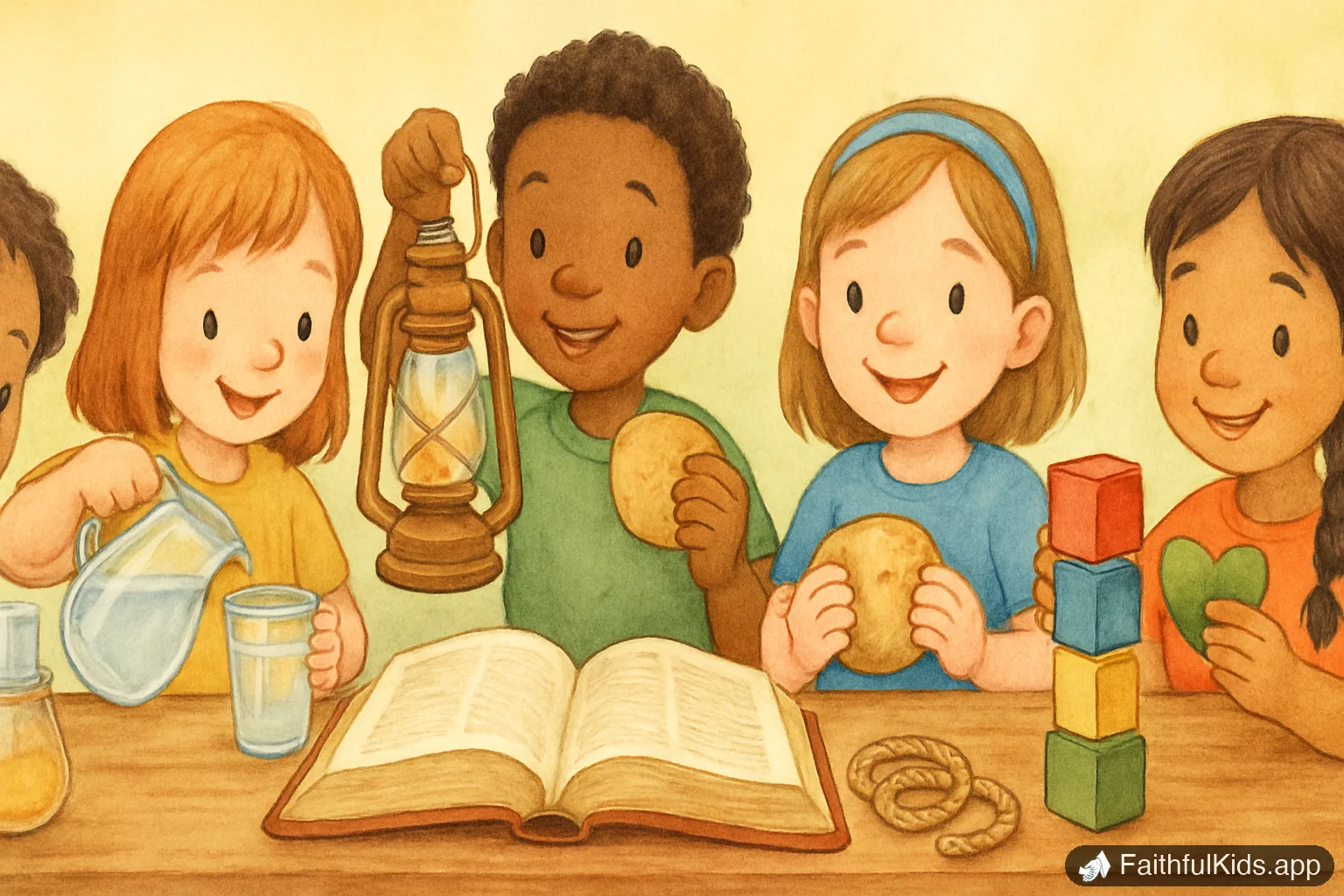
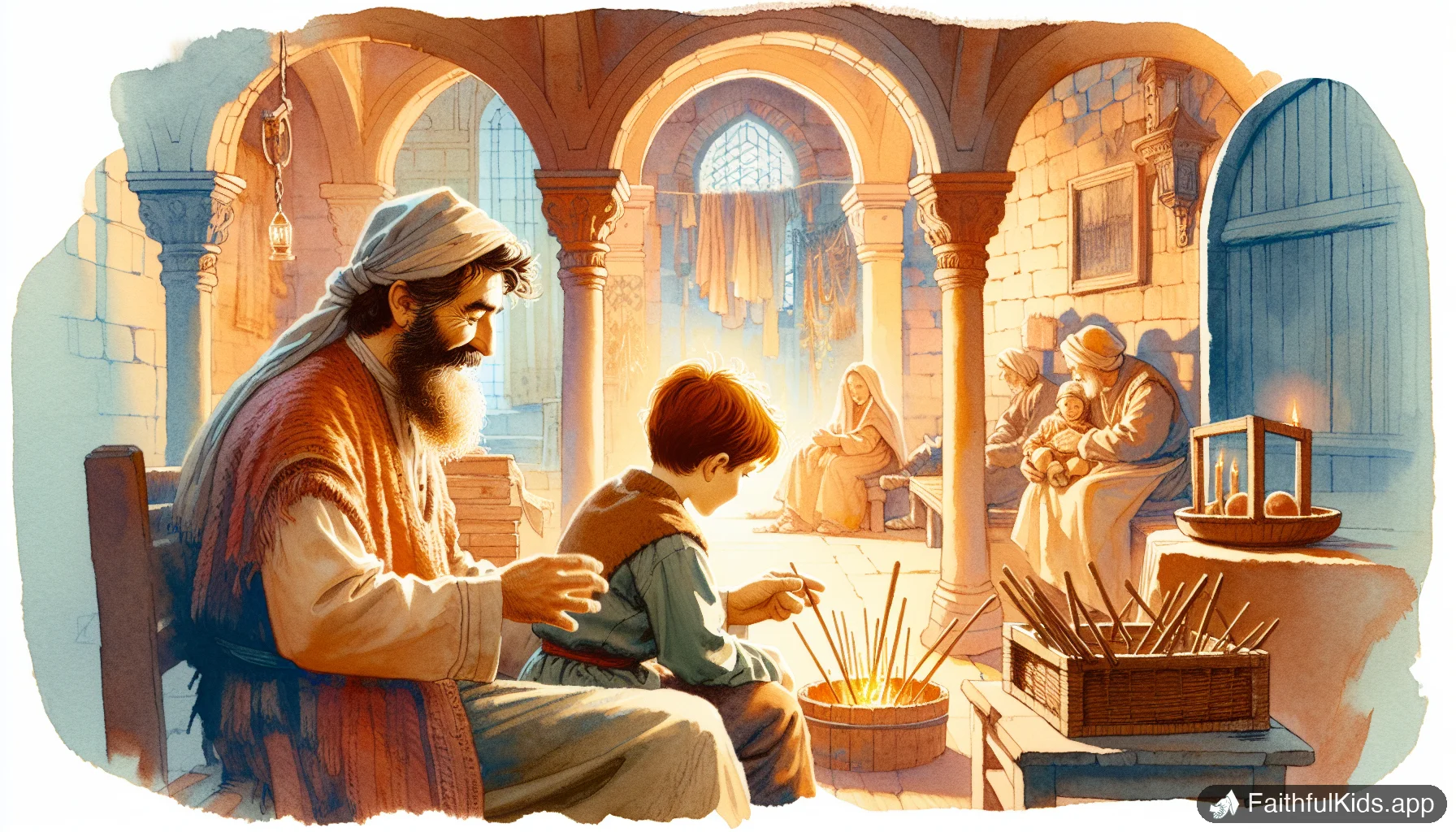
An object lesson is a short teaching that uses one physical object -- a flashlight, a seed, a sponge -- to make one abstract truth concrete and memorable. In a Bible context, the object is the hook and the Scripture is the point: you show something surprising, connect it to a verse, and hand kids one sentence they can repeat.
The format has a strict shape, and the shape is what makes it work. One object. One truth. One verse. One line. The moment an object lesson tries to teach three ideas, it stops being an object lesson and becomes a science demonstration with a sermon attached.
Why Do Object Lessons Work So Well With Kids?
Because children under about twelve think concretely -- they reason about things they can see, touch, and manipulate far more reliably than about ideas. Tell an 8-year-old that "sin separates us from God" and you have handed them four abstract nouns. Sprinkle pepper on a dish of water, let them touch it, then touch it again with a soap-dipped finger and watch the pepper flee to the edges, and they have a picture that will still be in their head at twenty.
Three things happen in a good object lesson that rarely happen in a talk:
Prediction. Asking "what do you think will happen?" before the reveal locks in attention, because now the child has a stake in the outcome.
Surprise. Memory research is boringly consistent on this: we remember what violates our expectations. The egg that dissolves, the pepper that flees, the toothpaste that will not go back.
Touch. A kid who holds the ice cube remembers differently than a kid who watched an adult hold it. Hand the object over whenever it is safe to.
There is one more reason worth naming: object lessons make abstract truth arguable. Kids ask questions about a demonstration they would never ask about a lecture, and those questions are where the actual teaching happens.
How Did Jesus Use Object Lessons?
Constantly, and with whatever was in front of him. Jesus almost never taught in abstractions -- he taught with objects his audience could see from where they were sitting.
Seeds. "The kingdom of heaven is like a mustard seed, which a man took and planted in his field. Though it is the smallest of all seeds..." (Matthew 13:31-32). A seed nobody would notice becomes the largest plant in the garden.
Lamps. "Neither do people light a lamp and put it under a bowl. Instead they put it on its stand, and it gives light to everyone in the house." (Matthew 5:15). Everyone in the room had a lamp and a bowl.
Coins. Asked about paying taxes, he did not argue -- he asked for a denarius. "Whose image is this? And whose inscription?" (Matthew 22:20). The object ended the debate.
Vines. "I am the vine; you are the branches." (John 15:5). Likely spoken near actual vineyards, to people who had seen what a cut-off branch looks like within a week.
Bread and a cup. At the Last Supper, Jesus took the two most ordinary items on the table and turned them into the church's central act of remembrance.
A child. When the disciples argued about who was greatest, "he called a little child to him, and placed the child among them" (Matthew 18:2). The object lesson was a person.
The pattern is consistent: take the ordinary thing already in the room, and let it carry the extraordinary idea.
How Do You Build Your Own Object Lesson in 4 Steps?
Start with the truth, not the object. Almost every flat object lesson was built backwards -- somebody found a cool experiment on the internet and reverse-engineered a verse onto it. Do it in this order instead.
Step 1: Name the one truth in one sentence
Write it out, in kid words, before you touch a single supply. "God's love does not depend on my behavior." "Small choices grow." "What I fill up on comes out when I get squeezed." If you cannot say it in one plain sentence, the lesson is not ready.
Step 2: Find the object that already behaves that way
Ask: what in my house does this? For "you become what you soak in," the answer is a sponge, or an egg in vinegar. For "words cannot be taken back," toothpaste. For "small things grow," a seed or yeast. The best objects are ones where the physical behavior maps to the truth without you having to explain the connection -- if you need three sentences of justification, the object is wrong.
Step 3: Anchor it to one verse you actually looked up
One verse, quoted short, cited out loud, opened in a real Bible so kids see where it came from. Resist stacking three references onto one object -- it dilutes the memory instead of strengthening it. And check that the verse means what your lesson says it means in context; a demonstration that misuses a verse teaches kids the trick and the wrong idea at once.
Step 4: Write the takeaway line and say it three times
The line is the deliverable. It should be short, concrete, and repeatable by the youngest kid present: Words come out easy, but they never go back in. Say it during the demonstration, again right after, and once more the next day when the object is nowhere in sight. That third repetition, cold, is what moves it from a fun activity to a thing they know.
See what they get
Watch a Real Lesson From the App
Press play on Walking on Water — a complete lesson exactly as your child sees it. 300+ episodes cover the whole Bible in order, each ending in a fun quiz to check what they learned.
A real lesson from the app — watch the whole thing free.
10 Classic Bible Object Lessons
These ten are the classics for a reason -- they are cheap, they work the first time, and generations of Sunday school teachers have tested them on real kids.
1. Toothpaste Words
Squeeze an entire tube onto a plate, then offer a reward to whoever can get it back in with a spoon. Teaches that words cannot be unsaid. "The words of the reckless pierce like swords, but the tongue of the wise brings healing." (Proverbs 12:18)
2. Pepper and Soap
Sprinkle pepper across a dish of water and call it sin; a finger dipped in dish soap sends it racing to the edges instantly. Teaches that we cannot push sin away ourselves. "If we confess our sins, he is faithful and just and will forgive us our sins." (1 John 1:9)
3. The Backpack of Rocks
Load a backpack with labeled rocks -- worries, grudges, guilt -- have a child wear it through the story, then lift it off their shoulders yourself. Teaches that Jesus takes the weight rather than lightening it. "Come to me, all you who are weary and burdened, and I will give you rest." (Matthew 11:28)
4. Salt and Light
A blind taste test between salted and unsalted popcorn, then a dark room and one flashlight. Teaches the two images Jesus used for his followers back to back. "You are the salt of the earth... You are the light of the world." (Matthew 5:13-14)
5. The Four Soils
Plant identical beans in four cups -- gravel, thin soil over rock, soil full of weeds, and good potting mix -- and check them daily for two weeks. Same seed, wildly different results. "But the seed falling on good soil refers to someone who hears the word and understands it." (Matthew 13:23)
6. Sand House vs. Rock House
Two paper cups, one on a tray of sand and one on a flat brick, and a pitcher of water for the storm. Teaches that the storm comes to both and only the foundation differs. "Everyone who hears these words of mine and puts them into practice is like a wise man who built his house on the rock." (Matthew 7:24)
7. The Dirty Penny Bath
Grimy pennies dropped into vinegar with a spoonful of salt come out shiny in sixty seconds. Teaches that we do not scrub ourselves clean -- we come to the one who cleans. "Though your sins are like scarlet, they shall be as white as snow." (Isaiah 1:18)
8. The Flashlight Path
Cross a dark hallway with obstacles, first without light, then with a flashlight aimed only a few feet ahead. Teaches how God's guidance usually works: the next step, not the whole staircase. "Your word is a lamp for my feet, a light on my path." (Psalm 119:105)
9. Armor of God Dress-Up
Raid the house for a helmet, a shield, a belt, boots, and a cardboard-tube sword, and suit a child up piece by piece as you read the passage. Then point out the detail kids never forget: there is no armor for your back. "Put on the full armor of God, so that you can take your stand against the devil's schemes." (Ephesians 6:11)
10. The Balloon and the Breath
A limp balloon that cannot do anything until something invisible fills it -- and in the Bible's original languages, the word for Spirit also means breath or wind. "You will receive power when the Holy Spirit comes on you." (Acts 1:8)
Four things, in order of how often they happen: teaching two truths at once, explaining before demonstrating, skipping the Bible entirely, and never repeating the takeaway line. The third one is the serious one. An object lesson that never opens Scripture is a magic trick -- kids remember the pepper and forget why it mattered. Do the demonstration, then read the verse from a real Bible, then say the line.
Two smaller failure modes worth naming: untested reactions (test anything chemical once beforehand, and if it flops live, ask the kids why -- troubleshooting together often teaches better than a clean demo) and the adult hogging the object. Hand it over. Kids remember what their own hands did.
Object lessons are the hook, not the meal. They work best as the opening five minutes of a lesson that then goes to the actual passage -- families who use Faithful Kids often run the object lesson first, watch the story episode second, and let the quiz do the review.
Print a Review Game
Once kids know the stories these lessons come from, our free Bible Trivia Pack turns them into a game: 100 questions in easy, medium, and hard rounds with every answer's Scripture reference. Print it once and it covers class review, family game night, and the car.
Frequently Asked Questions
What is an object lesson, in simple terms?
An object lesson is a teaching that uses a physical object to explain one abstract idea. A teacher shows or does something surprising with an everyday item, then names the truth it illustrates -- for example, squeezing toothpaste out of a tube to show that words cannot be taken back. The term is used in classrooms generally, but it is most associated with Bible teaching for children.
Why are they called object lessons?
Because the object does the teaching. The name dates to nineteenth-century education, when reformers pushed for lessons built on real things children could examine rather than on memorized text. The idea is older than the label, though -- prophets used physical signs, and Jesus taught almost entirely with objects, from seeds and lamps to bread and a coin.
Did Jesus use object lessons?
Yes, constantly. He taught with mustard seeds, lamps under bowls, a coin bearing Caesar's image, vines and branches, bread and wine, fig trees, and once with a child he placed in the middle of the disciples. His parables follow the same logic: take something the audience can already picture and let it carry a truth they cannot.
What age are object lessons best for?
Ages 4-12, with the strongest results between 5 and 10, though teens engage readily when the demonstration is genuinely surprising. Preschoolers need two-to-four-minute versions with one big visual and no small parts; elementary kids handle delayed payoffs like a seed that takes two weeks; middle schoolers respond best to lessons that raise a question worth arguing about.
How long should an object lesson take?
Five to ten minutes for elementary kids and two to four for preschoolers. A useful split is two minutes of demonstration, two to four minutes connecting it to the passage, and one minute repeating the takeaway line. Multi-day lessons like planted seeds only need sixty seconds of checking per day, and the anticipation does the work.
Can object lessons replace the Bible story?
No -- an object lesson is the hook, and the passage is the meal. The best sequence is demonstration first to capture attention, then the Scripture it points to, then the takeaway line to seal it. A lesson that stops before the Bible teaches kids a memorable trick with no truth attached, which is worse than teaching nothing.
🌙 Free: The Bedtime Bible Kit
Seven nights of five-minute stories — a story, a prayer, and one question to whisper about.
Free printable + a few helpful emails. Unsubscribe anytime.