Blog/16 Bible Object Lessons for Kids Using Household Items
Guide
16 Bible Object Lessons for Kids Using Household Items
Ages 5+·12 min read··By Faithful Kids Team·Updated August 20, 2026
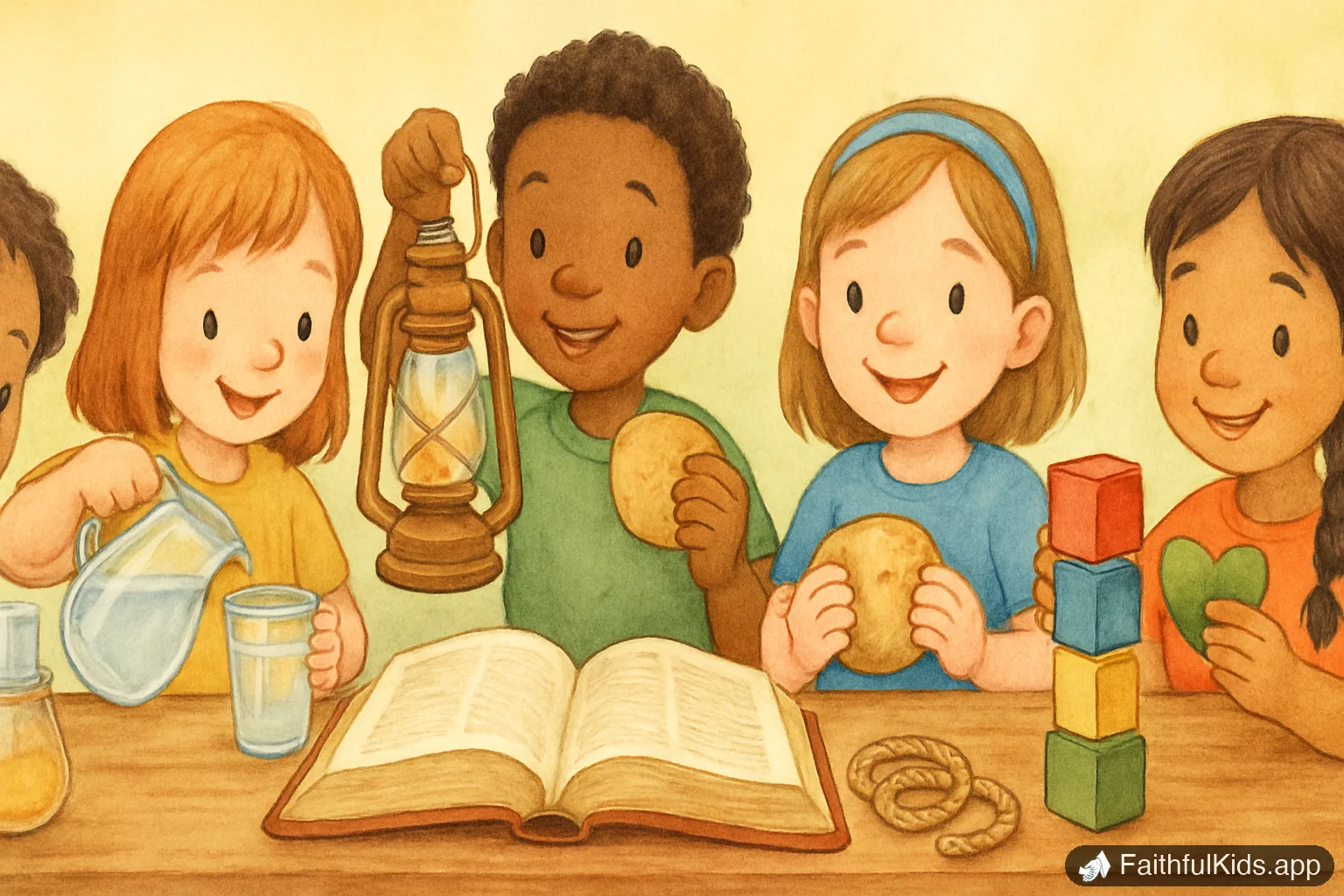
A Bible object lesson uses an everyday item -- toothpaste, a flashlight, an egg -- to make one spiritual truth unforgettable, and every lesson below uses things already in your house. Each of these 16 includes exact steps, the verse it teaches, and the one-line takeaway your kids will still be quoting next month.
Object lessons work because kids remember what they see and touch far longer than what they hear. Jesus taught this way constantly -- seeds, coins, bread, lamps. Keep each lesson under ten minutes, let kids do the hands-on part, and land the takeaway line word-for-word. The line is the lesson. If the whole approach is new to you, start with our explainer on what an object lesson actually is and come back here for the supplies.
Lessons About Words and the Heart
These five lessons make invisible heart issues visible -- start here if you're new to object lessons.
1. Toothpaste Words
You need: a tube of toothpaste, a paper plate, a spoon.
Steps: Have your child squeeze the whole tube onto the plate -- kids love this part. Then offer a dollar to anyone who can put it all back in with the spoon. They can't.
Verse: "The words of the reckless pierce like swords, but the tongue of the wise brings healing." (Proverbs 12:18)
Takeaway line:Words come out easy, but they never go back in.
2. The Crumpled Heart
You need: one sheet of paper cut into a heart.
Steps: Have kids take turns saying an unkind thing people say ("You're so dumb") while crumpling the heart a little more each time. Then apologize to the heart and smooth it out. The wrinkles stay.
Verse: "Do not let any unwholesome talk come out of your mouths, but only what is helpful for building others up." (Ephesians 4:29)
Takeaway line:Sorry helps, but wrinkles stay -- so be careful what you crumple.
3. The Egg in Vinegar
You need: a raw egg, a jar, white vinegar, 2-3 days of patience.
Steps: Put the egg in the jar, cover with vinegar, and check daily. The shell fizzes, softens, and dissolves until the egg is rubbery and fragile. The egg slowly became like what it sat in.
Verse: "Do not be misled: 'Bad company corrupts good character.'" (1 Corinthians 15:33)
Takeaway line:You become what you soak in.
4. The Bruised Apple
You need: two apples -- secretly drop one on the floor a few times the day before so it's bruised inside but looks fine.
Steps: Show both apples and ask which is better. They look identical. Cut both open and reveal the brown bruises. People can look great outside while hurting inside -- and God sees the inside.
Verse: "People look at the outward appearance, but the Lord looks at the heart." (1 Samuel 16:7)
Takeaway line:God checks the inside of the apple.
5. The Sponge Squeeze
You need: a sponge, a bowl of water.
Steps: Soak the sponge, then squeeze it and ask, "Why did water come out?" Because water is what went in. Then: "When someone squeezes you -- teases you, blames you -- what comes out?" Whatever you've been filling up on.
Verse: "For the mouth speaks what the heart is full of." (Luke 6:45)
Takeaway line:When life squeezes you, what's inside spills out.
Lessons About Sin, Forgiveness, and Grace
These four lessons show what sin does and what Jesus does about it -- the pepper one gets audible gasps. When forgiveness is the specific thing you need to teach, we have a full set of forgiveness demonstrations that go further than these four do.
6. Pepper, Soap, and the Rescue
You need: a shallow dish of water, ground pepper, dish soap.
Steps: Sprinkle pepper on the water and call it sin -- it spreads everywhere. Have your child dip a finger in: pepper sticks. Now dab that finger in dish soap and touch the water again -- the pepper instantly races to the edges.
Verse: "If we confess our sins, he is faithful and just and will forgive us our sins and purify us from all unrighteousness." (1 John 1:9)
Takeaway line:We can't push sin away ourselves -- Jesus clears it in one touch.
7. The Dirty Penny Bath
You need: the grimiest pennies you can find, 1/4 cup vinegar, 1 teaspoon salt, a bowl.
Steps: Let kids examine the dull, dirty pennies. Stir salt into vinegar, drop the pennies in, wait 60 seconds, and pull them out shiny. The penny didn't clean itself -- it just had to get in the bath.
Verse: "Though your sins are like scarlet, they shall be as white as snow." (Isaiah 1:18)
Takeaway line:We don't scrub ourselves clean -- we come to the One who cleans.
8. The Backpack of Rocks
You need: a backpack, several heavy rocks or canned goods, sticky notes.
Steps: Label each rock with a worry or sin kids name ("I lied," "scared of the test") and load the pack. Have your child wear it while doing a normal task. Then read the verse and physically lift the backpack off their shoulders.
Verse: "Come to me, all you who are weary and burdened, and I will give you rest." (Matthew 11:28)
Takeaway line:Jesus doesn't lighten the backpack -- He takes it.
9. Yeast in the Dough
You need: two small bowls of flour-and-water dough, a pinch of yeast in one, a warm spot, an hour.
Steps: Mix both doughs, adding yeast to only one, and mark them. Come back after an hour: the yeast dough has visibly puffed. A pinch you couldn't even see changed the whole lump -- which is how one "small" sin or one small act of faith spreads through a life.
Verse: "A little yeast works through the whole batch of dough." (Galatians 5:9)
Takeaway line:Small things never stay small.
Lessons Straight From Jesus' Teaching
These four put Jesus' own metaphors in kids' hands. They pair well with our Bible crafts with lessons if you want a make-and-take afterward.
10. Salt and Light Taste Test
You need: two bowls of popcorn (one salted, one not), a flashlight, a dark closet or bathroom.
Steps: Blind taste test first -- kids always pick the salted bowl: salt makes you want more. Then crowd into the dark room, sit in blackness for ten seconds, and click on the flashlight. Ask: did the light have to try hard? No -- light just wins.
Verse: "You are the salt of the earth... You are the light of the world." (Matthew 5:13-14)
Takeaway line:Salt makes people thirsty for God; light just has to show up.
11. Seed Jars (Parable of the Sower)
You need: 4 clear jars or cups, dried beans, and four "soils": rocks only, rocks with a little dirt, dirt mixed with grass/weeds, and good potting soil. Damp paper towels work too.
Steps: Plant a bean in each jar, label them like the parable (path, rocky, thorny, good soil), water, and check daily for two weeks. The good-soil bean visibly outgrows the rest.
Verse: "But the seed falling on good soil refers to someone who hears the word and understands it." (Matthew 13:23)
Takeaway line:Same seed, different soil -- be the good dirt.
12. Sand Castle vs. Rock (Wise and Foolish Builders)
You need: a baking tray, a pile of sand or flour, a flat rock or brick, two paper cups as "houses," a pitcher of water.
Steps: Build one cup-house on the sand and one on the rock. Let your child play the storm: pour water around both. The sand house tilts and slides; the rock house stands.
Verse: "Everyone who hears these words of mine and puts them into practice is like a wise man who built his house on the rock." (Matthew 7:24)
Takeaway line:Storms come to both houses -- only the foundation is different.
13. The Flashlight Path
You need: a flashlight, a dark hallway, a few pillows as obstacles.
Steps: Turn off the lights and ask your child to cross the hallway. They stumble. Now hand them the flashlight, aimed just a few feet ahead. They cross safely one step at a time without ever seeing the whole path -- which is how God usually guides.
Verse: "Your word is a lamp for my feet, a light on my path." (Psalm 119:105)
Takeaway line:God lights the next step, not the whole staircase.
Teaching kids that God guides them leads straight into teaching them to talk to Him, so our object lessons on prayer are the natural follow-up to this one.
If small hands need something to do while you read, the free lost sheep coloring page is made for exactly that.
See what they get
Watch a Real Lesson From the App
Press play on David and Goliath — a complete lesson exactly as your child sees it. 300+ episodes cover the whole Bible in order, each ending in a fun quiz to check what they learned.
You need: raid the house -- a winter hat (helmet of salvation), an oven mitt or lid (shield of faith), a belt (truth), a big coat or apron (breastplate of righteousness), rain boots (readiness of the gospel of peace), a wrapping-paper tube (sword of the Spirit).
Steps: Read Ephesians 6:13-17 slowly while your child suits up piece by piece, naming what each item stands for. Then quiz in reverse: point at a piece, they shout its meaning. Finish with the detail kids never forget -- there's no armor for your back.
Verse: "Put on the full armor of God, so that you can take your stand against the devil's schemes." (Ephesians 6:11)
Takeaway line:God armors you from head to toe -- so stand, don't run.
15. The Balloon and the Breath
You need: one balloon per kid.
Steps: Hold up a limp balloon and ask it to fly. Nothing. Blow it up and ask what changed -- nothing you can see, only breath inside. In the Bible's original languages, the word for Spirit also means breath or wind. Let the balloons go and enjoy the chaos.
Verse: "You will receive power when the Holy Spirit comes on you." (Acts 1:8)
Takeaway line:Same balloon, new breath -- the Spirit fills us with power we can't make ourselves.
16. Oil and Water (Set Apart)
You need: a clear bottle, water, cooking oil, food coloring.
Steps: Fill the bottle halfway with colored water, add oil, seal, and let your child shake it hard. The oil separates and rises every single time. Christians live in the world -- but we don't have to dissolve into it.
Verse: "Do not conform to the pattern of this world, but be transformed by the renewing of your mind." (Romans 12:2)
Takeaway line:Shaken with the world, but never dissolved into it.
How Do You Make an Object Lesson Actually Stick?
Keep it to one truth, let the kids' hands do the work, and repeat the takeaway line until they say it with you. Don't stack three verses onto one egg -- one object, one truth, one line. Ask a question before the reveal ("What do you think happens when...?") because prediction locks in attention. And revisit casually: a week later, hold up the toothpaste at bedtime and raise an eyebrow -- your kids will finish the lesson for you. For more low-prep ideas, browse our Bible activities for kids at home, or reinforce the same truths with the video-plus-quiz lessons at Faithful Kids. And the Fruit of the Spirit deserves its own list -- we've got a story for each fruit in Fruit of the Spirit for kids.
Frequently Asked Questions
What is a Bible object lesson?
A Bible object lesson is a short teaching that uses a physical item -- toothpaste, a flashlight, an egg -- to illustrate one spiritual truth from Scripture. Kids remember concrete things they see and touch far longer than abstract explanations, which is why Jesus taught with seeds, coins, lamps, and bread.
What ages do object lessons work best for?
Object lessons work best for ages 4-12, with the sweet spot around 5-10. Preschoolers need the simplest one-step versions (salt and light, the balloon), while tweens handle delayed-payoff lessons like the egg in vinegar. Even teens engage when the demonstration is surprising. For a list written entirely at the youngest level, see our object lessons for preschoolers.
How long should a Bible object lesson take?
Five to ten minutes is ideal: two minutes of demonstration, two minutes connecting it to the verse, and one repeated takeaway line. Multi-day lessons like the egg in vinegar or seed jars take one minute of checking per day, which builds anticipation.
Can I use these object lessons for Sunday school or kids church?
Yes -- all 16 work for classrooms as well as home. For groups, pick lessons where every child gets hands-on (crumpled hearts, balloons, penny baths), and prep one supply set per 3-4 kids. They slot neatly into any lesson plan as the opening hook.
Do object lessons replace reading the actual Bible story?
No -- an object lesson is the hook, not the meal. The best pattern is object lesson first to grab attention, then the Bible passage it points to, then the takeaway line to seal it. A lesson that never opens the Bible teaches kids the trick but not the truth.
What if the demonstration fails in front of the kids?
Laugh, and use it -- a flopped demonstration is memorable too. Test anything with a chemical reaction (pepper and soap, penny bath, egg in vinegar) once beforehand. If it still fails live, ask the kids why it might not have worked; troubleshooting together often teaches the point better than a perfect show.
🌙 Free: The Bedtime Bible Kit
Seven nights of five-minute stories — a story, a prayer, and one question to whisper about.
Free printable + a few helpful emails. Unsubscribe anytime.