Blog/Who Was King Saul in the Bible? Story for Kids
Guide
Who Was King Saul in the Bible? Story for Kids
Ages 5+·8 min read··By Faithful Kids Team·Updated November 2, 2026
Saul is the Bible's most sobering "what might have been." He was Israel's very first king; tall, strong, humble at the start, personally chosen and anointed by the prophet Samuel. And across the chapters of 1 Samuel, kids can watch something happen that no battle could do to him: a good beginning slowly ruined from the inside, by half-obedience, excuses, and jealousy.
His story runs from 1 Samuel 9 to 31. It pairs perfectly with David's story, because they share most of their chapters, one rising, one falling.
A King Found Looking for Donkeys (1 Samuel 9-10)
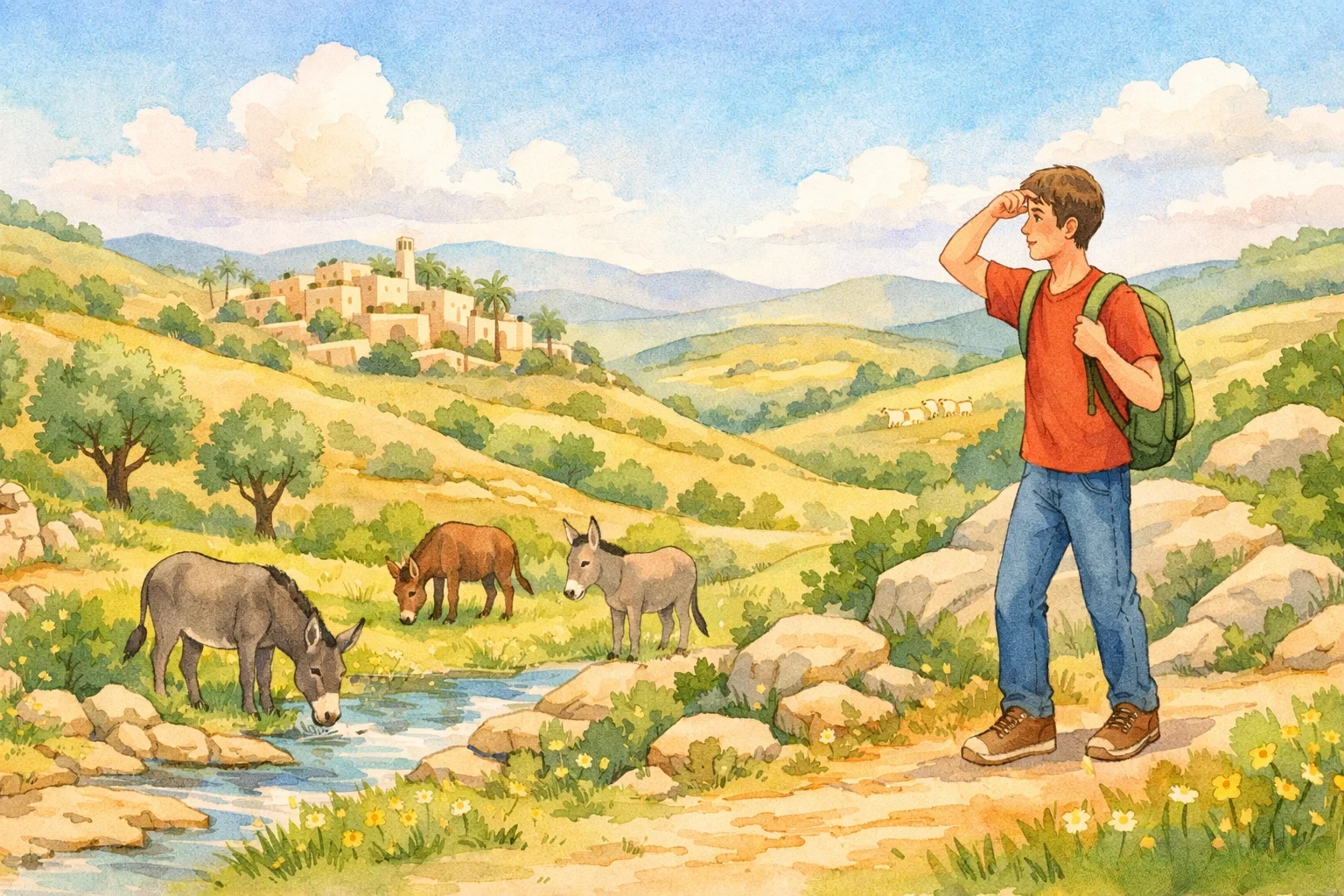
Israel had demanded a king "such as all the other nations have," and God told Samuel to give them one. The man God pointed out was almost comically ordinary at that moment: Saul, a young man from the smallest tribe, Benjamin, who was out searching the hill country for his father's lost donkeys.
Saul was impressive to look at, "a head taller than anyone else", but notice his first reactions. When Samuel hinted at his future, Saul protested that his clan was the least important in the smallest tribe. And on the day he was publicly chosen by lot at Mizpah, they couldn't find him: he was hiding among the supplies (1 Samuel 10:22).
Samuel anointed him, the Spirit of God came on him, and when the Ammonites threatened the town of Jabesh Gilead, Saul rallied all Israel and won a smashing rescue. The kingdom began with real promise. (We tell it in Saul: The First King.)
Key lesson for kids: Saul didn't start proud, he started hiding in the luggage. Nobody is born a cautionary tale. What a person becomes is built choice by choice, which is exactly why your small choices matter.
The First Crack: Impatience (1 Samuel 13)
Two years into his reign, facing a massive Philistine army at Gilgal, Saul was told to wait seven days for Samuel to come and offer the sacrifice. Seven days passed, Samuel was late, soldiers were deserting; and Saul offered the burnt offering himself, a thing a king had no right to do.
Samuel arrived as the smoke rose. Saul's explanation is a masterpiece of excuse-making: the men were scattering, you didn't come, the Philistines were gathering, "so I felt compelled" (1 Samuel 13:12). Samuel's answer fell like a stone: "You have done a foolish thing... your kingdom will not endure."
Key lesson for kids: Waiting is a test, often the main test. Saul could fight giants' armies but couldn't hold still for one more hour. When obeying God gets slow, that's not God forgetting you; that's usually the exam.
The Second Crack: Half-Obedience (1 Samuel 15)
God gave Saul a clear command in the war against the Amalekites, and Saul carried it out, mostly. He kept the best sheep and cattle, and spared King Agag, apparently as a trophy. When Samuel arrived, Saul greeted him with a straight face: "I have carried out the Lord's instructions."
Samuel's reply has become proverbial: "What then is this bleating of sheep in my ears?" (1 Samuel 15:14).
Saul's excuses shifted, the soldiers did it; we saved the animals for sacrifice; finally, "I was afraid of the men and so I gave in to them" (15:24). Samuel delivered the verdict in words every child should learn: "To obey is better than sacrifice... Because you have rejected the word of the Lord, he has rejected you as king" (15:22-23). (Full story: Saul's Disobedience.)
Key lesson for kids: Ninety-percent obedience is still disobedience, especially when the missing ten percent is the part you wanted to keep. And notice Saul's real reason: fear of what people thought. Caring more about people's opinions than God's word is where most compromise starts.
The Long Jealousy (1 Samuel 16-27)
After God rejected Saul, Samuel secretly anointed a shepherd boy in Bethlehem, David. And in one of the Bible's strange mercies, David first entered Saul's service as the harp player whose music soothed the troubled king.
Then came Goliath, and the women's victory song: "Saul has slain his thousands, and David his tens of thousands." The text says Saul kept a jealous eye on David from that day forward (1 Samuel 18:9), and jealousy became the engine of his remaining years. He threw spears at David while he played. He hunted him through the wilderness with armies. Twice David could have killed Saul and refused, once cutting the corner of his robe in a cave and calling out to show it, and twice Saul wept and admitted, "You are more righteous than I" (1 Samuel 24:17), only to resume the hunt later.
Key lesson for kids: Jealousy is a fire that cooks the person holding it. David never hurt Saul once; Saul's envy wrecked his own peace, family, and reign. When someone else shines, the healthy prayer is "thank you, God, for their gift", said until you mean it.
See what they get
Watch a Real Lesson From the App
Press play on The Good Samaritan, a complete lesson exactly as your child sees it. 300+ episodes cover the whole Bible in order, each ending in a fun quiz to check what they learned.
A real lesson from the app, watch the whole thing free.
The Sad End (1 Samuel 28-31)
Saul's final days are the darkest in the book. With Samuel dead and God silent toward him, Saul, the king who had banned mediums, disguised himself and consulted one at Endor the night before his last battle. The next day on Mount Gilboa, the Philistines overwhelmed Israel; Saul's sons fell, including Jonathan, David's loyal friend, and Saul, wounded, died on his own sword (The Fall of King Saul).
David's grief was real, his lament for Saul and Jonathan (2 Samuel 1) honors them both: "How the mighty have fallen!"
Key lesson for kids: Saul's story is sad on purpose. The Bible shows where pride, half-obedience and jealousy finally lead, so that the reader, not the king, gets the second chance.
🕯️ Free: 25 Days of Advent Bible Readings
December 1 to 25, one short reading a night, from the first promise to the manger. Printable for the fridge.
Free printable + a few helpful emails. Unsubscribe anytime.
Why King Saul Matters
He's the control group for David. Same throne, same prophet, same wars; the one difference was the heart, which is exactly what God had said He looks at (1 Samuel 16:7).
His fall teaches the big three: impatience under pressure, obedience trimmed to taste, and envy of someone else's blessing. Every kid will face all three.
He shows that gifts don't guarantee character. Saul had height, strength, courage, and the Spirit's empowering; none of it substituted for a surrendered heart.
His story frames Israel's monarchy, from the people's demand for a king to the rise of David's line that leads to Jesus. Quiz the era with our 1 Samuel Bible trivia, and find Gilgal, Gibeah and Mount Gilboa on the free map of ancient Israel.
Watch on Faithful Kids
Your kids can watch Saul's whole arc, the donkeys, the hiding, the spear, the cave, in short animated episodes on Faithful Kids, about two minutes each with a quiz and reflection after every story.
Why did God choose Saul if He knew Saul would fail?
The Bible doesn't fully answer that, but it gives two anchors. First, Israel asked for a king "such as all the other nations have" (1 Samuel 8:5), and Saul was exactly that kind of king, impressive on the outside. Second, Saul's failure wasn't fated; the texts hold him responsible for real choices, and Samuel told him his kingdom could have endured (1 Samuel 13:13). God used even Saul's reign to prepare Israel for David, and to teach every reader since what kind of heart a throne requires.
Is King Saul the same Saul as in the New Testament?
No, they're different men, a thousand years apart, though both were from the tribe of Benjamin. The New Testament Saul was a Pharisee who persecuted the church until he met Jesus on the Damascus road and became Paul the apostle. We tell that story in Saul Meets Jesus and his profile in Who Was Paul?.
Did Saul ever repent?
He said "I have sinned" at least three times (1 Samuel 15:24, 24:17, 26:21), and some of those moments, especially weeping at the cave, read as genuinely moved. But each time, his behavior resumed unchanged, which is the story's hard lesson: feeling sorry and turning around are different things. Scripture leaves his final standing with God unstated and lets the pattern of his life speak.
What happened between Saul and the medium at Endor?
On the eve of his last battle, with God not answering him "by dreams or Urim or prophets" (1 Samuel 28:6), Saul asked a medium to call up Samuel. The passage describes Samuel appearing and confirming the judgment already spoken: the kingdom was torn away, and Saul would fall the next day. It's one of the Bible's strangest scenes, and its plain function in the story is tragic; the king who began by God's word ends seeking a banned séance because he'd lost the word long before.
🕯️ Free: 25 Days of Advent Bible Readings
December 1 to 25, one short reading a night, from the first promise to the manger. Printable for the fridge.
Free printable + a few helpful emails. Unsubscribe anytime.