Blog/12 Memory Verse Games That Make Scripture Stick
Guide
12 Memory Verse Games That Make Scripture Stick
Ages 5+·14 min read··By Faithful Kids Team·Updated August 19, 2026
The best memory verse games force kids to recall the words instead of just reading them. That single difference -- retrieval instead of repetition -- is what turns a fun ten minutes into a verse a child still knows next month. Below are 12 games built on that principle, each with how to play, the group size it fits, and the specific memory mechanism it uses.
A lot of "memory verse games" are really just games with a verse taped to the side. Kids have a blast, nobody remembers the verse by Wednesday, and the leader concludes that games don't work. They do work -- but only when the game itself is the recall practice, not the reward for finishing it.
What Makes a Memory Verse Game Actually Work?
Three things, and you can check any game against them in about five seconds.
It makes kids produce the words, not read them. Reading a verse off a board feels like learning and mostly isn't. The moment a child has to supply a missing word from memory, the brain does real work, and real work is what gets stored.
It repeats with variation. Saying a verse ten times in a row is boring and surprisingly ineffective. Saying it ten times in ten slightly different formats -- whispered, scrambled, backwards, with motions -- forces the brain to re-encode it each time.
It spaces the practice out. A verse learned hard on Sunday and never touched again is gone by the following Sunday. Games you can replay in two minutes, weeks later, are worth more than elaborate ones you'll only run once.
Every game below hits at least two of the three. The 20 techniques in our guide to Bible memory verse strategies for kids go deeper on the non-game side of the same science.
1. Word Drop
Group size: 1 to 30. Works equally well one-on-one at the kitchen table or with a full classroom.
How to play: Write the whole verse on a whiteboard, poster, or piece of paper. Read it aloud together. Erase one word -- start with an easy filler word -- and read the verse again, saying the missing word from memory. Erase another. Keep going, one word at a time, until the board is blank and the group is reciting the entire verse from nothing. Let a different child choose which word disappears next; it keeps everyone scanning the text.
Why it works for memory: This is textbook fading -- support is removed gradually while the recall demand rises, so kids are never guessing blindly but never coasting either. By the last few rounds they are doing full retrieval without noticing the transition. It is the single most reliable memory verse game there is, which is why it has survived in Sunday school rooms for a century.
2. Verse Puzzle Race
Group size: 1 to 12, or teams of 3-4 in a bigger room.
How to play: Write the verse on a sentence strip and cut it apart -- into individual words for older kids, into two- and three-word phrases for younger ones. Include the reference on its own piece. Scramble the pieces, then have the child or team rebuild the verse in order and read it aloud. Time it. Then shuffle and beat the time. Three rounds is usually the sweet spot before energy drops.
Why it works for memory: Reassembling word order trains sequence memory, which is the part kids actually lose first. A child who "knows" a verse but stalls halfway through has a sequencing gap, not a vocabulary gap. Cutting phrases rather than single words for beginners also teaches natural chunking, and chunked verses are far easier to hold.
3. Motion Mapping
Group size: Any, from a single toddler to a hundred kids in a gym.
How to play: Break the verse into four to six short phrases. Assign each phrase a simple, obvious gesture -- point up for "the Lord," hands over heart for "my shepherd," palms out and empty for "I shall not want." Say the verse together with the motions three times. Then do the motions with no words and let kids fill in the verse. Finally, do the words with no motions.
Why it works for memory: Movement stores the verse in a second memory system, so the child has two independent paths to the same words. When the verbal path stalls, the body supplies the cue. This is why motion mapping is unbeatable for preschoolers and for any child who cannot sit still -- and why the motions-only round matters most. That round is pure retrieval.
4. Relay Recall
Group size: 6 to 40, in teams of 4-6. This is your large-group workhorse.
How to play: Write each word of the verse on its own index card and make one full set per team. Pile each team's shuffled set at the far end of the room. On "go," one player at a time runs down, grabs a single card, runs back, and lays it in the team's growing line. Only one card per trip. When a team believes their verse is complete and in order, they stand and recite it together. First team to recite correctly wins -- correctly, not fastest, or the game rewards sloppiness.
Why it works for memory: Between sprints, kids stare at a half-built verse trying to figure out what comes next. That gap is unglamorous and it is where the learning happens. The running also burns the energy that would otherwise sabotage a quiet review, which is why this game rescues the last fifteen minutes of a restless class. For more crowd-sized options, our Sunday school games for kids list sorts 22 games by group size.
5. Whisper Chain
Group size: 6 to 20, seated in a line or circle.
How to play: Show the verse once, then hide it. Whisper the verse to the first child. They whisper it to the next, and so on down the line. The last child says out loud what reached them. Compare it to the real verse and laugh at the damage. Then run it again in the opposite direction and see how much less it drifts on the second pass.
Why it works for memory: Every child in the chain has to hold the verse, reconstruct it, and produce it -- that is encode, store, and retrieve in about four seconds each. The comedy of the mangled version is not a side effect; errors that are noticed and corrected are remembered better than words that were never gotten wrong. Always run the second pass, because that is the one where accuracy jumps.
6. Backwards Build
Group size: 1 to 15.
How to play: Start with the last two or three words of the verse and the reference. Say just that. Then add the phrase before it and say both. Keep adding phrases from the end toward the beginning until you are saying the whole verse from the start. Older kids can race a sibling; younger kids can do it with you as a call-and-response.
Why it works for memory: In normal front-to-back practice, the opening gets rehearsed constantly and the ending barely at all -- which is exactly why kids trail off near the end. Building backwards inverts the practice load, so the finish is the strongest part. It also means the verse is always moving toward familiar ground, which keeps confidence high.
See what they get
Watch a Real Lesson From the App
Press play on Daniel in the Lions Den — a complete lesson exactly as your child sees it. 300+ episodes cover the whole Bible in order, each ending in a fun quiz to check what they learned.
A real lesson from the app — watch the whole thing free.
7. First-Letter Sprint
Group size: 1 to 30.
How to play: Write only the first letter of each word of the verse in a row on the board. "God is love" becomes "G i l." Point to the letters and have kids say the full verse. Erase a few letters and repeat. Older kids can copy their own letter-strip onto paper and use it as a pocket cue all week.
Why it works for memory: The letters carry the rhythm and word count of the verse while giving away almost nothing, so the recall demand is high but the structure is still there. This is a competition-level mnemonic technique, and it scales beautifully to longer passages that other games can't handle.
8. Beach Ball Verse Volley
Group size: 8 to 25, standing in a circle.
How to play: Toss a beach ball across the circle. Whoever catches it says the next word of the verse, then immediately tosses it on. Keep the ball moving until the verse is finished, then start over without pausing. When the group gets good, speed it up, or reverse direction mid-verse so nobody can predict their word.
Why it works for memory: Nobody knows which word they'll get, so all 20 kids track the entire verse the whole time rather than rehearsing their one assigned line. The physical catch adds just enough distraction that recall has to be genuinely automatic to survive it -- which is a fair test of whether a verse is actually learned.
9. Hot Potato Recitation
Group size: 5 to 20.
How to play: Pass an object around the circle while music plays. When the music stops, whoever is holding it recites the verse alone -- or, for a gentler version, says the next phrase. If they get stuck, the circle helps, and the object keeps moving. Play until every child has been caught at least once.
Why it works for memory: Solo recitation is the hardest and most valuable form of retrieval, and most kids will never volunteer for it. The randomness removes the social cost of being picked. Keep the rescue rule generous and cheerful -- the goal is that being caught feels like a turn, not a test.
10. Musical Freeze Verse
Group size: 10 to 40. Best with high energy and low ceilings for chaos.
How to play: Kids move around the room while music plays. When it stops, everyone freezes and shouts the verse in unison. Start the music again. Each round, drop one phrase from the group recitation and replace it with silence -- so by round five they are shouting a verse full of gaps that each child fills silently in their head, then landing together on the final phrase.
Why it works for memory: The silent-gap rounds are covert retrieval, and covert retrieval is nearly as effective as saying it aloud while being far less intimidating. Meanwhile the movement between rounds resets attention, which is why this game holds a large group longer than seated repetition ever will.
11. Sword Drill Sprint
Group size: 4 to 30, one Bible per child.
How to play: Bibles closed and held up. The leader calls out the reference -- "Philippians 4:13" -- and kids race to find it, stand, and read it aloud. Then close the Bibles and have the group say it from memory. Run three or four references, mixing in verses learned weeks ago.
Why it works for memory: Most memory verse games train the words and neglect the address, so kids end up knowing a verse they can't find or cite. Drilling the reference alongside the text links the two, which is what makes a verse usable later in life. It also gets old verses back in circulation, which is the spaced review most programs skip.
12. The Verse Vault
Group size: Any. This is the review game, and it matters more than the other eleven.
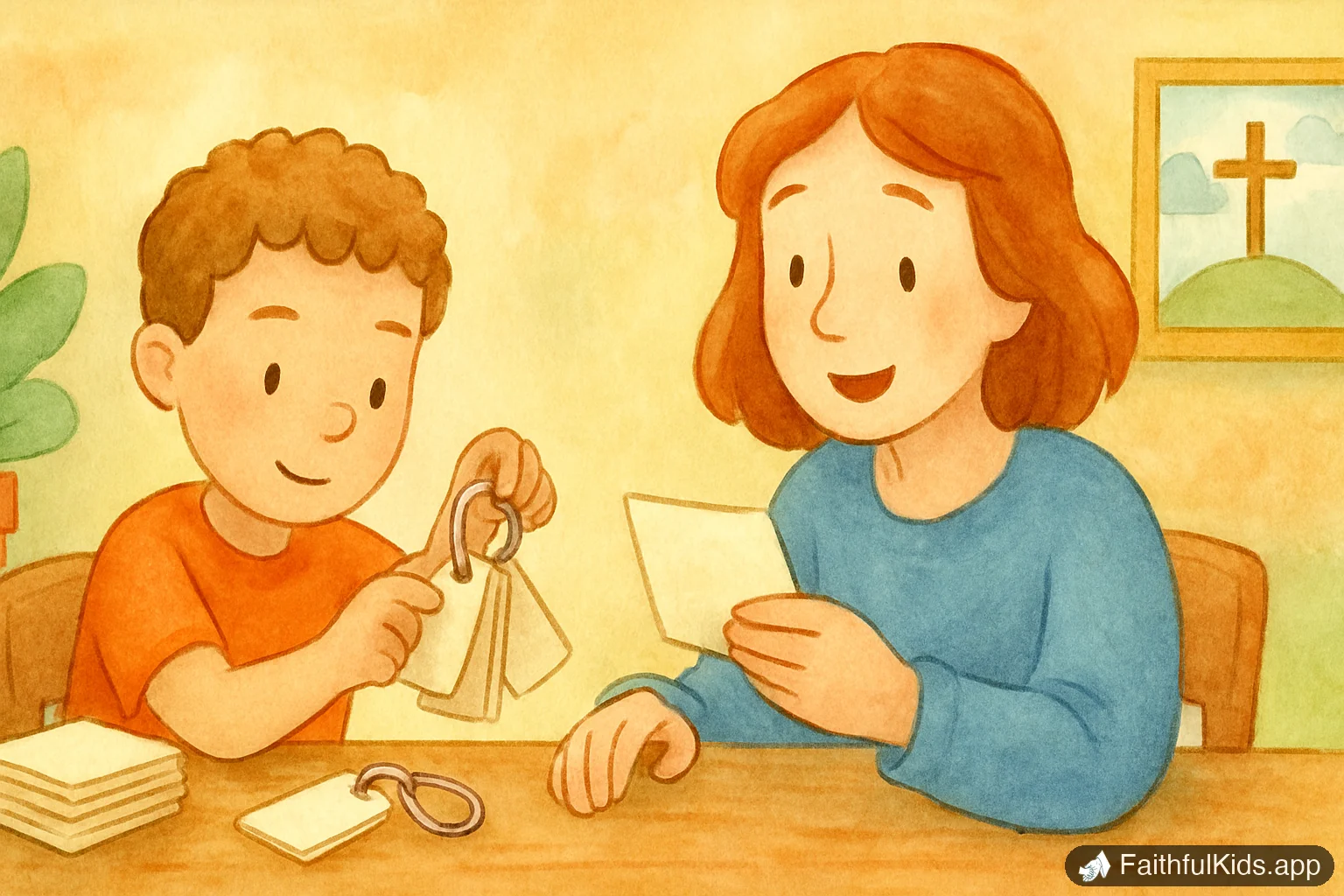
How to play: Keep every verse your family or class has learned on index cards in a box -- the "vault." Once a week, draw three cards at random and try to recite each one. Verses recited cleanly go back in the vault; verses that stumble go into a small "needs work" stack that gets drawn from first next time. Set a family record for cards cleared in one sitting and try to beat it. Our printable Bible memory verse cards give you 20 verses already formatted to start the box.
Why it works for memory: This is spaced repetition, the single best-evidenced memory technique there is, disguised as a two-minute game. Learning a new verse every week without review produces a child who knows exactly one verse -- this week's. The vault is what converts a year of Sunday school into a lifetime bank of Scripture.
How to Run These Without It Turning Into Chaos
Pick one verse and rotate the games rather than picking one game and rotating verses. Five different games on Psalm 56:3 across a week will plant it permanently. Five verses in five games will plant none of them.
Keep each game under ten minutes. Stop while kids still want more -- the game you end early is the game they ask for next time.
Play the same verse's games on non-consecutive days. Monday, Wednesday, Friday beats three rounds on Monday, and it costs you nothing.
Start with verses short enough to win at. Our list of Bible verses for kids to memorize is sorted by age, and our 40 short memory verses roundup is built for the youngest players, so you can pick something a five-year-old can finish rather than something an adult admires.
If you want the stories behind the verses, short animated Bible lessons on Faithful Kids give kids the context that makes "be strong and courageous" mean something before they ever try to memorize it.
For the nights when nobody has energy for a game, our free Bedtime Bible Kit gives you seven short readings and a goodnight prayer that ride the routine you already have -- print it once and it covers a week of wind-downs.
For a version that scores itself, try the Bible trivia game on our site and let the kids chase the streak counter.
We also drew a set of free Bible word searches — eleven puzzles you can play in the browser or print for a class.
If you're planning a whole night, our list of youth group games sorts 55 of them by group size, with rules, materials, and prep time for each.
What is the best memory verse game for a large group?
Relay Recall and Musical Freeze Verse handle the biggest groups best because every child is active the entire time and neither one requires taking turns. Beach Ball Verse Volley works well up to about 25. Avoid solo-recitation games like Hot Potato with very large groups, since most kids end up waiting instead of practicing.
How do I play a memory verse game with only one child?
Word Drop, Backwards Build, First-Letter Sprint, and Verse Puzzle Race are all built for one. Add a stopwatch and let your child compete against their own previous time -- one-on-one games need a scoreboard of some kind, and beating yesterday's record supplies it without needing an opponent.
Do memory verse games work for preschoolers?
Yes, with two adjustments: cut verses into phrases rather than words, and lean heavily on Motion Mapping. A four-year-old can learn "God is love" (1 John 4:8) or "Be kind to one another" (Ephesians 4:32) with gestures in a single sitting. Keep sessions to three or four minutes and repeat them daily rather than running one long session weekly.
How long does it take a child to memorize a Bible verse?
A short verse usually takes three to five short practice sessions spread over several days. Cramming it in one sitting produces a verse the child can recite that evening and has lost within a week. Spacing the same total practice across Monday, Wednesday, and Friday roughly doubles long-term retention for no extra effort.
How often should we review verses we already learned?
Once a week for the first month, then once a month after that. This is exactly what The Verse Vault is for -- three random cards a week takes two minutes and is the difference between a child who has memorized 40 verses and a child who has memorized 40 verses one at a time and forgotten 39.
Should I give prizes for memorizing verses?
Small recognition helps, but tie it to the review, not the first recitation. Rewarding a verse the day it's learned pays kids for cramming; rewarding a verse still remembered a month later pays them for the thing you actually want. Milestone celebrations at 10, 25, and 50 verses in the vault work better than a sticker per verse.
🌙 Free: The Bedtime Bible Kit
Seven nights of five-minute stories — a story, a prayer, and one question to whisper about.
Free printable + a few helpful emails. Unsubscribe anytime.