Teaching the Bible to Large Groups of Kids: A Field Guide
Ages 5+·11 min read··By Faithful Kids Team·Updated August 20, 2026
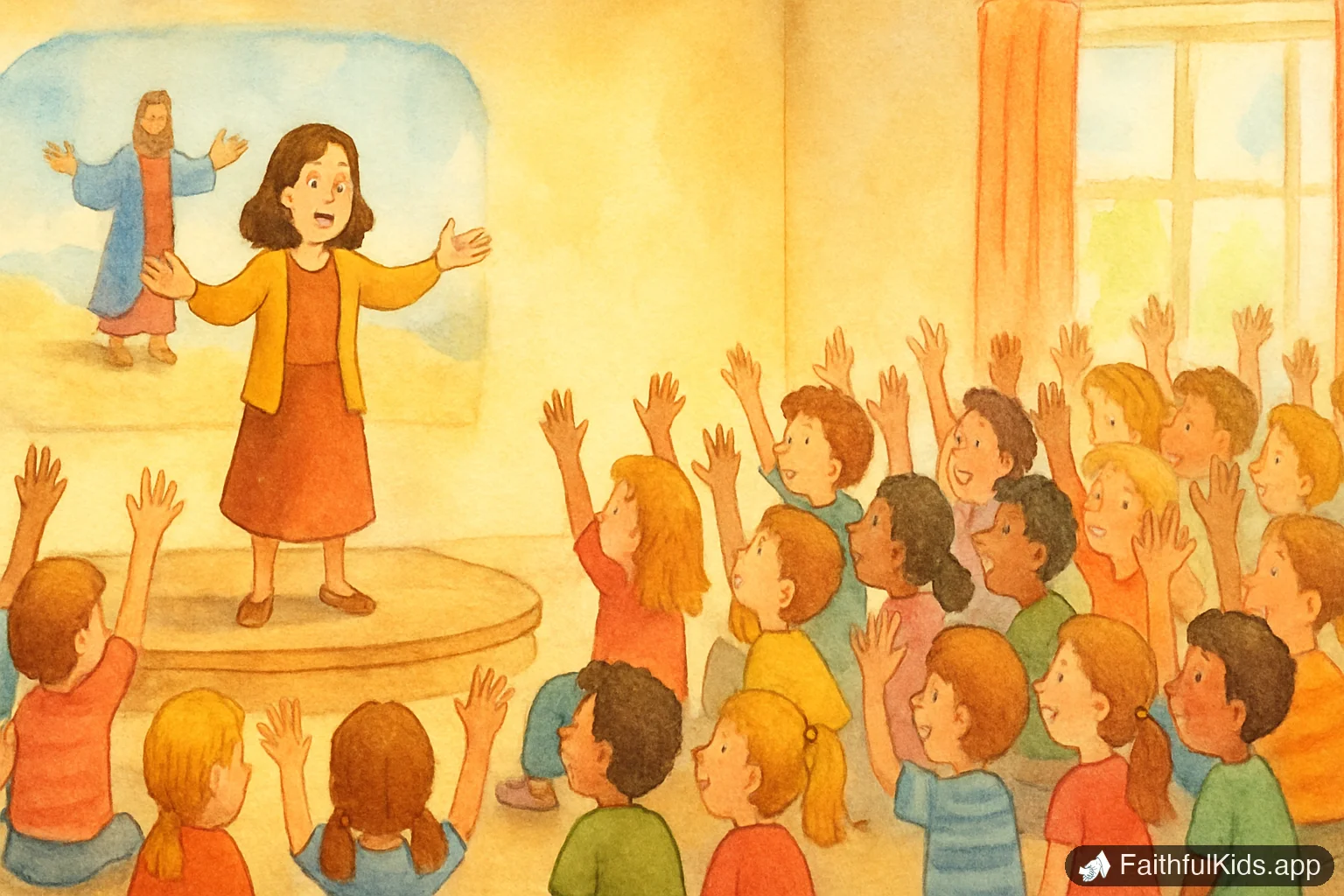
Teaching the Bible to 20 or more kids works when you stop trying to scale up a small-class lesson and instead run three systems: predictable crowd-management routines, a station rotation that keeps group sizes small, and helpers with specific assigned jobs. Big groups don't need a louder teacher -- they need better structure.
I learned this the hard way the first Sunday our class jumped from 9 kids to 27. The lesson that had worked beautifully for 9 dissolved into chaos for 27 -- not because the kids were worse, but because the format was wrong. Everything below is what actually holds a room of 20, 40, or 60 kids, whether it's a combined Sunday school class, a midweek program, or VBS week.
How Do You Manage a Crowd of 20+ Kids?
You manage a crowd with pre-taught routines, not in-the-moment instructions -- kids in large groups follow patterns, not directions. Every large-group program that runs smoothly has drilled these five routines until they're automatic:
1. An attention signal. Pick one and never change it: a call-and-response ("God is good!" / "All the time!"), a clap pattern kids echo, or a raised hand that spreads silently through the room. Practice it as a game the first week -- "let's see how fast we can get to silent" -- and use it before every transition. A good signal gets a room of 40 quiet in under five seconds.
2. A seating system. Assign kids to color teams or table groups the moment they walk in (a colored wristband or name tag sticker works). Now "everyone sit down" becomes "Red team, carpet squares by the window" -- and 30 kids sort themselves in seconds instead of puddling in the middle of the room.
3. Transition scripts. Chaos in big groups happens between activities, not during them. Move groups one at a time ("Blue team, walk to the craft table -- go. Now green team..."), and give kids waiting something to do: a song, a countdown, or a "statue challenge." Never release the whole room at once.
4. A noise meter. Define three volume levels -- level 0 (silent, for prayer and Bible reading), level 1 (whisper, for crafts), level 2 (talking, for games) -- and post them. "We're at level 1" replaces "quiet down!" and gives kids an actual target instead of a vague scolding.
5. The 80/20 attention rule. In a group of 25+, plan for kids to be actively doing something 80% of the time and listening 20%. A large group can genuinely listen for 5-8 minutes at a stretch, maximum. Build the lesson around that number rather than fighting it.
Why Do Station Rotations Work Better Than One Big Lesson?
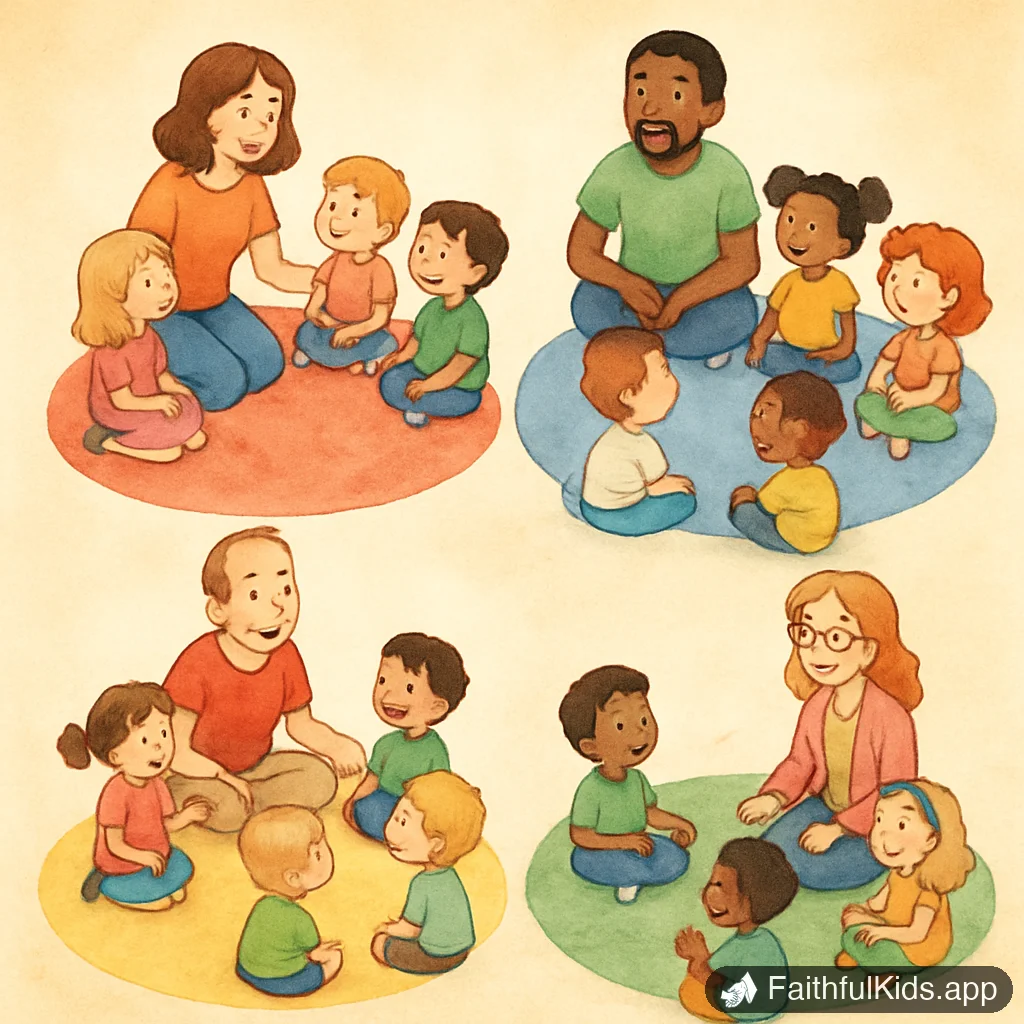
Rotations turn one teacher facing 30 kids into three helpers each facing 10 -- and 10 is a teachable number. Instead of stretching one lesson to fill an hour, you teach the same Bible story from three angles at three stations, and groups rotate every 12-15 minutes.
A proven rotation for a 60-minute hour with 24-36 kids:
Time
Station A
Station B
Station C
0:00-0:10
Whole group together: welcome, song, story intro
0:10-0:25
Bible story + discussion
Craft or activity page
Game or object lesson
0:25-0:40
Game or object lesson
Bible story + discussion
Craft or activity page
0:40-0:55
Craft or activity page
Game or object lesson
Bible story + discussion
0:55-1:00
Whole group together: recap, memory verse, prayer
Why this shape works:
The story station stays small. Every child hears the Bible story in a group of 8-12, where they can actually be asked questions -- something impossible with 30. Good story-station material is the backbone; our Bible lesson plans for Sunday school breaks down how to structure that 15-minute teaching block.
Only one station needs a strong teacher. Your best storyteller anchors the story station and teaches it three times. The craft and game stations can be run by helpers following a card of instructions -- which is exactly the level of responsibility most volunteers want.
Movement is built in. Kids never sit longer than 15 minutes, so you spend almost no energy on wiggle suppression.
Repetition happens invisibly. Kids meet the same story three ways -- heard, made, and played -- which beats hearing it once for three times as long.
For groups of 20-25, run two stations instead of three and keep the rotation at 15 minutes. For 40+, add a fourth station (memory verse games or snack) rather than letting any group exceed 12 kids.
What Games Work With a Big Group?
The best large-group games need zero equipment, no turn-taking lines, and involve every child simultaneously -- if kids are standing in line waiting a turn, the game is wrong for the size. Six formats that scale to any number:
1. Four corners, Bible edition. Label corners 1-4, ask a review question with four answer options, kids run to the corner they believe. Everyone moves, everyone answers, nobody is "out."
2. Team trivia blocks. Color teams confer for 15 seconds, then one rotating spokesperson answers. Questions organized by difficulty keep both the 5-year-olds and the 11-year-olds in the game -- pull from a bank like our Bible trivia for kids so you're never writing questions Saturday night.
3. Whole-room sorting. "If you'd rather be brave like David, this wall; wise like Solomon, that wall." Movement plus a review of character traits, no props.
4. Simon Says: Scripture edition. "God says... march like the Israelites! God says... build like Noah!" Works with 60 kids as easily as 6.
5. Silent lineup challenges. Teams line up by birthday month or height without talking. This is secretly crowd-management training disguised as a game.
6. Echo-motion memory verse races. Teams compete to perform the verse with motions, fastest clean run wins. Loud, physical, and it's memory work.
Rotate a handful of these rather than inventing new ones weekly -- familiar games start faster and run cleaner. Our full list of Sunday school games for kids has more that scale well past 20 players. If your big room skews middle and high school, the games built for middle and high schoolers collection is sized for that crowd, and the games that need zero setup are what to reach for on the week a station leader cancels an hour before start.
One caution: avoid elimination games with big groups. Eliminated kids in a group of 30 become a bored, unsupervised crowd within a supervised one -- and that's where behavior problems hatch. For a teen-heavy room, swap the running games for Scripture-based games for youth, which win on teamwork and Bible knowledge rather than pure energy.
See what they get
Watch a Real Lesson From the App
Press play on Noah and the Great Flood — a complete lesson exactly as your child sees it. 300+ episodes cover the whole Bible in order, each ending in a fun quiz to check what they learned.
A real lesson from the app — watch the whole thing free.
How Do You Coordinate Helpers So They Actually Help?
Give every helper a named job with a specific station and specific kids -- helpers without assignments drift to the back wall and check their phones, not from laziness but from not knowing what's theirs. In a room of 20+ kids you need roughly one adult per 8 kids (one per 5 for preschoolers), each holding one of these roles:
The Teacher runs the story station and nothing else. Protect this person from door duty and bathroom runs.
Station leaders each own one station with an instruction card: the activity steps, the one connection sentence to the Bible story, and the supply list. If a helper can read the card, they can run the station.
The Shepherd owns transitions, bathroom trips, latecomers, and the child having a hard day. This is the most underrated role in children's ministry -- with a good shepherd, the teacher never stops teaching.
The Door person handles check-in, security tags, and parents at pickup.
Three habits that keep the team working:
1. Brief before, not during. A five-minute huddle before kids arrive ("here's the story, here's your card, here's who's on bathroom duty") prevents the mid-class "wait, what are we doing?" conversation that always happens in front of the kids.
2. Send the plan by midweek. Even a three-line text -- story, stations, memory verse -- turns helpers from bodies into teammates. Helpers who know the story can reinforce it at the craft table instead of just supervising glue.
3. Give behavior authority explicitly. Tell helpers, in front of the kids on week one, "Miss Dana and Mr. Rob have the same rules I do." Otherwise every correction routes through you, and you become the bottleneck in your own classroom.
How Do You Keep the Bible Central When the Group Is Huge?
Anchor every element -- game, craft, station, song -- to one single truth sentence, and say that sentence at least once per station. Big programs drift into entertainment when the story becomes one station among many instead of the spine of all of them. Pick the one thing ("God kept His promise to Abraham"), print it on every station card, and open and close the hour with it as a whole group.
Two structural helps: start the hour with a strong hands-on hook -- an object lesson works brilliantly at whole-group scale because 40 kids can all see a demonstration even when they can't all see a picture book. When the day's sentence is about talking to God, the prayer demonstrations are the easiest ones to run from the front of a crowded room. And end with the same short recap format every week: "Where were we in the story? What did God do? What's our sentence?" Some teachers also point families to at-home reinforcement -- several in our program use Faithful Kids, where kids rewatch the same story as a video lesson with a quiz, so Sunday's one truth sentence gets a second landing during the week.
The goal of all this structure isn't control for its own sake. It's that a well-run room of 30 kids is a room where a 7-year-old can actually hear that God knows her name -- and nobody is too busy putting out fires to tell her.
Frequently Asked Questions
How many adults do I need for a large group of kids?
Plan for one adult per 8 kids for elementary ages, and one per 5 for preschoolers -- so a group of 30 elementary kids needs at least 4 adults. This isn't only about safety ratios; it's what makes station rotations possible, since each station needs its own leader. Always have a minimum of two unrelated adults in the room regardless of group size, per standard child-safety policy.
What is the ideal group size for a station rotation?
Eight to twelve kids per station. Below 8, rotations add overhead without much benefit; above 12, the story station loses the discussion dynamic that makes it worth doing. Divide your total by 10 to decide how many stations to run -- 30 kids means three stations, 45-50 means four or five.
How do I handle a wide age range (5 to 12) in one large group?
Group by age at the stations even if you gather as one big room. Rotate a 5-7 group, an 8-9 group, and a 10-12 group, and have station leaders adjust depth rather than content -- same story, easier questions for the youngest, "why do you think" questions for the oldest. For whole-group games, use team formats where older kids can carry younger teammates rather than compete against them.
What do I do with kids who act out in a big group?
Use proximity and jobs before consequences: the Shepherd helper moves near the child, and the child gets a role -- holding the prop, being scorekeeper -- because most big-group misbehavior is a bid for attention or a response to under-stimulation. If it continues, a quiet reset beside a helper (not a public call-out) protects both the child's dignity and the room's momentum. Persistent patterns deserve a friendly conversation with the parent, framed as teamwork.
How long should the teaching portion be for a large group?
Five to eight minutes of straight teaching, maximum -- even for older elementary kids. In a rotation model you'll teach that 5-8 minute story three times to small groups, with discussion stretching each block to about 15 minutes. If you must teach the whole room at once, break every 3-4 minutes with an echo phrase, a motion, or a stand-up-sit-down question.
Does the station rotation model work for VBS?
Yes -- VBS is where the rotation model was refined, and most published VBS curricula are built on it. The same principles apply at higher volume: story anchored by your best teacher, stations run from instruction cards, color-team crowd management, and one truth sentence per day repeated at every station. If you're planning a VBS week, start with our guide to picking the right stories in Bible stories for VBS.
🌙 Free: The Bedtime Bible Kit
Seven nights of five-minute stories — a story, a prayer, and one question to whisper about.
Free printable + a few helpful emails. Unsubscribe anytime.