Blog/How to Explain Giving to a Child (Tithing Made Simple)
Guide
How to Explain Giving to a Child (Tithing Made Simple)
Ages 5+·11 min read··By Faithful Kids Team·Updated August 16, 2026
Giving means gladly sharing what we have -- money, things, time, and help -- because everything we have came from God in the first place. For a child: "God shared everything with us, so we get to share with others. Giving is how love leaves your hands."
Notice the word get. The whole art of teaching kids generosity is keeping it in the "get to" column and out of the "have to" column. The Bible is emphatic: "God loves a cheerful giver" (2 Corinthians 9:7). A child who learns giving as a tax will drop it the moment no one is checking. A child who learns giving as a joy has learned something that lasts.
Here is how to explain generosity and tithing at kid level, make it practical with an actual allowance, and keep the whole thing cheerfully non-legalistic.
What Is the Simple Explanation of Giving?
Here is a script you can say word for word: "Everything we have is really a gift from God -- our house, our food, our money, even our time and our talents. God does not give us things just to pile them up. He gives to us so we can enjoy them AND share them. When we give -- some of our money to church, a toy to a kid who needs one, our time to help someone -- we are being like God, because God is the biggest giver there is. He even gave us Jesus. And here is God's secret: giving actually makes you happier than keeping. Jesus said, 'It is more blessed to give than to receive' (Acts 20:35). That means giving is not losing. It is one of the best feelings there is."
The theology underneath is simple stewardship: it all belongs to God, we are managers, and generosity is the family resemblance of people who know they have been given everything.
How Do You Explain Tithing to a Child?
Keep tithing simple and grace-based: a tithe means giving the first part of what we receive -- traditionally a tenth -- back to God through the church, as a way of saying "thank You, and I trust You." For a child with a $10 allowance, that is $1, which conveniently makes the math a first-grade problem.
Two framing choices matter enormously here:
Frame it as "first," not "leftover." "We give God the first part, not the scraps at the end, because He comes first in our family." Kids intuitively understand that you give your best seat, first bite, and front of the line to people you honor.
Frame it as trust and thanks, not payment. God does not need the dollar -- "He owns everything already." The tithe is training for OUR hearts: it loosens money's grip on us and reminds us where everything comes from. In that sense, giving is an act of worship -- love for God coming out of our hands. Say it plainly: "God does not love you more when you give and less when you do not. Giving is not how we buy God's love -- Jesus already settled that. Giving is how we say thank you for it."
And be honest with older kids: the ten-percent tithe comes from the Old Testament; the New Testament never sets a percentage but calls for cheerful, generous, sometimes even sacrificial giving (2 Corinthians 9:7). Ten percent is a fantastic training wheel and a time-honored practice -- just never teach it as a toll booth God stands behind. The rule of thumb for kids: "Ten percent is a great place to start. Generosity is the goal."
How Do You Make Giving Practical with an Allowance?
Use three jars -- GIVE, SAVE, SPEND -- and let your child physically divide their money every time they receive any. Concrete beats abstract, and the ritual does the teaching. Here is a setup that works in real life:
Pay allowance in divisible cash. If allowance is $5, pay it as five ones (or ten quarters plus bills). A single bill cannot be split; the lesson dies at the wallet.
Let the child choose the split -- with a floor. Many families do 10% give / a set percent save / the rest spend, but letting a child choose to give MORE some weeks is where cheerfulness grows. The only rule: giving comes out first.
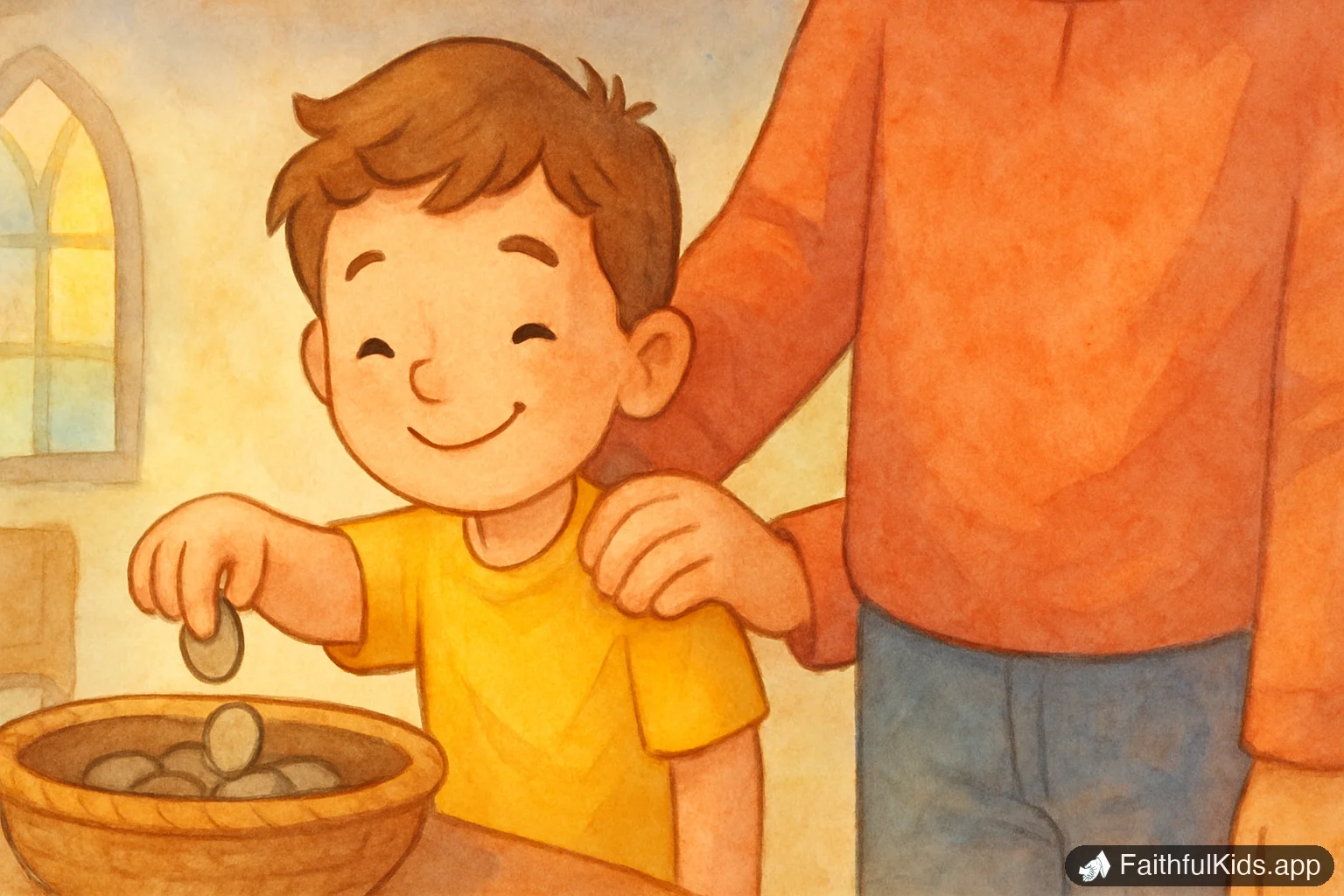
Make the giving visible and personal. A dollar disappearing into an offering plate is abstract. Let your child physically put their own money in at church, or better, aim it at something they can picture: sponsoring a child, buying supplies for a food pantry, an animal through a relief catalog.
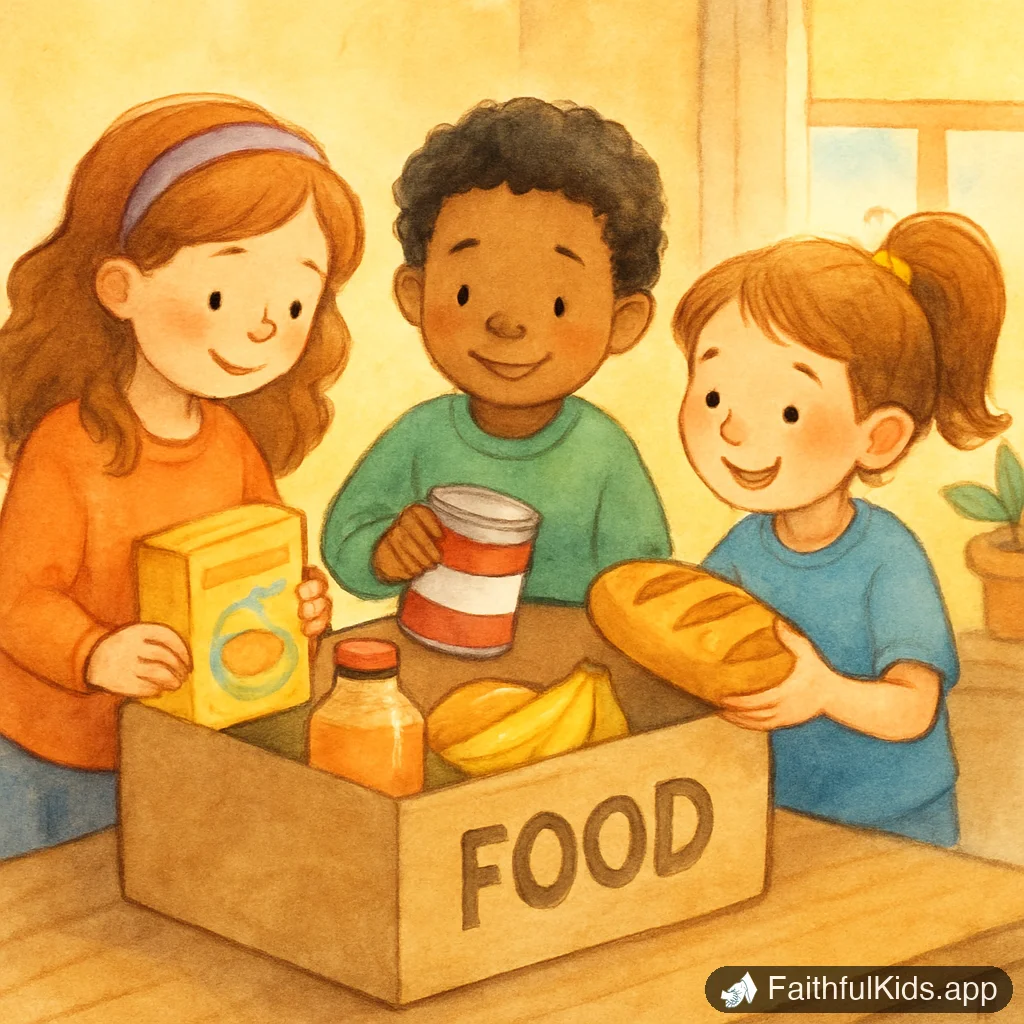
Include non-money giving on purpose. Kids are cash-poor but rich in time, toys, and talent. Count it all: choosing toys to give away before a birthday, making cards for a nursing home, helping a neighbor rake. Generosity is a lifestyle with a money department, not the reverse -- these Bible verses about kindness make good companions here.
Debrief the feeling. After your child gives, ask one question: "How did that feel?" Naming the warmth is how "cheerful giver" becomes their identity rather than your slogan.
Let them see YOU give. Kids catch generosity like a cold. Mention it naturally ("We give to our church because everything we have came from God") without lecturing or boasting.
One caution: skip giving-for-rewards schemes ("give a dollar, get ice cream") -- outsourcing the motivation teaches kids to give only when paid. For verses to anchor the jar labels, our list of Bible verses about generosity for kids has short, memorizable options.
What Does the Widow's Offering Teach Kids?
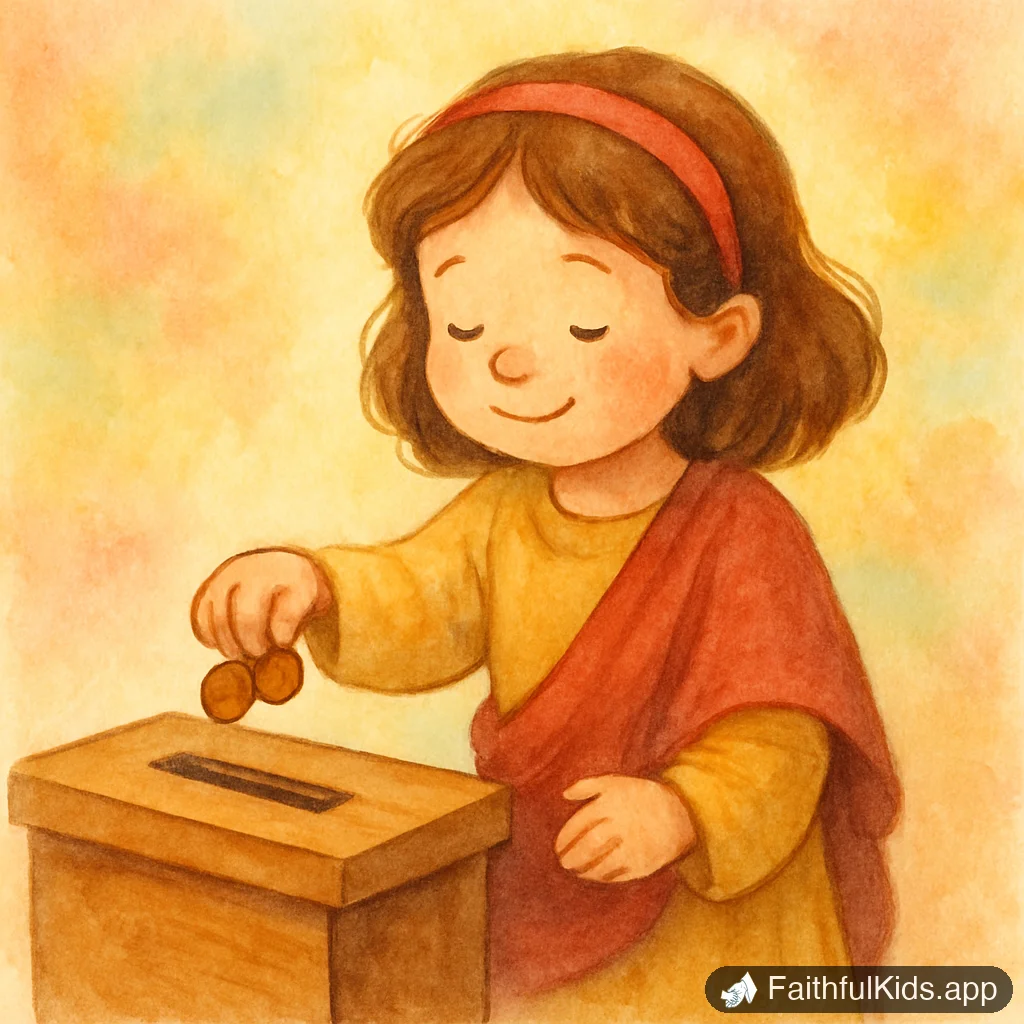
Jesus' favorite giver put in less than a penny -- and that story (Mark 12:41-44) teaches kids the single most important truth about giving: God measures the heart, not the amount. Rich people were dropping in large amounts, loudly. Then a poor widow put in two tiny copper coins, and Jesus called His disciples over: "this poor widow has put more into the treasury than all the others."
This story is gold for kids precisely because kids are the widows of the family economy -- their two quarters can feel embarrassing next to a grown-up's check. Jesus says the opposite: "God is not counting the money. He is looking at how much love is in it. Your quarter, given with a whole heart, weighs more to God than a fortune given to show off."
Ask your child: "Why did Jesus say she gave MORE than the rich people? What do you think God notices when you give?" Pair it with the boy who handed Jesus five loaves and two fish (John 6:9) -- small gift, huge result -- and the lesson is complete: no gift is too small for God to love or use. Our collection of Bible stories about kindness for kids rounds out the theme with more read-together options, and the video lessons at Faithful Kids pair stories like the widow's offering with quizzes kids can answer on their own.
See what they get
Watch The Widows Oil Come Alive
The Widows Oil is one of 300+ short narrated video lessons your child will love. Watch the whole episode right here — in the app, every lesson ends with a fun quiz to check what they learned.
A real lesson from the app — watch the whole thing free.
How Do You Teach Giving at Every Age?
Ages 4-6: Giving equals sharing, made physical. Practice with things they can hold: putting a coin in the plate with their own hand, choosing one toy to give away, handing food across at a food drive. Keep the sentence simple: "God shares with us, so we share with others." Expect it to be genuinely hard sometimes -- sharing costs a four-year-old real pain -- and praise the act warmly without shaming the struggle.
Ages 7-10: Add money, math, and meaning. This is prime three-jar age: they can compute ten percent, track savings, and connect their dollar to a real outcome. Introduce the widow's offering and 2 Corinthians 9:7, and let them make some genuine choices about where their giving goes -- ownership is what turns practice into conviction.
Ages 11+: Talk motives and money's pull. Preteens can handle the real questions: Why does Jesus talk about money so much? Because it competes for our hearts -- "where your treasure is, there your heart will be also" (Matthew 6:21). They can also graduate to bigger commitments: giving from babysitting income, serving regularly, or leading a family giving project. And keep it secret-friendly: Jesus praised giving that does not advertise itself (Matthew 6:3-4), which lands well with this age's radar for showoffs.
What Questions Will Kids Ask About Giving?
"Why does God need my money? Can't He make money?" "He does not need it at all -- God owns everything already. Giving is not for God's benefit; it is for ours. It trains our hearts to be generous instead of grabby, and God uses what we give to help real people through the church."
"What happens if I don't tithe? Will God be mad?" "God's love for you does not go up and down with your giving -- Jesus took care of that forever. But you would be missing out on one of the happiest habits there is. We give because we get to, not because we will get in trouble."
"Do I have to give my birthday money?" "Gift money is yours to steward too, but let's not turn giving into a grab. Here is the question to ask instead: 'God, what would be fun to do with some of this?' Cheerful is the goal. Some kids give from birthday money and love it; the choice being yours is part of the point."
"If I give, will God give me more money back?" "God promises that generous people end up blessed -- but He never promises giving works like a vending machine. Sometimes the blessing is money; more often it is joy, contentment, and getting to be part of what God is doing. We give to be like God, not to make a deal with Him."
"My friend's family doesn't tithe. Are they doing it wrong?" "Different families follow Jesus a little differently on this, and that is okay -- the Bible commands generosity but does not set one exact number for everyone. We can be excited about how our family gives without judging anyone else's."
What Should You NOT Say About Giving?
Don't say "God won't bless you unless you give." That is legalism with a bow on it, teaching kids to see God as a slot machine. Grace first, always: we give because we are loved, not to get loved.
Don't force it and call it cheerful. Marching a sobbing child to the offering plate teaches resentment, not generosity. Keep the giving floor small, keep the choices real, and let joy grow at its own pace.
Don't shame small gifts. "That's all you're giving?" undoes the entire widow's-offering lesson in four words. God treasures the two coins.
Don't make giving performative. Announcing your child's generosity to the relatives, or letting them do it, trains giving-for-applause -- the exact thing Jesus warned about in Matthew 6:1-4. Celebrate privately.
Don't hide your own giving completely. Secrecy from showing off is biblical; secrecy from your kids just means they never see generosity modeled. Let them catch you giving, matter-of-factly and often.
Frequently Asked Questions
How do I explain tithing to a child in simple terms?
Tithing means giving the first part of what we receive -- traditionally one dime out of every dollar -- back to God through the church, as a way of saying thank You and putting God first. Keep it grace-based: God does not love us more when we give, and ten percent is a starting point for generosity, not a law that earns His approval.
At what age should kids start tithing or giving?
As soon as they have money -- typically ages 5-7, when allowances begin. Even before that, toddlers can practice giving with their hands: putting a coin in the offering, sharing food, giving away a toy. Starting young, with small amounts and real choices, builds the habit before self-consciousness or stinginess sets in.
How much of their allowance should a child give?
Ten percent is the classic and practical starting point -- easy math, meaningful amount, historic Christian practice. Set giving as the first split (a GIVE / SAVE / SPEND jar system works well), but leave room for your child to choose to give more some weeks. The New Testament emphasizes cheerful generosity over a fixed percentage.
What is the best Bible story to teach kids about giving?
The widow's offering (Mark 12:41-44), because it answers a child's biggest worry -- "my gift is too small" -- straight from Jesus' mouth: God measures the heart, not the amount. The boy who gave Jesus his five loaves and two fish (John 6:9) makes a perfect companion story about God doing big things with small gifts.
How do I teach generosity without making it legalistic?
Anchor everything in 2 Corinthians 9:7 -- God loves a cheerful giver, not a compelled one. Practically: keep required amounts small, give kids real choices about where their giving goes, never tie God's love to their giving, never shame small gifts, and debrief the joy afterward. Model it yourself where they can see.
🌙 Free: The Bedtime Bible Kit
Seven nights of five-minute stories — a story, a prayer, and one question to whisper about.
Free printable + a few helpful emails. Unsubscribe anytime.