Blog/20 Sunday School Teacher Tips for Real Classroom Problems
Guide
20 Sunday School Teacher Tips for Real Classroom Problems
Ages 5+·11 min read··By Faithful Kids Team·Updated August 20, 2026
The best Sunday school teacher tips are solutions to specific problems -- discipline that doesn't escalate, ways to draw out shy kids and rein in know-it-alls, prep shortcuts for busy weeks, and habits that prevent burnout. Below are 20 field-tested tips, organized by the exact problem they solve, gathered from years of Sunday mornings that did not go as planned.
None of these require special training or a bigger budget. They require about one week each to become habits -- and they work whether you teach four kids or forty.
How Do You Handle Discipline Without Ruining the Morning?
Handle discipline with prevention and proximity first, consequences last -- most Sunday school misbehavior is boredom, hunger, or a bid for attention wearing a disguise. These five tips solve the majority of it:
1. Set three rules, not ten
Kids can't hold ten rules in their heads, and neither can you mid-lesson. Use three: Listen when someone's talking. Keep your hands to yourself. Have fun learning about God. Post them, rehearse them the first two weeks, and point silently at the poster instead of lecturing.
2. Move toward the trouble, not against it
Before you say anything to a disruptive child, simply teach from beside them. Proximity resolves more than half of classroom disruptions with zero words spoken -- and it never creates the public standoff that a called-out name does.
3. Give the wiggly kid a job
The child kicking the chair is usually the child with nothing to do. Make him the page-turner, prop-holder, or "sound effects manager" for the story. You're not rewarding misbehavior; you're redirecting energy that was going to go somewhere either way.
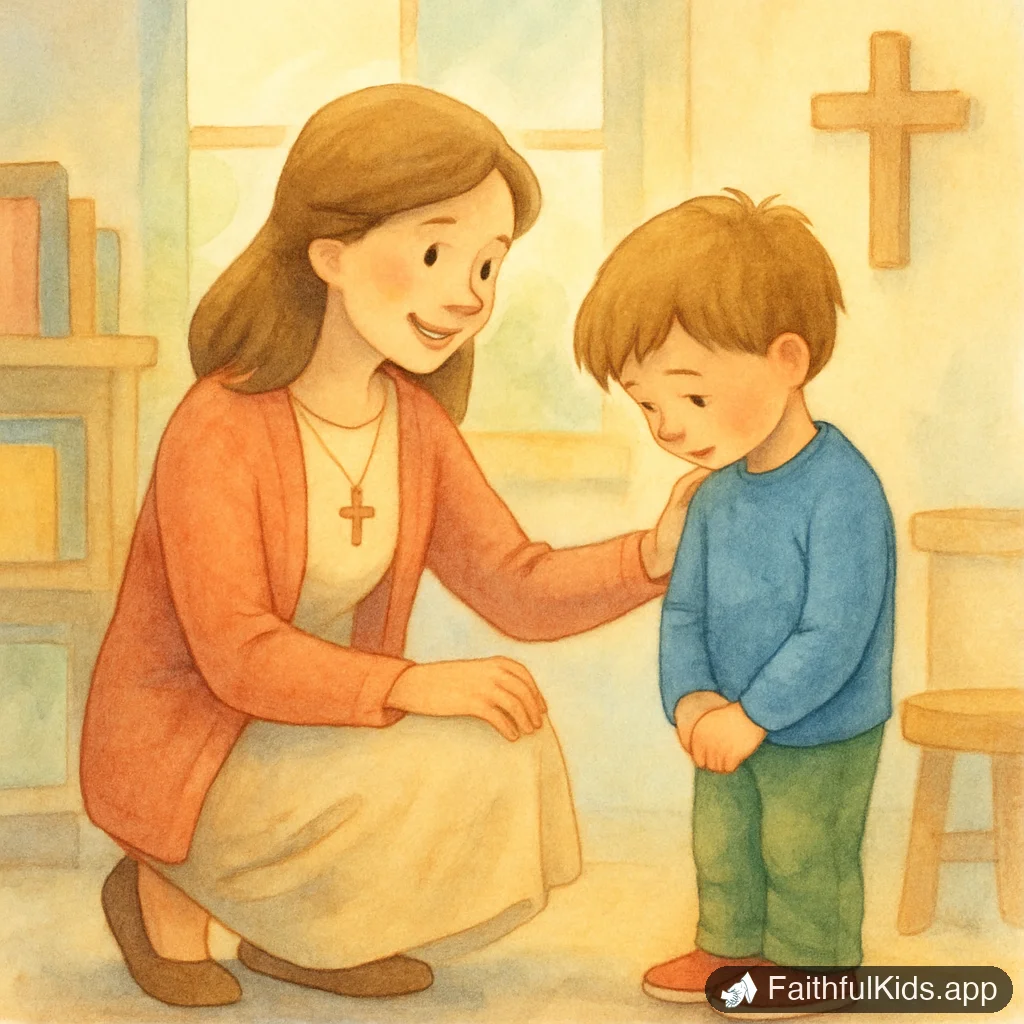
4. Correct in private, praise in public
A quiet "I need your help making this work -- can you do that?" beside a child accomplishes what "Stop it, Marcus!" across the room never will. Flip it for praise: catching a kid doing something right, out loud, teaches the whole room what gets attention in your class.
5. Never discipline with Scripture
Don't weaponize the Bible ("God says to obey!") as a behavior tool. It's effective for about two weeks and then teaches kids that Scripture is the thing adults hit you with. Behavior gets classroom rules; the Bible stays good news.
What Do You Do With Shy Kids?
Give shy kids low-risk ways to participate long before you ask them to speak -- shyness is almost never disinterest, and the quiet child in the corner is often listening harder than anyone. Four tips:
6. Use "everybody answers" formats
Thumbs up or down, move to a corner, hold up fingers, write on a slip of paper. A shy child who won't raise her hand will absolutely point thumbs-down on "Did Jonah want to go to Nineveh?" -- and every one of those low-stakes participations makes speaking later more likely.
7. Give warning before calling on them
Say "In a minute I'm going to ask you what you'd build the ark out of" and then circle back. Advance notice converts a terrifying spotlight into a manageable turn. Cold-calling a shy kid, by contrast, can cost you a month of trust.
8. Let them answer through a partner
"Turn to your neighbor and tell them your answer" gets 100% of the class talking, including the child who would never address the group. Then ask, "Who heard a good answer from their partner?" -- shy kids will happily report someone else's answer, and eventually their own. Pair this with genuinely open-ended prompts; our Bible discussion questions for kids are built for exactly this format.
9. Notice them at the door
A shy child's participation is won in the greeting, not the lesson. Learn one thing about her -- the dog, the soccer team, the loose tooth -- and mention it next week at the door. Kids speak up in rooms where they're sure they're known.
What Do You Do With the Know-It-All?
Channel the know-it-all instead of suppressing him -- a child who blurts every answer is usually a child who loves this material and hasn't learned what to do with that yet. Three tips:
10. Make him the expert with a boundary
"Caleb, you know this story really well, so here's your challenge: I need you to be my checker. Let three people answer first, and then I'll ask if they got it right." He gets status; everyone else gets airtime.
11. Ask questions without single answers
Know-it-alls dominate fact questions ("How many days was Jonah in the fish?") but can't dominate wondering questions ("What do you think Jonah was thinking on day two?"). The more your questions require opinion and imagination, the more evenly the conversation spreads.
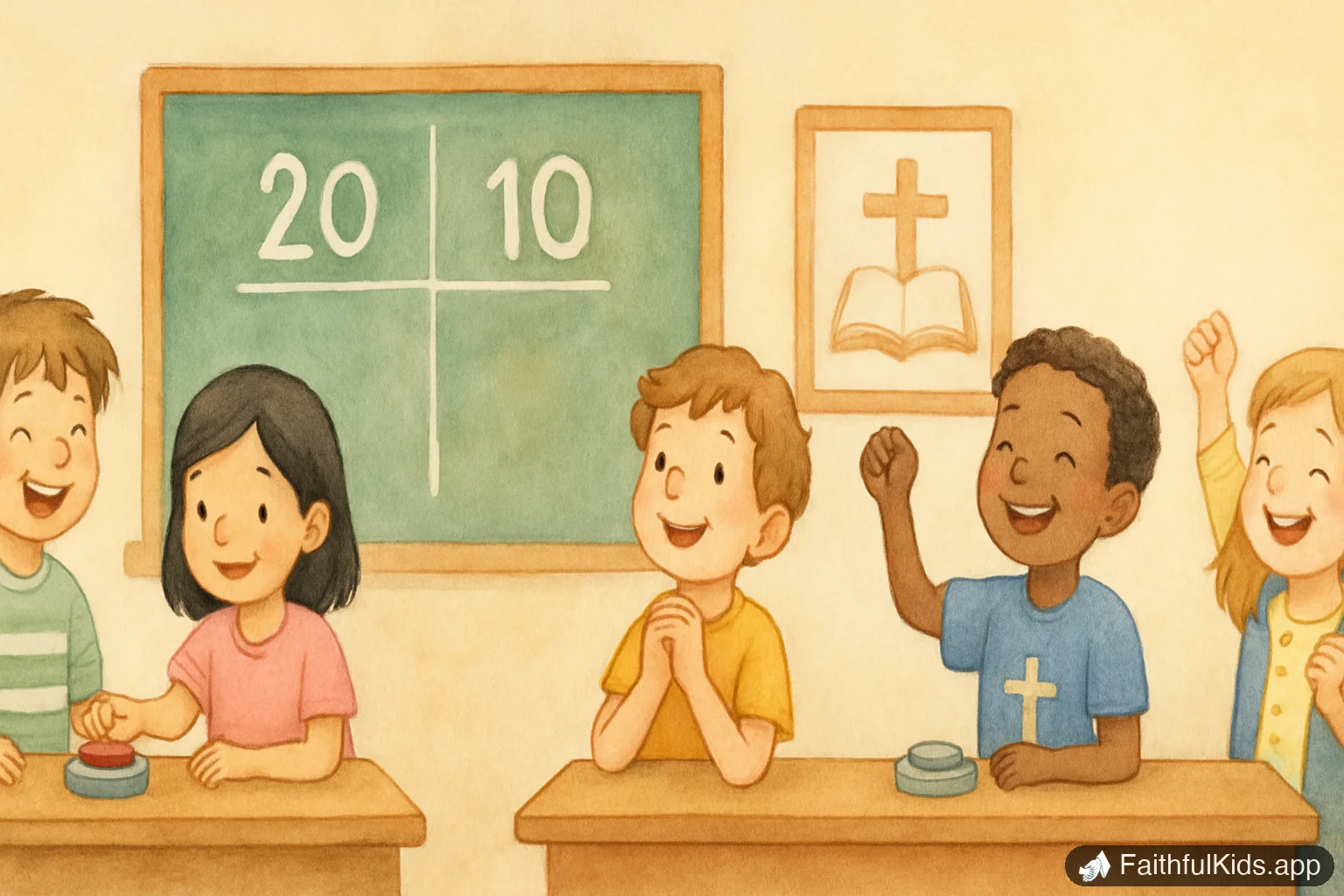
12. Use the answer-once rule for games
In review games, institute "every player answers before anyone answers twice." It converts the fastest hand in the room from a game-ender into a teammate who starts coaching others -- which is what you actually want that knowledge doing. The rule matters most in December, when visitors swell the room and the Christmas Sunday school games get loud enough for one confident kid to run away with the whole morning.
See what they get
Watch a Real Lesson From the App
Press play on Noah and the Great Flood — a complete lesson exactly as your child sees it. 300+ episodes cover the whole Bible in order, each ending in a fun quiz to check what they learned.
A real lesson from the app — watch the whole thing free.
How Do You Prep a Lesson When the Week Got Away From You?
Prep the spine, not the decorations: one story, one truth sentence, one question, one activity -- a lesson with those four things prepared in 20 minutes beats an elaborate one prepared in three exhausted hours. Four shortcuts:
13. Keep a one-page lesson skeleton
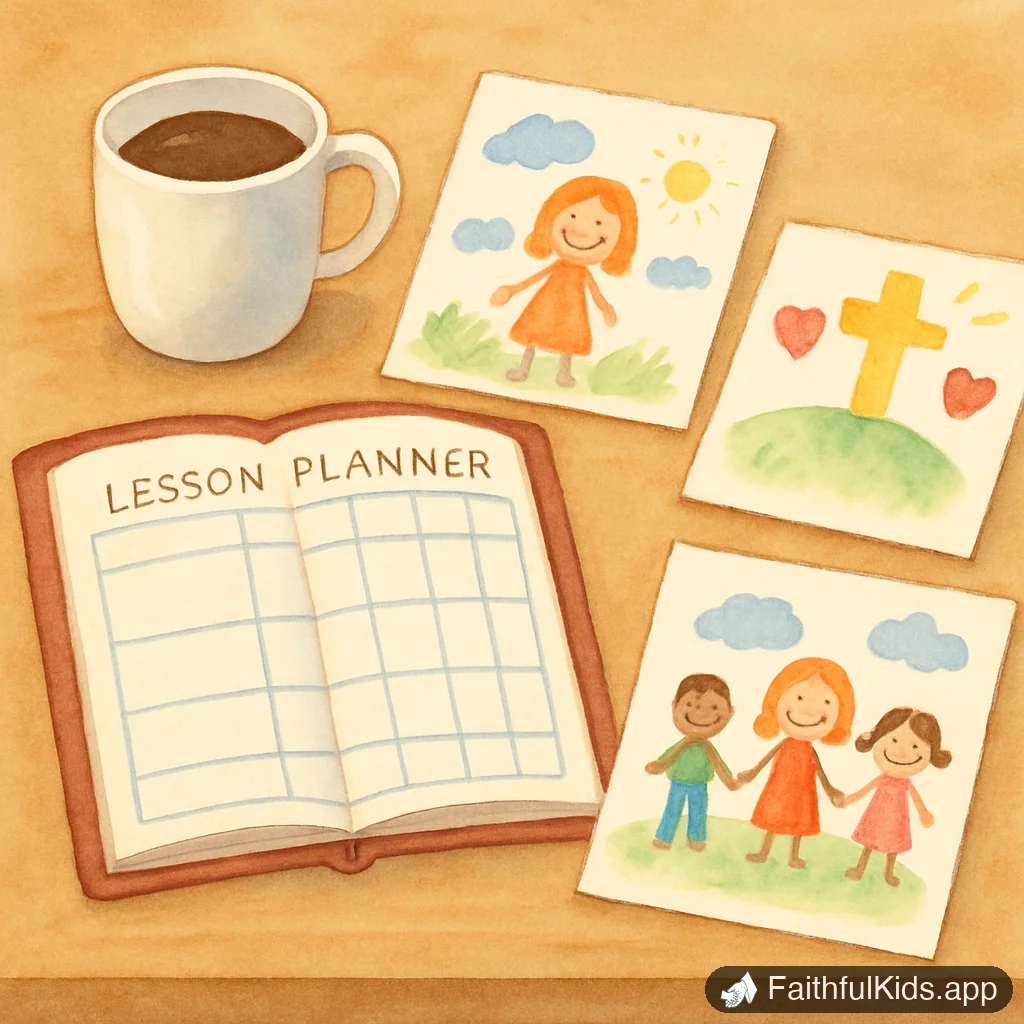
Write the reusable structure once -- opener (5 min), story (10), activity (15), discussion (5), prayer (5) -- and just fill in this week's content. You stop reinventing the container every week and start only preparing the contents. If you want the full framework, our guide to Bible lesson plans for Sunday school walks through it block by block.
14. Build an emergency drawer
One drawer or bin holding a no-prep review game, a stack of coloring pages, a ball for question toss, and a list of Sunday school games that need zero materials. When the craft fails, attendance doubles, or you get asked to teach at 8 a.m. Sunday, the drawer is the difference between a scramble and a shrug. Print two or three free printable lessons and slide them in there as well, because a complete backup lesson beats a stack of coloring pages on the Sunday everything falls apart.
15. Steal from your household for object lessons
A flashlight, a packet of seeds, a sponge, a locked box -- ten minutes of kitchen scavenging produces an object lesson that outperforms a worksheet every time. Kids forget handouts by lunch; they retell the flashlight-under-the-bowl demonstration to their parents in the car.
16. Prepare questions, not paragraphs
If prep time is short, spend it writing three good questions rather than polishing your retelling. You already know the story well enough to tell it; what fills 15 minutes with actual learning is "What would you have done?" -- not a more eloquent monologue.
How Do You Avoid Burning Out as a Sunday School Teacher?
Prevent burnout by right-sizing the job before you resent it -- most Sunday school burnout comes from unsustainable design, not insufficient devotion. Four tips:
17. Recruit a co-teacher and actually alternate
Two teachers alternating lesson weeks -- with the off-week person assisting -- cuts prep load in half and means a sick Sunday isn't a crisis. If your church culture treats asking for help as weakness, be the one who changes that; longevity is worth more to those kids than heroics.
18. Let good enough be good enough
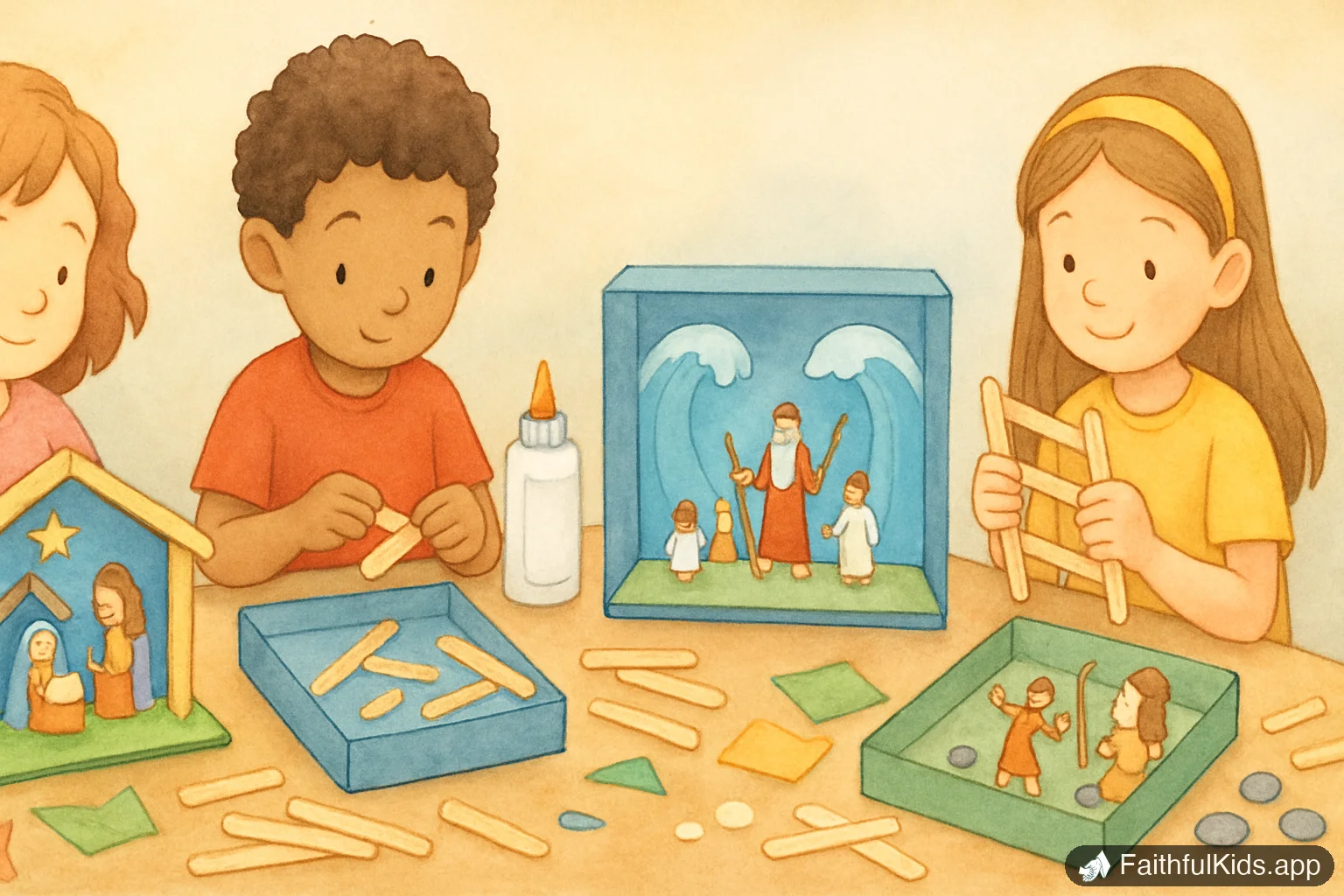
The Pinterest-perfect craft and the hand-lettered visuals are optional; the warm adult who shows up every week knowing kids' names is not. Kids don't remember production value. They remember that Miss Anna was glad to see them -- and honestly, making church fun for kids has far more to do with warmth and play than polish.
19. Keep your own tank filled
Teaching every Sunday can quietly replace being fed on Sunday. Guard something that feeds you -- an adult class, a midweek group, a listening plan through a Bible app during commutes -- because you cannot pour out of an empty cup for very long, and kids can tell when you're running on fumes.
20. Collect the wins somewhere you can see them
Keep a note on your phone for the moments: the kid who prayed out loud the first time, the question about heaven that stunned you, the parent who said their son retells your lessons at dinner. On the February morning when nobody listens and the glue spills, that note is the evidence that the work is working. As one classic verse puts it: "Let us not become weary in doing good, for at the proper time we will reap a harvest if we do not give up" (Galatians 6:9).
One last multiplier that costs you nothing: connect with parents. A two-line text on Tuesday -- "We covered David and Goliath, ask your kid about the five stones!" -- turns your 45 weekly minutes into a conversation that continues at home. Some families extend it further with tools like Faithful Kids, where kids rewatch Bible stories as video lessons with quizzes during the week, and those kids walk in the next Sunday already warmed up.
Rather not print anything? The Bible trivia quiz on our site is free and works on a phone.
If you need something with no prep at all, the Bible word search plays on a phone and prints on one sheet.
Youth leaders: the master list of youth group games is sorted by how many students you actually have, not by how many the game wants.
Leaders who want a round for themselves should try our hard Bible trivia for adults, 50 questions with answers and verse references.
Consistency and warmth matter more than Bible knowledge or teaching talent. A good Sunday school teacher shows up reliably, learns kids' names and lives, keeps lessons simple and honest, and treats questions -- even weird ones -- as wins. The knowledge grows on the job; the reliability has to be there from day one.
How do I handle a child who constantly disrupts class?
Start with prevention: seat them near you, give them a job, and use proximity before words. If disruption continues, correct privately and briefly, then partner with the parent early -- framed as "help me help your kid love this class," not as a complaint. Reserve removing a child from the room for safety issues, and loop in your ministry leader when a pattern persists.
How much time should I spend preparing a Sunday school lesson?
For most volunteer teachers, 30-60 minutes is plenty once you use a repeatable lesson structure. Spend the first 10 minutes reading the passage yourself, 20 minutes on your story-and-questions plan, and the remainder gathering materials. If prep regularly exceeds 90 minutes, you're likely over-decorating the lesson -- simplify the container and reuse it.
What do I do when kids ask a question I can't answer?
Say "That's a great question -- I don't know, and I'm going to find out" and then actually follow up the next week. This models intellectual honesty and shows kids that faith isn't threatened by hard questions. For genuinely heavy questions (death, suffering, salvation), give a short truthful answer and let the parent know it came up so they can continue at home.
How do I keep older kids engaged when they think Sunday school is babyish?
Give them responsibility and real questions. Preteens disengage from being taught at but engage with being consulted -- so ask their opinions, let them run the review game, and use discussion formats over crafts. Debate-style questions ("Was Jonah's anger fair?") respect their growing minds and reliably wake up a bored 11-year-old.
Should new Sunday school teachers follow a curriculum or write their own lessons?
Start with a curriculum or a consistent lesson framework for your first year, then customize as confidence grows. A curriculum handles scope and accuracy while you focus on learning classroom skills -- discipline, pacing, discussion -- which are the harder part at first. Our age-sorted lessons for kids work as that spine if your church hasn't handed you one. Most experienced teachers land in the middle: a curriculum spine with their own openers, questions, and activities layered on.
🌙 Free: The Bedtime Bible Kit
Seven nights of five-minute stories — a story, a prayer, and one question to whisper about.
Free printable + a few helpful emails. Unsubscribe anytime.